How Many Hz Should A Violin Be Tuned To: Easy Guide
A violin should usually be tuned to A4 at 440 Hz, with the other strings set by perfect fifths.
Knowing how many Hz a violin should be tuned to helps you match a tuner, orchestra, piano, or recording. The standard is simple, but performance settings, string type, temperature, and playing style can change the best choice. This guide explains the correct violin frequencies, how to tune each string, and which common mistakes to avoid.

How many Hz should a violin be tuned to?
The standard answer to how many Hz should a violin be tuned to is 440 Hz for the open A string. This pitch is called A4, or A above middle C. It vibrates at 440 cycles per second.
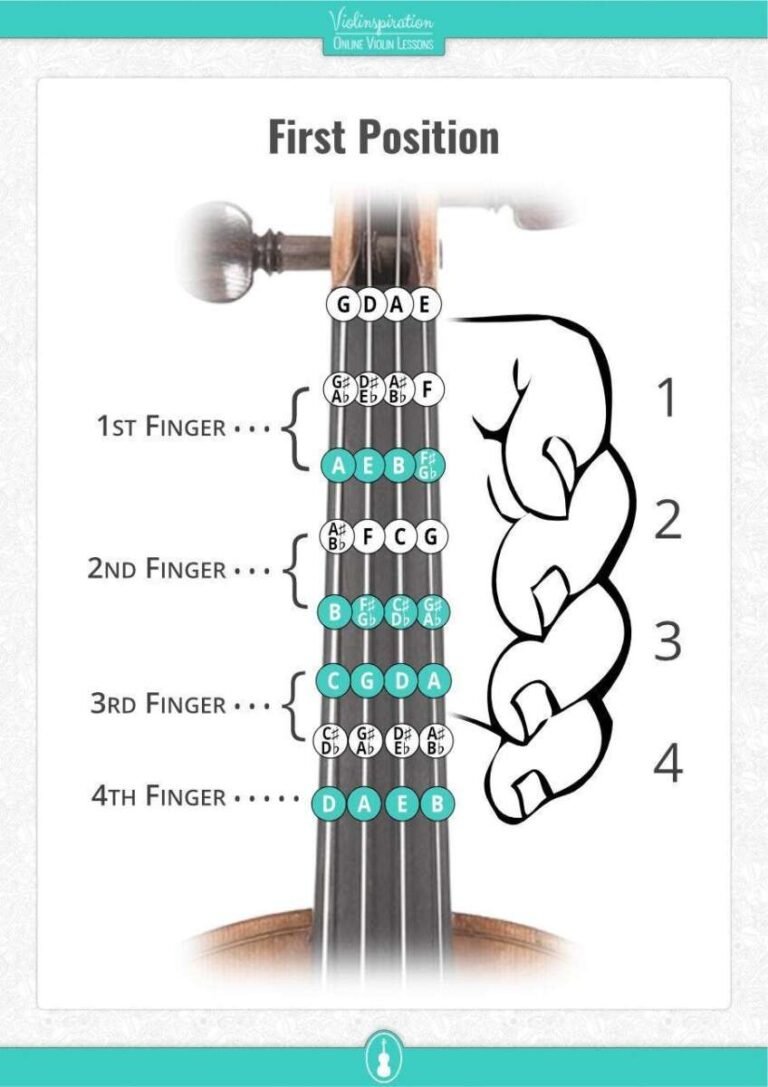
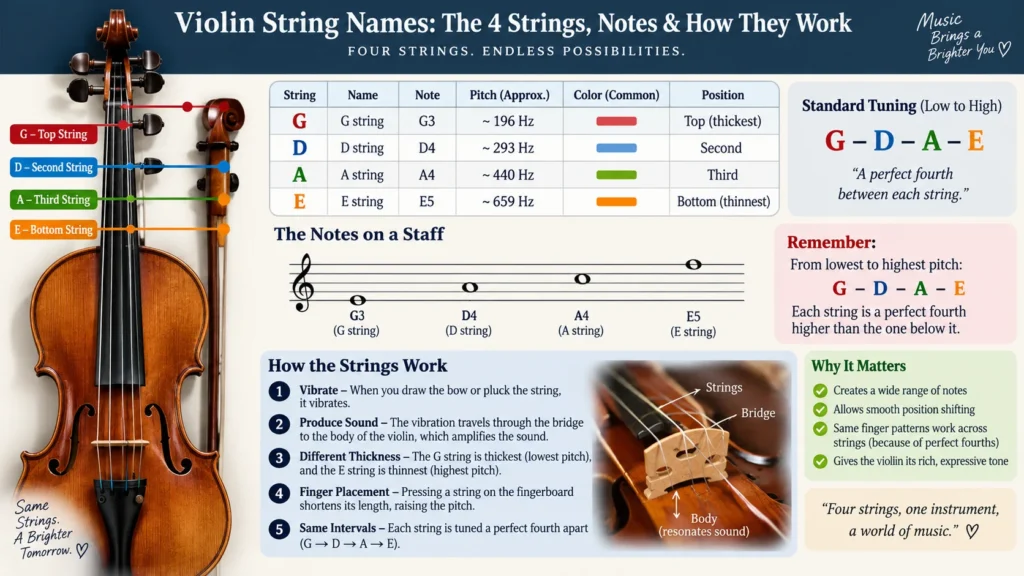
The other three violin strings are tuned in perfect fifths below and above A4:
| Violin string | Scientific pitch | Standard frequency |
|---|---|---|
| G string | G3 | 196.00 Hz |
| D string | D4 | 293.66 Hz |
| A string | A4 | 440.00 Hz |
| E string | E5 | 659.26 Hz |
These numbers answer how many Hz should a violin be tuned to under the common modern standard. The A string is the reference point, while the G, D, and E strings are tuned by intervals of a perfect fifth.
A violin does not use one single frequency for every string. Each string has its own target pitch. Together, these four pitches create the normal violin tuning: G3–D4–A4–E5.

Why is A4 tuned to 440 Hz?
A4 at 440 Hz is known as concert pitch. It gives musicians a shared reference, much like setting every clock in a building to the same time.
The international standard ISO 16 identifies A4 = 440 Hz as the recommended tuning frequency. This standard helps instruments play together, even when they come from different makers or countries.
Before modern standards became common, musicians used several pitch levels. A4 could be lower or higher depending on the city, era, orchestra, or instrument. This is why historical violin music may use a different reference pitch.
Today, 440 Hz is common for:
• Student practice
• Most digital tuners
• School ensembles
• Chamber music
• Many studio recordings
The answer to how many Hz should a violin be tuned to is therefore usually 440 Hz, unless a conductor, teacher, or ensemble gives you another pitch.
Violin string frequencies explained
Understanding the frequency of each violin string makes tuning much easier. Frequency measures how many times a string vibrates each second.
The open G string vibrates at about 196 times per second. The D string vibrates at about 294 times per second. The A string vibrates 440 times per second, and the E string vibrates about 659 times per second.
The strings are separated by perfect fifths:
• G to D
• D to A
• A to E
A perfect fifth has a frequency ratio of about 3:2. In real playing, the exact numbers may vary slightly depending on the tuning system and the instrument.
When you tune with an electronic tuner, you normally use these equal-tempered targets:
• G3: 196.00 Hz
• D4: 293.66 Hz
• A4: 440.00 Hz
• E5: 659.26 Hz
The question how many Hz should a violin be tuned to becomes more useful when you know that these are target values, not four identical settings.

How to tune a violin to 440 Hz
The most reliable method is to tune the A string first. Once the A string is correct, tune the other strings by perfect fifths or with a chromatic tuner.
Follow these steps:
-
Place the tuner where you can see it clearly.
-
Select chromatic mode if the tuner has more than one setting.
-
Play the open A string.
-
Adjust the fine tuner or peg until the tuner reads A4 at 440 Hz.
-
Play the open D string.
-
Tune D until it is one perfect fifth below A.
-
Tune the G string below D.
-
Tune the E string above A.
-
Check every string again because changing one string can affect the bridge and overall tension.
A clip-on tuner is helpful in a noisy room. A phone app can work well in quiet conditions, but the microphone may pick up background sounds. For the most accurate result, play one open string at a time and let the note ring clearly.
When tuning with pegs, turn them slowly. Push the peg inward as you turn it so it stays in place. Sudden movements can cause the pitch to jump or the string to break.

Should violin strings be tuned by a tuner or by ear?
A tuner gives you a clear answer to how many Hz should a violin be tuned to. It is especially useful for beginners, new strings, practice sessions, and ensemble work.
Experienced players often use both a tuner and their ears. The tuner provides the starting point, while the ear checks how the strings sound together.
To tune by ear, compare adjacent open strings:
• D should sound a perfect fifth above G.
• A should sound a perfect fifth above D.
• E should sound a perfect fifth above A.
When two notes are close but not perfectly matched, you may hear a wavering sound called beats. The beats slow down as the interval becomes more stable.
There is one important detail. Electronic tuners usually measure equal-tempered notes. Violinists may adjust open-string intervals slightly for a smoother, purer sound. This is normal in solo playing, but players should follow the conductor or ensemble when performing with others.

Is 440 Hz always the correct violin tuning?
No. A4 at 440 Hz is the standard reference, but it is not the only valid choice.
Many orchestras tune A4 to 441 Hz, 442 Hz, or 443 Hz. Some professional groups use 444 Hz or higher to create a brighter sound. The correct choice depends on the ensemble and the instruments involved.
For example, if an orchestra tunes to A4 = 442 Hz, the violinist should tune the A string to 442 Hz. The other strings then rise slightly as well.
Common reference pitches include:
• 440 Hz: General modern standard
• 441 to 443 Hz: Common orchestral range
• 415 Hz: Often used for Baroque performance
• 392 Hz: Used in some historical performance settings
A Baroque violinist may ask how many Hz should a violin be tuned to and receive the answer 415 Hz. This lower pitch is about a semitone below modern 440 Hz tuning.
Never choose a different reference pitch without checking the music director, ensemble leader, recording plan, or teacher.

What does 442 Hz do to a violin?
Tuning A4 to 442 Hz raises the pitch slightly above standard 440 Hz. The difference is small, but it matters when many instruments play together.
At A4 = 442 Hz, the approximate open-string frequencies are:
| Violin string | Approximate frequency at A4 = 442 Hz |
|---|---|
| G3 | 196.89 Hz |
| D4 | 294.99 Hz |
| A4 | 442.00 Hz |
| E5 | 662.25 Hz |
A 442 Hz violin may sound slightly brighter or more energized than one tuned to 440 Hz. The change is subtle, so most listeners may not notice it alone. They will notice it when the violin plays with an ensemble tuned to a different pitch.
The key lesson is consistency. A violin tuned to 440 Hz can sound out of tune beside an orchestra tuned to 442 Hz, even when the instrument itself is working correctly.
How temperature affects violin tuning
Temperature and humidity can change violin tuning. Wood expands and contracts, while strings respond to changes in tension and length.
A cold room may make the instrument behave differently from a warm stage. Dry air can also affect the violin’s wood, bridge, and sound. These changes do not always move every string by the same amount.
Before an important performance:
• Let the violin adjust to the room for 15 to 30 minutes.
• Tune after the instrument reaches room temperature.
• Check the tuning again just before playing.
• Avoid placing the violin near heaters, air vents, or direct sunlight.
• Keep the instrument in a suitable case when you are not playing.
New strings often stretch for several days. During that time, you may need to tune often. This does not mean the strings are defective. It is a normal part of settling in.
Common mistakes when tuning a violin
Many tuning problems come from small habits rather than a poor instrument. Knowing how many Hz should a violin be tuned to is helpful, but technique matters just as much.
Avoid these common errors:
• Tuning every string without checking the A reference
• Turning the peg too quickly
• Using the wrong tuner mode
• Plucking too hard while checking pitch
• Ignoring the ensemble’s requested pitch
• Tuning in a cold room and performing in a warm hall
• Tightening the E string too far
• Forgetting to check the bridge after major tuning changes
The E string has the highest pitch and can break if adjusted too sharply. Turn its peg or fine tuner in small movements.
The bridge should remain upright, with its feet flat on the violin top. If the bridge leans forward during tuning, stop and correct it carefully or ask a teacher or violin technician for help.
Fine tuners, pegs, and electronic tuners
Fine tuners make small pitch changes easy. They are useful for beginners and for strings that need only a little adjustment. Many violins have a fine tuner on the E string, while student instruments may have four fine tuners.
Pegs make larger changes. They are necessary when a string is far from its target frequency, but they require a gentle hand.
A quality electronic tuner should show:
• The note name
• Whether the pitch is sharp or flat
• The amount of pitch difference
• The selected reference pitch, if adjustable
Before tuning, check that the tuner is set to A4 = 440 Hz unless your ensemble uses another setting. A tuner set to 442 Hz will give different targets from one set to 440 Hz.
If a tuner constantly shows unstable readings, check the battery, room noise, microphone position, and string condition.
Pure fifths versus equal temperament
The answer to how many Hz should a violin be tuned to depends partly on the tuning system.
Equal temperament divides the octave into twelve equal semitones. Most digital tuners use this system. It allows a violin to match a piano and other fixed-pitch instruments.
Pure fifths use a simple frequency relationship of 3:2. Many violinists prefer the clear, ringing quality of pure fifths when tuning the open strings by ear.
These systems are very close, but they are not identical. A violinist playing alone may adjust notes for a more resonant sound. A violinist playing with piano should usually match the piano and follow the ensemble’s pitch.
This is not a contradiction. It is a practical choice based on the musical setting.
How often should you tune a violin?
You should check violin tuning every time you play. A violin can drift even during a short practice session.
Tune more often when:
• You install new strings
• The weather changes
• You move between rooms
• You travel
• You play outdoors
• You perform with an ensemble
• You notice beats between open strings
A professional player may check tuning before practice, after warming up, and again before a concert. Beginners should develop the same habit without feeling pressured. Tuning is part of playing the violin, not a separate task.
A well-tuned instrument also makes practice more productive. It trains your ear to recognize correct pitch instead of forcing you to adapt to a sour or unstable sound.
A practical tuning routine for beginners
Use this short routine each time you pick up the violin:
-
Check the tuner reference and set it to 440 Hz.
-
Tune the A string first.
-
Tune the D string below A.
-
Tune the G string below D.
-
Tune the E string above A.
-
Play each open string again.
-
Test simple fifths between neighboring strings.
-
Make small final adjustments.
If the pegs feel tight, loose, or difficult to control, do not force them. A violin shop can apply suitable peg compound or repair the pegbox.
For new players, the most important habit is patience. A slow, careful adjustment is safer and more accurate than trying to reach the target in one large turn.
Frequently Asked Questions
How many Hz should a violin be tuned to for standard playing?
A standard violin is tuned with the A string at 440 Hz, also called A4 or concert pitch. The other strings are G3 at about 196 Hz, D4 at about 293.66 Hz, and E5 at about 659.26 Hz.
Should I tune my violin to 440 Hz or 442 Hz?
Use 440 Hz unless your orchestra, teacher, conductor, or recording session requests another pitch. Many orchestras use 442 Hz, so matching the group is more important than following a fixed number.
What frequency is the A string on a violin?
The open A string is normally A4 at 440 Hz. It is the main reference string used to tune the other three violin strings.
What are the standard violin string frequencies?
The standard frequencies are G3 at 196.00 Hz, D4 at 293.66 Hz, A4 at 440.00 Hz, and E5 at 659.26 Hz. These values assume A4 is set to 440 Hz and the strings follow the usual fifth-based tuning.
Can I tune a violin by ear?
Yes, you can tune a violin by ear by comparing the open strings in perfect fifths. A tuner is still useful because it provides a reliable reference, especially for beginners and ensemble playing.
Why does my violin go out of tune so quickly?
New strings, temperature, humidity, slipping pegs, and changes in string tension can cause tuning to move. Allow the instrument to settle, tune slowly, and have a violin technician inspect persistent peg or bridge problems.
Is 415 Hz suitable for a violin?
A4 at 415 Hz is common in some Baroque music settings. Use it only when the ensemble and musical style call for historical pitch, because it is lower than modern 440 Hz concert pitch.
Conclusion
The standard answer to how many Hz should a violin be tuned to is A4 at 440 Hz. From that reference, tune the G, D, and E strings to about 196.00, 293.66, and 659.26 Hz. Always check whether your orchestra or teacher uses another pitch, such as 442 Hz or 415 Hz.
Tune slowly, let new strings settle, and use both a reliable tuner and your ears. With a consistent routine, accurate violin tuning becomes quick and natural. Practice these steps at your next session, and explore more violin technique resources to keep building a stronger, more confident sound.

Senior Music Reviewer
Alex Carter is a seasoned music reviewer with over a decade of experience in the world of sound and instruments. Passionate about helping musicians and enthusiasts make informed choices, he brings sharp insights and in-depth knowledge to every review. From classical instruments to modern gear, Alex combines technical expertise with a love for music to deliver content that resonates with readers.
As a Senior Music Reviewer and expert author on Tuneluma.com, Alex is dedicated to sharing honest evaluations, practical advice, and thoughtful commentary to guide readers in their musical journey.