How Do You Tune A Guitar A Half Step Down: Easy Guide
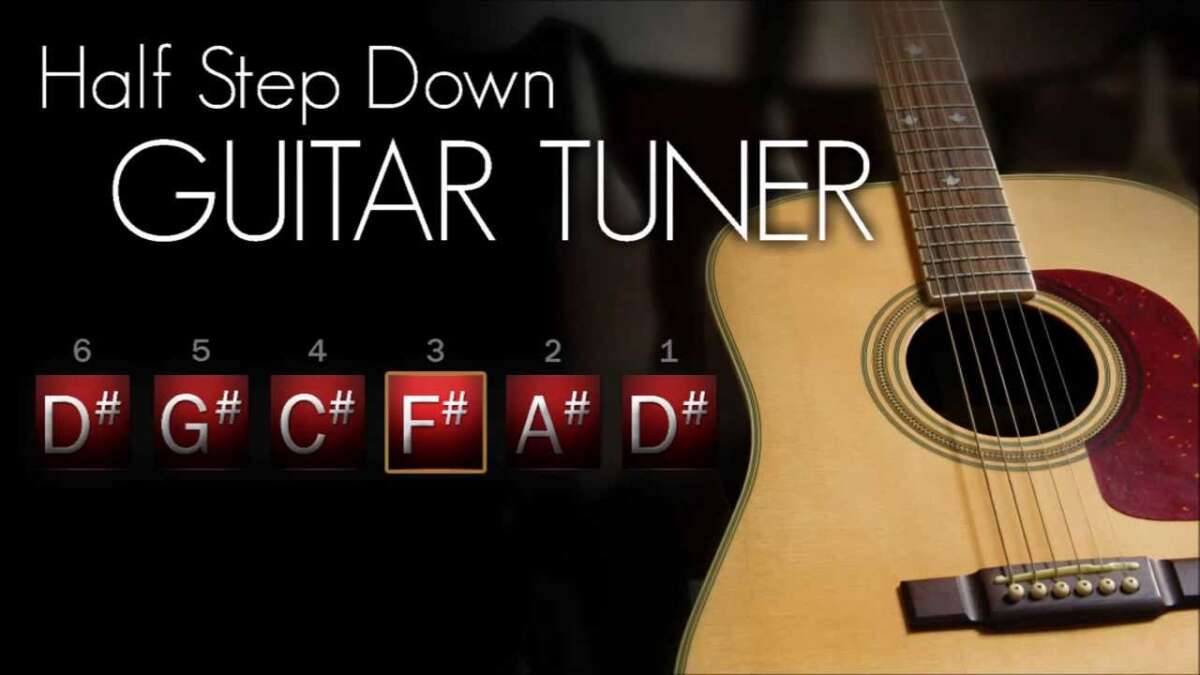
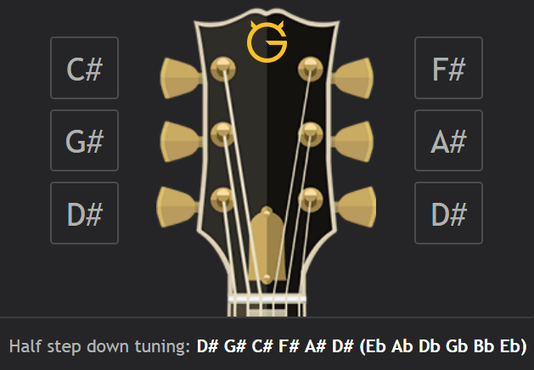
Tune each string one semitone lower: Eb, Ab, Db, Gb, Bb, and Eb from low to high.
Learning how to tune a guitar a half step down is simple once you know the correct note targets. This tuning lowers every string by one fret, which gives the guitar a darker tone, softer string feel, and a slightly lower vocal range. In this guide, you will learn several reliable tuning methods, how to avoid common mistakes, and how to keep your guitar stable after the change.
What does tuning a guitar a half step down mean?
Tuning a guitar a half step down means lowering every string by one semitone. A semitone is the distance from one note to the next key on a piano, including both white and black keys.
Standard guitar tuning is:
| String | Standard note | Half step down |
|---|---|---|
| 6th, thickest | E | Eb |
| 5th | A | Ab |
| 4th | D | Db |
| 3rd | G | Gb |
| 2nd | B | Bb |
| 1st, thinnest | E | Eb |
The low and high strings both become Eb. You may also see this tuning written as E-flat tuning, Eb tuning, or D-sharp tuning. Eb is the correct musical spelling in most guitar charts because the notes move down from E, A, D, G, B, and E.
When you tune a guitar a half step down, the fret shapes stay the same. An E major shape still looks like E major, but it sounds as Eb major. This makes the tuning useful for singers, rock bands, blues players, and guitarists who want a warmer sound without learning new chord shapes.

How do you tune a guitar a half step down with a tuner?
The easiest method is to use a chromatic tuner. A chromatic tuner detects the note you play and shows whether the pitch is sharp, flat, or correct.
Follow these steps to tune a guitar a half step down:
- Turn on your chromatic tuner.
- Play the thickest string, the 6th string.
- Lower the string from E until the tuner reads Eb or D#.
- Tune the 5th string from A down to Ab or G#.
- Tune the 4th string from D down to Db or C#.
- Tune the 3rd string from G down to Gb or F#.
- Tune the 2nd string from B down to Bb or A#.
- Tune the 1st string from E down to Eb or D#.
- Play each string again and make small adjustments.
Most tuners show enharmonic notes. For example, Eb and D# have the same pitch, and Ab and G# have the same pitch. If your tuner displays D# instead of Eb, that is normal.
Tune each string slowly. Turn the tuning peg in small movements, then let the note settle before making another change. This gives the tuner time to read the pitch accurately.
When I tune a guitar a half step down, I usually tune below the target note first and then raise the string up to it. This helps reduce slack around the tuning post and often keeps the guitar in tune for longer.
How do you tune a guitar a half step down by ear?
You can tune a guitar a half step down by ear, but a tuner is more accurate. An electronic tuner should be your first choice if you are recording, playing with other musicians, or matching a song.
To tune by ear, use a known Eb note as your starting point. You can find one on a piano, a keyboard app, a pitch pipe, or another properly tuned instrument.
Then match each string to these notes:
• 6th string: Eb
• 5th string: Ab
• 4th string: Db
• 3rd string: Gb
• 2nd string: Bb
• 1st string: Eb
You can also tune by using the relationship between the strings. The 5th fret of the 6th string matches the open 5th string. The 5th fret of the 5th string matches the open 4th string. The 5th fret of the 4th string matches the open 3rd string.
The one exception is between the 3rd and 2nd strings. The 4th fret of the 3rd string matches the open 2nd string. From the 2nd string to the 1st string, return to the 5th-fret relationship.
This method checks the intervals between strings, but it does not guarantee that the entire guitar matches concert pitch. Your guitar may sound good by itself but still be too high or low when you play with a band.

How do you tune a guitar a half step down using a phone app?
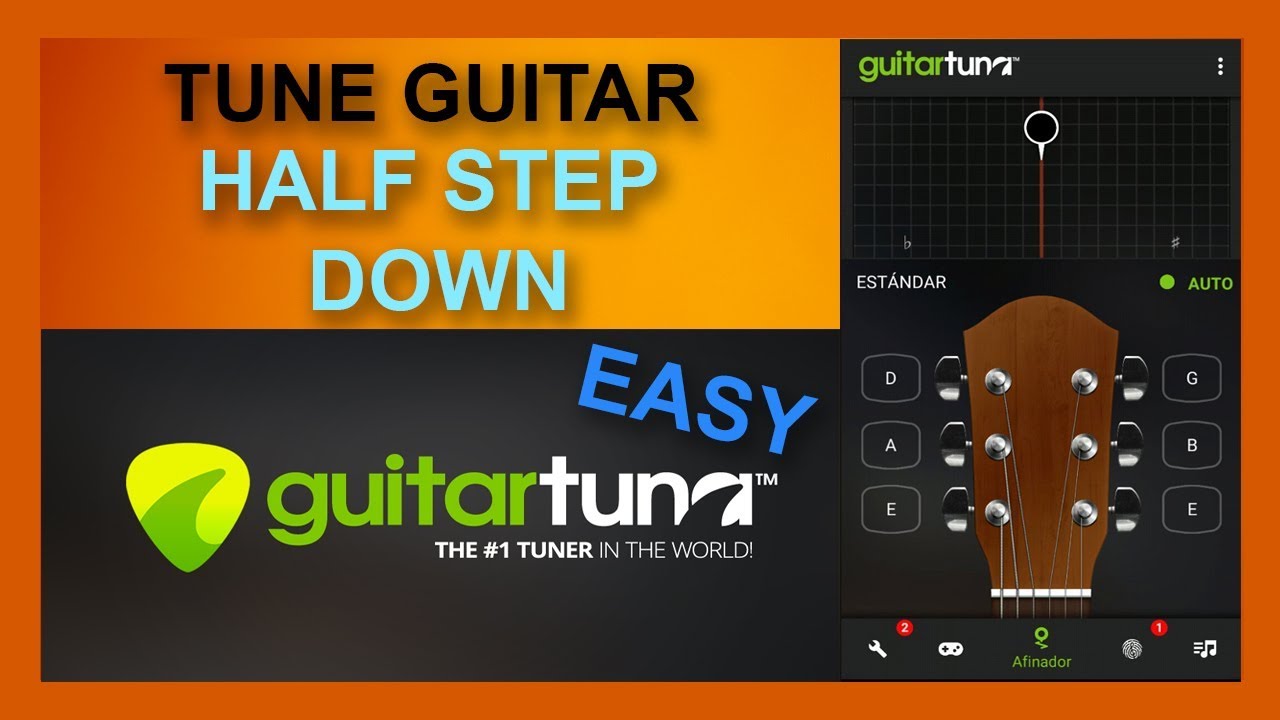
A guitar tuning app can tune a guitar a half step down just like a clip-on tuner. Open the app, choose chromatic mode, and play one string at a time.
Some apps include a preset called “Eb tuning,” “E-flat tuning,” or “half step down.” If you select that preset, the app should display the correct target for all six strings.
If the app only shows standard tuning, use these targets:
• Eb for the 6th string
• Ab for the 5th string
• Db for the 4th string
• Gb for the 3rd string
• Bb for the 2nd string
• Eb for the 1st string
Use your phone in a quiet room. Loud speakers, fans, and nearby instruments can confuse the microphone. A clip-on tuner often works better in a noisy rehearsal space because it reads vibration through the guitar.
A common mistake is to select “flat tuning” without checking the setting. Some apps lower the tuning by a full step or use a different reference pitch. Always confirm that the app is set to one semitone below standard tuning.

Why do guitarists tune a half step down?
Many guitarists tune a guitar a half step down for tone, comfort, and vocal range. The change is small, but it can make a noticeable difference.
A darker guitar tone
Lower tuning can produce a deeper and slightly heavier sound. The open strings have less tension, which may make the notes feel rounder and less bright.
This sound became popular in rock, blues, metal, and alternative music. Many classic songs use Eb tuning because it adds weight without making the guitar feel extremely low.
Easier singing
A half step can make a song easier to sing. If the original key sits just above your comfortable range, lowering the guitar by one semitone may help you reach the high notes with less strain.
This is useful for solo performers. You can keep familiar chord shapes while moving the entire song to a friendlier pitch.
Softer string tension
When you tune a guitar a half step down, the strings become slightly looser. This can make bends, vibrato, and wide chord stretches feel easier.
The change is not dramatic. It is enough to notice, but not usually enough to make the strings feel unstable when the guitar is set up well.
Matching a recording
Some recordings use Eb tuning. If you play along in standard tuning, every chord may sound one semitone too high. Tuning a guitar a half step down lets your open strings match the recording.
Always check the recording before changing your tuning. Some older recordings are slightly sharp or flat because of analog tape speed, instrument tuning, or mastering choices.
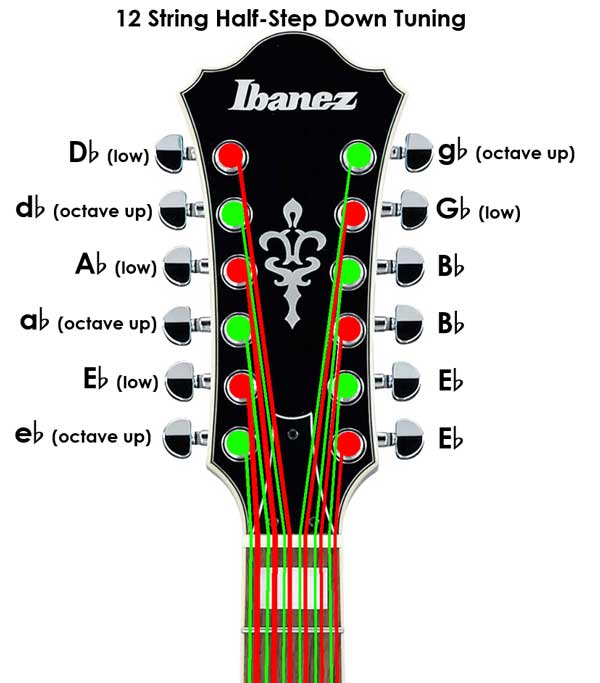
How do you tune a guitar a half step down without confusing it with Drop D?
Half-step-down tuning and Drop D tuning are different.
When you tune a guitar a half step down, every string moves down one semitone:
Eb Ab Db Gb Bb Eb
In Drop D, only the 6th string changes:
D A D G B E
You can also combine the two systems. Half-step-down Drop D tuning becomes:
Db Ab Db Gb Bb Eb
This tuning is useful when you want the lower sound of Eb tuning and the one-finger power chords available with a low 6th string.
Here is a simple way to remember the difference:
• Half step down changes all six strings.
• Drop D changes only the 6th string.
• Half-step-down Drop D changes all six strings, with the 6th string lowered one extra whole step.
Confusing these tunings can make songs sound wrong even when the guitar seems properly tuned. Check the full string sequence before you begin.

How do you tune a guitar a half step down and keep it in tune?
After you tune a guitar a half step down, the strings may drift for a few minutes. This happens because the strings and tuning posts are adjusting to the new tension.
Use these steps to improve tuning stability:
- Tune all six strings once.
- Tune them again from the 6th string to the 1st string.
- Stretch each string gently with your fingers.
- Retune every string.
- Check the tuning again after playing for several minutes.
To stretch a string, place one finger under it near the 12th fret and gently pull it a small distance away from the fretboard. Do not yank it. Excessive force can damage the string or bridge.
New strings need more time to settle. Old strings may also have trouble holding pitch because they have lost elasticity or developed kinks.
String condition, tuning machines, the nut, bridge, and temperature all affect tuning stability. If your guitar goes flat after every bend, the problem may not be the tuning itself. A binding nut slot or loose tuning machine may need attention.

Does tuning a guitar a half step down require different strings?
Most guitars do not need new strings for a half-step-down tuning. A normal set of strings works well, especially if it has a common light or medium gauge.
However, lower tension can make very light strings feel loose. You may notice fret buzz, weak picking response, or strings that move too much during bends.
If you normally use .009–.042 strings, you might prefer .010–.046 strings for a firmer feel. If you use .010–.046 strings already, you can usually keep the same set.
Acoustic guitars may respond more clearly to a slightly heavier set because their strings drive the top of the instrument. Electric guitars are often more forgiving, though every instrument is different.
Do not change string gauge only because you lower the tuning once. Try your current strings first. Change gauge if the guitar feels too loose or develops persistent buzz.
After a major gauge change, the neck relief, nut slots, and intonation may need adjustment. A qualified guitar technician can check these areas without guessing.

How does half-step-down tuning affect intonation and guitar setup?
Lowering the tuning does not normally damage a guitar. It does change string tension, and that can affect the guitar’s feel and setup slightly.
Lower tension may cause:
• More fret buzz
• A softer picking response
• Slightly different neck relief
• Less accurate intonation if the strings move too much
• A need for small tuning adjustments
Intonation controls whether the guitar plays in tune across the fretboard. Check it by comparing the 12th-fret harmonic with the fretted 12th-fret note. If the fretted note is sharp or flat, the bridge saddle may need adjustment.
A half step is a modest change, so many guitars need no setup at all. Still, watch for new buzz, poor tuning stability, or notes that sound sharp higher up the neck.
On a floating tremolo system, the change can be more noticeable. Lowering all six strings reduces the pull against the springs, so the bridge may shift position. You may need to adjust the spring tension or have a technician balance the bridge.
Common mistakes when tuning a guitar a half step down
The biggest mistake is lowering the strings by the wrong amount. Some players tune to D standard, which is a full step down, when they intended Eb tuning.
Avoid these errors:
• Do not tune every string down to the next letter name.
• Do not use Drop D unless the song calls for it.
• Do not trust color alone on a tuner; read the note name.
• Do not tune only the 6th and 1st strings.
• Do not make large turns on the tuning pegs.
• Do not skip the second tuning pass.
• Do not ignore string buzz after lowering tension.
• Do not assume D# and Eb are different pitches.
A tuner may show a note that looks wrong because of enharmonic spelling. D# and Eb sound the same on an equal-tempered instrument. The key point is that each string must be one semitone below its standard note.
In my own setups, the most common problem has been tuning too quickly. The first pass looks correct, but later strings pull slightly on the neck and change the earlier notes. A second pass solves most of that drift.
How do you tune a guitar a half step down for songs and tabs?
When a song uses half-step-down tuning, the chord shapes may look familiar but sound lower. A tab may state “Eb tuning,” “tune down a half step,” or “E-flat standard.”
Before playing, confirm the tuning in the song’s instructions. Then tune the guitar from the thickest string to the thinnest string:
Eb Ab Db Gb Bb Eb
If the tab uses standard chord names while the guitar is tuned down, play the shapes exactly as written. The real pitch will be one semitone lower.
For example, an open E shape produces an Eb chord. An A shape produces an Ab chord. An open D shape produces a Db chord.
Some guitar lessons write the sounding pitch rather than the shape name. That can create confusion. Read the tuning note and chord names together, and listen to the recording when possible.
A capo can raise the pitch after you tune a guitar a half step down. A capo on the first fret brings the open strings back to standard concert pitch, although the fretboard feel and chord voicings may still differ slightly.
Frequently Asked Questions About How Do You Tune a Guitar a Half Step Down
What notes are used for half-step-down guitar tuning?
The notes are Eb, Ab, Db, Gb, Bb, and Eb from the thickest string to the thinnest. This is also called E-flat standard tuning.
Is tuning a guitar a half step down the same as Drop D?
No. Half-step-down tuning lowers all six strings, while Drop D lowers only the 6th string from E to D. Half-step-down Drop D lowers all strings and changes the 6th string to Db.
Can I use a regular guitar tuner for half-step-down tuning?
Yes. Use a chromatic tuner and select Eb, Ab, Db, Gb, Bb, and Eb as the targets. Some tuners show D#, G#, C#, F#, A#, and D instead, which are enharmonic equivalents.
Will tuning a guitar a half step down damage it?
No. This is a common and safe tuning for acoustic and electric guitars. Lower tension may cause minor fret buzz or setup changes, but it does not normally harm the instrument.
Do I need thicker strings for half-step-down tuning?
Not always. Most standard string sets work well, but very light strings may feel loose. A slightly heavier gauge can provide a firmer feel and reduce unwanted movement.
Why does my guitar go out of tune after I lower every string?
The strings, tuning posts, and neck are settling into the new tension. Tune the guitar twice, stretch the strings gently, and retune after playing for a few minutes.
Can I tune a guitar a half step down by ear?
Yes, but you need a reliable Eb reference note. A chromatic tuner is more accurate and is the better option for recording or playing with other musicians.
Conclusion
To tune a guitar a half step down, lower every standard string by one semitone: Eb, Ab, Db, Gb, Bb, and Eb. A chromatic tuner is the fastest and most accurate method, while careful retuning and gentle string stretching help improve stability.
This tuning can give your guitar a warmer tone, softer tension, and a more comfortable range for singing. Set your tuner to chromatic mode, make small adjustments, and check each string twice before you play. Try it with a song you know, then explore other guitar tuning guides and share your results in the comments.

Senior Music Reviewer
Alex Carter is a seasoned music reviewer with over a decade of experience in the world of sound and instruments. Passionate about helping musicians and enthusiasts make informed choices, he brings sharp insights and in-depth knowledge to every review. From classical instruments to modern gear, Alex combines technical expertise with a love for music to deliver content that resonates with readers.
As a Senior Music Reviewer and expert author on Tuneluma.com, Alex is dedicated to sharing honest evaluations, practical advice, and thoughtful commentary to guide readers in their musical journey.