What Key Is A Guitar In: Easy Guide To Guitar Keys
A guitar is not locked to one key; its tuning and the song determine the key you play.
When people ask what key is a guitar in, they often mean its standard tuning. A guitar is usually tuned to E, A, D, G, B, and E, but those notes do not place the whole instrument in one musical key. The song, chord progression, scale, capo position, and tuning all help determine the key.
Understanding this difference makes chord charts, scales, and songwriting much easier. This guide explains guitar tuning, musical keys, common guitar keys, capo use, and simple ways to identify the key of any song.

Is a Guitar in a Specific Key?
A guitar is not naturally in one key. Unlike a piano song written in C major, a guitar can play in many keys without changing its standard tuning.
The guitar is a chromatic instrument. This means it can play all 12 notes in Western music:
• A
• A-sharp or B-flat
• B
• C
• C-sharp or D-flat
• D
• D-sharp or E-flat
• E
• F
• F-sharp or G-flat
• G
• G-sharp or A-flat
The key depends on the notes and chords used in a song. For example, if a song centers on the chord G and uses chords that belong to G major, the song is likely in G major.
So, the answer to what key is a guitar in depends on the context. The guitar itself has a tuning, while the music played on it has a key.
Tuning and key are different
Tuning describes the pitch of the open strings. Key describes the musical home of a song.
This is similar to the difference between an alphabet and a sentence. The guitar tuning gives you the available starting notes, but the song decides how those notes work together.

What Key Is a Guitar Tuned to in Standard Tuning?
Standard guitar tuning is E–A–D–G–B–E, from the thickest string to the thinnest string.
The strings are usually tuned as follows:
| String | Common name | Note |
|---|---|---|
| 6th string | Lowest or thickest string | E |
| 5th string | A string | A |
| 4th string | D string | D |
| 3rd string | G string | G |
| 2nd string | B string | B |
| 1st string | Highest or thinnest string | E |
The lowest and highest strings are both E, but they are two octaves apart. This tuning is called standard tuning because it is the most common setup for acoustic, electric, and classical guitar.
The open strings spell E, A, D, G, B, and E. However, this does not mean the guitar is in the key of E major. Open strings are only individual notes, not a complete key or chord progression.
Why standard tuning is so common
Standard tuning creates useful relationships between the strings. Most neighboring strings are tuned four notes apart, while the G-to-B relationship is a major third.
This setup allows guitarists to play:
• Open chords with simple finger shapes
• Major and minor scales
• Barre chords
• Power chords
• Arpeggios
• Chords in many different keys
Standard tuning also works well for guitar lessons, chord charts, music theory, and most popular songs.

Why the Guitar Is Often Associated With E, A, or G
Many beginners notice that guitar songs often use E, A, G, C, and D chords. This can make it seem as if the guitar is “in” one of these keys.
The real reason is that these chords are easy to play in open position. Open chords use the guitar’s open strings, so they often sound full and bright.
Common beginner-friendly chords include:
• C major
• G major
• D major
• A major
• E major
• E minor
• A minor
• D minor
These chords appear in many songs because they are comfortable under the fingers. They do not limit the guitar to those keys.
Common guitar keys
The most common keys for beginner guitar songs include:
• G major
• C major
• D major
• A major
• E major
• E minor
• A minor
• D minor
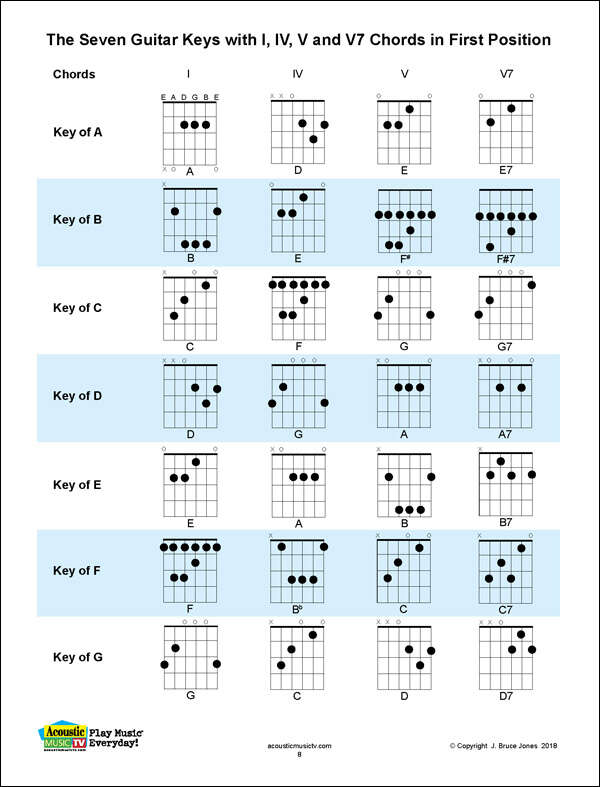
These keys work well with open chords. For example, a song in G major may use G, C, D, and Em. A song in C major may use C, F, G, Am, and Dm.
A guitarist may also use a capo to play these easy chord shapes while making the song sound in a different key.

What Determines the Key of a Guitar Song?
The key of a guitar song is determined by its tonal center. The tonal center is the note or chord that feels like “home.”
Several musical features can reveal the key:
The final chord
Many songs end on the tonic chord, which is the main chord of the key. If a song repeatedly returns to G and ends on G, it may be in G major.
This is a helpful clue, but it is not perfect. Some songs end on a different chord for emotional effect.
The chord progression
Chord patterns often reveal the key. In the key of C major, common chords include:
• C major
• D minor
• E minor
• F major
• G major
• A minor
• B diminished
A progression such as C–G–Am–F strongly suggests C major. The same shapes may appear in another key if a capo or transposition is used.
The melody
The melody often highlights the key’s main note. If the vocal line repeatedly settles on C, and the chords support C major, the song may be in C.
Melody can be more useful than chords when a song uses borrowed chords or unusual progressions.
The scale
The notes used in the song can also show its key. A song using the notes C, D, E, F, G, A, and B may be in C major or A minor. These keys share the same notes, so the tonal center matters.
The sound of resolution
Listen for the point where the music feels finished. That note or chord often identifies the key.
When I help newer players find what key is a guitar song in, I ask them to hum the note that feels most settled. Then we compare that note with the final chord. This simple method often works better than guessing from the first chord.
How to Find What Key a Guitar Song Is In
You can identify the key of many guitar songs with a simple process.
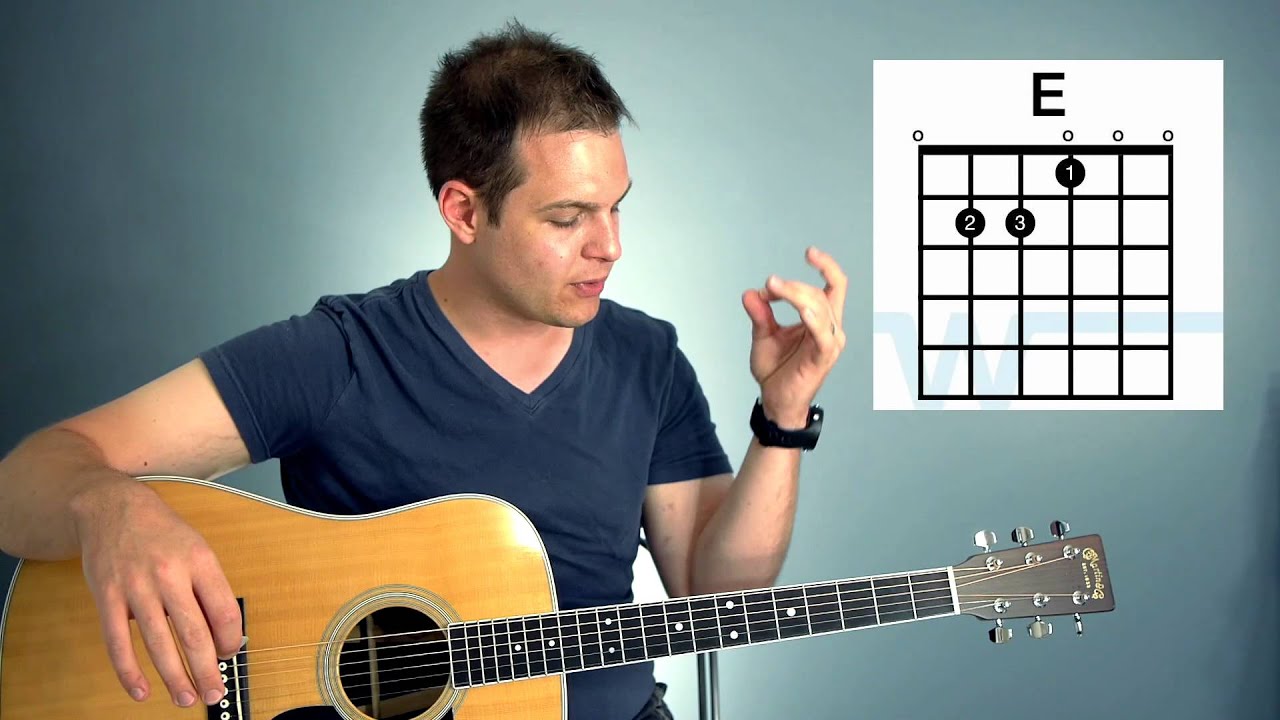
Step 1: List the chords
Write down every chord in the song. Include the verse, chorus, bridge, and ending if they use different chords.
For example, suppose the song uses:
• G
• C
• D
• Em
These chords commonly belong to G major.
Step 2: Look for the home chord
Find the chord that feels most stable. It often appears at the end of a section or at the end of the song.
If G feels like home, the song may be in G major. If Em feels like home, it may be in E minor. G major and E minor share the same basic notes, so the feeling of resolution matters.
Step 3: Compare the chords with a key
Use a basic major key chord pattern:
- Major
- Minor
- Minor
- Major
- Major
- Minor
- Diminished
For G major, the chords are:
• G major
• A minor
• B minor
• C major
• D major
• E minor
• F-sharp diminished
If most of the song’s chords fit this group, G major is a strong possibility.
Step 4: Check the melody
Play the suspected tonic note against the melody. If the note sounds stable at the end of phrases, you may have found the key.
This step helps separate relative major and minor keys. For example, C major and A minor use the same notes, but they have different tonal centers.
Step 5: Watch for exceptions
Not every song follows one key perfectly. Songwriters may use:
• Borrowed chords
• Temporary key changes
• Secondary dominant chords
• Modal sounds
• Blues notes
• Chromatic passing chords
One unusual chord does not always mean the song has changed keys.

Does a Capo Change the Key of a Guitar?
Yes. A capo raises the pitch of every open string and chord shape by one half step for each fret.
For example:
• Open G shape with no capo sounds in G
• Open G shape with capo on the 1st fret sounds in A-flat
• Open G shape with capo on the 2nd fret sounds in A
• Open G shape with capo on the 3rd fret sounds in B-flat
The chord shape stays the same under your fingers, but the actual sound moves higher.
Capo transposition chart
| Capo fret | G shape sounds as |
|---|---|
| Open | G |
| 1st fret | A-flat |
| 2nd fret | A |
| 3rd fret | B-flat |
| 4th fret | B |
| 5th fret | C |
A capo is useful when a singer needs a higher key or when you want to avoid difficult barre chords.
For example, a song may sound in A major but use simple G, C, and D shapes with a capo on the second fret. The written chord shapes are G, C, and D, but the audience hears A, D, and E.
A common capo mistake
Many players say the song is in G because they are using G shapes. That can be incorrect.
The shapes describe what your fingers play. The sounding key describes the actual pitch after the capo is applied. Always separate “shape” from “concert key.”

What Are Alternate Guitar Tunings?
Alternate tunings change the pitches of the open strings. They can make certain keys, chords, or musical styles easier to play.
Popular alternate tunings include:
• Drop D: D–A–D–G–B–E
• Half-step down: E-flat–A-flat–D-flat–G-flat–B-flat–E-flat
• Whole-step down: D–G–C–F–A–D
• Open G: D–G–D–G–B–D
• Open D: D–A–D–F-sharp–A–D
• DADGAD: D–A–D–G–A–D
Drop D tuning
Drop D lowers the thickest string from E to D. This makes a powerful D5 power chord possible with one finger across the lowest three strings.
Drop D is common in rock, metal, folk, and modern worship music. It does not mean the whole guitar is automatically in D major. The song still determines the key.
Open tunings
In an open tuning, the open strings form a complete chord. Open G, for example, creates a G major chord when all strings are played open.
Open tunings are popular for slide guitar and blues. They can make one key feel very natural, but the guitar can still play other keys with fretting and chord shapes.
Down tuning
Some players tune every string down by a half step. This makes the instrument sound lower and may reduce tension slightly.
A guitar tuned E-flat–A-flat–D-flat–G-flat–B-flat–E-flat is not simply “in the key of E-flat.” It has a different tuning, but the song’s key still depends on its chords and melody.

How Guitar Keys Affect Chords and Scales
The key tells you which notes and chords are likely to work together. This helps you choose chords, write melodies, improvise, and build solos.
For example, the G major scale contains:
G, A, B, C, D, E, and F-sharp.
The main chords from G major are:
• G major
• A minor
• B minor
• C major
• D major
• E minor
• F-sharp diminished
A lead guitarist can begin with the G major scale over a song in G major. A player can also use the E minor pentatonic scale in many G major settings because E minor is the relative minor of G major.
Major keys
Major keys often sound bright, open, or resolved. Common guitar major keys include C, G, D, A, and E.
These keys work well with standard tuning because they include many comfortable open chords.
Minor keys
Minor keys often sound darker, more serious, or more emotional. Common guitar minor keys include E minor, A minor, and D minor.
E minor is especially easy for beginners because the open Em chord uses only two fingers. A minor is also common in folk, rock, blues, and pop music.
The circle of fifths
The circle of fifths shows how musical keys relate to each other. It can help you understand key signatures, chord families, and common chord changes.
For guitarists, it is useful when:
• Transposing a song
• Choosing a capo position
• Building chord progressions
• Understanding sharps and flats
• Planning a modulation
You do not need to memorize the entire circle at once. Start with C, G, D, A, and E major, since these keys appear often in guitar music.

How to Tune a Guitar Correctly
Correct tuning is the first step before deciding what key a guitar song is in. A guitar that is out of tune can make every chord sound wrong.
Standard tuning with a tuner
Use a chromatic tuner and tune each string to:
- 6th string: E
- 5th string: A
- 4th string: D
- 3rd string: G
- 2nd string: B
- 1st string: E
Tune upward to the note when possible. This can help the string hold its pitch more steadily, though fresh strings may still need several checks.
Tune by ear
You can also tune using the 5th-fret method:
• The 5th fret of the 6th string matches the open 5th string
• The 5th fret of the 5th string matches the open 4th string
• The 5th fret of the 4th string matches the open 3rd string
• The 4th fret of the 3rd string matches the open 2nd string
• The 5th fret of the 2nd string matches the open 1st string
This method depends on having one string in tune first. A tuner is more reliable, especially when playing with other instruments.
Use a reference pitch
Many tuners use A4 at 440 hertz as the standard reference. Some orchestras and ensembles use a slightly different reference, so check the setting when playing with others.
In everyday guitar playing, the exact reference matters less than making sure all instruments use the same one.
Common Mistakes When Identifying a Guitar Key
Understanding what key is a guitar song in becomes easier when you avoid a few common errors.
Mistake 1: Confusing tuning with key
Standard tuning is E–A–D–G–B–E. That does not mean every song played on the guitar is in E.
The guitar can play in every key. Tuning only describes the open-string pitches.
Mistake 2: Naming the first chord as the key
Many songs begin on a chord that is not the tonic. A song may start on Am but eventually feel centered on G or C.
Always listen for the chord that feels like home.
Mistake 3: Ignoring the capo
A capo changes the sounding pitch. If you use a capo on the second fret and play G shapes, the music sounds in A.
Write down both details when practicing: the chord shape and the concert key.
Mistake 4: Assuming major and relative minor are the same
C major and A minor share the same notes, but they do not sound the same. The tonic determines which one is the actual key.
Listen to the bass line, final chord, and points of rest.
Mistake 5: Trusting an automatic key finder completely
Apps and online tools can suggest a key, but they may struggle with blues, modal music, short clips, or songs with key changes.
Use technology as a guide. Confirm the answer with your ears and basic music theory.
Practical Examples of Guitar Keys
Examples make the idea clearer.
Example 1: G, C, and D
A song using G, C, and D is often in G major. G feels like the home chord, while C and D create movement away from and back to G.
This is one of the most common chord groups for beginners.
Example 2: C, F, G, and Am
This group often points to C major. The chords belong to the C major scale, and C usually provides the strongest sense of resolution.
An F chord may feel difficult at first because it is often played as a barre chord. A partial F shape can be used while building finger strength.
Example 3: Em, C, G, and D
This progression may be in E minor or G major. Both keys use the same basic notes.
To decide, listen to whether Em or G feels like the final resting place. The melody and bass line can provide the answer.
Example 4: D, G, and A with a capo
Suppose you play D, G, and A shapes with a capo on the second fret. The actual chords sound as E, A, and B.
The song is therefore in E major if E feels like the tonal center. Your hands are using D shapes, but the audience hears a higher key.
Example 5: Drop D power chords
A rock song may use open low D and power chords around it. This can create a strong D center.
Still, the song could use a D minor or D Mixolydian sound rather than D major. The tuning suggests useful shapes, but the full musical context determines the key and mode.
Tips for Choosing the Best Key on Guitar
The best key is not always the easiest key to play. It should fit the singer, instrument, and mood of the song.
Use these practical tips:
• Choose a key that fits the singer’s vocal range.
• Use a capo to keep comfortable chord shapes.
• Transpose the song if the original key feels too high or low.
• Check whether the open strings create unwanted noise.
• Practice the same progression in two or three keys.
• Learn both chord shapes and actual sounding notes.
• Use a tuner before every serious practice session.
When I practice a song, I first find the key that fits my voice. Then I choose the easiest chord shapes for that key. This order saves time and prevents the common mistake of forcing a song into a key just because the chords look easy.
A beginner may prefer G major because of its open chords. A singer may need F major, A major, or B-flat major instead. There is no single best guitar key for every player.
Frequently Asked Questions About What Key Is a Guitar In
What key is a guitar in standard tuning?
A guitar in standard tuning is tuned to E–A–D–G–B–E from the thickest string to the thinnest. This is a tuning system, not one musical key, so the guitar can play songs in every key.
Is a guitar tuned to E major?
No. The open strings include E, A, D, G, B, and E, but they do not form an E major chord. A song played on the guitar may be in E major, but the instrument itself is not fixed to that key.
What is the easiest key to play on guitar?
G major, C major, D major, E major, A major, and E minor are often easy for beginners because they use common open chords. The easiest key also depends on your finger strength, the song, and the singer’s range.
Does a capo change the key of a song?
Yes. A capo raises every chord by one half step for each fret. For example, G chord shapes with a capo on the second fret produce the sound of A major.
How can I tell what key a guitar song is in?
List the song’s chords, find the chord that feels like home, and compare the chord group with a major or minor key. Check the melody and final chord as well, because the first chord is not always the tonic.
Can a guitar play in any key?
Yes. A normally tuned guitar can play in all 12 major and minor keys, although some keys are easier because they use open chords. Barre chords, movable scales, and a capo make other keys more accessible.
What key is a guitar in if it uses Drop D tuning?
Drop D tuning lowers the thickest string from E to D. It makes D-based chords and power chords easier, but the song can still be in D major, D minor, or another mode depending on its notes and progression.
Conclusion
A guitar is not in one fixed key. In standard tuning, its strings are tuned to E, A, D, G, B, and E, but the key of a song comes from its chords, melody, tonal center, capo position, and tuning choices.
To find what key is a guitar song in, listen for the home chord, study the progression, check the melody, and remember that chord shapes may differ from the actual sounding key. Start by practicing common keys such as G, C, D, A, E, and E minor, then use a capo or barre chords to explore more.
Tune your guitar, play a simple progression, and train your ear to hear where the music wants to rest. For more guitar tips, explore related lessons and share your favorite key or chord progression in the comments.

Senior Music Reviewer
Alex Carter is a seasoned music reviewer with over a decade of experience in the world of sound and instruments. Passionate about helping musicians and enthusiasts make informed choices, he brings sharp insights and in-depth knowledge to every review. From classical instruments to modern gear, Alex combines technical expertise with a love for music to deliver content that resonates with readers.
As a Senior Music Reviewer and expert author on Tuneluma.com, Alex is dedicated to sharing honest evaluations, practical advice, and thoughtful commentary to guide readers in their musical journey.