
How Do You Tune A 12 String Guitar: Easy Step By Step Guide
Introduction
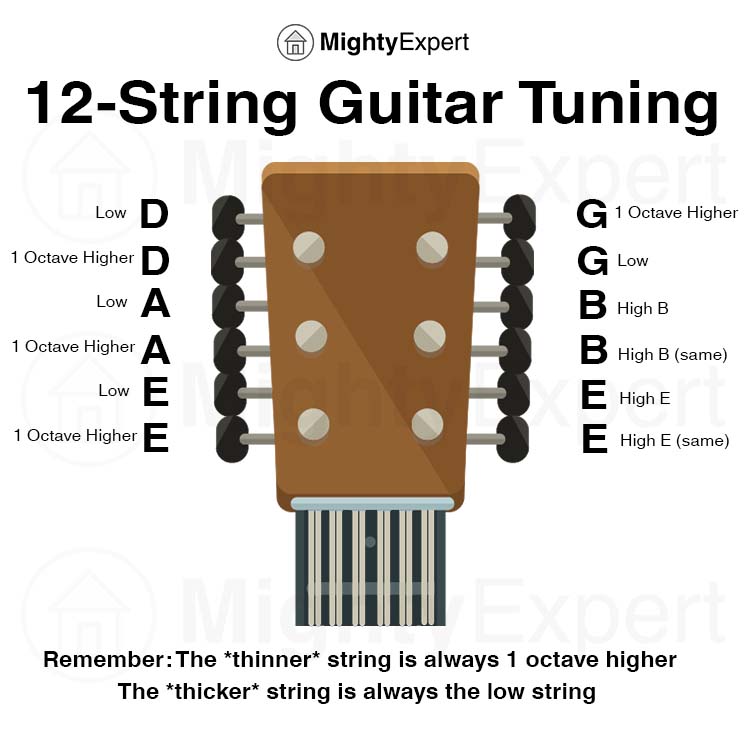
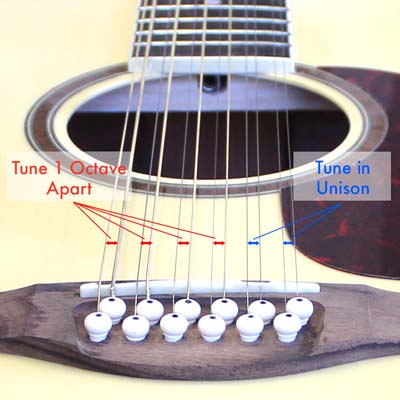
To tune a 12-string guitar, tune its six pairs of strings to standard guitar notes: E, A, D, G, B, and E. The lower four pairs usually contain one regular string and one thinner string tuned an octave apart. The B and high E pairs use two strings tuned to the same note.
For guitarists in the United States, the usual reference is standard pitch, A=440 Hz. A chromatic tuner makes the job much easier. Tune slowly, pluck one string at a time, and check each pair again because the added string tension can pull the neck and bridge slightly as the guitar settles.

Standard 12-String Guitar Tuning
A standard 12-string guitar has six courses. A course means two strings that sit beside each other and are played together as one note.
The normal tuning is:
| Course | Main note | Pair relationship | Common pitch names |
|---|---|---|---|
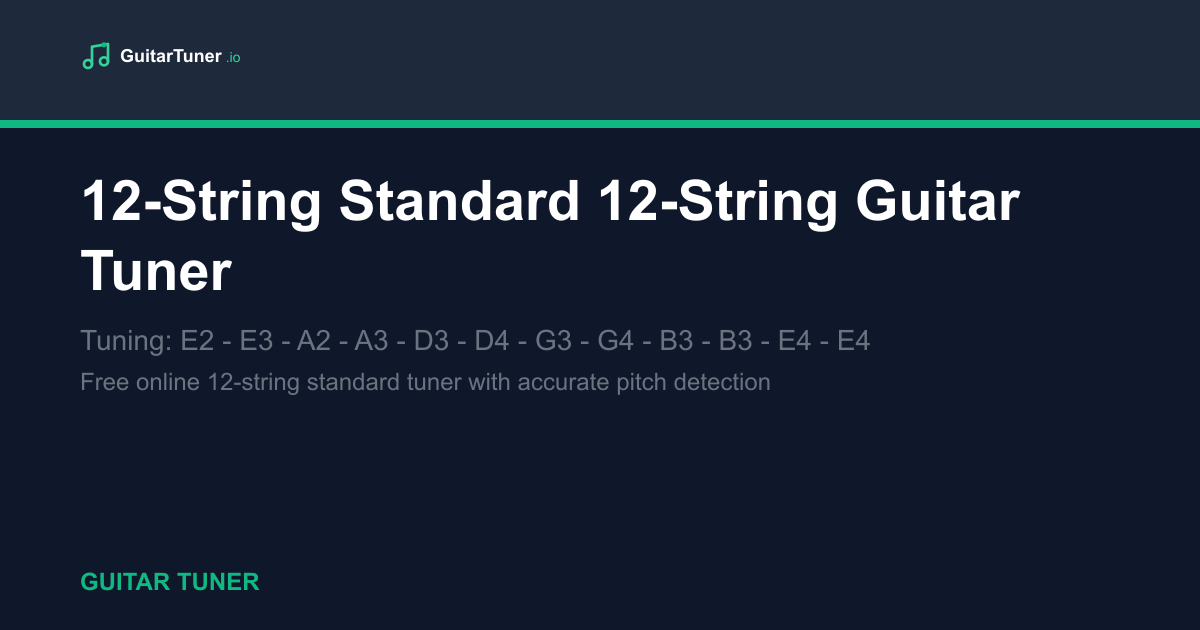
| 6th pair | Low E | One octave apart | E2 and E3 |
| 5th pair | A | One octave apart | A2 and A3 |
| 4th pair | D | One octave apart | D3 and D4 |
| 3rd pair | G | One octave apart | G3 and G4 |
| 2nd pair | B | Same pitch | B3 and B3 |
| 1st pair | High E | Same pitch | E4 and E4 |
The thicker string in the E, A, D, and G courses usually carries the lower note. The thinner string carries the higher octave. In the B and high E courses, both strings match at the same pitch.
From the lowest-sounding course to the highest, the notes are:
E–A–D–G–B–E
That is the same note layout as a six-string guitar. The difference is that each note has a second string beside it.
Why the octave strings matter
The octave strings create the wide, shimmering sound linked with a 12-string guitar. If one octave string is too low or too high, the guitar may sound:
- Out of tune when you strum open chords
- Harsh or “chorused” in an unpleasant way
- Weak on one side of a pair
- Unstable when you play higher up the neck
A pair can sound close when played alone but still clash when strummed. Always check the strings together after tuning them separately.
What You Need Before Tuning
You need a reliable tuner, a stable guitar, and enough time to make two or three passes.
Use a chromatic tuner
A chromatic tuner reads the actual note and tells you whether the string is sharp or flat. A clip-on tuner works well because it reads vibration through the guitar rather than relying only on room sound.
A tuner with a 12-string mode can help, but it is not required. A standard chromatic setting is often more useful because you can see each note clearly.


Avoid relying on:
- A pitch-memory app without a live note display
- A noisy room
- Another guitar that may itself be out of tune
- Harmonics as your only reference
- Tuning by ear when you are still learning the octave pairs
Check the guitar’s condition
before you begin:
- Place the guitar in playing position.
- Check that the strings sit correctly in the nut and bridge.
- Make sure no string is visibly damaged or badly kinked.
- Turn the tuner on and select chromatic mode.
- Set the guitar’s volume low or unplug it if you are using a pickup.
If the guitar has just moved from a cold car into a warm home, let it rest before tuning. Wood and strings can shift with temperature and humidity. A sudden change can make the first tuning pass unreliable.
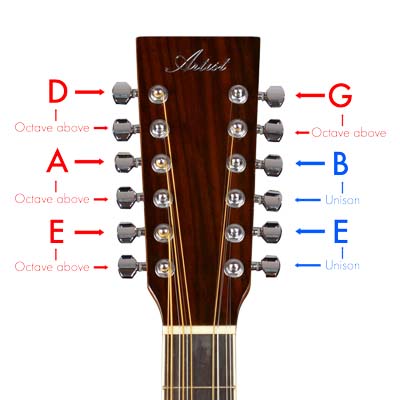
Know which tuning machines control which strings
The layout varies by guitar. Some 12-string guitars have six tuning posts on each side of the headstock. Others place the paired tuners in a stacked or mixed arrangement.
Trace each string from the bridge to its tuning machine before turning anything. If you turn the wrong machine, you can loosen or over-tighten a neighboring string.

How to Tune a 12-String Guitar Step by Step
The safest method is to tune one course at a time. Start with the lower courses, then tune the higher courses.
1. Set the tuner to chromatic mode
Place the tuner where you can see it clearly. If you use a clip-on tuner, attach it to the headstock.
The tuner should show:
- The note name
- Whether the note is sharp or flat
- A center or “in tune” position
A note that reads above the target is sharp. A note that reads below the target is flat.
2. Start with the low E course
Find the two lowest strings. Tune the thicker string to E first. Then tune the thinner neighboring string to the higher E octave.
The thicker string should produce the low E you expect from a standard six-string guitar. The thinner string should read the same letter but at the higher octave.
Do not assume the tuner will always display the octave number. Many tuners show only “E.” Use the string’s thickness and sound as a guide. The thin octave string should sound clearly higher than the thick string.
3. Tune the A course
Tune the thick string to A. Then tune the thin string in the pair to the higher A octave.
Pluck near the sound hole or pickup area with a light, even stroke. A hard pluck can make the note read sharp for a moment.


4. Tune the D course
Tune the thicker D string to D. Then tune the thinner octave string to the higher D.
The thin octave string should not be tuned to the same pitch as the thick string. If both strings sound like the same low D, the octave string is too low.
5. Tune the G course
Tune the thicker G string to G. Then tune its thinner partner to the higher G octave.
The G course can be easy to confuse because the octave is not as low or high as the E and A pairs. Watch the tuner, then listen for a clear, blended sound.
6. Tune the B course
Tune both B strings to the same pitch. Unlike the lower four courses, this pair does not use an octave.
Pluck the strings one at a time. The tuner should identify both as B. Then pluck them together and listen for a smooth sound without a pulsing beat.
7. Tune the high E course
Tune both high E strings to the same pitch. These strings are usually the thinnest and need the most care.
Turn the tuning machine in small amounts. Stop if the string feels unusually tight, looks damaged, or begins to make a sharp clicking sound.
8. Repeat the full process
After all 12 strings are close, repeat the tuning order from low E to high E.
This second pass matters because each string adds tension to the neck and bridge. When one string reaches pitch, the others may shift slightly. A third quick pass is normal on a new set of strings.
9. Check open chords
Play a few simple open chords, such as:
- G major
- C major
- D major
- E minor
- A major
Strum gently. If a course sounds rough, stop and tune the two strings in that course again. The goal is not just for each string to satisfy the tuner. The pairs must also sound clean together.

Which String Should You Tune First in Each Pair?
Tune the thicker, lower-pitched string first, then tune the thinner string beside it.
For the standard octave courses:


- Thick E, then thin E octave
- Thick A, then thin A octave
- Thick D, then thin D octave
- Thick G, then thin G octave
For the unison courses:
- First B, then second B
- First high E, then second high E
This order gives the tuner a strong reference and makes it easier to identify the octave relationship. If your guitar uses an unusual string layout, follow the physical string positions and confirm the pitch on the tuner.
How to Tune Each String Without Breaking It
Turn the tuning key slowly. If a string is below pitch, raise it gradually until it reaches the target note.
If you pass the note, do not simply drop the string back down and stop. Lower it slightly below the target, then raise it back up. This helps seat the string and reduces slack around the tuning post.
Use this pattern:
- Pluck the string once.
- Read the tuner.
- Turn the tuning key a small amount.
- Pluck again.
- Stop when the display centers on the target note.
Avoid large, fast turns. A 12-string set has more strings and more total tension than a six-string set, so careless tuning can cause a string to break or a poorly maintained instrument to develop problems.
If a string breaks while tuning, move your face and hands away from the headstock. Replace the string before continuing.

How to Tell Whether a 12-String Is in Tune
A correctly tuned 12-string guitar passes three checks.
The tuner check
Each string shows the correct note:
- E and E octave
- A and A octave
- D and D octave
- G and G octave
- B and B
- E and E
The tuner should settle near the center rather than moving widely between sharp and flat.
The pair check
Play each pair together. A well-matched pair sounds full and steady.
If you hear a regular “wah-wah” pulse, the two strings may be slightly out of tune. The faster the pulse, the greater the pitch difference. Adjust one string in very small steps.
The chord check
Play open chords and listen for clean harmony. If the individual strings look correct but chords still sound wrong, check the pairs again. Also make sure you are not pressing too hard, since excessive finger pressure can make fretted notes sound sharp.
Why a 12-String Guitar Keeps Going Out of Tune
A 12-string guitar may need several tuning passes for normal reasons.


New strings are stretching
Fresh strings often stretch during the first playing sessions. Tune the guitar, gently stretch each string by hand along the fretboard, and tune again.
Use only light pressure. Do not yank the strings upward, especially on the thin octave and high E strings.
The strings are not seated
A string can slip slightly at the bridge, nut, or tuning post. This often causes one string to drop in pitch soon after tuning.
If the problem continues, inspect the string windings and check that the string is properly secured. A repair shop can correct a slipping bridge pin, nut slot, or tuning post.
The neck or body is reacting to humidity
Acoustic guitars respond to changes in moisture and temperature. Very dry conditions may contribute to fret problems, cracks, or changes in action. Excess moisture can also affect playability and tuning stability.
Keep the guitar in a stable indoor environment. If you suspect a serious humidity problem, have the instrument checked by a qualified guitar technician.
The tuner is hearing too many strings
When tuning a 12-string guitar, nearby strings can vibrate sympathetically. This may confuse a microphone-based tuner.
Mute the other strings with your hand while tuning one string. A clip-on tuner may also help because it reads the guitar’s vibration directly.
The string is old or damaged
Old strings can lose brightness and make accurate tuning harder. A damaged string may produce unstable readings or fail suddenly. Replace strings that are corroded, kinked, frayed, or difficult to tune.
Should You Tune a 12-String Guitar Down a Half Step?
Many players tune a 12-string guitar down a half step to reduce tension and create a slightly lower sound. In that tuning, every note moves down one semitone:
| Standard tuning | Half-step-down tuning |
|---|---|
| E | E-flat |
| A | A-flat |
| D | D-flat |
| G | G-flat |
| B | B-flat |
| E | E-flat |
This can make some guitars feel easier to play, but it is not required for every 12-string guitar. The correct choice depends on the guitar’s design, string gauge, setup, and the sound you want.
Use standard tuning when:
- You need to match standard chord shapes and recordings
- Your instrument is designed and set up for standard pitch
- You want the most familiar reference for lessons and charts
Consider half-step-down tuning when:
- You prefer a lower vocal range
- The guitar feels unusually tight at standard pitch
- Your manufacturer or technician supports that setup
- You want a slightly softer string feel
Do not change tuning to hide a serious setup problem. Excessive neck relief, high action, fret buzz, or bridge movement should be inspected by a qualified repair professional.
Common 12-String Tuning Mistakes
Tuning both strings in a lower course to the same note
The E, A, D, and G courses normally use octave pairs. If both strings are tuned to the same low note, the instrument will not have the usual 12-string sound.
Tuning the octave string one octave too high
A thin string can snap if you continue turning after it has already reached its correct octave. Watch the tuner and compare the sound with the matching thick string.
Tuning by color or position alone
String layouts differ between guitar models. Always trace the string to its tuning machine and verify the note on the tuner.
Plucking too hard
A hard attack can push the pitch sharp. Use a light, repeatable pluck.
Skipping the second pass
The first pass brings the guitar close. The second pass brings the courses into balance. Always check the complete instrument again.
Ignoring unusual resistance
If a tuning key becomes very stiff, a string will not rise in pitch, or the bridge appears to lift, stop tuning. Do not force the hardware. A technician should inspect the guitar.
Quick Tuning Reference
Use this sequence from the lowest course to the highest:
- Thick low E
- Thin high E octave
- Thick A
- Thin high A octave
- Thick D
- Thin high D octave
- Thick G
- Thin high G octave
- B
- B
- High E
- High E
Then repeat the sequence and test a few open chords.
Key Takeaways
- Standard 12-string tuning is E–A–D–G–B–E by course.
- The E, A, D, and G courses normally use octave pairs.
- The B and high E courses use unison pairs.
- Use a chromatic tuner and tune one string at a time.
- Tune the thicker strings first, then the thinner octave strings.
- Make at least two complete tuning passes.
- Mute nearby strings if the tuner gives unstable readings.
- Stop if a string, tuning machine, or bridge behaves unusually.
Frequently Asked Questions
Do you tune a 12-string guitar the same way as a 6-string?
You use the same six main notes, but each note has two strings. The E, A, D, and G pairs normally use octaves, while the B and high E pairs use the same pitch.
Can I use a regular guitar tuner for a 12-string guitar?
Yes. A chromatic guitar tuner works for a 12-string guitar. Tune each string separately and mute the other strings so the tuner does not read unwanted vibrations.
Which string is the octave string on a 12-string guitar?
In the E, A, D, and G courses, the thinner string is normally the higher octave string. The B and high E pairs are usually tuned to the same pitch.
Why does my 12-string sound out of tune even when the tuner says it is correct?
The two strings in one or more courses may be slightly mismatched. Play each pair together and listen for a pulsing beat. Retune one string in small steps, then check an open chord.
Is it easier to tune a 12-string guitar down a half step?
It can feel easier because the strings have less tension, but the best tuning depends on the instrument and setup. If the guitar has structural or setup problems, lowering the pitch is not a substitute for repair.
How often should I tune a 12-string guitar?
Tune it every time you play, especially with new strings or after temperature and humidity changes. A stable guitar may need only small adjustments once the strings settle.
Conclusion
The most reliable way to tune a 12-string guitar is to use a chromatic tuner, tune each course slowly, and check the pairs together. Start with the thick strings, add the octave or unison strings, then make a second full pass.
If the guitar will not hold pitch, a string keeps slipping, or the bridge and neck show unusual movement, stop forcing the tuning. Replace damaged strings and have the instrument inspected by a qualified guitar technician.

Senior Music Reviewer
Alex Carter is a seasoned music reviewer with over a decade of experience in the world of sound and instruments. Passionate about helping musicians and enthusiasts make informed choices, he brings sharp insights and in-depth knowledge to every review. From classical instruments to modern gear, Alex combines technical expertise with a love for music to deliver content that resonates with readers.
As a Senior Music Reviewer and expert author on Tuneluma.com, Alex is dedicated to sharing honest evaluations, practical advice, and thoughtful commentary to guide readers in their musical journey.