A Flat Minor Chord Guitar: Easy Shapes And Tips
The A♭ minor chord on guitar uses A♭, C♭, and E♭ to create a dark, emotional sound.
Learning the a flat minor chord guitar players often avoid can open up new sounds in blues, rock, jazz, and pop. Its barre shapes may feel hard at first, but the right finger placement, slow practice, and smart alternatives make this chord much easier to play.
What Is the A Flat Minor Chord on Guitar?
The A flat minor chord is written as A♭m or Abm. It contains three notes:
• A♭, the root
• C♭, the minor third
• E♭, the perfect fifth
These notes create the chord’s minor quality. The C♭ is especially important because it gives A♭ minor its sad and tense sound.
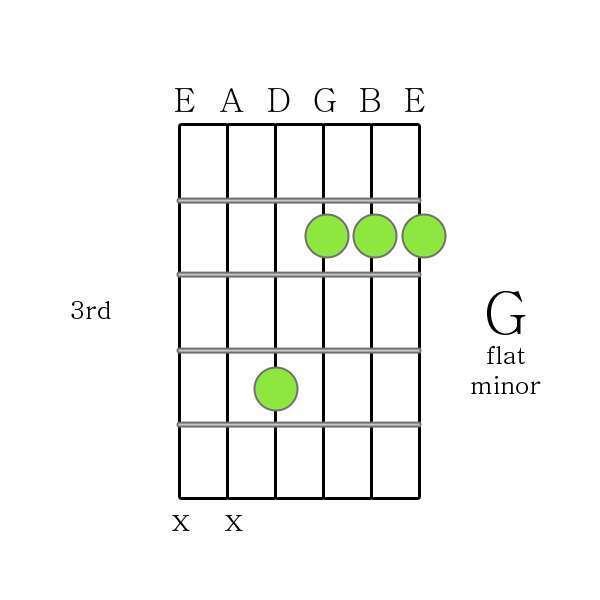
On a guitar in standard tuning, the a flat minor chord guitar shape is usually played as a barre chord. This is because A♭ is not common in open chord shapes. Many guitarists also use the enharmonic name G♯ minor, written G#m, because it is easier to read and play on guitar.
A♭ minor and G♯ minor sound exactly the same in equal temperament. The name depends on the musical key and the chord’s role in a song.

A Flat Minor Chord Guitar Shapes
The best way to learn the a flat minor chord guitar voicing is to start with a common movable shape. Once you know the shape, you can move it to play other minor chords.
A♭ Minor E-Shape Barre Chord
This is one of the most useful forms:
e|--4--|
B|--5--|
G|--6--|
D|--6--|
A|--4--|
E|--x--|
Use these fingers:
• Index finger: Barre the A string through the high E string at the 4th fret
• Ring finger: Barre the D, G, and B strings at the 6th fret
• Do not play the low E string
This shape is often called the A♭ minor or G♯ minor barre chord. Its notes are:
x 4 6 6 5 4
The A string at the 4th fret gives you A♭. The other notes complete the minor chord.
Full Six-String A♭ Minor Chord
You can also play the full version:
e|--4--|
B|--4--|
G|--4--|
D|--6--|
A|--6--|
E|--4--|
The fingering uses the E minor shape moved to the 4th fret:
• Index finger: Barre all six strings at the 4th fret
• Ring finger: 5th fret of the A string
• Pinky finger: 5th fret of the D string
• Middle finger: 5th fret of the G string
This version gives a strong, full sound. It can work well in rock, worship music, and rhythm guitar parts.
A-Shape A♭ Minor Chord
The a flat minor chord guitar shape based on the A minor form begins at the 11th fret:
e|--x--|
B|--11-|
G|--12-|
D|--13-|
A|--13-|
E|--11-|
A simpler version is:
x 11 13 13 12 11
This shape can feel more compact than the E-shape barre chord. It also gives a slightly different tone because it does not use the low E string.
G♯ Minor as an Easier Spelling
Many chord charts list this chord as G#m:
e|--4--|
B|--4--|
G|--4--|
D|--6--|
A|--6--|
E|--4--|
This is the same sound as A♭ minor. If you search for “G sharp minor guitar chord,” you will often find more lessons and diagrams than you will for “A flat minor guitar chord.”

How to Play the A Flat Minor Chord Clearly
Barre chords can make your hand feel tired. That is normal. The goal is not to squeeze as hard as possible. The goal is to use clean alignment and steady pressure.
Follow these steps:
- Place your index finger across the 4th fret.
- Keep the index finger close to the fret wire.
- Add the ring finger and pinky to the 6th fret.
- Add the middle finger if you are using the full six-string shape.
- Pick each string one at a time.
- Adjust any finger that causes a muted or buzzing note.
- Strum slowly only after each string sounds clean.
A common mistake is placing the index finger flat in the center of the fret. Moving it slightly toward the metal fret wire often reduces buzzing. You can also turn the index finger slightly onto its side. The firmer edge usually presses the strings more cleanly.
Your thumb should sit behind the guitar neck. Avoid wrapping it too far over the top while learning the a flat minor chord guitar shape. A relaxed wrist gives your fingers more room to reach the strings.

Common Problems With the A Flat Minor Chord
The a flat minor chord guitar shape often feels difficult for three main reasons: barre pressure, finger reach, and unwanted string noise.
Buzzing Notes
Buzzing often means one or more strings are not fully pressed. Check the following:
• Your index finger may be too far from the fret wire
• Another finger may be touching a nearby string
• Your wrist may be bent at an uncomfortable angle
• You may be pressing with too little or uneven pressure
Play each string separately. This method shows exactly where the problem starts.
Muted High Strings
The B and high E strings can sound weak when the index finger is not straight enough. Lift your elbow slightly and bring your wrist forward. This small change can help your index finger cover the top strings.
Hand Fatigue
Do not hold the chord for several minutes at once. Instead, use short repetitions:
• Hold the chord for five seconds
• Release your hand for five seconds
• Repeat five times
• Rest for 30 seconds
• Play the exercise again
This builds control without overworking your hand. Stop if you feel sharp pain. Normal effort is fine, but pain is a signal to rest and check your technique.
Accidental Open Strings
The A flat minor chord guitar shape does not usually use open strings. If you hear an open string ringing, check your picking hand and your index finger. A controlled strum is better than a wide, careless stroke.

Easier Alternatives to the A Flat Minor Chord
You do not always need a full barre chord. A smaller voicing can work well, especially when playing with a bass player or another guitarist.
Three-String A♭ Minor Shape
Try this compact voicing:
e|--4--|
B|--4--|
G|--4--|
D|--x--|
A|--x--|
E|--x--|
This uses the notes A♭, C♭, and E♭ in a small shape. It sounds light and clean. It works well for muted rhythm parts and higher guitar melodies.
Power Chord Option
A power chord does not contain the minor third, so it is not technically a minor chord. Still, it can replace A♭ minor in rock and metal:
e|--------|
B|--------|
G|--------|
D|--6-----|
A|--6-----|
E|--4-----|
This gives you A♭ and E♭. The missing C♭ means the chord sounds neutral rather than clearly minor.
Use G♯ Minor
If the A♭ name feels confusing, use G#m. The guitar shape is identical. This is often the fastest way to find lessons, tabs, and chord charts for the same sound.

Where the A Flat Minor Chord Fits in Music
A♭ minor is the relative minor of C♭ major. It can also appear as a borrowed chord in songs written in other keys. Its dark tone makes it useful for emotional transitions and dramatic endings.
You may hear the a flat minor chord guitar voicing in:
• Slow ballads
• Film and game music
• Blues-based rock
• Jazz progressions
• Gospel and worship music
• Pop songs with a darker bridge
• Metal and alternative rock
A simple progression is:
A♭m – D♭m – E♭m – A♭m
Another useful progression is:
A♭m – F♭ – D♭m – E♭
In practical guitar writing, musicians may rename some chords to make the chart easier to read. For example, F♭ is enharmonically equal to E major, but the correct name depends on the key and harmonic function.
Try this rhythm pattern:
Down – Down – Up – Up – Down – Up
Start with one strum per beat. Then add the pattern when the chord changes feel smooth.

A Practice Plan for Beginners
A short practice plan works better than forcing long sessions. Give the a flat minor chord guitar shape five to ten focused minutes each day.
Step 1: Practice the Barre Alone
Lay your index finger across the 4th fret. Pick each string. Do not add the other fingers until most strings ring clearly.
Step 2: Add the Minor Shape
Add the ring finger and pinky. Move slowly. Your goal is accurate placement, not speed.
Step 3: Practice Chord Changes
Move between easy chords and A♭ minor:
E – A♭m – E – A♭m
Then try: