Introduction
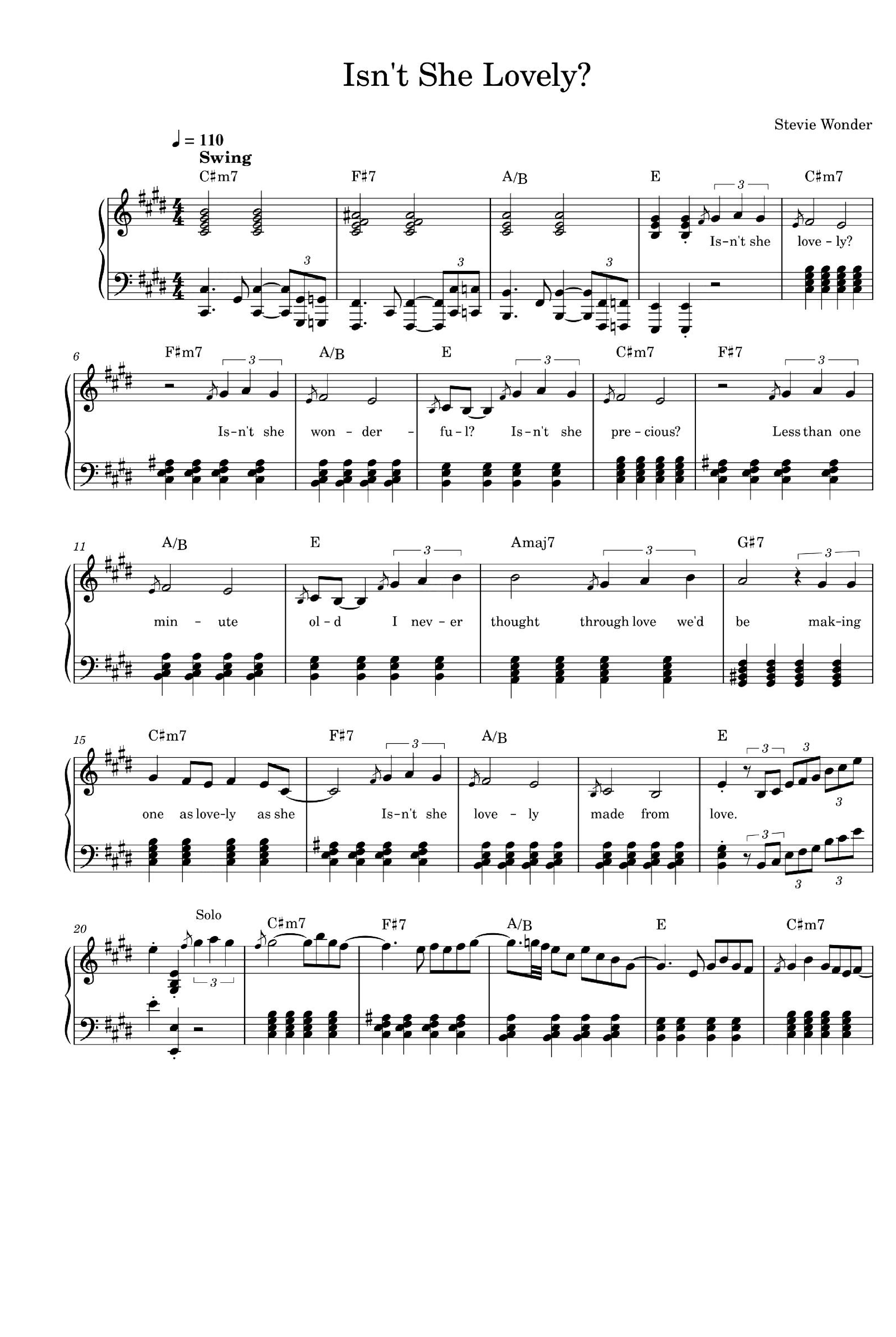
If you want “Isn’t She Lovely” piano sheet music in the United States, start with a licensed digital or printed arrangement from a reputable music publisher or sheet music store. The song was written and recorded by Stevie Wonder and first appeared on his 1976 album Songs in the Key of Life.
The best edition depends on your goal. A beginner may need a simple melody-and-chord version. An advanced player may want a fuller piano transcription that captures the bass, rhythm, and harmony of the original recording.
Because the song is still protected by copyright, avoid downloading unauthorized scans or copying a paid arrangement. Legal sheet music supports the copyright owners and is more likely to include clear notation, correct credits, and useful performance notes.


Where to Find Legal “Isn’t She Lovely” Piano Sheet Music
The safest place to look is an authorized sheet music publisher, licensed digital music store, or established music retailer serving the U.S. market. Search for the song title, Stevie Wonder as the composer or artist, and the exact arrangement type you need.
Useful sources may include:
- Official publisher catalogs
- Licensed digital sheet music stores
- Major U.S. music retailers
- Public library music collections
- School or university music libraries
- Authorized songbooks that include Stevie Wonder arrangements
Search for the complete title, including the apostrophe:
“Isn’t She Lovely” piano sheet music Stevie Wonder
You can also search by arrangement:
“Isn’t She Lovely” easy piano sheet music
“Isn’t She Lovely” piano solo
“Isn’t She Lovely” lead sheet
“Isn’t She Lovely” piano vocal guitar
Availability can change. A title may appear in a digital store one month and move to another publisher or format later. Check the listing for the publisher, arranger, format, page count, and permitted use before buying.
What a legal listing should show
A trustworthy listing usually identifies:
- The song title
- Stevie Wonder as the songwriter or original artist
- The arranger
- The publisher or rights holder
- The instrument or ensemble
- The difficulty level
- Whether the file is a digital download or a physical book
- Printing or device limits for digital copies
A listing with no publisher, no composer credit, or an unusually low price deserves caution. A free preview may be legitimate, but a complete scan of a commercially published arrangement usually is not automatically free to use.
Digital versus printed editions
Digital sheet music is useful when you want to start playing right away. Many licensed services let you transpose, change the page size, or play a limited audio preview. These features vary by service and by title.
Printed music may be a better choice if you prefer paper, perform from a music stand, or want a songbook with several related pieces. Printed editions also avoid problems caused by expired downloads, locked accounts, or device limits.


| Format | Best for | Check before purchase |
|---|---|---|
| Digital PDF or app edition | Fast access and flexible display | Printing rules, device access, and download limits |
| Printed single song | A focused performance copy | Edition level and page count |
| Songbook | Several songs in one purchase | Whether the arrangement is piano solo or piano-vocal |
| Lead sheet | Chord-based playing and singing | Whether the melody and chord symbols are complete |

Choose the Right Arrangement
The phrase “piano sheet music” can describe several very different products. Read the arrangement label before you buy, because two editions of the same song may feel completely different at the keyboard.
Easy piano
An easy piano arrangement reduces large chords, quick passages, and complex rhythms. It may keep the main melody in the right hand while using simple bass notes or block chords in the left hand.
Choose this version if you:
- Read music at an early level
- Want to play the song without copying the recording
- Need a manageable arrangement for lessons
- Prefer a slower, simpler introduction
An easy arrangement may not include every rhythm or keyboard part heard on the original recording. That is a normal trade-off, not a printing error.
Piano solo
A piano solo arrangement is written for one pianist. It may include the melody, harmony, bass, and rhythmic figures at the same time.
Look for the stated level:
- Beginner: simple rhythm and limited hand movement
- Early intermediate: more chord movement and syncopation
- Intermediate: fuller harmony and more active bass
- Advanced: dense voicings, wider leaps, and closer detail to the recording
The level labels are not fully standardized. One publisher’s intermediate edition may be easier or harder than another’s. Use the preview pages when available.
Piano, vocal, and guitar
A piano-vocal-guitar edition is designed for a singer with accompaniment. The piano part may be less detailed than a true solo arrangement because the vocal line carries the main melody.
This format is useful when you plan to:
- Sing while playing
- Accompany another singer
- Perform with a guitarist
- Use chord symbols for a band or worship-style setting
It may not be the best choice if you want the piano to reproduce the full instrumental character of the recording.
Lead sheet
A lead sheet usually gives the melody, lyrics, and chord symbols. It leaves much of the accompaniment to the performer.
A lead sheet can work well for players who already understand:
- Chord construction
- Inversions
- Rhythmic comping
- Syncopation
- Basic jazz, soul, or pop harmony
It is not usually the easiest option for a first-time piano player.


How to Tell if an Arrangement Fits Your Skill Level
Preview the first page and ask three practical questions:
- Can you read the rhythm without guessing?
- Can your left hand reach the largest chord or interval?
- Can you play the passage slowly without stopping every few beats?
If the answer is no to all three, choose an easier edition. If the music looks very simple but you want the sound of the original recording, choose a fuller arrangement instead.
Signs that an edition may be too hard
You may need a simpler version if the music contains:
- Frequent sixteenth-note syncopation
- Large left-hand jumps
- Chords with many notes
- Fast changes between inversions
- Several accidentals in each measure
- Independent rhythms in both hands
- Long sections with few repeated patterns
A difficult arrangement is not always better. The right edition is the one you can play with steady time and a relaxed hand position.
A useful practice test
After buying or legally accessing the music, try this process:
- Read the right-hand part alone.
- Read the left-hand part alone.
- Mark repeated rhythms and chord shapes.
- Practice at a slow tempo with a metronome.
- Join the hands in short phrases.
- Increase the tempo only when the notes remain even.
The song’s bright, syncopated feel depends on steady rhythm. Playing every note correctly but losing the pulse can make the piece sound stiff.

How to Make a Simple Arrangement Sound More Like the Recording
A basic arrangement can still sound musical if you focus on rhythm, harmony, and touch. You do not need to copy every studio part to capture the song’s character.
Keep the pulse steady
Start with a slow metronome. Count evenly, then add the offbeat rhythms. Syncopation works only when the main beat stays clear.
If the rhythm feels hard, clap the pattern before playing it. You can also practice the left hand alone while counting aloud.
Use smooth chord changes
When the score gives chord symbols, choose nearby inversions instead of moving every finger to a new root position. This reduces hand movement and creates a smoother sound.
For example, keep common notes between nearby chords when possible. This technique is called voice leading. It helps a simple accompaniment sound more connected.
Add dynamics
Do not play every note at the same volume. Try:
- A lighter touch in quiet phrases
- A fuller sound at musical peaks
- Clear melody notes above the accompaniment
- Slight emphasis on important rhythmic accents
The exact dynamics should come from the arrangement and your musical judgment. Avoid forcing the sound with excess pressure.
Use the sustain pedal with care
The sustain pedal can connect chords, but too much pedal can blur the rhythm. Change the pedal with the harmony unless the score gives a different instruction.


A useful test is to play one phrase with no pedal, then add small pedal changes. If the bass becomes muddy or the beat loses clarity, use less pedal.
What to Do If You Cannot Find the Exact Edition
Search by arrangement type rather than by title alone. A publisher may list the song under “piano solo,” “easy piano,” “piano vocal,” or “lead sheet.”
Try these steps:
- Search the title in quotation marks.
- Add “Stevie Wonder” to narrow the results.
- Add your format, such as “easy piano” or “piano solo.”
- Check the publisher and arranger.
- Open the preview pages.
- Confirm that the edition is available for purchase in the United States.
- Read the digital-use and printing terms.
If one store does not carry the arrangement, search the publisher’s own catalog. You can also ask a music retailer to order a printed edition.
Do not confuse arrangements with transcriptions
A transcription aims to reproduce a recorded performance. An arrangement adapts the song for a particular player, instrument, or skill level.
A transcription may include more details but can be harder to play. An arrangement may sound less like the recording but work better for lessons, casual playing, or singing.
What about chord websites?
Chord websites can help you understand the harmony, but they are not the same as licensed piano sheet music. They may omit rhythm, melody, voicings, introductions, or exact bass movement.
Use chord information as a learning aid only when the site has the right to publish it. Do not treat an incomplete chord chart as a full substitute for a legal score.

Common Mistakes When Buying or Learning the Song
Buying the wrong format
A listing may say “piano” but actually be piano-vocal music, a lead sheet, or a collection with a simplified accompaniment. Read the instrument line carefully.
Ignoring the preview
The cover can look appealing while the notation does not match your needs. Preview the first pages and check the level, key, hand position, and amount of detail.
Assuming “easy” means identical to the recording
Easy piano music removes some complexity. If you want the original groove, you may need an intermediate arrangement or a teacher who can help you build the accompaniment.
Playing too fast too soon
The familiar recording can tempt you to rush. Learn the notes at a controlled tempo first. Speed should come after accuracy and comfort.
Copying or sharing a purchased file
A paid digital score is normally licensed for personal use under the seller’s terms. Do not email copies to friends, upload them to a group, or post screenshots unless the license permits it.


U.S. copyright rules can be complex, especially for public performance, arrangement, reproduction, and online sharing. For a school, business, public event, or commercial recording, check the applicable license terms or ask the venue, educator, publisher, or a qualified copyright professional.

Frequently Asked Questions
Is “Isn’t She Lovely” piano sheet music free?
Some previews, educational excerpts, or public library resources may be free to view. A complete commercial arrangement is generally not free simply because it appears online. Look for a publisher and a lawful license before downloading.
What is the easiest version for a beginner?
An easy piano arrangement is usually the best starting point. Choose one with a simple left hand, clear fingering, a moderate amount of page detail, and a preview that feels readable to you.
Is the song suitable for a beginner pianist?
The melody may be approachable, but the original groove can challenge a new player. A simplified arrangement can make the notes easier while you build skill with syncopation, chord changes, and pedal control.
Can I transpose the sheet music to another key?
Some licensed digital editions include a transposition tool. Printed music may require rewriting the notes or using music software. Check the edition’s features and license before modifying or distributing a transposed copy.
Do I need a piano-vocal arrangement if I only want to play piano?
No. Choose a piano solo edition if you want the piano to carry the whole piece. Choose piano-vocal music if you plan to sing or accompany someone else.
Key Takeaways
- Buy from an authorized publisher, retailer, or licensed digital service.
- Select the format before the title: easy piano, piano solo, piano-vocal-guitar, or lead sheet.
- Use previews to check the level, key, hand reach, and amount of detail.
- Expect a simplified version to differ from Stevie Wonder’s recording.
- Practice the rhythm slowly, then add dynamics and careful pedal use.
- Do not share or download unauthorized copies.
Conclusion
The best “Isn’t She Lovely” piano sheet music is the legal edition that matches your playing goal. Beginners usually benefit from an easy piano version. Players who want a fuller solo sound should compare intermediate or advanced arrangements. Singers and accompanists may prefer piano-vocal music, while experienced players can use a lead sheet.
Before you buy, confirm the publisher, arranger, format, skill level, and preview pages. Then learn the rhythm at a slow pace and build the song phrase by phrase. That approach gives you a playable arrangement and preserves the lively feel that makes Stevie Wonder’s song so memorable.

Senior Music Reviewer
Alex Carter is a seasoned music reviewer with over a decade of experience in the world of sound and instruments. Passionate about helping musicians and enthusiasts make informed choices, he brings sharp insights and in-depth knowledge to every review. From classical instruments to modern gear, Alex combines technical expertise with a love for music to deliver content that resonates with readers.
As a Senior Music Reviewer and expert author on Tuneluma.com, Alex is dedicated to sharing honest evaluations, practical advice, and thoughtful commentary to guide readers in their musical journey.