How Do You Tune A Bass Guitar: Easy Step-By-Step
Tune a bass guitar by matching each string to the correct pitch with a tuner, then fine-tune by ear.
Learning how do you tune a bass guitar is one of the first skills every bassist should master. Correct tuning improves your tone, protects your practice time, and helps every chord, scale, and bass line sound right. This guide explains standard tuning, tuner types, step-by-step methods, common mistakes, alternate tunings, and practical tips used by experienced players.
Why Proper Bass Tuning Matters
A bass guitar can sound wrong even when your technique is strong. If one string is sharp or flat, every note on that string shifts in pitch. The problem becomes easy to hear when you play with a guitarist, drummer, keyboard player, or backing track.
Tuning also affects intonation. Intonation is the accuracy of the notes as you move up the fretboard. A poorly tuned open string can make higher notes seem wrong, even when the bass itself is set up well.
Regular tuning helps you:
- Play in tune with other musicians
- Build accurate ear training
- Record cleaner bass tracks
- Avoid practicing notes with the wrong pitch
- Notice setup problems sooner
- Develop a reliable pre-show routine
A useful comparison is a map. Tuning gives your fingers the right landmarks. Without those landmarks, even a skilled player can get lost.

What Is Standard Bass Tuning?
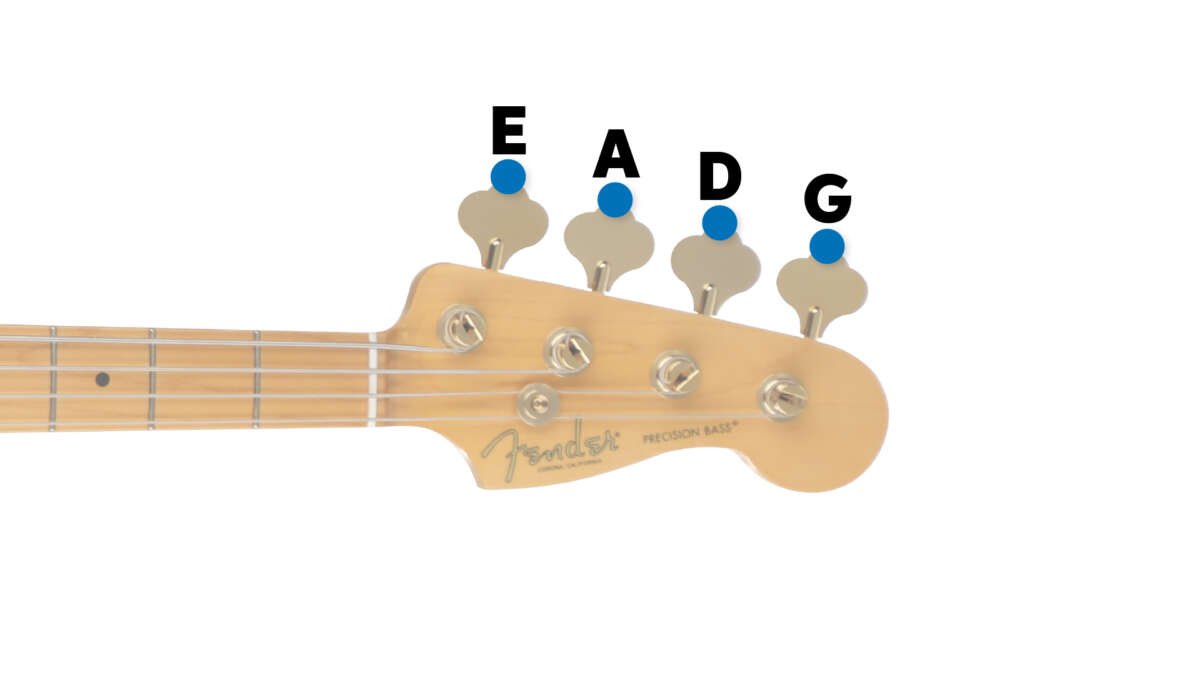
The most common four-string bass tuning is E-A-D-G. The strings are arranged from the thickest string to the thinnest string:
- E string: E1, about 41.20 Hz
- A string: A1, about 55.00 Hz
- D string: D2, about 73.42 Hz
- G string: G2, about 98.00 Hz
These notes are tuned in perfect fourths. The only exception in the usual bass range is the interval between the G string and the next higher instrument string, if one is present.
For a five-string bass, standard tuning is usually B-E-A-D-G. A six-string bass is commonly tuned B-E-A-D-G-C.
Most electronic tuners use A4 at 440 Hz as the reference pitch. This is the standard used in many modern musical settings. Some orchestras and bands use a slightly different reference, so always match the tuning reference used by your group.
When someone asks, “How do you tune a bass guitar?” they usually mean tuning the instrument to E-A-D-G with an electronic tuner.

What You Need Before Tuning
You do not need expensive gear to tune a bass. A basic clip-on tuner or a reliable tuning app is enough for most players.
Prepare these items:
- Your bass guitar
- A fresh battery if your bass uses active electronics
- An electronic tuner, clip-on tuner, or tuning app
- A quiet space
- A small amplifier, if you prefer tuning through your amp
- A soft cloth to control extra string noise
A chromatic tuner is the most flexible choice. It detects any note and shows whether the note is sharp, flat, or in tune. A bass-specific tuner can also work well, but it may respond more slowly to very low notes.
Clip-on tuners read vibration from the headstock. They are useful in noisy rooms because they do not depend on the sound from the amplifier. Pedal tuners are ideal for live performance because they mute the bass signal while you tune.
Tuning apps can be convenient, but phone microphones may struggle with low bass frequencies. Hold the phone close to the instrument and tune in a quiet room for better results.

How Do You Tune a Bass Guitar Step by Step?
The best method is simple: tune each string to its target note, check the strings again, and make small adjustments.
1. Set up the tuner
Turn on your tuner and select chromatic mode if it has more than one setting. If the tuner allows you to choose a reference pitch, use A=440 Hz unless your band or instructor says otherwise.
Mute the other strings with your fretting hand or part of your palm. Extra string noise can confuse the tuner.
2. Start with the thickest string
Play the open E string. Do not press a fret. The tuner should show E.
If the note is too low, the display may show a flat symbol or move toward the left. Turn the E-string tuning key slowly to raise the pitch.
If the note is too high, lower the pitch slightly. Then tune upward to the target note. Approaching the note from below helps reduce slack in the tuning post.
3. Tune the A string
Play the open A string and adjust its tuning key until the tuner shows A. Use a steady pluck near the middle of the string.
Avoid hitting the string too hard. A strong attack can make the note sound sharp for a moment. Let the note ring, then read the tuner after the initial attack settles.
4. Tune the D string
Play the open D string and adjust it to D. Keep the other strings quiet.
If the string rings for too long, lightly touch it after the tuner has read the pitch. This keeps the room quiet and makes the next reading clearer.
5. Tune the G string
Play the open G string and adjust it until the tuner shows G. The G string is thin and can react quickly to small movements of the tuning key.
Turn the key in small steps. If you make a large turn, you may pass the correct pitch and need to correct it again.
6. Check every string again
Tuning one string can slightly change the neck tension. This may affect the pitch of strings you tuned earlier.
Repeat the process in this order:
- E
- A
- D
- G
Most basses need two or three passes for accurate tuning. This is especially true after installing new strings.
7. Check the bass while fretting notes
Play the 12th-fret harmonic on each string, then compare it with the fretted 12th-fret note. They should be close in pitch.
This test does not replace a full setup, but it can reveal an intonation issue. If the open strings are correct but higher notes sound consistently sharp or flat, the bridge may need adjustment.

How Do You Tune a Bass Guitar Without a Tuner?
You can tune a bass by comparing fretted notes, but this method gives relative tuning rather than guaranteed concert pitch. It works well when you need to get through a rehearsal and do not have an electronic tuner.
Use the 5th-fret method:
- Tune the open A string to a known pitch if possible.
- Play the 5th fret on the E string.
- Compare it with the open A string.
- Adjust the E string until both notes match.
- Play the 5th fret on the A string.
- Compare it with the open D string.
- Adjust the D string until both notes match.
- Play the 5th fret on the D string.
- Compare it with the open G string.
- Adjust the G string until both notes match.
You can also use harmonics. The 7th-fret harmonic on the E string should match the 5th-fret harmonic on the A string. The same pattern works between A and D, and between D and G.
This method can be hard for new players because two notes may sound similar even when they are slightly out of tune. Listen for beating, which is a pulsing sound caused by nearby pitches. As the notes become more accurate, the beating slows down and disappears.
When explaining how do you tune a bass guitar without a tuner, it is important to mention the limitation: the whole instrument may be in tune with itself but still be too high or too low for the rest of the band.

How Do You Tune a Bass Guitar With Harmonics?
Natural harmonics offer a clean way to compare notes. Touch the string lightly above the 5th, 7th, or 12th fret, then pluck it and quickly lift your finger.
For standard tuning, use these comparisons:
- 7th-fret harmonic on the E string with 5th-fret harmonic on the A string
- 7th-fret harmonic on the A string with 5th-fret harmonic on the D string
- 7th-fret harmonic on the D string with 5th-fret harmonic on the G string
Harmonics are useful because they produce a clear pitch with fewer overtones than a heavy fretted note. Still, they require a trained ear and a gentle touch.
Do not press the string down when playing a harmonic. Your finger should only touch the string lightly. If the note sounds dull, move your finger slightly until the harmonic rings clearly.
This technique is a helpful part of learning how do you tune a bass guitar by ear, but a good chromatic tuner remains faster and more consistent for beginners.

Common Bass Tuning Mistakes to Avoid
Many tuning problems come from small habits rather than poor equipment.
Tuning only once
Bass strings change tension as you adjust them. Always check the full set at least twice.
Turning the tuning key too far
Large movements can send the note far past the target. Make quarter-turns or smaller adjustments, then check the tuner again.
Tuning with too much attack
A hard pluck can create a sharp first sound. Use a medium, even pluck and allow the note to settle.
Ignoring the tuning direction
On some basses, turning the key clockwise raises the pitch. On others, the direction depends on the headstock design. Watch the tuner instead of relying on memory.
Forgetting new-string stretching
New strings often go flat after you tune them. Gently stretch each string by pulling it away from the fretboard with moderate pressure, then tune again.
Tuning in a noisy room
A microphone tuner may detect voices, drums, or nearby instruments. Use a clip-on tuner or mute the other strings.
Tuning by the wrong note
A tuner may show a note that is not your target. For example, the E string can be tightened until it reaches F, but F is not the correct standard note for that string.
A common lesson from hands-on bass setup work is that patience beats force. Most tuning issues improve when you make small changes, mute extra noise, and check the instrument more than once.

Alternate Bass Tunings
Standard E-A-D-G tuning is not the only option. Many styles use alternate tunings to reach lower notes or make certain riffs easier to play.
Drop D tuning
Drop D changes the lowest string from E to D:
- D
- A
- D
- G
This tuning is common in rock, metal, folk, and worship music. It lets you play a low D with one open string and makes some power-chord patterns easier.
Half-step-down tuning
In this tuning, every string moves down one semitone:
- E-flat
- A-flat
- D-flat
- G-flat
Some bands use this tuning for a darker sound or to reduce vocal strain. Use a chromatic tuner and select the correct note names.
Whole-step-down tuning
Every string moves down two semitones:
- D
- G
- C
- F
This creates a lower overall range but may require heavier strings to maintain stable tension.
Five-string bass tuning
A standard five-string bass is tuned:
- B
- E
- A
- D
- G
The low B string gives you five extra semitones below the standard low E. Because the B string is thick, it may need more time to settle after tuning.
C standard tuning
C standard tuning lowers each string by two whole steps:
- C
- F
- B-flat
- E-flat
This tuning may need heavier strings and a setup adjustment. Do not assume that any tuning will feel or sound good with the factory string gauge.
When using alternate tunings, label your bass or keep a tuning note nearby. A quick reminder prevents confusion during rehearsals.

How String Type and Setup Affect Tuning Stability
Tuning is not controlled by the tuning keys alone. Strings, the nut, bridge, neck, and playing style all affect stability.
Old strings can lose brightness and become difficult to tune. They may also develop flat spots or uneven tension. New strings sound lively, but they need stretching and repeated checks.
The nut is the small part that guides the strings near the headstock. If a string sticks in the nut slot, it may make a pinging sound while tuning. The pitch may also jump instead of changing smoothly.
The bridge saddles control string length and intonation. If open notes sound correct but fretted notes are wrong, the issue may be intonation rather than basic tuning.
Temperature also matters. Moving from a cold car to a warm stage can change string tension. Give the bass a few minutes to adjust before tuning for a performance.
For stable tuning:
- Wind strings neatly around the tuning posts
- Keep enough wraps on each post
- Stretch new strings gently
- Lubricate the nut only with a suitable product
- Store the bass away from extreme heat and cold
- Check neck relief and intonation during a professional setup
If one string repeatedly goes sharp or flat while the others remain stable, inspect the string, tuning machine, and nut slot. A repair technician can identify the cause safely.

A Reliable Bass Tuning Routine for Practice and Shows
Build tuning into your routine instead of treating it as an emergency task. Tuning before every practice session takes less than a minute once you are familiar with the process.
Before practice:
- Turn on the tuner.
- Mute unused strings.
- Tune from the lowest string to the highest.
- Repeat the pass.
- Play a few fretted notes and listen.
Before a performance:
- Tune in a quiet area.
- Check the bass again after warming up.
- Tune after changing strings.
- Confirm the band’s reference pitch.
- Keep a backup tuner or battery nearby.
I recommend tuning again after the first song if you have installed fresh strings. New strings often settle under the pressure of playing, especially when the bass has moved between rooms.
During practice, compare the tuner with your ears. The tuner gives you a clear target, while your ears teach you how pitch feels and sounds. Both skills matter.
How Do You Tune a Bass Guitar More Accurately?
Accuracy improves when your technique is consistent. Pluck each string near the same spot, use a similar force, and let the note ring for the same amount of time.
Tune upward to the target note whenever possible. If you pass the note, lower the string below the target and raise it again. This helps the string sit firmly against the tuning post.
Mute every string you are not checking. Resonating strings can cause false readings, especially with low notes.
If the tuner display moves back and forth, try these fixes:
- Pluck more gently
- Move the tuner closer to the headstock
- Use a fresh battery
- Mute nearby strings
- Tune in a quieter room
- Check whether the tuner is set to chromatic mode
Do not chase every tiny movement on the display. Bass strings vibrate in complex ways, and the reading may shift slightly as the note decays. Aim for a stable center reading and confirm it with your ears.
Frequently Asked Questions About How Do You Tune a Bass Guitar
What is the standard tuning for a four-string bass?
The standard tuning is E-A-D-G, from the thickest string to the thinnest. The low E string is the lowest in pitch, while the G string is the highest.
Can I tune a bass guitar with a guitar tuner?
Yes, if the tuner can detect low bass notes or has a bass mode. Some basic guitar tuners may struggle with the low E string, so a chromatic clip-on tuner is often a better choice.
How often should I tune my bass?
Tune your bass before every practice session, rehearsal, and performance. Check it again after changing strings, moving between temperatures, or playing for a long time.
Why does my bass go out of tune so quickly?
Common causes include new strings, poor string winding, temperature changes, slipping tuning machines, nut friction, or a loose bridge part. If one string keeps drifting, have the instrument checked by a qualified technician.
Should I tune a bass up or down to reach the correct note?
Lower the string below the target, then tune upward to the correct pitch. This usually leaves the string tension more stable than tuning down from a note that is too high.
Can I tune a bass by ear?
Yes, but tuning by ear usually gives relative tuning unless you have a reference pitch. Use the 5th-fret method or harmonics, then check the result with a tuner when possible.
Do heavier bass strings stay in tune better?
Heavier strings can provide more tension, especially in lower tunings, but they are not automatically more stable. The correct gauge depends on the bass, tuning, scale length, setup, and playing style.
Conclusion
Knowing how do you tune a bass guitar gives you a stronger foundation for every song you play. Start with standard E-A-D-G tuning, use a reliable chromatic tuner, make small adjustments, mute unwanted noise, and check the strings more than once.
With practice, tuning becomes a quick habit rather than a frustrating chore. Tune your bass before your next session, listen closely to the pitch, and explore more bass setup and technique resources to keep improving.

Senior Music Reviewer
Alex Carter is a seasoned music reviewer with over a decade of experience in the world of sound and instruments. Passionate about helping musicians and enthusiasts make informed choices, he brings sharp insights and in-depth knowledge to every review. From classical instruments to modern gear, Alex combines technical expertise with a love for music to deliver content that resonates with readers.
As a Senior Music Reviewer and expert author on Tuneluma.com, Alex is dedicated to sharing honest evaluations, practical advice, and thoughtful commentary to guide readers in their musical journey.