What Does It Mean In Guitar Tabs: Easy Guide For Beginners
In guitar tabs, symbols show which strings and frets to play, plus techniques such as bends, slides, and muted notes.
If you are asking what does it mean in guitar tabs, you are likely looking at a symbol that seems confusing at first. Guitar tablature is simple once you know its visual language, and this guide explains the most common signs with clear examples, practical tips, and lessons learned from real playing situations.
What guitar tabs are designed to show
Guitar tabs, often called tablature, are a simple map of the guitar neck. They show where to place your fingers rather than naming each note with traditional music notation.
A standard guitar tab has six horizontal lines:
• The top line represents the high E string.
• The second line represents the B string.
• The third line represents the G string.
• The fourth line represents the D string.
• The fifth line represents the A string.
• The bottom line represents the low E string.
The word “high” describes pitch, not the string’s position on the guitar. The high E string is the thinnest string, while the low E string is the thickest.
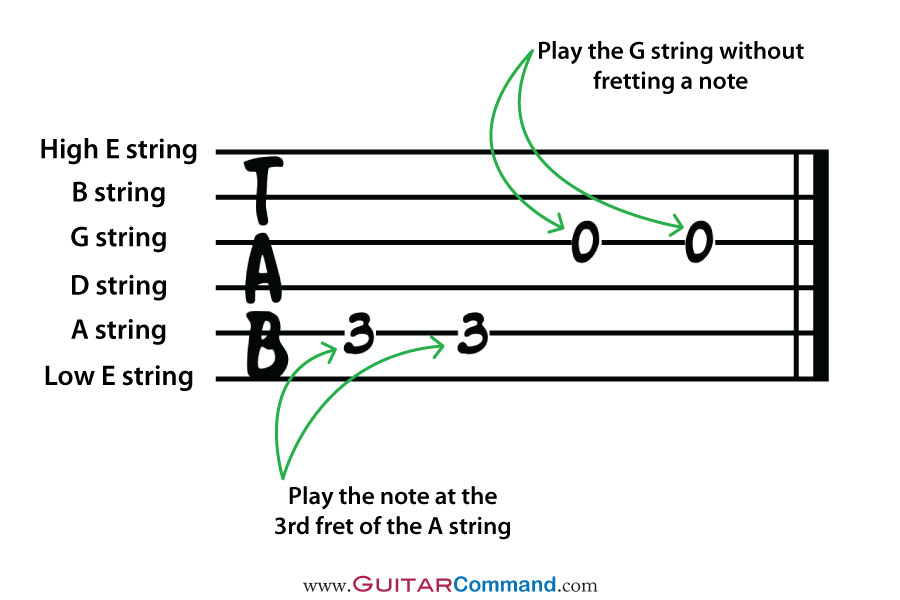
Numbers appear on these lines. Each number tells you which fret to play:
• 0 means play the string open.
• 1 means play the first fret.
• 5 means play the fifth fret.
• 12 means play the twelfth fret.
For example:
e|---0---1---3---|
B|---------------|
G|---------------|
D|---------------|
A|---------------|
E|---------------|
This means to play the open high E string, then the first fret, then the third fret.
When people ask what does it mean in guitar tabs, they may be asking about a number, a letter, or a special mark. The surrounding lines and symbols usually provide the answer.

What does it mean in guitar tabs when you see an “x”?
The letter “x” usually means a muted note. You touch the string lightly with your fretting hand, but you do not press it firmly enough to create a clear pitch.
A muted note sounds like a short click, thud, or percussive hit. It is common in funk, rock, pop, and rhythm guitar parts.
Example:
e|---x---x---x---x---|
B|---x---x---x---x---|
G|---x---x---x---x---|
D|---x---x---x---x---|
A|---x---x---x---x---|
E|---x---x---x---x---|
This pattern tells you to strum the strings while muting them. It does not mean to skip the strings.
An “x” can also appear inside a chord shape. For example:
e|---x---|
B|---1---|
G|---0---|
D|---2---|
A|---3---|
E|---x---|
Here, you do not play the low E or high E strings. The other strings form a C chord.
This is one of the most common answers to what does it mean in guitar tabs. However, context matters. In some tabs, an “x” may mark a dead note, an intentionally muted string, or a string that should not be played.
A useful practice tip is to listen to the recording. If the sound is sharp and percussive, the “x” is likely a muted hit. If the part sounds like a clean chord, the “x” probably means to avoid that string.
How to read numbers, open strings, and chords
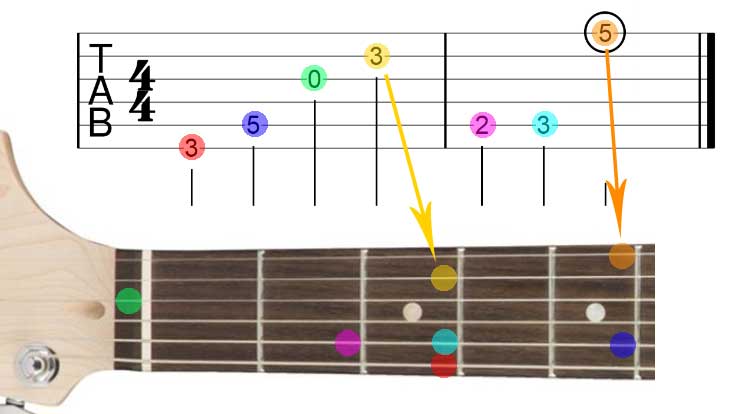
Numbers in guitar tabs show fret positions. You read them from left to right, much like reading a sentence.
Consider this example:
e|----------------|
B|----------------|
G|----------------|
D|---------2------|
A|-----2-3---3-2--|
E|-3-0------------|
The notes are played in the order they appear from left to right. Numbers stacked vertically should be played at the same time.
For example:
e|---0---|
B|---1---|
G|---0---|
D|---2---|
A|---3---|
E|-------|
This shows a C major chord. Because the numbers line up, you strum the notes together.
A tab may also show chord names above the staff:
      C
e|---0---|
B|---1---|
G|---0---|
D|---2---|
A|---3---|
E|---x---|
The chord name helps you recognize the shape, while the tab shows exactly which strings to use.
One mistake I often see new players make is reading each number as a separate note even when the numbers are stacked. Remember this rule:
• Numbers side by side usually form a melody or single-note line.
• Numbers stacked vertically usually form a chord or simultaneous notes.
The rhythm may not always be clear in basic tabs. You may need to listen to the song or use a tab site that includes rhythmic stems and timing marks.
Common symbols and what they mean in guitar tabs
Once you understand the lines and numbers, the next step is learning technique symbols. These marks tell you how to play a note, not only which fret to choose.
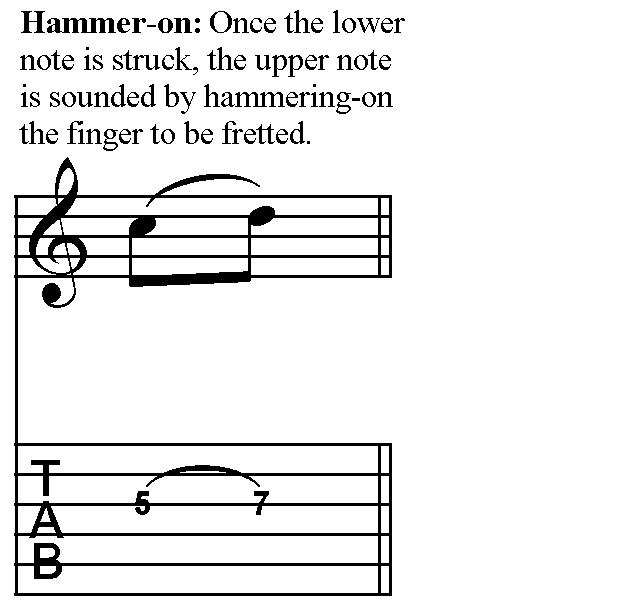
Hammer-on: h
A hammer-on means you pick the first note, then use another finger to sound a higher note without picking again.
e|---5h7---|
Play the fifth fret, then quickly place another finger on the seventh fret. The second note should sound smooth and connected.
Pull-off: p
A pull-off moves from a higher fret to a lower fret. Pick the higher note, then lift your finger to sound the lower note.
e|---7p5---|
Do not simply lift your finger straight up. Give the string a small pull as you release it so the lower note speaks clearly.
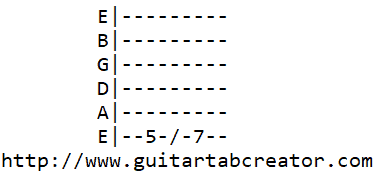
Slide: / or \
A forward slash usually means slide up the neck:
e|---5/7---|
A backward slash usually means slide down:
e|---7\5---|
The exact slash direction can vary by tab writer, so listen to the recording when in doubt.
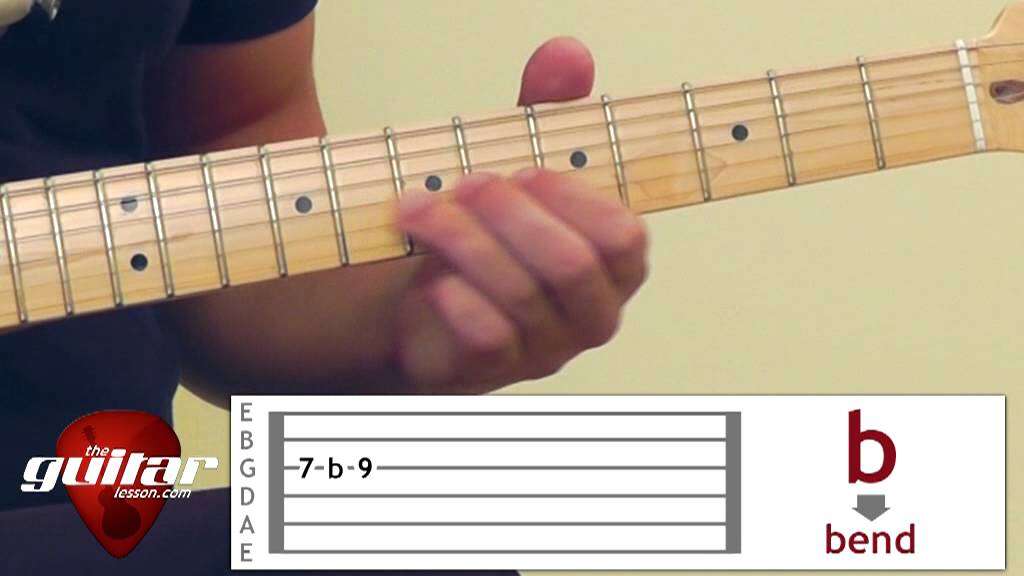
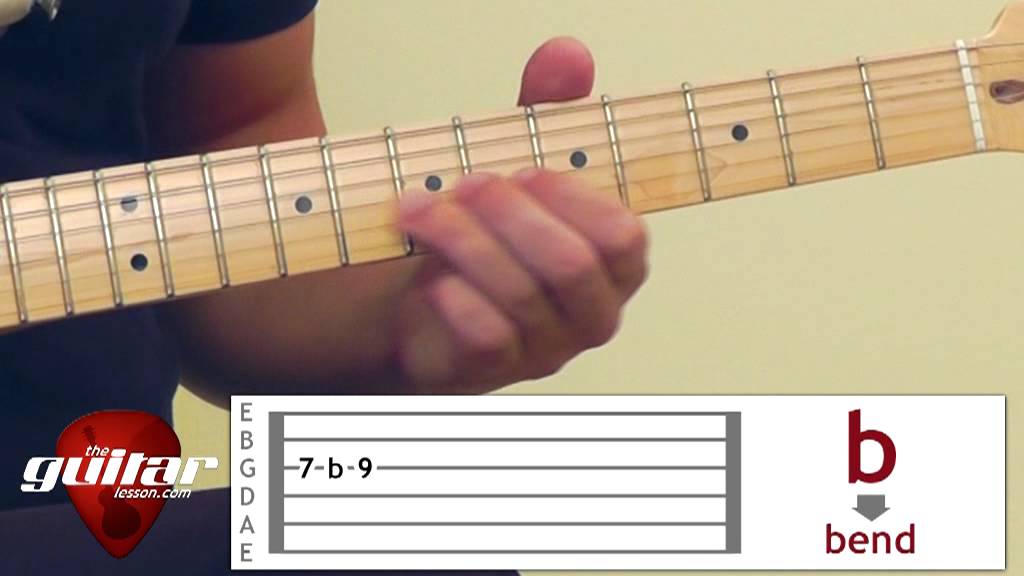
Bend: b
A “b” means bend the string to raise its pitch.
e|---7b9---|
Play the seventh fret and bend it until it sounds like the ninth fret. A bend marked “full” usually means a whole-step bend, while “1/2” means a half-step bend.
Release: r
An “r” means release a bend:
e|---7b9r7---|
Bend the seventh fret up to the pitch of the ninth fret, then release the bend back to the original pitch.
Vibrato: ~
A tilde means vibrato:
e|---7~---|
Vibrato gently moves the pitch up and down. Use your fretting hand to create a controlled, even motion.
Palm mute: PM
“PM” means palm mute. Rest the edge of your picking-hand palm lightly near the bridge.
PM----| PM----|
e|-----5-5-5-5-|
Palm muting creates a tight, muted sound. It is especially common in metal, punk, country, and rock.
Harmonic: < >
Angle brackets may mark a harmonic:
e|---<12>---|
Lightly touch the string directly above the twelfth fret and pick it. Natural harmonics should sound clear and bell-like.
Understanding these symbols makes it easier to answer what does it mean in guitar tabs without guessing from the page.
What rhythm and timing symbols mean
Many beginner tabs show the correct notes but give little information about rhythm. This is a major limitation of plain text tablature.
Some tabs use stems, beams, rests, and note values above or below the tab. These work much like standard music notation. Other tabs use spacing to suggest timing, but spacing is not always accurate.
You may see symbols such as:
• A vertical line to mark a measure.
• Chord names placed above the tab.
• “R” or a rest mark to show silence.
• Parentheses to show a note that is heard but not picked again.
• Numbers connected by lines to show legato playing.
For example:
e|---5-(7)---|
The note in parentheses may indicate a ghost note, a sustained note, or a note created by a technique rather than a new pick stroke. Different websites use parentheses in slightly different ways.
When timing is unclear, follow this process:
-
Listen to the song at a slower speed.
-
Find the first beat of each measure.
-
Tap your foot while counting “1 and 2 and 3 and 4 and.”
-
Play only the first note of each beat.
-
Add the smaller notes after the main rhythm feels steady.
In my own teaching and practice, rhythm causes more trouble than fret numbers. A player can know every fret and still sound lost if the timing is weak. Treat the tab as a map, but use the recording as the clock.
A practical example of reading guitar tabs
Let us examine a short example:
e|----------------5h7-5----------------|
B|------------5-8-------8-5------------|
G|--------5-7---------------7-5--------|
D|----5-7-----------------------7-5----|
A|--7-------------------------------7--|
E|-------------------------------------|
Here is how to read it:
• Start with the seventh fret on the A string.
• Move through the notes from left to right.
• Play the hammer-on from the fifth fret to the seventh fret on the high E string.
• Follow the curved musical shape created by the notes.
• Play the numbers in sequence unless they are stacked vertically.
This type of tab may represent a scale pattern, a guitar solo, or a melodic exercise. The tab tells you the location of each note, but it may not show exact rhythm.
Another example includes a slide and a muted note:
e|-------------------|
B|-------------------|
G|---5/7---7---x-5---|
D|-------------------|
A|-------------------|
E|-------------------|
Play the fifth fret, slide to the seventh fret, play the seventh fret again, strike a muted note, and finish on the fifth fret.
Start slowly. Accuracy matters more than speed. Use a metronome, and increase the tempo only when every note sounds clean.

Guitar tab versus standard music notation
Guitar tabs are easier to start with because they show finger locations directly. Standard notation shows pitch, rhythm, key, and musical structure more fully.
Tabs are useful for:
• Learning riffs quickly.
• Copying guitar solos.
• Finding chord shapes.
• Understanding alternate tunings.
• Studying fingerstyle patterns.
Standard notation is useful for:
• Reading exact rhythm.
• Playing with orchestras or ensembles.
• Understanding musical keys.
• Transposing music.
• Communicating with musicians who use traditional notation.
Neither system is automatically better. They solve different problems. Many professional guitarists use both, especially when a piece has complex rhythm or multiple guitar parts.
The main limitation of guitar tabs is that the quality depends on the person who wrote them. User-submitted tabs may contain wrong frets, poor timing, or unclear symbols. Compare difficult passages with a reliable recording, official sheet music, or a trusted educational source.
Common mistakes beginners make with guitar tabs
Learning what does it mean in guitar tabs becomes much easier when you avoid a few common errors.
• Reading the top line as the thickest string. The top line is the high E string, not the low E string.
• Playing every string in a chord. An “x” usually means mute or skip that string.
• Ignoring the rhythm. Correct notes played at the wrong time still sound wrong.
• Pressing too hard. Excess pressure can make notes sharp and cause hand fatigue.
• Skipping the recording. Tabs often leave out small details, such as slides, vibrato, and rests.
• Treating tab symbols as universal. Some writers use different marks for the same technique.
• Playing too fast too soon. Slow practice builds control and cleaner muscle memory.
A mistake I made early on was trusting a difficult tab without checking the tuning. The notes seemed impossible because the song used a down-tuned guitar. Always look for tuning information at the top of the tab before you begin.

How tuning changes the meaning of guitar tabs
Standard tuning is written from the thickest string to the thinnest string as E A D G B E. Many tabs assume this tuning unless another tuning is listed.
Common alternate tunings include:
• Drop D: D A D G B E.
• D standard: D G C F A D.
• Open G: D G D G B D.
• Open D: D A D F# A D.
The fret numbers remain tied to the written string lines, but the actual pitches change with the tuning. A number that normally produces an A note may produce a different pitch in an alternate tuning.
For example, in Drop D, the lowest string is tuned down from E to D. A “0” on that string now gives you a low D, not a low E.
Check these details before playing:
• Tuning.
• Capo position.
• Number of strings.
• Whether the tab is for electric or acoustic guitar.
• Any special instructions from the tab writer.
A capo also changes the sound while keeping the same basic chord shapes. Some tabs show fret numbers relative to the capo, while others show the actual fret positions. Read the instructions carefully.

How to learn guitar tabs faster
Use a simple routine rather than trying to play the whole song at once.
-
Read the tuning and capo information.
-
Identify the hardest symbol or technique.
-
Practice the fretting hand without picking.
-
Practice the picking rhythm on open strings.
-
Combine both hands at a slow tempo.
-
Divide the tab into short sections.
-
Repeat each section until it feels natural.
-
Connect the sections gradually.
Keep your fingers close to the fretboard. Use the fingertips, and place them just behind the fret when possible. This reduces buzzing and helps each note ring clearly.
Record yourself once in a while. A phone recording can reveal timing problems that are hard to notice while you are playing. It also helps you track progress, which can be encouraging when a song first feels out of reach.
Frequently Asked Questions About What Does It Mean in Guitar Tabs
What does an “x” mean in guitar tabs?
An “x” usually means to mute the string or avoid playing it. If it appears across several strings, it often creates a percussive muted strum.
What does 0 mean in guitar tabs?
The number 0 means play the string open, without pressing any fret. The string should ring at its natural pitch for the current tuning.
What does “h” mean in guitar tabs?
The letter “h” means hammer-on. Pick the first note, then sound the higher note by pressing another finger onto the string without picking again.
What does “p” mean in guitar tabs?
The letter “p” means pull-off. Pick the higher note, then lift your fretting finger so the lower note sounds without another pick stroke.
What does a slash mean in guitar tabs?
A slash usually means slide between two frets. For example, 5/7 means play the fifth fret and slide up to the seventh fret.
What does “b” mean in guitar tabs?
The letter “b” means bend the string. Raise the note’s pitch by pushing or pulling the string until it reaches the target pitch.
Do guitar tabs show rhythm?
Some tabs show rhythm clearly, but basic text tabs often do not. When timing is missing, listen to the recording and count the beat while practicing.
Are guitar tabs easier than standard notation?
Tabs are often easier for beginners because they show exact fret locations. They may be less complete than standard notation because rhythm, note length, and musical context are sometimes limited.
Conclusion
Guitar tabs are a practical map of the fretboard. Numbers show frets, the six lines show strings, and symbols explain techniques such as muting, bending, sliding, hammer-ons, and pull-offs. When asking what does it mean in guitar tabs, always check the symbol, its position, and the surrounding musical context.
Start with short sections, confirm the tuning, listen to the original recording, and practice slowly with a steady beat. With these habits, guitar tabs stop looking like secret code and start feeling like clear directions. Try one tab today, and share your progress or favorite tab-reading tip with other players.

Senior Music Reviewer
Alex Carter is a seasoned music reviewer with over a decade of experience in the world of sound and instruments. Passionate about helping musicians and enthusiasts make informed choices, he brings sharp insights and in-depth knowledge to every review. From classical instruments to modern gear, Alex combines technical expertise with a love for music to deliver content that resonates with readers.
As a Senior Music Reviewer and expert author on Tuneluma.com, Alex is dedicated to sharing honest evaluations, practical advice, and thoughtful commentary to guide readers in their musical journey.