How Many Octaves On A Guitar: Guitar Range Explained
A standard 24-fret guitar covers four octaves, while most 22-fret guitars cover nearly four octaves.
The answer to how many octaves on a guitar depends on its tuning, fret count, and lowest and highest notes. A standard six-string guitar usually spans from low E2 to either D#6 or E6, but extended-range guitars can go much higher or lower. This guide breaks down the math, fretboard layout, guitar types, and practical ways to use that range.

What Is an Octave on a Guitar?
An octave is the distance between one note and another note with the same name at double or half the frequency. For example, E2 and E3 are one octave apart, even though they sound at different pitches.
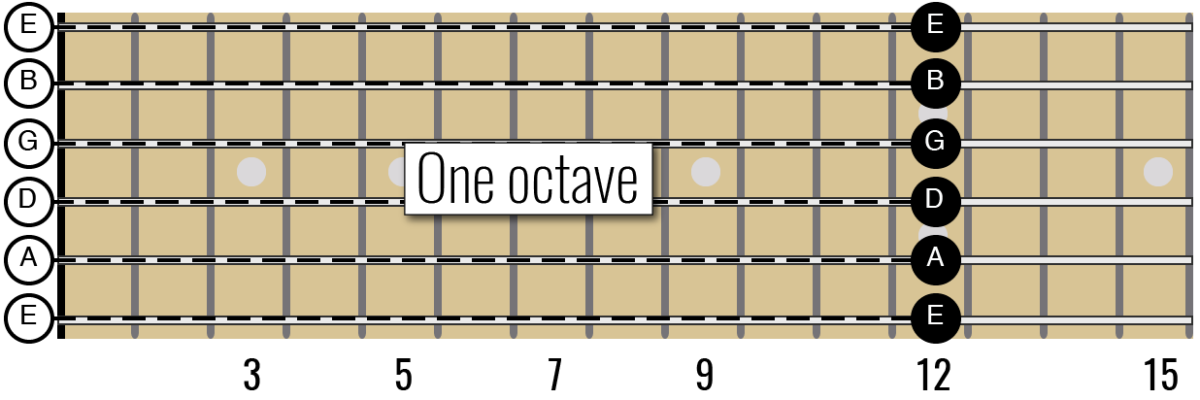
On a guitar, one octave equals 12 frets, or 12 semitones. If you play an open string and then play the same string at the 12th fret, you reach the same note name one octave higher.
For example:
• Open low E string: E2
• 12th fret on the low E string: E3
• 24th fret on the low E string: E4
The same pattern appears on every string. The 12th fret acts like a midpoint on the string because it divides the vibrating length in half.
When people ask how many octaves on a guitar, they may mean two different things:
• The range of one string
• The total range from the lowest note to the highest note
Those answers are not always the same. A standard guitar may cover two octaves on one string but almost four octaves across the entire fretboard.

How Many Octaves on a Guitar?
A standard six-string guitar usually has a range of about three and a half to four octaves. A 22-fret guitar reaches nearly four octaves, while a 24-fret guitar can cover exactly four octaves from low E2 to high E6.
Here is the basic comparison:
| Guitar setup | Lowest note | Highest note | Approximate range |
|---|---|---|---|
| 20-fret guitar | E2 | C#6 | 3 octaves and 8 semitones |
| 21-fret guitar | E2 | D6 | 3 octaves and 9 semitones |
| 22-fret guitar | E2 | D#6 | 3 octaves and 10 semitones |
| 24-fret guitar | E2 | E6 | 4 octaves |
| 7-string guitar | B1 | E6 | About 4 octaves and 5 semitones |
| 8-string guitar | F#1 or E1 | E6 or higher | More than 4 octaves |
These numbers assume standard tuning and a normal high E string. Alternate tunings can change the total range.
So, if someone asks how many octaves on a guitar, the most useful short answer is about four octaves on a modern 24-fret guitar and slightly less on a typical 20- or 22-fret guitar.
How Guitar Frets Create Octaves
The guitar fretboard is built around semitones. Each fret raises a note by one half step. Twelve half steps make one octave.
The note pattern on a single string looks like this:
- Open string: starting note
- 1st fret: one semitone higher
- 12th fret: one octave higher
- 24th fret: two octaves higher
Suppose you play the open A string:
• Open string: A2
• 2nd fret: B2
• 12th fret: A3
• 24th fret: A4
This design makes the fretboard easy to measure. The 12th fret is the key reference point for tuning, intonation, and octave shapes.
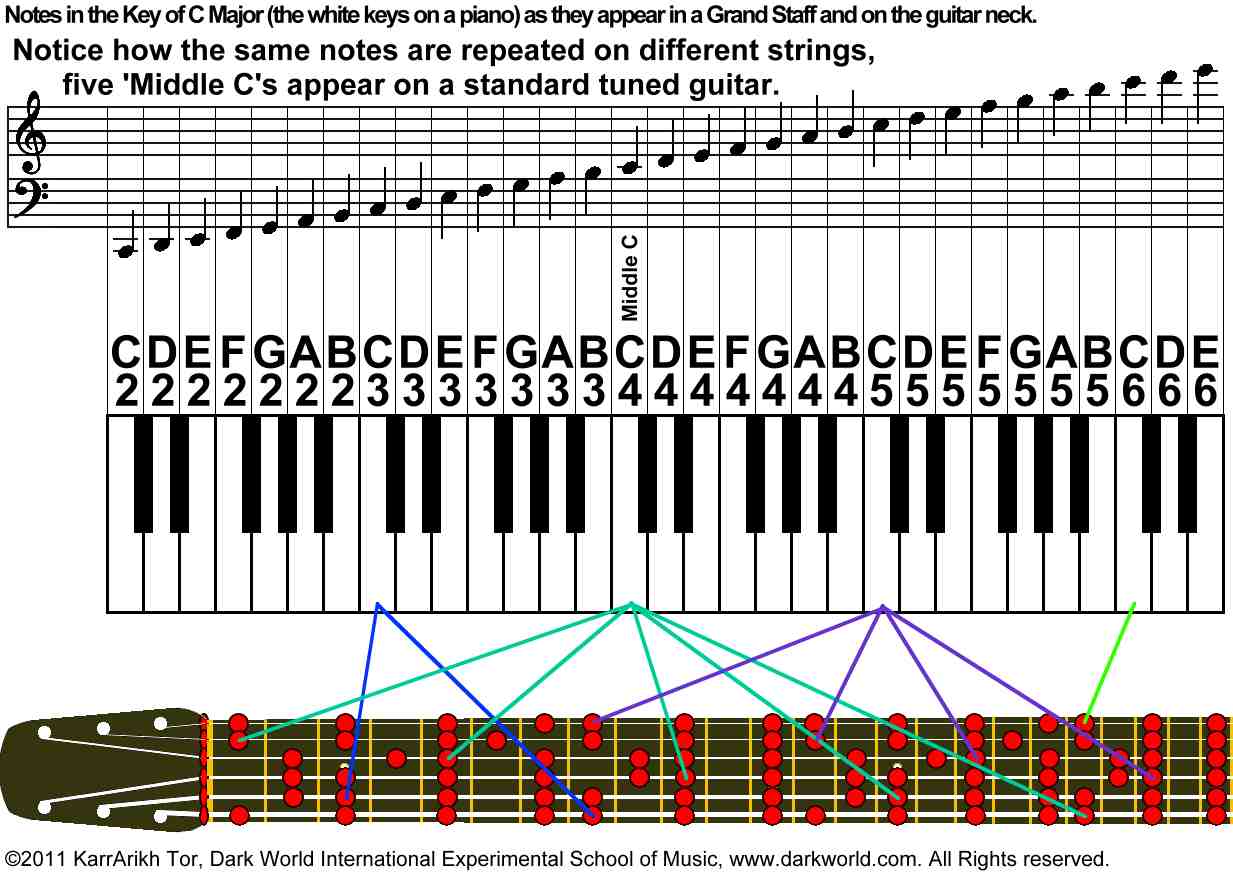
However, the notes are not arranged in one straight line across the entire guitar. The same pitch appears in several places. For example, the note E can be played on the open sixth string, the second fret of the fourth string, the seventh fret of the fifth string, and many other locations.
That repeated layout gives the guitar its unique strength. You can play the same melody in different positions, with different tones and levels of comfort.

Octave Range of Each Guitar String
In standard tuning, the six strings are tuned as follows:
• 6th string: E2
• 5th string: A2
• 4th string: D3
• 3rd string: G3
• 2nd string: B3
• 1st string: E4
If the guitar has 24 frets, each string covers two octaves from its open note to its 24th fret.
| String | Open note | 12th fret | 24th fret |
|---|---|---|---|
| 6th string | E2 | E3 | E4 |
| 5th string | A2 | A3 | A4 |
| 4th string | D3 | D4 | D5 |
| 3rd string | G3 | G4 | G5 |
| 2nd string | B3 | B4 | B5 |
| 1st string | E4 | E5 | E6 |
On a 22-fret guitar, each string covers one octave plus 10 semitones. The highest note on the high E string is D#6.
This explains why asking how many octaves on a guitar can produce different answers. A single string may cover two octaves, but the complete instrument covers a wider range because the strings begin at different pitches.

The Full Range of a Standard Six-String Guitar
A standard guitar in standard tuning begins with E2, the open sixth string. On a 24-fret model, its highest note is E6 at the 24th fret of the first string.
The distance from E2 to E6 is four octaves:
• E2 to E3: one octave
• E3 to E4: two octaves
• E4 to E5: three octaves
• E5 to E6: four octaves
A 22-fret guitar ends on D#6 instead. That note is one semitone below E6, so the range is three octaves and 11 semitones when counted from E2.
A 20-fret guitar reaches C#6 on the high E string. Its total range is about three octaves and eight semitones.
These figures describe the theoretical pitch range. The usable musical range may be smaller because very high notes can sound thin, sharp, or difficult to sustain. Guitar design, pickup type, string tension, scale length, and playing technique all affect how useful the highest notes feel.

How Many Octaves on a Guitar by Fret Count
Fret count is one of the fastest ways to estimate how many octaves on a guitar.
20-fret guitars
Many acoustic guitars have 20 frets. With standard tuning, they usually span from E2 to C#6.
This range is enough for nearly all acoustic songs, chord work, fingerstyle pieces, and common lead parts. The shorter high-end range is rarely a problem for rhythm players.
21-fret guitars
A 21-fret guitar reaches D6 on the high E string. This adds one semitone compared with a 20-fret instrument.
Many classic electric guitars use 21 frets. Their tone and neck feel often matter more to players than the missing few high notes.
22-fret guitars
A 22-fret guitar reaches D#6. This design is common on electric guitars and gives players nearly four octaves across the full instrument.
The 22nd fret often provides a good balance between upper-register access, traditional tone, and comfortable neck design.
24-fret guitars
A 24-fret guitar reaches E6 on the high E string. This gives the instrument a complete four-octave span from low E2.
Many rock, metal, fusion, and progressive players prefer 24 frets because they can play two full octaves above the 12th fret position. The neck pickup may also shift slightly toward the bridge to make room for the extra frets, which can change the tone.
How Tuning Changes Guitar Octaves
Tuning changes the lowest and highest notes, so it changes how many octaves on a guitar are available.
Drop D tuning
In Drop D, the sixth string falls from E2 to D2. The top note stays the same, so the total range increases by one whole step.
A 24-fret guitar in Drop D reaches from D2 to E6. That is four octaves plus two semitones.
Half-step-down tuning
In E-flat tuning, every string moves down one semitone. The lowest note becomes E♭2, and the highest note on a 24-fret guitar becomes E♭6.
The number of octaves stays the same, but the whole range sits lower.
D standard tuning
D standard lowers every string by two semitones. The lowest string becomes D2, and the high string becomes D4 when open.
The interval between the lowest and highest notes remains nearly four octaves on a 24-fret guitar. The range has shifted down rather than expanded.
Open tunings
Open tunings change the note relationships between strings. They can make certain chords easier, but they do not automatically add more frets or more octaves.
For example, open G tuning can make slide guitar simple because the open strings form a G chord. The total range still depends on the lowest and highest notes that the guitar can produce.

How Many Octaves on a Guitar Compared With Other Instruments?
A guitar has a wide range for its size, but its range is different from that of a piano, bass, or violin.
A standard piano has more than seven octaves. A four-string bass usually covers about three octaves, depending on its fret count and tuning. A standard violin covers roughly four octaves with advanced technique.
A 24-fret guitar covers four octaves by pitch range, but the player can access many of those notes in several positions. This makes the guitar more flexible than the raw number suggests.
A guitar also uses bends, harmonics, vibrato, slides, and effects. These tools can extend its expressive range without adding extra frets. A skilled guitarist can make one note feel like a vocal phrase rather than a fixed point on a keyboard.

Extended-Range Guitars and Their Octaves
Seven-string and eight-string guitars add lower notes. They are popular in metal, progressive rock, jazz, fusion, and modern studio music.
A typical seven-string guitar is tuned B1, E2, A2, D3, G3, B3, and E4. On a 24-fret model, the range extends from B1 to E6.
That is about four octaves and five semitones. The extra low B gives the player deeper power chords and bass-like access without changing the familiar upper six strings.
Eight-string guitars may use a low F#1 or E1. Some models also add a higher string. Their total range can exceed five octaves, depending on the tuning and fret count.
The trade-offs include:
• Wider necks
• More complex string muting
• Different picking techniques
• Greater demand on amplification and setup
• More difficult chord shapes
More range is not always better. The right guitar depends on the music you play and how comfortably you can control the instrument.
How to Find Octaves on the Guitar Fretboard
You can find octaves by using simple fretboard shapes. These shapes help with scales, chords, improvisation, and note memorization.
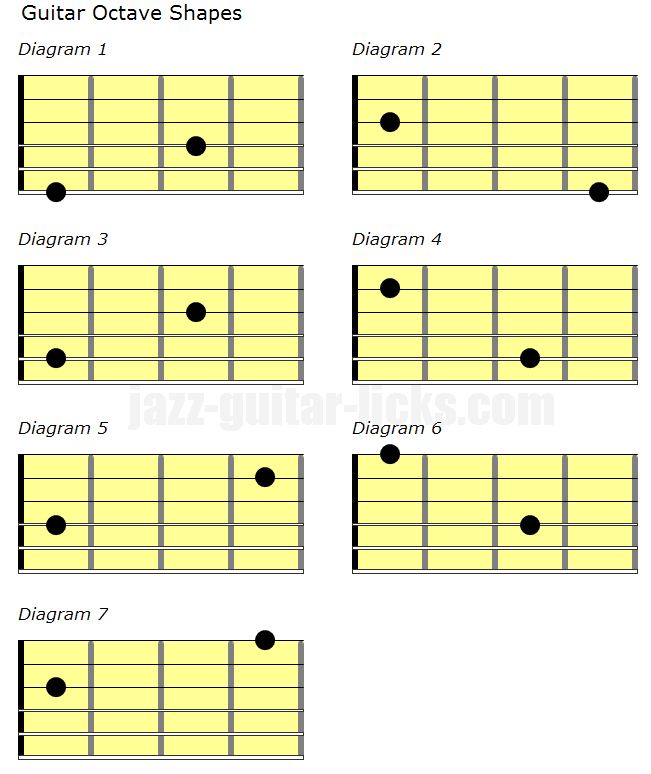
Octave shape across two strings
A common octave shape uses the sixth and fourth strings. Play a note on the sixth string, then move two strings higher and two frets up.
For example:
• Sixth string, 5th fret: A
• Fourth string, 7th fret: A one octave higher
On the fifth and third strings, the shape works the same way. The second string creates a small adjustment because of the guitar’s tuning between the G and B strings.
Octave shape on one string
Play any note, then move 12 frets higher on the same string. This always produces the same note name one octave above.
For example:
• Fifth string, 3rd fret: C
• Fifth string, 15th fret: C one octave higher
This is one of the best ways to understand how many octaves on a guitar are available on each string.
Natural harmonics
Natural harmonics at the 12th fret produce a clear octave above the open string. Harmonics at the 7th and 19th frets produce other high partials, though they may not sound exactly like simple octave notes.
When I practice octave shapes, I start with one string and say the note names aloud. This avoids a common mistake: learning shapes without learning the actual notes.
Why Guitarists Need to Understand Octaves
Knowing the octave range helps you choose notes with purpose. It also makes the fretboard feel less random.
Octave knowledge helps with:
• Building scales in several positions
• Finding chord tones
• Writing guitar solos
• Creating bass lines
• Moving riffs to a new register
• Avoiding muddy low notes
• Adding bright high notes
• Understanding intervals
For example, a low E power chord may sound heavy and broad. Move the same shape up 12 frets, and the chord becomes brighter and more focused.
Octaves also help guitarists work with singers. If a melody sits too low, you can move it up one octave without changing its basic shape. This is especially useful when arranging songs for different voices.
A practical lesson is to avoid chasing the highest fret just because it exists. A well-placed note at the 10th fret may sound more musical than a strained note at the 24th fret.
Common Mistakes When Counting Guitar Octaves
One common mistake is counting fret numbers instead of measuring pitch. A 24-fret guitar does not have 24 octaves. It has 24 semitone steps on each string, which equals two octaves per string.
Another mistake is ignoring the starting note. A high E string and a low E string share the same note name, but they begin two octaves apart when played open.
Some players also count the open strings incorrectly. The open sixth string is E2, while the open first string is E4. That difference already creates two octaves before you press a fret.
Keep these points in mind:
• Twelve frets equal one octave on one string
• Twenty-four frets equal two octaves on one string
• The full guitar range depends on the lowest and highest strings
• Tuning can raise or lower the entire range
• Fret count does not always equal usable musical range
• High frets may need careful setup and technique
A tuner, fretboard chart, or pitch reference can help confirm notes when you are unsure.
Tips for Practicing Across the Full Guitar Range
Start by playing the lowest note and highest note on your guitar. Say each note aloud. This gives you a clear physical sense of how many octaves on a guitar your instrument can produce.
Then practice one octave at a time.
- Play E2 on the open sixth string.
- Find E3 at the 12th fret.
- Find E4 at the 24th fret or another string position.
- Continue upward using nearby strings.
- Repeat the exercise in different keys.
Use a metronome at a slow speed. Play cleanly before increasing tempo.
It also helps to compare the same note in two positions. For example, play A at the fifth fret of the sixth string and again at the seventh fret of the fourth string. Listen for how the same pitch changes color because of string thickness and pickup location.
A lesson I often return to is this: range is useful only when the notes are controlled. Work on intonation, muting, timing, and tone at the same time as you explore the highest frets.
Frequently Asked Questions About How Many Octaves on a Guitar
How many octaves does a standard guitar have?
A standard six-string guitar usually covers about three and a half to four octaves. A 24-fret guitar reaches four octaves from E2 to E6 in standard tuning.
Does a 22-fret guitar have four octaves?
A 22-fret guitar has almost four octaves across its full range. In standard tuning, it runs from E2 to D#6, which is one semitone short of four complete octaves.
How many octaves are on one guitar string?
A 12-fret span equals one octave on a single string. A 24-fret string covers two octaves from its open note to its 24th fret.
Do alternate tunings add more octaves?
Alternate tunings can expand or reduce the total range by changing the lowest or highest notes. They usually shift the range rather than adding a full octave.
Does a seven-string guitar have more octaves than a six-string guitar?
A seven-string guitar usually adds a low B string, giving it more than four octaves on a 24-fret model. Its exact range depends on the tuning and whether the guitar has 22 or 24 frets.
Can guitar harmonics extend the instrument’s octave range?
Harmonics can produce pitches above the fretted range, but they are not usually counted as part of the standard fretboard range. Their volume, sustain, and pitch depend on the string, technique, and guitar setup.
Why do some guitars have 20, 21, 22, or 24 frets?
Fret count affects range, neck design, tone, and playing comfort. More frets provide higher notes, while fewer frets may preserve a traditional neck and pickup layout.
Conclusion
So, how many octaves on a guitar? Most standard six-string guitars cover about three and a half to four octaves. A 20-fret guitar reaches slightly above three octaves, a 22-fret guitar comes close to four, and a 24-fret guitar can span a full four octaves in standard tuning.
Your tuning, fret count, string number, and guitar design all affect the final answer. Play the open notes, find the 12th-fret octaves, and map the highest notes on your own instrument. Then use that range to build cleaner solos, stronger arrangements, and more confident fretboard knowledge. Explore your guitar’s full range today, and share your favorite octave exercise or tuning in the comments.

Senior Music Reviewer
Alex Carter is a seasoned music reviewer with over a decade of experience in the world of sound and instruments. Passionate about helping musicians and enthusiasts make informed choices, he brings sharp insights and in-depth knowledge to every review. From classical instruments to modern gear, Alex combines technical expertise with a love for music to deliver content that resonates with readers.
As a Senior Music Reviewer and expert author on Tuneluma.com, Alex is dedicated to sharing honest evaluations, practical advice, and thoughtful commentary to guide readers in their musical journey.