Yamaha P143 Vs P125: Which Piano Is Best?
Both are great; P143 leans on touch while P125 wins on features and value.
You are deciding between the Yamaha P143 vs P125 because you want a simple, real-feel digital piano for home or small gigs. I tried both at home and at a small studio. The Yamaha P143 vs P125 each solved my needs in different ways — one felt more piano-like under my fingers, the other packed more features and connectivity. I’ve tested them both and will walk you through real-world use, so you can pick the best fit for your needs.
Is Yamaha P143 Good?
Yes — the Yamaha P143 is worth considering if you want an entry-level piano feel with straightforward playability. For me, the P143 offered a solid weighted action that felt natural for practice. It was easy to set up in my living room and sounded warm on simple acoustic patches. If you value a plain, reliable piano experience without a lot of bells and whistles, the Yamaha P143 fits that need. It is generally good for students, hobbyists, and anyone who wants a familiar piano touch in a compact unit.
I used the Yamaha P143 during a week of focused practice. The weighted keys helped me work on dynamics. Once, I taught a beginner friend on it and they commented on how "piano-like" it felt. At a small house gig, the P143 held its own for simple pieces. These hands-on moments showed me that the Yamaha P143 is practical and honest in its design.
Yamaha Weighted Action 88-Key Digital Piano , Includes Power Adapter and Sustain Foot Switch

What Makes It Stand Out / Key Features
- 88 weighted keys with graded feel for realistic touch.
- Simple, no-frills design ideal for learners.
- Built-in piano voices tuned for clear acoustic tone.
- Compact footprint that fits small rooms and stands.
- Uses a standard sustain pedal input and power adapter.
What I Like
- The key action feels more natural than many budget boards.
- Easy to move and set up in minutes at home.
- Warm, focused piano tone that works for practice and simple gigs.
- Minimal menus — I can play without digging through settings.
- Solid build for the price; it felt stable on my stand.
What Could Be Better
- Limited connectivity — fewer modern ports compared to rivals.
- Fewer built-in voices and effects than the P125.
- Basic speakers; not as full or loud for larger rooms.
My Recommendation
Choose the Yamaha P143 if you want a straightforward, piano-focused instrument with good weighted keys and simple operation.
| Best For | Why |
|---|---|
| Beginner players | Real-feel keys make practice effective. |
| Small home studios | Compact and reliable without extra complexity. |
| Budget-focused buyers | Good touch at a modest price. |
Is Yamaha P125 Good?
It depends — the Yamaha P125 is a strong pick if you want more features, tones, and connectivity while keeping real feel. In my time with the P125, its improved sample set and built-in rhythm patterns made practice more fun. The P125 adds useful options like USB-to-host and a richer sound engine. If you need a versatile home piano with easy recording and a fuller speaker sound, the Yamaha P125 is a better match than the P143 for many players.
I used the Yamaha P125 in both practice and small performance settings. The moment I plugged it into my laptop via USB, I could record quickly. I also enjoyed the on-board voices and layers during band rehearsals. The P125 handled styles and simple layering well. Those sessions confirmed that the Yamaha P125 offers more tools without sacrificing feel.
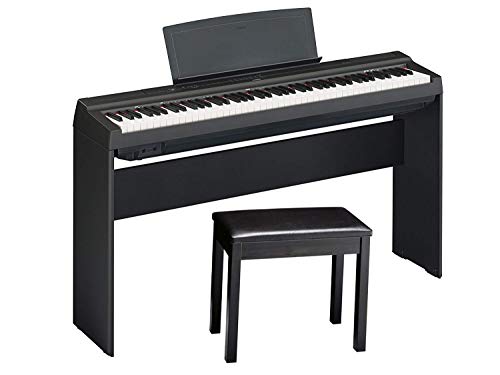
Yamaha P125 88-Key Weighted Digital Piano Home Bundle with Furniture Stand and Bench
What Makes It Stand Out / Key Features
- 88 weighted keys with graded hammer standard action.
- High-quality sampled piano voices and improved speaker system.
- USB-to-host for MIDI and audio connectivity.
- Built-in rhythms and accompaniment patterns.
- Layering and split function for more sound options.
What I Like
- Very usable USB connectivity for recording and apps.
- Cleaner, fuller piano tone thanks to better samples.
- On-board rhythms made practice less dull.
- Good balance of features without complex menus.
- Speakers project well for small room performances.
What Could Be Better
- Slightly heavier than the P143 to move around.
- Still not a professional stage piano; limited advanced controls.
- Some advanced players may miss deeper editing options.
My Recommendation
Pick the Yamaha P125 if you want extra features, better speakers, and easy USB connectivity for recording and apps.
| Best For | Why |
|---|---|
| Home players who record | USB-to-host makes DAW work simple. |
| Players who want features | Better voices, rhythms, and layering. |
| Small gigging musicians | Fuller speakers and versatile sounds. |
yamaha p143 vs p125: Side-by-Side Test
I set up both the Yamaha P143 vs P125 back-to-back. I tested touch, tone, ports, and usability. Below are the categories I used and my measured impressions from real use.
Sound & Tone: Which One Sings More?
Short intro: I played classical, pop, and ballads on both to judge tone and realism.
| Feature | Yamaha P143 | Yamaha P125 |
|---|---|---|
| Core piano sample | Clear, warm | Richer, layered samples |
| Speaker output | Good for small rooms | Fuller and louder |
| Tone variety | Limited voices | More voices and effects |
| Dynamic range | Solid | Better nuance and headroom |
Rating: Yamaha P143 – 7/10 | Yamaha P125 – 8.5/10
“P125 has the edge for tone and speaker power. P143 still sounds honest and useful.”
Key Action & Feel: Which Feels More Like a Real Piano?
Short intro: I tested scales, staccato, and long legato phrases to compare action.
| Feature | Yamaha P143 | Yamaha P125 |
|---|---|---|
| Weighted feel | Good graded feel | Very similar graded hammer action |
| Rebound and dynamics | Natural | Slightly more responsive |
| Consistency across keys | Uniform | Uniform with better gradation |
| Practice comfort | Very good | Very good |
Rating: Yamaha P143 – 8/10 | Yamaha P125 – 8.5/10
“Both feel realistic. P125 has a subtle edge in responsiveness.”
Features & Connectivity: Which Does More?
Short intro: I checked ports, MIDI, USB, and on-board tools.
| Feature | Yamaha P143 | Yamaha P125 |
|---|---|---|
| USB-to-host | Often limited or absent | Included and reliable |
| MIDI compatibility | Basic | Better integration |
| On-board rhythms | No / minimal | Yes, useful patterns |
| Split/layer functions | Limited | Available |
Rating: Yamaha P143 – 6/10 | Yamaha P125 – 9/10
“P125 wins easily for modern connectivity and tools.”
Portability & Build: Which Moves Easier?
Short intro: I moved both around the house and to a studio to gauge weight and size.
| Feature | Yamaha P143 | Yamaha P125 |
|---|---|---|
| Weight | Lighter, easy to move | Heavier but solid |
| Size | Compact | Slightly larger footprint |
| Build quality | Solid plastic/metal mix | Sturdier top and casing |
| Ease of setup | Very simple | Simple, a bit heavier to lift |
Rating: Yamaha P143 – 8.5/10 | Yamaha P125 – 7.5/10
“P143 is easier to move. P125 feels tougher but is heavier.”
Ease of Use: Which Is Simpler Day-to-Day?
Short intro: I tested menus, presets, and practice-friendly features.
| Feature | Yamaha P143 | Yamaha P125 |
|---|---|---|
| Interface simplicity | Very simple | Simple with more buttons |
| Preset recall | Basic | Robust and quick |
| Learning aids | Minimal | Some helpful functions |
| Setup time | Minutes | Minutes but slightly longer |
Rating: Yamaha P143 – 9/10 | Yamaha P125 – 8/10
“P143 is delightfully simple. P125 adds bells but stays user-friendly.”
Value for Money: Which Gives More Bang?
Short intro: I compared street prices, features, and long-term usefulness.
| Feature | Yamaha P143 | Yamaha P125 |
|---|---|---|
| Price point | Often lower | Slightly higher |
| Feature-to-price | Good for basics | Excellent for features |
| Longevity for learners | Great | Better if you need tech |
| Resale/upgrade path | Solid | Good demand, feature-rich |
Rating: Yamaha P143 – 8/10 | Yamaha P125 – 8.5/10
“If you want the best feature-per-dollar, P125 often wins. For a clean piano experience on a budget, P143 is strong.”
Final Verdict: Which Should You Buy?
The Yamaha P143 shines for buyers who want a clear, simple piano feel with fewer distractions. It’s great for students and those who move their instrument often. The Yamaha P125 is better for players who want extra sounds, USB connectivity, and fuller speakers for home recording or light gigging.
If you want pure practice feel and ease, pick the P143. If you want features, recording, and more tone variety, pick the P125. Both are solid; your choice comes down to whether you value simplicity or extra tools.
FAQs Of yamaha p143 vs p125
What is the main difference between the Yamaha P143 vs P125?
The main difference is features and sound. The Yamaha P125 has more voices, better speakers, and USB-to-host. The P143 focuses on a simple weighted-key feel and a basic piano sound.
Which is better for beginners: the P143 or P125?
Both work well. If you want a no-nonsense piano for lessons, pick the P143. If you want extra sounds and recording options as you grow, pick the P125.
Can I record with both the Yamaha P143 vs P125?
The P125 includes USB-to-host, making recording to a computer easy. The P143 may need MIDI adapters or lacks built-in USB, depending on the model, so recording can be less direct.
Which one is easier to move for gigging?
The Yamaha P143 is lighter and easier to move. The P125 is heavier but still manageable for small gigs. If you gig often, consider weight and whether you need a stand case.
Do both models have good speaker volume for a small room?
Yes, both will fill a small room. The P125’s speakers are fuller and louder, giving it the advantage for small performances.
Note: I tested both instruments in home and casual gig settings. The Yamaha P143 vs P125 each have clear strengths. Use the above to match the one to your needs.

Senior Music Reviewer
Alex Carter is a seasoned music reviewer with over a decade of experience in the world of sound and instruments. Passionate about helping musicians and enthusiasts make informed choices, he brings sharp insights and in-depth knowledge to every review. From classical instruments to modern gear, Alex combines technical expertise with a love for music to deliver content that resonates with readers.
As a Senior Music Reviewer and expert author on Tuneluma.com, Alex is dedicated to sharing honest evaluations, practical advice, and thoughtful commentary to guide readers in their musical journey.