What Is A Minor Blues Scale Piano: Easy Guide
A minor blues scale on piano uses six notes to create a soulful, tense, and expressive blues sound.
If you are wondering what is a minor blues scale piano, you are exploring one of the most useful scales in blues, jazz, rock, and gospel. It adds color to simple chords, helps you build strong solos, and gives your playing a more human voice. This guide explains the notes, pattern, fingering, sound, uses, and practice methods in a clear way.
What Is a Minor Blues Scale on Piano?
The minor blues scale is a six-note scale based on the natural minor scale. It contains a flat third, flat fifth, and flat seventh. These notes create the tension and emotion linked with blues music.
The formula is:
• 1, flat 3, 4, flat 5, 5, flat 7
In the key of C, the minor blues scale uses:
• C, E-flat, F, G-flat, G, B-flat
The final note, C, repeats the first note one octave higher. On a piano, you can see this pattern clearly because the black and white keys make the intervals easy to track.
When people ask, “what is a minor blues scale piano,” they often want to know how this scale differs from a regular minor scale. The answer is simple: the minor blues scale adds a flat fifth, also called the blues note.
The Notes in the C Minor Blues Scale
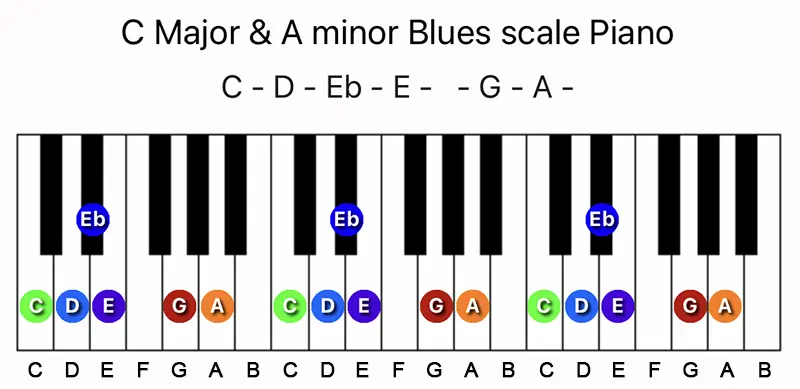
The C minor blues scale is a good starting point because it uses three white keys and three black keys. Play these notes in order:
- C
- E-flat
- F
- G-flat
- G
- B-flat
- C
The interval pattern gives each note a role:
• C is the root. It feels like home.
• E-flat is the minor third. It gives the scale its sad or serious quality.
• F is the perfect fourth. It adds movement.
• G-flat is the flat fifth, or blues note. It creates strong tension.
• G is the perfect fifth. It adds stability after the blues note.
• B-flat is the minor seventh. It gives the scale a relaxed, soulful sound.
The flat fifth is often treated as a passing note. You may play it briefly between F and G, rather than resting on it for a long time. This is one reason the scale sounds expressive instead of simply dark.
If you understand what is a minor blues scale piano in the key of C, you can move the same pattern to every other key. The shape changes on the keyboard, but the interval formula stays the same.
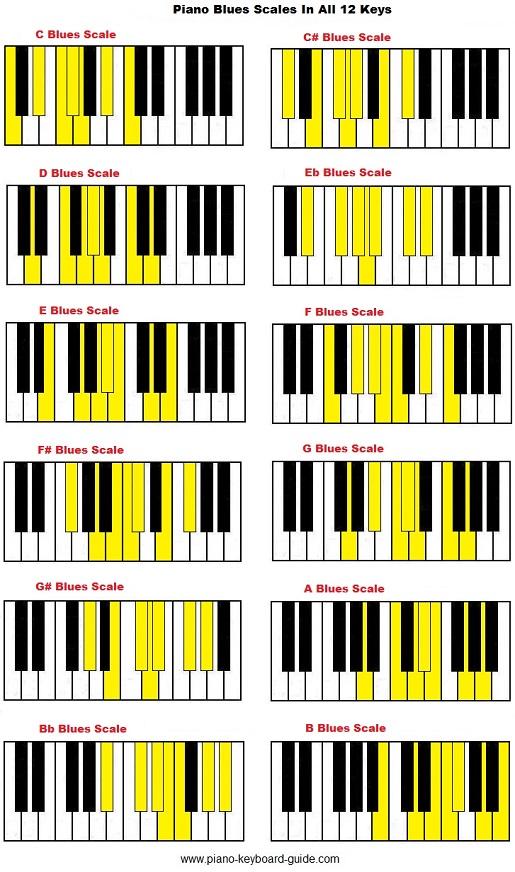
How to Build a Minor Blues Scale in Any Key
You do not need to memorize every scale as a separate group of notes. Learn the formula, then apply it from any root note.
Use these steps:
- Choose the root note.
- Find the minor third, or flat third.
- Add the perfect fourth.
- Add the flat fifth.
- Add the perfect fifth.
- Add the minor seventh.
- Return to the root.
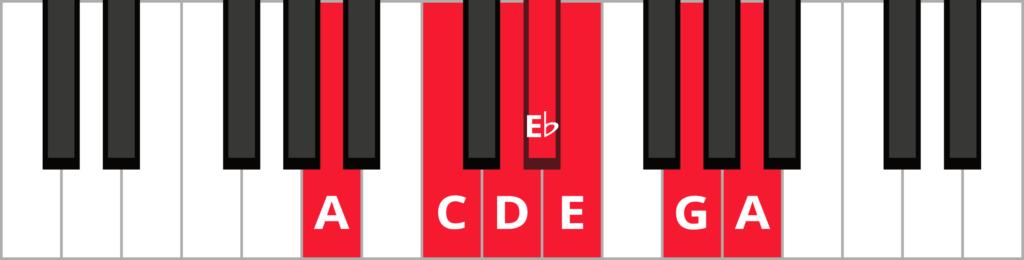
For example, the A minor blues scale is:
• A, C, D, E-flat, E, G, A
The G minor blues scale is:
• G, B-flat, C, D-flat, D, F, G
The E minor blues scale is:
• E, G, A, B-flat, B, D, E
A useful shortcut is to start with the natural minor scale and add the flat fifth. For example, the C natural minor scale is C, D, E-flat, F, G, A-flat, B-flat. Lowering the fifth, G, gives you G-flat. The result is the C minor blues scale.
This approach answers what is a minor blues scale piano in a practical way. It is not only a list of notes. It is a repeatable system that works in all 12 keys.

Minor Blues Scale Formula Compared With Other Scales
Many piano players confuse the minor blues scale with the pentatonic scale or natural minor scale. They are related, but they do not sound or function in exactly the same way.
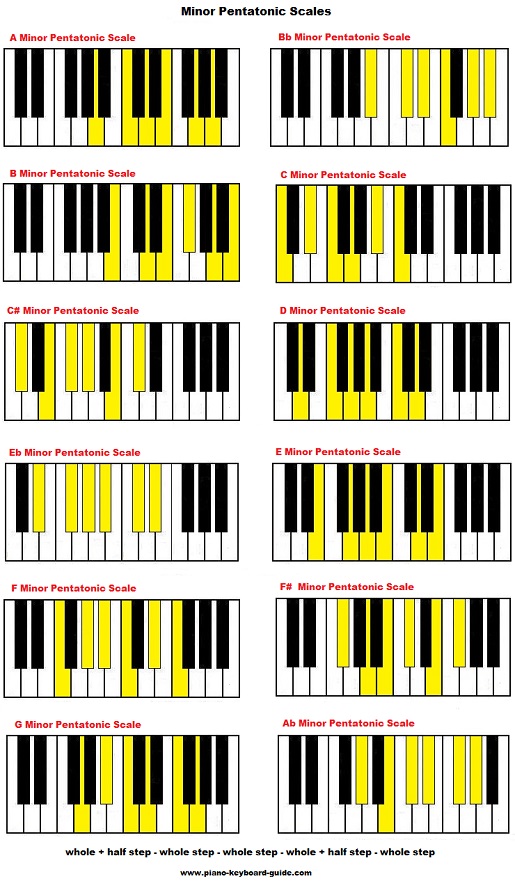
Minor pentatonic scale
The minor pentatonic scale has five notes:
• 1, flat 3, 4, 5, flat 7
In C, that gives you C, E-flat, F, G, and B-flat.
The minor blues scale adds the flat fifth:
• C, E-flat, F, G-flat, G, B-flat
That extra note creates more tension and a stronger blues flavor.
Natural minor scale
The natural minor scale has seven notes:
• 1, 2, flat 3, 4, 5, flat 6, flat 7
The C natural minor scale is C, D, E-flat, F, G, A-flat, and B-flat.
The minor blues scale removes the second and flat sixth, then adds the flat fifth. This gives it a shorter, more focused sound.
Major blues scale
The major blues scale uses this formula:
• 1, 2, flat 3, 3, 5, 6
It often sounds brighter than the minor blues scale. Blues musicians may switch between major and minor blues ideas over the same chord progression.
Understanding what is a minor blues scale piano becomes easier when you compare these related scales. Think of the minor pentatonic scale as the basic outline and the blues scale as that outline with an extra brush of tension.

How to Play the Minor Blues Scale on Piano
Start slowly with the C minor blues scale:
• Right hand ascending: C, E-flat, F, G-flat, G, B-flat, C
• Right hand descending: C, B-flat, G, G-flat, F, E-flat, C
There is no single correct fingering for every player. A useful starting fingering for the right hand is:
• 1, 2, 3, 4, 5, 3, 1
Here, 1 means the thumb and 5 means the little finger. You can adjust the fingering if your hand feels tense.
For the left hand, try:
• 5, 3, 2, 1, 3, 2, 1
Fingerings can change when you play more than one octave. The best fingering is the one that lets your hand move smoothly without twisting your wrist.
Keep your fingers close to the keys. Press each note with a relaxed hand. The goal is not to play the scale as fast as possible. The goal is to make each note even, clear, and controlled.
In my teaching experience, many beginners rush the flat fifth because it feels unusual. Slow down at that note. Let your ear notice the pull from G-flat to G. That small movement is one of the main sounds that makes the scale feel like blues.
How the Minor Blues Scale Sounds
The minor blues scale often sounds emotional, gritty, and slightly unresolved. It can suggest sadness, confidence, struggle, or cool restraint, depending on how you play it.
The flat third is important because it gives the scale a minor quality. The flat fifth adds bite. The minor seventh keeps the sound open and relaxed rather than fully settled.
Try this simple phrase in C:
• C, E-flat, F, G-flat, G, E-flat, C
Now try:
• G, G-flat, F, E-flat, C
The first phrase rises with tension and then returns home. The second phrase uses the blues note as a quick passing sound.
Tone depends on more than the notes. These choices also matter:
• Rhythm: Short, repeated notes can sound sharp and funky.
• Timing: Playing slightly behind the beat can create a relaxed blues feel.
• Dynamics: Louder notes can make a phrase sound bold.
• Articulation: Smooth notes feel vocal, while short notes feel percussive.
• Repetition: Repeating a small idea often sounds more musical than playing every note in the scale.
A scale is like a box of colors. The music comes from how you choose and combine those colors.

Using the Minor Blues Scale Over Chords
The minor blues scale works well over minor blues progressions, minor seventh chords, and many modal grooves. For example, C minor blues is a natural choice over Cm7 when the harmony stays centered on C minor.
You can also use it in several common settings:
• Blues and jazz improvisation
• Rock guitar and piano solos
• Gospel fills
• R&B melodies
• Funk lines
• Film and game music
• Keyboard introductions and endings
Be careful when using a minor blues scale over a major chord. Blues music often mixes major and minor sounds, but the result depends on the chord, melody, and style. A minor third over a major chord can sound expressive, but it may also sound harsh if you hold it too long.
For example, over a C7 chord, C minor blues can work in a blues setting. The E-flat may rub against the E natural inside the chord. That clash is not always a mistake. In blues, players often bend, slide, or pass through the minor third before resolving toward the major third.
If you are learning what is a minor blues scale piano for improvisation, listen to the chord beneath you. The same note can sound strong in one moment and tense in another.

Minor Blues Scale Piano Exercises
Practice should connect your fingers, ears, and sense of rhythm. Use short exercises instead of playing the scale up and down for ten minutes without focus.
Exercise 1: Play the scale slowly
Play the C minor blues scale in quarter notes. Use a metronome at a slow speed, such as 60 beats per minute. Aim for even timing and a relaxed hand.
Exercise 2: Use groups of three
Play:
• C, E-flat, F
• E-flat, F, G-flat
• F, G-flat, G
• G-flat, G, B-flat
• G, B-flat, C
This helps you see the scale as small musical groups rather than one long line.
Exercise 3: Add a simple rhythm
Try this rhythm:
• Long, short, short, long
Apply it to small groups of notes. Rhythm often makes a basic scale sound more musical at once.
Exercise 4: Practice call and response
Play a short phrase with your right hand. Answer it with another phrase. For example:
• Call: C, E-flat, F, G-flat
• Response: G, B-flat, G, C
This method teaches you to create musical sentences.
Exercise 5: Improvise with fewer notes
Use only C, E-flat, F, and G at first. Add G-flat and B-flat later. Limiting your choices can improve creativity and phrasing.
A common mistake is to focus only on speed. In real playing, a slow phrase with a strong rhythm usually sounds better than a fast scale with no direction.
Common Mistakes to Avoid
Learning what is a minor blues scale piano is easy in theory, but several habits can slow your progress.
Treating the scale like a drill
Playing straight up and down helps with note knowledge. It does not automatically teach phrasing. Create short ideas, repeat them, and change the rhythm.
Overusing the blues note
The flat fifth is powerful because it creates tension. If you stop on it in every phrase, it can lose its effect. Use it as a passing tone, then resolve to the fifth or root.
Ignoring rhythm
Blues is strongly connected to groove. Practice with a metronome, drum loop, or backing track. Even three notes can sound convincing with good timing.
Playing with a stiff hand
Tension can cause uneven notes and discomfort. Keep your wrist loose, lower your shoulders, and use only the movement you need.
Forgetting the chord
A scale does not sound correct in every situation. Check the chord progression before choosing your scale. Listen for notes that clash with the harmony.
Staying in one key
Once you know C minor blues, move to A, E, G, and F. Transposing builds true understanding and helps you play with other musicians.
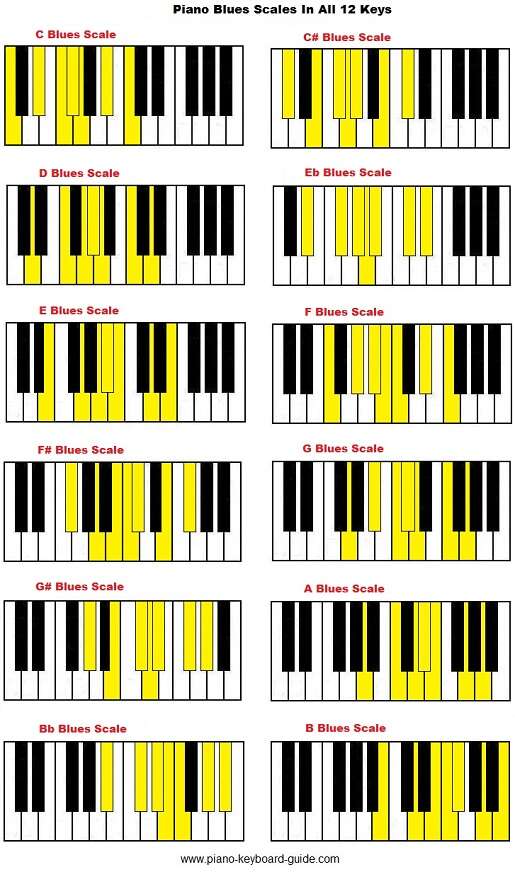
Minor Blues Scale Patterns in All 12 Keys
The same formula works in every key. Here are the 12 minor blues scales:
• C: C, E-flat, F, G-flat, G, B-flat
• C-sharp: C-sharp, E, F-sharp, G, G-sharp, B
• D: D, F, G, A-flat, A, C
• E-flat: E-flat, G-flat, A-flat, A, B-flat, D-flat
• E: E, G, A, B-flat, B, D
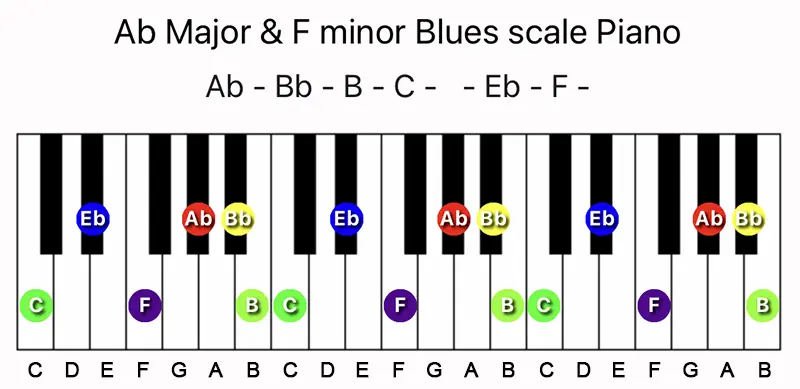
• F: F, A-flat, B-flat, B, C, E-flat
• F-sharp: F-sharp, A, B, C, C-sharp, E
• G: G, B-flat, C, D-flat, D, F
• A-flat: A-flat, B, D-flat, D, E-flat, G-flat
• A: A, C, D, E-flat, E, G
• B-flat: B-flat, D-flat, E-flat, E, F, A-flat
• B: B, D, E, F, F-sharp, A
The enharmonic spelling can vary in written music. For example, some notes may appear with sharp names instead of flat names. The sound may be the same on an equal-tempered piano, but correct spelling depends on the key and musical context.
Do not try to memorize all 12 keys in one sitting. Learn two or three keys at a time. C, A, G, and E are useful early choices because they appear often in popular piano music.
What Is a Minor Blues Scale Piano Used For?
The minor blues scale is mainly used to create melodies, fills, solos, and improvisations. It is especially useful when you want a strong emotional sound without searching for many notes.
You can use it to:
• Create a piano solo over a blues progression
• Build a bass line with the left hand
• Add a short fill between vocal phrases
• Write a melody for a song
• Practice improvisation over a minor groove
• Add tension before resolving to a chord tone
For a simple left-hand pattern, play C and G together, then use the right hand to explore the C minor blues scale. Keep the left hand steady and make the right-hand phrases short.
For a fuller sound, try a C minor seventh chord in the left hand with a blues phrase in the right hand. The chord contains C, E-flat, G, and B-flat, which are already part of the scale. This makes the scale feel connected to the harmony.
The best answer to what is a minor blues scale piano is practical: it is a small group of notes that gives you a reliable starting point for expressive piano playing.
Frequently Asked Questions About What Is a Minor Blues Scale Piano
What is a minor blues scale piano?
A minor blues scale on piano is a six-note scale made from the root, flat third, fourth, flat fifth, fifth, and flat seventh. It is widely used in blues, jazz, rock, gospel, funk, and R&B.
What notes are in the C minor blues scale?
The C minor blues scale contains C, E-flat, F, G-flat, G, and B-flat. The next C begins the scale again one octave higher.
Is the minor blues scale the same as the minor pentatonic scale?
No. The minor pentatonic scale has five notes, while the minor blues scale adds the flat fifth. That extra note creates more tension and gives the scale its classic blues color.
Can I use the minor blues scale over major chords?
Yes, especially in blues and other styles that mix major and minor sounds. However, the minor third and other tense notes may need careful phrasing or resolution when the chord is major.
What is the easiest key for learning the minor blues scale on piano?
C minor is often a convenient starting key because its notes are easy to identify. A minor is also helpful because it uses mostly white keys, with E-flat as the blues note.
How should beginners practice the minor blues scale?
Begin with one octave at a slow tempo. Then practice short phrases, different rhythms, and simple improvisation over a steady chord or backing track.
Why does the flat fifth sound tense?
The flat fifth sits between the fourth and perfect fifth. This close relationship creates a strong pull, so players often use it as a passing note before resolving to the fifth.
Conclusion
The minor blues scale is a six-note piano scale with the formula 1, flat 3, 4, flat 5, 5, and flat 7. In C, the notes are C, E-flat, F, G-flat, G, and B-flat. Its power comes from the balance between stable notes and expressive tension.
Start with C minor blues, play slowly, and focus on rhythm, phrasing, and relaxed movement. Then move the pattern to other keys and use it over simple minor grooves or blues progressions. Explore more piano scale lessons, practice with a backing track, and share your favorite blues phrase in the comments.

Senior Music Reviewer
Alex Carter is a seasoned music reviewer with over a decade of experience in the world of sound and instruments. Passionate about helping musicians and enthusiasts make informed choices, he brings sharp insights and in-depth knowledge to every review. From classical instruments to modern gear, Alex combines technical expertise with a love for music to deliver content that resonates with readers.
As a Senior Music Reviewer and expert author on Tuneluma.com, Alex is dedicated to sharing honest evaluations, practical advice, and thoughtful commentary to guide readers in their musical journey.