In the United States, drum corps is best described as a competitive marching activity with strong athletic demands. It includes organized contests, strict rules, intense training, and judging. Members march, play instruments, dance, and perform for long periods while wearing heavy uniforms and carrying equipment.
So, is drum corps a sport? Yes, in the broad and practical sense. But it is not usually classified as a traditional team sport like football, basketball, or baseball. It is more often grouped with the marching arts, performing arts, or judged sports, much like competitive cheer, dance, and figure skating.
The answer depends on what someone means by “sport.” If the term requires physical skill, training, rules, and competition, drum corps qualifies. If it requires a ball, direct one-on-one play, or recognition by the NCAA, drum corps does not fit that narrower definition.

What Is Drum Corps?
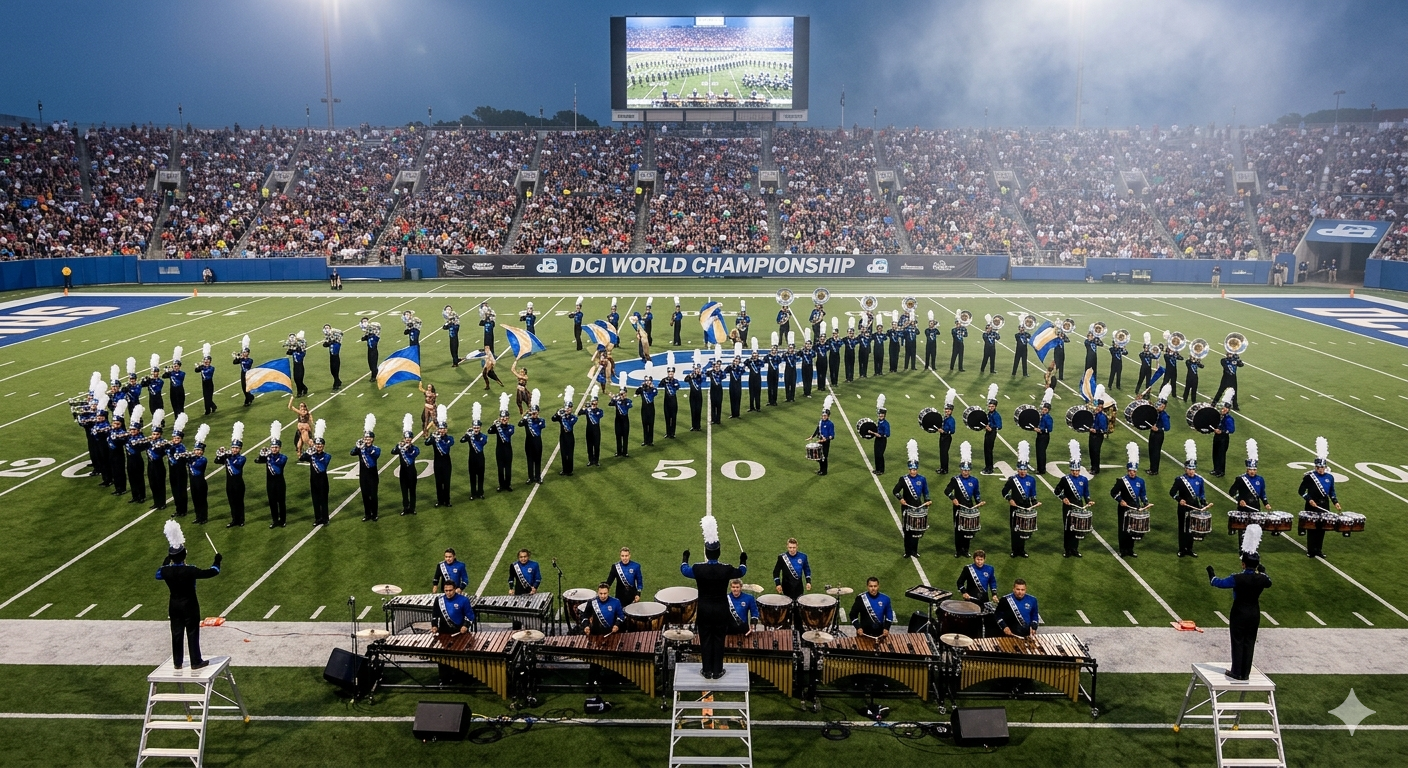
Drum corps is a competitive form of marching music. Members perform with brass instruments, percussion instruments, and—often—color guard equipment such as flags, rifles, and sabres.
In the United States, the largest circuit is Drum Corps International, often called DCI. DCI describes itself as a nonprofit organization that supports the activity and hosts competitions for corps from across the country and beyond.
A modern drum corps show often includes:
- Brass music
- Battery percussion
- Front ensemble percussion
- Choreography
- Marching and body movement
- Visual formations
- Color guard work
- Themed costumes, props, or set pieces
- A written field show that lasts several minutes
A corps performs as one large unit. Its score usually reflects both music and visual performance. Judges review areas such as musical achievement, visual effect, ensemble coordination, performance quality, and general effect.
Drum corps is not the same as a school marching band. A high school marching band usually represents a school and may perform at football games. A drum corps usually operates as an independent organization and focuses on a competitive summer tour.
DCI corps also have specific age rules. Most performers are between the ages of 14 and 21, although age limits can vary by policy and corps. Members who reach the upper age limit are often said to “age out.”
Why Drum Corps Can Be Considered a Sport
Drum corps meets several common features of sport: physical exertion, skill development, formal competition, rules, coaching, and performance under pressure.
It requires serious physical effort
A drum corps member may march for much of a show while playing an instrument, moving at set speeds, changing direction, and maintaining posture.
The physical load can come from:
- Long rehearsals
- Repeated full-show runs
- Fast movement across a field
- Heat and sun exposure
- Heavy brass or percussion equipment
- Repeated lifting and catching
- Dance and tumbling
- Limited recovery during tour
A brass player may carry an instrument for an entire rehearsal. A snare drummer may carry a heavy drum while marching and playing complex rhythms. A color guard member may sprint, leap, spin equipment, and perform dance phrases.
That combination demands more than musical talent. It requires strength, endurance, coordination, balance, flexibility, and control.
Research on marching musicians has examined heart rate, energy use, heat stress, and physical strain. The exact demands vary by instrument, role, show design, weather, and rehearsal schedule. Still, the evidence supports a simple point: marching performance can place a meaningful physical demand on the body.
It requires structured training
Drum corps members do not simply memorize music and walk onto a field. They train for months.
Training can include:
- Cardiovascular conditioning
- Core and leg strength
- Flexibility work
- Breathing practice
- Marching technique
- Instrument technique
- Dance training
- Equipment handling
- Repeated drill rehearsal
- Mental focus and recovery planning
Many corps use rehearsal blocks similar to athletic practice. Staff teach a skill, members repeat it, and the full group works to improve timing and consistency.
A member may need to perform the same difficult section dozens of times. The goal is not only to finish the show. The goal is to make every step, note, visual effect, and transition match the corps standard.
It has organized competition
Drum corps competitions have a clear structure. Corps perform for judges, receive scores, and advance through a season of events.
DCI uses published rules and judging systems. Corps compete at regional shows and championship events. Scores help determine rankings and competitive placement.
This is similar to other judged sports. In gymnastics, diving, figure skating, and competitive cheer, judges evaluate execution and effect rather than simply counting points scored against an opponent.
Drum corps usually does not involve direct physical contact between teams. That does not remove its competitive nature. The corps still competes under common rules against other groups.
It combines individual and team performance
Every member has an individual responsibility. A single missed step, wrong note, dropped flag, or timing error can affect the entire production.
At the same time, the score depends heavily on group performance. The corps must move, play, and react as one unit.
This makes drum corps both:
- An individual skill activity, because members develop personal technique
- A team activity, because the final result depends on group timing and unity
That mix is common in many recognized sports and performance-based competitions.

Why Some People Do Not Call Drum Corps a Sport
The disagreement usually comes from the definition of sport.
Some people use “sport” to mean a contest with:
- Direct opposition
- A ball or other game object
- A fixed playing area
- A simple scoring system
- Little or no artistic judgment
Drum corps does not meet all of those conditions. Its scoring includes judgment. Music and visual design matter. The corps does not tackle, block, or directly stop another corps during a performance.
For that reason, many organizations and schools place drum corps under labels such as:
- Marching arts
- Performing arts
- Competitive music
- Artistic athletics
- Judged activity
- Extracurricular activity
None of these labels fully explains the activity on its own.
Calling drum corps a performing art highlights its music, design, and expression. Calling it a sport highlights its physical demands, training, rules, and competition. Both descriptions explain part of the truth.
A useful comparison is competitive figure skating. It combines athletic movement with music, choreography, and artistic judging. Drum corps works in a similar space, although the skills and performance setting are different.
Is Drum Corps an Official Sport?
There is no single worldwide or United States-wide rule that decides whether every activity is a sport. Different organizations use different standards.
Drum corps is not generally an NCAA varsity sport. It does not appear alongside college sports such as soccer, swimming, or wrestling in the normal NCAA structure.
It is also not usually treated as a traditional school sport by state high school athletic associations. A school may support marching band or indoor percussion, but that does not automatically make those activities official sports under state athletic rules.
At the same time, drum corps has many features of an organized sport:
| Feature | Does drum corps have it? |
|---|---|
| Physical training | Yes |
| Skill-based performance | Yes |
| Organized teams | Yes |
| Published rules | Yes |
| Coaches and instructors | Yes |
| Formal competition | Yes |
| Scoring and rankings | Yes |
| Direct physical opposition | Usually no |
| NCAA classification | No |
The best answer is therefore:
Drum corps is a competitive physical activity and performing art. It can reasonably be called a sport, but it is not usually an official NCAA or school athletic sport.
The label can also depend on the purpose. For a conversation about training and effort, “sport” is useful. For college eligibility, school policy, insurance, or athletic department rules, the organization’s formal classification matters more.

How Athletic Is Drum Corps?
Drum corps can be highly athletic, but the demands differ by section.
Brass
Brass members must control breathing, posture, embouchure, and movement at the same time. They often march while carrying an instrument and playing music that requires endurance and power.
The main physical demands may include:
- Breath control
- Upper-body endurance
- Core stability
- Leg endurance
- Balance
- Heat management
- Movement accuracy
Percussion
Battery percussionists carry instruments while marching and playing. The equipment can add a significant load, and the performer must maintain timing while moving.
Percussion demands may include:
- Shoulder and back endurance
- Grip control
- Core strength
- Leg strength
- Coordination
- Repeated impact tolerance
- High concentration
Front ensemble players usually do not march with instruments, but they may play physically demanding parts during long rehearsals. They also help move and set equipment.
Color guard
Color guard often has the most visible dance and movement demands. Members may run, leap, spin equipment, perform floor work, and catch objects while staying in time with the music.
Common demands include:
- Flexibility
- Explosive movement
- Balance
- Spatial awareness
- Shoulder strength
- Landing control
- Repeated throwing and catching
The full corps
The full group must perform in changing weather and on different fields. Heat, humidity, rain, poor sleep, travel, and long rehearsal days can affect performance and recovery.
That does not mean every member experiences the same workload. A conclusion about “how athletic drum corps is” must account for the performer’s section, equipment, show design, rehearsal plan, and physical condition.
Is Drum Corps Harder Than a Traditional Sport?
There is no fair universal ranking. Drum corps and traditional sports test different skills.
A football player may face contact, short bursts of speed, and strength demands. A distance runner may face sustained aerobic effort. A drum corps member may need to combine movement, music, memory, posture, and team timing for an entire show.
The better question is not “Which is harder?” It is:
What type of difficulty does the activity require?
Drum corps is difficult because members must perform several tasks at once. A player may need to:
- Remember music and drill.
- Watch spacing and form.
- March at a precise tempo.
- Maintain sound quality.
- Respond to staff instructions.
- Manage breathing and fatigue.
- Perform consistently in front of judges.
This is a high coordination load. Physical fitness alone is not enough, and musical skill alone is not enough.
A traditional athlete can also face complex mental and technical demands. The comparison should respect both kinds of work instead of treating one as less serious.
Is Drum Corps Safe?
Drum corps can be safe when organizations plan for heat, hydration, rest, equipment load, and gradual training. It also carries real risks.
Common concerns include:
- Heat illness
- Dehydration
- Overuse injuries
- Stress injuries
- Blisters
- Falls
- Shoulder or back strain
- Hearing damage from loud sound
- Sleep loss
- Mental fatigue
Members should follow the corps’ medical and safety instructions. They should also report pain, dizziness, confusion, unusual weakness, or breathing problems promptly.
A person who feels faint, confused, severely overheated, or unable to cool down needs urgent medical attention. Do not treat serious heat symptoms as normal rehearsal fatigue.
Safer training practices include:
- Drinking fluids on a planned schedule
- Taking approved breaks
- Using shade when available
- Wearing suitable clothing and sun protection
- Building training volume over time
- Checking equipment fit
- Reporting pain early
- Protecting hearing during non-performance settings
- Getting enough food and sleep
- Following staff and medical protocols
A corps member should not push through sharp pain or serious symptoms to avoid losing rehearsal time.
Drum Corps vs. Marching Band
Drum corps and marching band share many skills, but they are not identical.
| Area | Drum corps | Marching band |
|---|---|---|
| Main organization | Independent corps | Often a school or college |
| Season | Commonly a touring summer season | Often tied to the school year |
| Competition focus | Usually central | May be one part of the program |
| Age range | Often youth and young adults | Usually students in one school |
| Rehearsal model | Intensive camps and tour | School rehearsals and events |
| Performance setting | Competitions and tour shows | Football games, parades, and contests |
| Membership | Audition-based in many corps | Often school-based |
The two activities overlap. Both use brass, percussion, drill, visual design, and teamwork.
The largest difference is the operating model. Drum corps members often travel and rehearse as a full-time summer group. A school marching band usually balances performance with classes and other school activities.
Can You Put Drum Corps on a College Resume?
Yes. Drum corps can show useful skills, especially when the member describes the work clearly.
Rather than writing only “participated in drum corps,” a resume can mention:
- Team collaboration
- Leadership
- Time management
- Performance under pressure
- Long-term practice
- Travel responsibility
- Physical endurance
- Peer instruction
- Conflict resolution
- Attention to detail
A section leader, drum major, captain, or instructional staff member can describe added duties. The strongest resume entry explains what the person did and what skills the role required.
Drum corps can also support college applications. It may show commitment, discipline, artistic ability, and the ability to work within a demanding team.
It should not be presented as an NCAA athletic credential unless the specific school or program defines it that way.
Key Takeaways
- Drum corps can reasonably be called a sport because it involves training, physical skill, rules, teams, and formal competition.
- It is also a performing art, because music, choreography, design, and artistic judgment shape the result.
- Drum corps is not usually an official NCAA or school athletic sport.
- The activity places different demands on brass, percussion, and color guard members.
- The most accurate label is often competitive marching arts or a judged athletic performance activity.
- For questions about eligibility, school credit, insurance, or athletic status, check the rules of the specific organization.
Frequently Asked Questions
Is drum corps more physical than marching band?
It can be. Drum corps often has a longer and more intensive rehearsal schedule, more travel, and a stronger focus on a full competitive production. The exact physical demand still depends on the corps, section, show design, and rehearsal plan.
Do drum corps members get paid?
Most performers are not paid as employees for participating. Members may pay fees for tuition, travel, food, uniforms, or other tour costs. Policies vary by corps, so applicants should review the current membership agreement before committing.
Is drum corps harder than football?
Neither is automatically harder. Football and drum corps require different skills and create different physical demands. Football may involve contact and explosive power, while drum corps combines endurance, movement, music, memory, and precision.
Can drum corps count as a sport for school credit?
That depends on the school or district. Some schools may offer credit for marching band or related performance activities, while others may not. Ask the school’s athletic office, activities office, or registrar for its written policy.
What is the difference between DCI and WGI?
DCI is best known for outdoor summer drum corps competition. WGI organizes indoor events such as indoor percussion and color guard. The activities overlap in skills, but their seasons, formats, and performance spaces differ.
Sources and Further Reading
The following organizations provide useful information about the activity and its structure:
- Drum Corps International
- DCI About Us
- DCI Rules and Policies
- Winter Guard International
- NCAA Sports
- National Athletic Trainers’ Association
Conclusion
Drum corps is not easy to classify with one word. In the United States, it is best understood as a competitive marching activity that combines sport-like training with the performing arts.
It has physical effort, coaching, rules, teamwork, and competition. It also depends on music, visual design, and artistic judgment. Calling it only a sport leaves out its creative side. Calling it only an art form ignores the athletic work required to perform.
If someone asks, “Is drum corps a sport?” the most accurate short answer is: Yes, in a broad sense—but formally, it is usually classified as a competitive marching art rather than an NCAA sport.

Senior Music Reviewer
Alex Carter is a seasoned music reviewer with over a decade of experience in the world of sound and instruments. Passionate about helping musicians and enthusiasts make informed choices, he brings sharp insights and in-depth knowledge to every review. From classical instruments to modern gear, Alex combines technical expertise with a love for music to deliver content that resonates with readers.
As a Senior Music Reviewer and expert author on Tuneluma.com, Alex is dedicated to sharing honest evaluations, practical advice, and thoughtful commentary to guide readers in their musical journey.