How To Strum A Violin: Easy Beginner Guide
To strum a violin, lightly brush across its strings with a fingertip, thumb, or pick while keeping the instrument steady.
Learning how to strum a violin can add a fresh sound to folk, pop, country, and experimental music. A violin is built mainly for bowing, so strumming needs a gentle touch and careful control. This guide explains safe hand positions, simple patterns, common mistakes, and ways to make strummed violin sound musical rather than harsh.

What Does It Mean to Strum a Violin?
To strum a violin means to sweep across two or more strings in one smooth motion. You can use your index finger, thumb, fingernail, or a soft pick. The motion is similar to guitar strumming, but the violin’s smaller body and higher string tension require much less force.
Most violinists use the bow for long, rich tones. Strumming creates a short, bright sound instead. It may sound percussive, sharp, or even slightly gritty, depending on your technique and the violin’s setup.
There are three common ways to strum a violin:
• Finger strumming uses the pad or nail of one finger.
• Thumb strumming uses the side of the thumb and gives a warm, soft attack.
• Pick strumming uses a thin, flexible pick for a louder and more even sound.
Many players also confuse strumming with pizzicato. Pizzicato means plucking one string, usually with the right index finger. Strumming means brushing across several strings in one motion.
Is Strumming a Violin Safe?
Strumming a violin is usually safe when you use light pressure and avoid hitting the bridge, fine tuners, and tailpiece. The strings can handle normal playing, but the bridge is delicate and can shift if you press or strike too hard.
Hold the violin in a stable position. You can place it under your chin as you would for normal playing, or rest it flat across your lap while practicing. A beginner may find lap position easier because it reduces tension in the neck and shoulder.
Keep these safety points in mind:
• Use a clean finger, thumb, or soft pick.
• Avoid metal picks and hard plastic picks.
• Do not scrape the strings with a long fingernail.
• Do not strum close to the bridge with force.
• Stop if the strings feel rough, loose, or damaged.
• Check that the bridge remains upright after practice.
A violin teacher or repair technician can check the bridge and string height if you are unsure. Never force a bridge back into place without learning the correct method.

How to Strum a Violin Step by Step
The best way to learn how to strum a violin is to begin with open strings. Do not add complex chords at first. Your goal is to control the movement and create an even rhythm.
1. Tune the violin
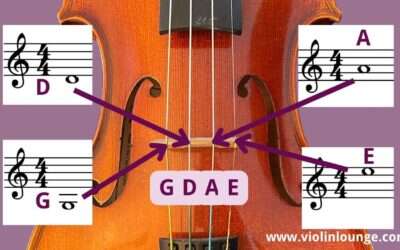
Tune the strings to the standard notes:
• G3 for the lowest string
• D4 for the next string
• A4 for the next string
• E5 for the highest string
Use an electronic tuner if possible. Strumming untuned strings makes it hard to judge your rhythm and sound.
2. Find a relaxed position
Place the violin under your chin or across your lap. Keep your shoulders low. Let your strumming hand move from the wrist instead of the elbow.
Your fingers should stay loose. Imagine brushing dust from a table. That image helps prevent the stiff, heavy motion that causes harsh sound.
3. Choose your strumming finger
Start with the pad of your index finger. Touch the strings lightly and sweep downward from the G string toward the E string.
Then try an upward motion from the E string toward the G string. Use a smaller movement than you would use on a guitar.
4. Start with two strings
Place your strumming finger near the middle of the fingerboard. Brush across the D and A strings only. These middle strings often produce a balanced sound and are easier to control.
Practice four slow downward strokes. Then practice four upward strokes. Keep the distance between each stroke equal.
5. Add all four strings
When two strings feel easy, sweep across G, D, A, and E. Use very little pressure. The finger should glide over the strings rather than push into them.
If the sound is too loud or scratchy, reduce your force. A smooth motion matters more than volume.
6. Practice a simple rhythm
Try this pattern:
• Down, down, down, down
• Down, up, down, up
• Down, down, up, up, down, up
Count slowly as “1, 2, 3, 4.” A metronome set between 50 and 70 beats per minute can help you keep steady time.
The key to how to strum a violin is consistency. A simple pattern played evenly sounds better than a complex pattern played with uneven force.

How to Use Your Left Hand While Strumming
You can strum open strings without using the left hand. To create different notes, press one or more strings against the fingerboard while your right hand strums.
This technique is not the same as guitar chord playing. A violin does not have frets, and its strings are tuned in fifths. Many guitar chords are difficult or impossible to play in the same shape on a violin.
Start with simple two-note combinations. For example, place one finger on the A string while leaving the D string open. Strum only those two strings and listen for a clear interval.
Keep your left-hand fingers curved. Press only as much as needed to create a clean note. Too much pressure can tire your hand and make your intonation less accurate.
A useful practice method is:
-
Play open D and A together.
-
Add the first finger on the A string.
-
Strum slowly and listen for a clear change.
-
Remove the finger and return to the open strings.
-
Repeat without squeezing the neck.
If the notes sound unclear, check that your finger is not touching a neighboring string. The violin rewards small, careful movements.
Finger, Thumb, or Pick: Which Is Best?
The best tool depends on the sound you want and your level of control.
Finger strumming
Finger strumming is the easiest place to begin. It feels natural and gives you strong control over volume. The sound is soft, but your fingertip may feel sore after long practice.
Use the fleshy part of the finger rather than the edge of the nail. This reduces scratching and gives the strings a warmer attack.
Thumb strumming
The thumb creates a round and gentle tone. It works well for slow patterns and folk-style playing. Move from the thumb joint and keep the wrist relaxed.
Some players use the side of the thumb for downward strokes and the index finger for upward strokes. This can make alternating patterns feel smooth.
Pick strumming
A thin pick can create a clear and bright tone. Choose a flexible pick, such as one designed for light guitar playing. Thick picks can strike the strings too hard and may feel difficult to control.