How Many Octaves Are On A Guitar: Fretboard Guide
Most guitars span about three to four octaves, depending on their tuning, string count, and highest fret.
The exact answer to how many octaves are on a guitar depends on the instrument and how you count its range. A standard six-string guitar usually reaches from low E2 to high E5, while extended-range guitars can go much lower. This guide explains guitar octaves, fretboard patterns, tuning, fret counts, and practical ways to find every octave on your instrument.
What Is an Octave on a Guitar?
An octave is the distance between one note and another note with the same name at double or half the frequency. For example, the note A4 is one octave above A3. Both notes are called A, but one sounds higher.
On a guitar, one octave equals 12 semitones. Since each fret raises a note by one semitone, moving 12 frets up creates an octave. This makes the guitar fretboard easy to measure.
For example:
• Open low E is E2.
• The 12th fret on the low E string is E3.
• The 24th fret on the low E string is E4.
The 12th fret is also the halfway point of the string. It produces the same note as the open string, one octave higher.
When people ask how many octaves are on a guitar, they may mean two different things:
• The total pitch range from the lowest note to the highest note.
• The number of octave shapes and repeated notes across the fretboard.
These are not the same. A guitar may have a three-octave pitch range but contain many repeated octave shapes.

How Many Octaves Are on a Standard Guitar?
A standard six-string guitar is usually tuned to E2, A2, D3, G3, B3, and E4. On a common 22-fret model, the highest note is D5 on the first string. That gives the instrument a range of about two octaves and ten semitones.
A 24-fret guitar reaches E5 on the first string. The distance from low E2 to high E5 is exactly three octaves. This is the clearest answer for how many octaves are on a guitar with 24 frets and standard tuning.
Many guitarists still say a standard guitar has “about four octaves.” They may be counting the full note layout across the neck, including repeated notes and the different registers available on separate strings. However, the strict lowest-to-highest pitch range of a typical 24-fret guitar is three octaves.
Here is a simple comparison:
| Guitar type | Lowest note | Highest note | Approximate range |
|---|---|---|---|
| 22-fret, six-string guitar | E2 | D5 | 2 octaves and 10 semitones |
| 24-fret, six-string guitar | E2 | E5 | 3 octaves |
| 12-fret classical guitar | E2 | E4 | 2 octaves |
| 19-fret classical guitar | E2 | B4 | About 2 octaves and 7 semitones |
| Seven-string guitar | B1 | E5 | About 3 octaves and 5 semitones |
The answer changes when you use alternate tunings, extended-range guitars, or special instruments.

How Guitar Frets Create Octaves
Each fret raises a string by one semitone. Two frets create a whole step, and 12 frets create one full octave.
The basic pattern looks like this:
- Play an open string.
- Move to the 12th fret.
- Play the same note name one octave higher.
- Move another 12 frets to reach the next octave, if the guitar has enough frets.
On the low E string, the pattern is:
• Open string: E2
• 12th fret: E3
• 24th fret: E4
On the high E string, the pattern is:
• Open string: E4
• 12th fret: E5
• 24th fret: E6, if the guitar has that many frets
This shows why the phrase how many octaves are on a guitar needs context. The low and high E strings share the same note name, but they begin two octaves apart. The high E string also starts in a much higher register.
A useful rule is:
Number of semitones = number of frets.
You can then divide the semitone distance by 12 to find the octave distance. For example, 36 semitones equal three octaves.

The Standard Guitar Range Explained
Standard tuning gives a six-string guitar a broad range because the strings are tuned in fourths, with one major third between the G and B strings.
The open strings are:
• 6th string: E2
• 5th string: A2
• 4th string: D3
• 3rd string: G3
• 2nd string: B3
• 1st string: E4
The lowest note is E2. This is the same pitch as the low E on a piano’s second octave. The highest note depends on the fret count.
A 21-fret guitar reaches C5 on the first string. A 22-fret guitar reaches D5. A 24-fret guitar reaches E5. These differences may seem small, but each extra fret adds one semitone.
Here is the high E string range by fret count:
• 12 frets: E4 to E5
• 21 frets: E4 to C5
• 22 frets: E4 to D5
• 24 frets: E4 to E5
So, how many octaves are on a guitar with standard tuning? Most six-string models cover nearly three octaves, and 24-fret models cover exactly three octaves from low E2 to high E5.
Some guitar designs use 25, 27, or more frets. These instruments extend the high range, but the body shape, neck joint, and pickup placement can affect playability.
How Many Octaves Are on a Guitar by String?
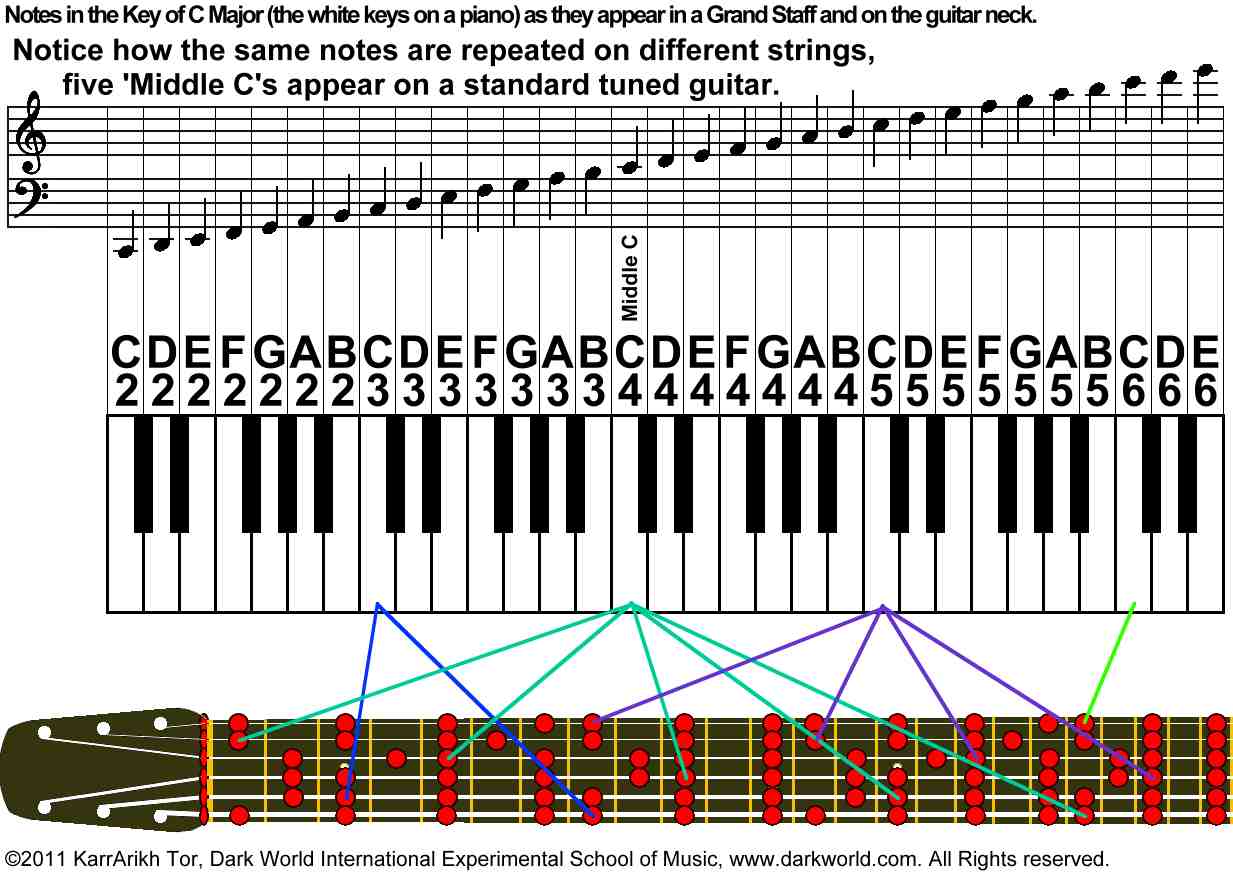
Each guitar string can cover more than one octave by itself. The exact number depends on the open-string pitch and the number of frets.
A 24-fret guitar gives every string a two-octave span. The open note appears again at the 12th fret and again at the 24th fret.
| String | Open note | 12th fret | 24th fret |
|---|---|---|---|
| 6th | E2 | E3 | E4 |
| 5th | A2 | A3 | A4 |
| 4th | D3 | D4 | D5 |
| 3rd | G3 | G4 | G5 |
| 2nd | B3 | B4 | B5 |
| 1st | E4 | E5 | E6 |
This table reveals an important detail. The guitar’s full range is not found on one string alone. It is created by combining the lowest notes of the bass strings with the highest notes of the treble strings.
A 24-fret high E string reaches E6, but the guitar’s lowest note is E2. The first string alone spans two octaves, while the entire instrument covers four octaves from E2 to E6 if that high E6 is included. This is why some players answer how many octaves are on a guitar with four octaves.
The difference comes from the definition of “guitar range.” Some people count the lowest and highest notes available anywhere on the instrument. Others focus on the practical six-string range most commonly used in guitar charts, which often ends around E5.
Why Different Sources Give Different Answers
You may see answers ranging from two to four octaves. This does not always mean someone made a mistake. The result depends on the guitar model, tuning, fret count, and counting method.
The main reasons include:
• A 12-fret guitar has less range than a 24-fret guitar.
• A seven-string guitar adds a low B string.
• A baritone guitar is tuned lower than a standard guitar.
• Drop tunings lower one or more strings.
• A guitar may include notes above the 12th fret.
• Some players count repeated octaves across the fretboard.
There is also a difference between written range and practical range. A note may be physically available but hard to play cleanly. Some high frets have limited space, and acoustic guitars may sound weaker near the end of the neck.
In my experience mapping scales and chord shapes, the most useful approach is to separate “pitch range” from “usable range.” A 24-fret electric guitar may reach E5 or higher, but many players spend most of their time below the 15th fret. That practical range matters more when writing songs or arranging melodies.

Octaves Across the Guitar Fretboard
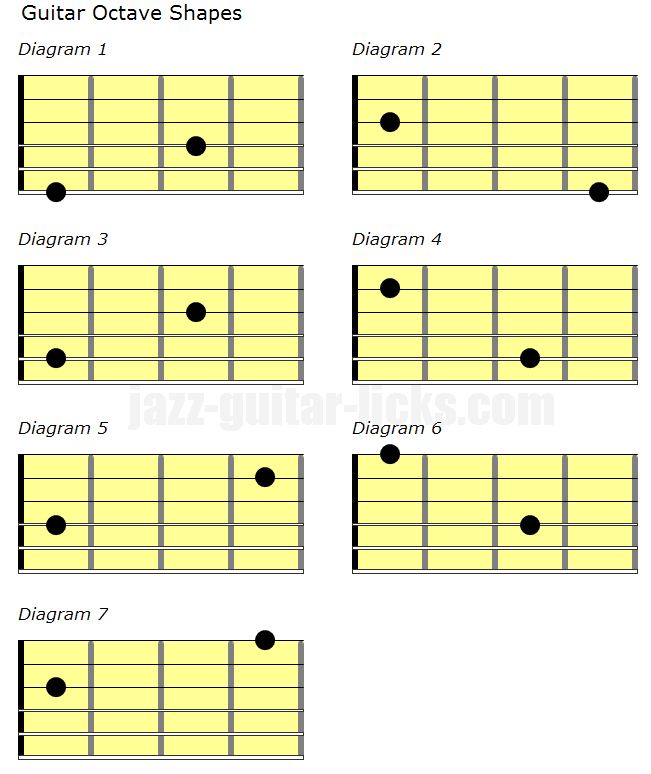
Guitarists often find octaves with movable shapes. These shapes help you locate the same note in several places without learning every note from scratch.
For a note on the sixth string, a common octave shape appears two strings higher and two frets higher. For example, the note at the fifth fret of the sixth string is A. Its octave appears at the seventh fret of the fourth string.
Another common shape appears one string higher and two frets higher, but the B string changes the pattern. This happens because the G-to-B string interval is a major third rather than a perfect fourth.
Common octave locations include:
• Same string, 12 frets higher.
• Two strings higher and two frets higher.
• One string higher and two frets higher in certain string groups.
• Harmonics at the 12th fret.
These patterns are useful for scales, riffs, chord voicings, and improvisation. They also explain why the guitar can feel larger than its basic pitch range suggests.
A practical exercise is to choose one note, such as G, and find it across all six strings. Play each G in order from low to high. Then repeat the exercise with A, C, and E. This quickly builds fretboard awareness.

How Tuning Changes the Number of Octaves
Tuning changes the lowest and highest available notes. Raising or lowering a string does not change the number of frets, but it changes the pitch range.
In drop D tuning, the lowest string moves from E2 to D2. A 24-fret guitar then reaches from D2 to E5. This range is slightly wider than standard tuning.
In D standard tuning, every string moves down a whole step. The lowest note becomes D2, and the high E string becomes D4 when open. A 24-fret guitar reaches D5 on the first string.
A baritone guitar often uses tunings such as B1, E2, A2, D3, F#3, and B3. Its scale length is longer, and its low notes have a firm, deep sound. The number of octaves still depends on the highest fret, but the complete register sits lower.
Seven-string and eight-string guitars extend the bass range:
• Seven-string guitars often add low B1.
• Eight-string guitars may add low F#1 or E1.
• Some instruments use fan-fret designs for better tension and tone.
The best answer to how many octaves are on a guitar must therefore include the tuning. A guitar in open tuning, baritone tuning, or a low extended tuning may have a very different range from a standard six-string model.

Acoustic, Electric, Classical, and Bass Guitar Ranges
Guitar type affects the answer because each design uses different fret counts, scale lengths, and tuning choices.
Acoustic guitar
Most steel-string acoustic guitars have 19 or 20 frets. Many have a neck joint near the 14th fret, so the upper range may be harder to reach. A typical acoustic guitar covers close to three octaves from low E to its highest practical note.
Electric guitar
Electric guitars often have 21, 22, or 24 frets. Their thinner strings and cutaway bodies make high notes easier to play. A 24-fret electric guitar usually offers a clear three-octave range from E2 to E5.
Classical guitar
Classical guitars often have 12 frets to the body and 18 or 19 total frets. Their nylon strings produce a warm tone, but the upper range can feel less direct. A typical classical guitar covers a little more than two octaves from low E.
Bass guitar
A standard four-string bass is commonly tuned E1, A1, D2, and G2. With 20 frets, it can reach E3 on the highest string. That gives it about two octaves from low E1 to high E3.
A five-string bass usually adds low B0. This extends the instrument’s range downward without greatly changing the high end.
When comparing how many octaves are on a guitar, avoid mixing guitar and bass terms. A bass guitar is part of the guitar family, but its tuning and register are much lower.

How to Find Your Guitar’s Exact Octave Range
You can calculate your guitar’s range in a few minutes. You only need to identify the lowest open note and the highest playable note.
Follow these steps:
- Tune the guitar accurately.
- Play the lowest open string.
- Identify the note name and octave.
- Find the highest fret on the highest string.
- Identify that note with a tuner or fretboard chart.
- Count the semitones between the two notes.
- Divide the semitone total by 12.
For example, a 24-fret guitar in standard tuning starts at E2 and ends at E5. The distance is 36 semitones. Since 36 divided by 12 equals three, the total range is three octaves.
You can also use a chromatic tuner. Play every note from the lowest string to the highest fret. This method shows the true range and helps you hear whether the highest notes remain clear.
One lesson I often apply is not to trust fret count alone. A guitar may have 24 frets, but poor setup, high action, or worn frets can make the final notes difficult to play. Check both the written range and the clean, musical range.
Why Octave Knowledge Matters for Guitar Players
Knowing how many octaves are on a guitar helps with more than trivia. It improves your understanding of scales, melodies, chords, and music theory.
Octave knowledge helps you:
• Move a melody into a better register.
• Build stronger solos.
• Create bass lines that support chords.
• Find the same note in several positions.
• Transpose riffs without losing the desired tone.
• Understand standard notation and tablature.
• Choose a guitar with the right range for your music.
Octaves also shape tone. The same note played on a low string sounds thicker and darker. Played on a high string, it sounds brighter and more focused. This is why guitarists often choose a note position for tone, not just convenience.
For example, an A note can appear on the sixth string, fourth string, third string, second string, and first string. Each version has the same note name but a different sound and feel.
When learning a solo, try playing one phrase in two octave positions. This small exercise can improve both fretboard knowledge and musical expression.
Common Mistakes When Counting Guitar Octaves
The most common mistake is counting frets instead of measuring the distance between the lowest and highest notes. A guitar with 24 frets does not automatically have 24 notes or four complete octaves.
Another mistake is ignoring the open strings. The open low E is part of the instrument’s range, just as the highest fretted note is. Leaving it out produces an incomplete answer.
Watch for these errors:
• Assuming every guitar has 24 frets.
• Confusing repeated notes with extra octaves.
• Forgetting that tuning changes pitch range.
• Counting fret markers as octave points.
• Treating the 12th fret as the end of the range.
• Ignoring the G-to-B string tuning difference.
The 12th fret repeats the open note one octave higher. It does not mark the highest note on the guitar. A guitar with 22 or 24 frets continues beyond that point.
It is also easy to confuse a note’s octave number with its position. For instance, the open first string is E4 in standard scientific pitch notation, while the open sixth string is E2. They share the same letter but sit two octaves apart.
Frequently Asked Questions About How Many Octaves Are on a Guitar
How many octaves does a six-string guitar have?
A typical six-string guitar covers nearly three octaves. A 24-fret guitar reaches exactly three octaves from E2 to E5, while a 22-fret guitar reaches slightly less.
Does a 24-fret guitar have four octaves?
A standard 24-fret guitar spans three octaves from its lowest note, E2, to its highest common note, E5. Some counting methods include the high E string’s full local range up to E6, which can lead people to describe the fretboard as covering four octaves.
How many octaves are between the open string and the 12th fret?
There is exactly one octave between an open string and its 12th fret. The 12th fret raises the string by 12 semitones, and 12 semitones equal one octave.
Does tuning change how many octaves are on a guitar?
Yes. Lower tunings extend the low end, while higher tunings raise the overall register. The number of frets stays the same, but the lowest and highest pitches change.
How many octaves does a seven-string guitar have?
A common seven-string guitar ranges from low B1 to high E5 with 24 frets. That equals about three octaves and five semitones, although the exact result depends on tuning and fret count.
Is a guitar’s octave range the same as its usable range?
No. A guitar may produce a note at its highest fret, but that note may sound weak or be difficult to play cleanly. Usable range depends on setup, fret access, string tension, and the instrument’s design.
Conclusion
So, how many octaves are on a guitar? A standard six-string guitar usually spans close to three octaves, while a 24-fret model reaches three octaves from low E2 to high E5. Extended-range guitars, alternate tunings, and different fret counts can expand or shift that range.
The key is to separate total pitch range from repeated octave positions across the fretboard. Use the 12-fret rule, check your tuning, and count from the lowest note to the highest playable note.
Take your guitar, find every version of one note, and play them from low to high. That simple exercise will make the fretboard feel smaller and help you use its full range with confidence.

Senior Music Reviewer
Alex Carter is a seasoned music reviewer with over a decade of experience in the world of sound and instruments. Passionate about helping musicians and enthusiasts make informed choices, he brings sharp insights and in-depth knowledge to every review. From classical instruments to modern gear, Alex combines technical expertise with a love for music to deliver content that resonates with readers.
As a Senior Music Reviewer and expert author on Tuneluma.com, Alex is dedicated to sharing honest evaluations, practical advice, and thoughtful commentary to guide readers in their musical journey.