Did Elvis Play The Guitar: The Truth Behind His Music
Yes, Elvis Presley played guitar, using it as a key part of his early sound and stage image.
The question “did elvis play the guitar” has a clear answer, but the full story is more interesting than a simple yes or no. Elvis was not known as a technical guitar virtuoso like Chet Atkins, yet his rhythm playing, guitar choices, and bold stage style helped shape rock and roll. This guide examines how he learned, what he played, how his technique changed, and why the guitar mattered so much to his career.

Did Elvis play the guitar?
Yes, Elvis played the guitar from a young age and carried one through much of his early career. The instrument helped him write, practice, perform, and present the image that made him famous.
Elvis’s guitar work was usually simple. He often played chords, rhythm patterns, bass runs, and short fills rather than long solos. His strength was not perfect technique. His strength was feel.
That distinction matters. A guitar can be used like a full orchestra, with complex chords and fast solos. Elvis often used it more like a frame around his voice. The guitar gave his singing a pulse and helped him connect country music, blues, gospel, and rhythm and blues.
When people ask, “did elvis play the guitar,” they may picture him holding the instrument on stage. Those images are accurate, but they do not tell the full story. Elvis used the guitar as both a musical tool and a part of his identity.
How Elvis learned to play guitar
Elvis received his first guitar as a child. Most accounts place this around his 11th birthday in 1946, when his parents gave him a guitar instead of the bicycle or rifle he had wanted.
The young Elvis began learning basic chords and songs. He did not follow the path of a formally trained musician. He learned by listening, copying, experimenting, and absorbing the music around him.
His early influences included:
• Gospel music from church and local singing groups
• Blues performers he heard in the South
• Country artists and radio shows
• Rhythm and blues singers and guitarists
• Friends and musicians who showed him chords and song patterns
This mix shaped his playing. Elvis did not treat musical styles as separate boxes. He blended them. His guitar playing reflected that same mix of simple country strumming, blues rhythm, and gospel timing.
Elvis also learned through direct experience. In the early days of his career, he used the guitar during small performances and recording sessions. Like many self-taught players, he likely learned some parts by ear and built a working style that suited his voice.
That approach has a useful lesson for new guitar players. You do not need advanced theory before making music. Learn a few useful chords, develop a steady rhythm, and play songs that make you want to improve.

What kind of guitar did Elvis play?
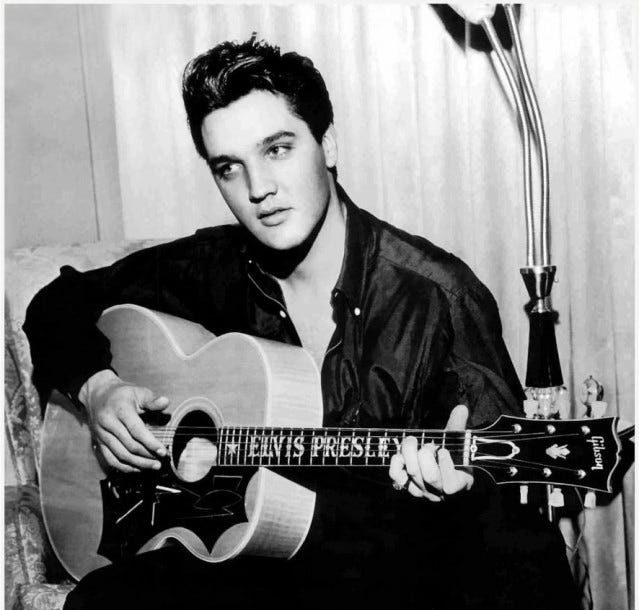
Elvis played several guitars during his career. His most famous early instrument was a 1942 Martin D-18 acoustic guitar.
He used the Martin D-18 during the early Sun Records period. The guitar had a natural look at first, but Elvis later decorated it with a distinctive design. He also used a Gibson J-200, one of the large, powerful acoustic guitars often linked with his image.
Other guitars associated with Elvis include:
• Martin D-28 acoustic guitars
• Gibson J-200 acoustic guitars
• Gibson Dove and similar acoustic models
• Fender electric guitars
• Custom-made stage guitars
The exact guitar varied by year, recording, tour, and television appearance. Photographs can also create confusion because Elvis sometimes used a guitar as a visual prop even when another musician handled most of the backing part.
His famous Gibson J-200 became strongly linked to his public image. Its large body gave it a bold appearance, and it suited the visual drama of early rock and roll. Elvis sometimes used guitars with custom finishes, colored paint, or decorative details.
The instrument was part of the show, but it was not only decoration. Elvis knew how to hold it, strum it, and use it to support his performance.

How Elvis used the guitar in his music
Elvis mainly used the guitar for rhythm and texture. He played chords while singing, added short fills, and used the instrument to drive the beat.
His playing often had three main jobs:
• Supporting his vocal line
• Adding movement between phrases
• Creating a visual link with country and blues traditions
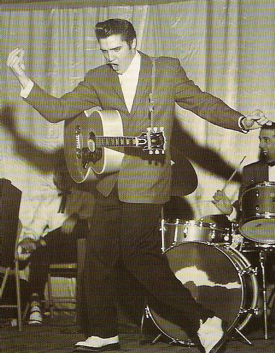
In early performances, Elvis often held the guitar high and moved with it. His body motion made the instrument seem more active than the notes alone might suggest. This helped create the excitement that shocked and thrilled audiences in the 1950s.
The guitar also gave Elvis a sense of control. Early performers often needed a way to fill space on stage. A guitar helped them look and sound like complete musicians, even when a small band supported them.
On recordings, the guitar heard in an Elvis song was not always played by Elvis. Session musicians often supplied guitar parts, and the sound of a record came from the entire band. This is one reason the question “did elvis play the guitar” needs a careful answer.
Elvis played guitar, but not every guitar part on an Elvis recording came from him. Good music research separates his personal playing from the work of the musicians around him.

Did Elvis play guitar on his recordings?
Sometimes, yes. However, the answer depends on the recording and the session.
During the early Sun Records period, Elvis played guitar in the studio and during performances. Scotty Moore played a major guitar role, while Bill Black played bass. The blend of Elvis’s rhythm guitar, Moore’s electric guitar, and Black’s bass helped create the raw Sun sound.
On later sessions, professional musicians often played the main guitar parts. Elvis sometimes focused on singing, arranging, supervising, or delivering the emotional performance. Studio records were team efforts, not always solo displays.
Several factors make it difficult to identify every guitar part:
• Multiple guitars could be recorded at once
• Session musicians could double or replace a part
• Overdubbing changed the final sound
• Live broadcasts did not always show every musician clearly
• Elvis sometimes held a guitar for presentation rather than continuous playing
The safest statement is this: Elvis was a genuine guitar player, but he was not the only guitarist in his recordings. His role changed as his career grew.
This is common in popular music. A singer may play an instrument during rehearsals or early sessions, then work with expert players for a larger studio production. That does not make the singer a fake musician. It shows how professional recordings are built.
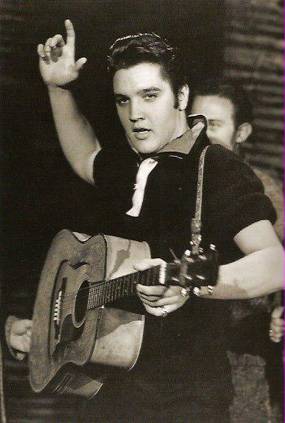
Was Elvis a good guitar player?
Elvis was a capable and influential rhythm guitarist, but he was not usually considered a technical guitar master.
He could play basic chords, keep time, strum with energy, and use the instrument naturally on stage. He understood how a guitar could support a vocal performance. These skills were important, even if he did not perform complex solos.
It is useful to judge Elvis by the role he wanted the guitar to play. If the standard is advanced fingerstyle technique, fast lead guitar, or difficult jazz harmony, Elvis was not among the top guitarists. If the standard is rhythm, stage presence, musical feel, and cultural impact, his guitar work mattered greatly.
His style had some clear limits:
• He did not often perform long guitar solos
• His chord vocabulary was not highly complex
• Other guitarists played many featured parts
• His guitar technique was less developed than his vocal style
Still, simple does not mean weak. A strong rhythm part can make a song move. A single chord pattern, played with the right timing and attitude, can be more effective than a page of difficult notes.
One practical lesson stands out. Beginners often chase speed before learning rhythm. Elvis’s example shows that steady timing, confident posture, and strong musical intent can make simple playing memorable.
Elvis’s most important guitar moments
Elvis used the guitar in several moments that helped define his career.
Early Sun Records performances
At Sun Records, Elvis appeared with a guitar while performing songs such as “That’s All Right.” The instrument connected him to country music while his voice and phrasing drew from blues and gospel.
This combination helped create something new. The guitar was not separate from the sound. It was part of the bridge between older Southern styles and early rock and roll.
Television appearances
During early television appearances, the guitar became part of Elvis’s visual identity. He could strum, move, and pose with the instrument while the camera focused on his unusual energy.
The guitar helped audiences understand him. It suggested a country performer, but his movement and vocal style pushed far beyond traditional country presentation.
The 1968 comeback special
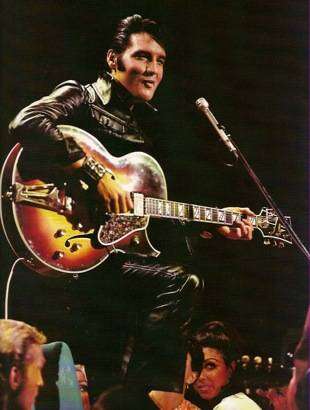
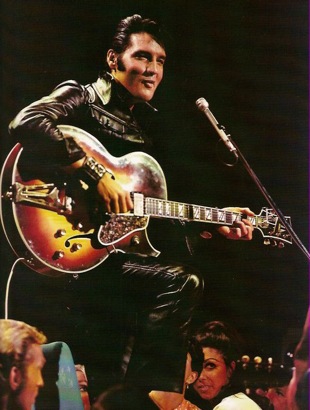
Elvis famously used a dark acoustic guitar during the informal jam sections of his 1968 television comeback special. These performances showed him close to the instrument, surrounded by musicians, and drawing from the direct spirit of his early work.
The guitar helped strip away some of the large production elements associated with his later career. In that setting, the instrument felt personal and immediate.
Las Vegas and later concerts
In the 1970s, Elvis often used guitars as part of a larger stage presentation. He may have played short sections, held the guitar during certain songs, or used it for visual effect while the band carried the detailed instrumental work.
These later appearances should not be judged by the same standard as his early trio performances. His role had changed from young guitarist-singer to headline entertainer with a large ensemble.
Why the guitar mattered to Elvis’s image
The guitar made Elvis look approachable, rebellious, and connected to American roots music. Before electric instruments and large stage productions became common, an acoustic guitar could signal that a performer was close to the audience.
For Elvis, the guitar carried several meanings:
• It linked him to country music
• It suggested that he was a working musician
• It supported his early singer-songwriter image
• It gave his movements a clear visual focus
• It helped separate him from polished pop singers of the era
His guitar was almost like a second costume. A suit, hairstyle, and guitar could tell the audience who he was before he sang a note.
That image had power, but it also created confusion. Some viewers assumed that holding the guitar meant Elvis played every part on every record. Others went too far in the opposite direction and treated the instrument as a prop. The truth sits between those views.
Elvis played guitar, and the guitar helped shape his identity. At the same time, his recordings depended on skilled musicians who added many of the instrumental details.

Elvis guitar playing compared with other musicians
Elvis should not be compared directly with artists whose main role was lead guitar. His musical role was closer to a singer who used rhythm guitar to strengthen the performance.
Scotty Moore, for example, was a more advanced guitarist and played major lead parts during Elvis’s early recordings. James Burton later became one of the key guitarists associated with Elvis’s live sound. Other studio and touring musicians also contributed important guitar work.
A fair comparison looks at function:
• Elvis used guitar to support his voice and stage presence
• Scotty Moore used guitar to create sharp, memorable lead lines
• James Burton used guitar to add country, rock, and modern electric textures
• Session players helped build polished studio arrangements
This does not reduce Elvis’s musicianship. It explains it. A band works best when each person serves the song.
In practical terms, Elvis was closer to a strong rhythm player and performer than to a guitar specialist. His value came from the full package: voice, rhythm, movement, timing, and emotional delivery.
What beginners can learn from Elvis’s guitar style
Elvis offers useful lessons for anyone learning guitar, even if their goal is not to imitate him.
Start with rhythm
Practice changing between simple chords without stopping. A steady beat is more useful than a difficult chord played badly.
Play songs you understand
Elvis learned through the music he loved. Choose songs that make you want to pick up the guitar each day.
Support the voice
Try singing while playing simple chords. The goal is not to fill every space. The guitar should help the song breathe.
Use dynamics
Play some parts softly and others with more force. Elvis understood that energy comes from contrast, not from playing everything loudly.
Avoid copying the pose without learning the part
A guitar can look impressive, but the sound matters most. Practice the rhythm before focusing on stage movement or appearance.
Listen to the whole band
Elvis’s best work came from interaction with other musicians. Pay attention to the bass, drums, piano, and lead guitar. Good playing is often about responding, not showing off.
I cannot claim personal concert or studio experience, but a useful research-based observation is clear: people often remember Elvis’s movement first and his rhythm second. That is why learners should study both the recorded sound and the visual performance. The two worked together.
Common myths about Elvis and the guitar
Several myths continue to surround Elvis’s guitar playing.
Myth: Elvis could not play at all
This is false. He played guitar from a young age and used it during early performances and recordings.
Myth: Elvis played every guitar part on his records
This is also false. Many recordings included professional guitarists and session musicians. His personal involvement varied by song and session.
Myth: Elvis was a top technical guitarist
This claim is overstated. Elvis was a strong rhythm player and a major performer, but he was not known for advanced lead guitar technique.
Myth: The guitar was always only a prop
That is too simple. The guitar was visually important, but Elvis could also play it and used it musically, especially during his early career.
Myth: His guitar style had no influence
This is misleading. His approach influenced how singer-guitarists presented themselves in early rock and roll. His use of rhythm, attitude, and movement became part of the language of popular performance.
The best historical answer avoids extremes. Elvis was neither a helpless poser nor a hidden guitar virtuoso. He was a real player whose main musical power came from combining guitar, voice, rhythm, and presence.
Frequently Asked Questions About Did Elvis Play the Guitar
Did Elvis really know how to play guitar?
Yes, Elvis knew how to play basic chords and rhythm guitar. He learned largely by ear and used the instrument in early performances, recordings, and television appearances.
What was Elvis’s first guitar?
Elvis received a guitar for his 11th birthday in 1946. It is commonly identified as a Kay or similar beginner acoustic guitar, although details about the exact instrument vary across historical accounts.
Did Elvis play guitar on “That’s All Right”?
Elvis is associated with guitar playing during the early Sun Records period, including performances of “That’s All Right.” Scotty Moore also played a central guitar role, so the recording should be understood as a group performance.
Was Elvis better at singing or guitar?
Elvis was far more accomplished and influential as a singer and performer. His guitar playing was useful and expressive, but his voice, phrasing, and stage presence were his greatest strengths.
What guitar is Elvis most famous for playing?
He is strongly associated with the Gibson J-200 acoustic guitar and the Martin D-18 used during his early career. He played other guitars as well, and the instrument changed across different periods.
Did Elvis play electric guitar?
Elvis handled and played electric guitars at different points, but he was mainly identified with acoustic guitar in his early image. Professional guitarists often provided the featured electric guitar parts in his recordings and shows.
Did Elvis write songs on guitar?
The guitar likely helped Elvis work through song ideas and arrangements, but he was not generally known as a major songwriter. Many songs connected with him were written by professional songwriters.
Why did Elvis hold a guitar on stage?
The guitar supported his rhythm and reinforced his connection to country, blues, and early rock music. It also became an important visual part of his performance style.
Conclusion
So, did elvis play the guitar? Yes. Elvis played guitar from childhood and used it as a rhythm instrument, a songwriting aid, and a powerful part of his stage image.
He was not a technical guitar virtuoso, and many guitar parts on his records came from skilled session and touring musicians. Yet his guitar playing still mattered because it helped unite his voice, movement, musical roots, and rebellious style.
If you are learning guitar, start with the lesson Elvis demonstrated so well: simple chords can make a lasting impact when the rhythm is strong and the performance feels real. Explore his early recordings, watch his live performances, and listen closely to the musicians around him. Then share your favorite Elvis guitar moment or keep learning from the artists who shaped rock and roll.

Senior Music Reviewer
Alex Carter is a seasoned music reviewer with over a decade of experience in the world of sound and instruments. Passionate about helping musicians and enthusiasts make informed choices, he brings sharp insights and in-depth knowledge to every review. From classical instruments to modern gear, Alex combines technical expertise with a love for music to deliver content that resonates with readers.
As a Senior Music Reviewer and expert author on Tuneluma.com, Alex is dedicated to sharing honest evaluations, practical advice, and thoughtful commentary to guide readers in their musical journey.