How Do You Play An F Chord On Guitar: Easy Steps
To play an F chord on guitar, press the first fret, shape the F major form, and strum only clear strings.
Learning how do you play an f chord on guitar can feel difficult at first, but the shape becomes much easier with the right steps. The full F major chord uses a barre, while a smaller version lets beginners play the chord without pressing all six strings. This guide explains both forms, common mistakes, practice methods, and useful chord changes from a practical guitarist’s viewpoint.

What Is the F Chord on Guitar?
The F chord is usually an F major chord. It contains three main notes:
- F, the root note
- A, the major third
- C, the perfect fifth
On guitar, these notes may appear more than once. A full F major barre chord from the low E string to the high E string creates the notes F, C, F, A, C, and F.
The F chord is important because it appears in many songs in the keys of C major, F major, and Bb major. It also teaches skills that you will use for many other barre chords.
If you are searching for how do you play an f chord on guitar, know that there is more than one correct shape. Beginners often start with a small F chord before moving to the full barre version.
How Do You Play an F Chord on Guitar?
There are two useful ways to play an F chord:
- The easy F chord for beginners
- The full F major barre chord
Start with the easy shape if your fingers are new to guitar. Move to the full shape when you can press the strings with steady force and keep each note clear.
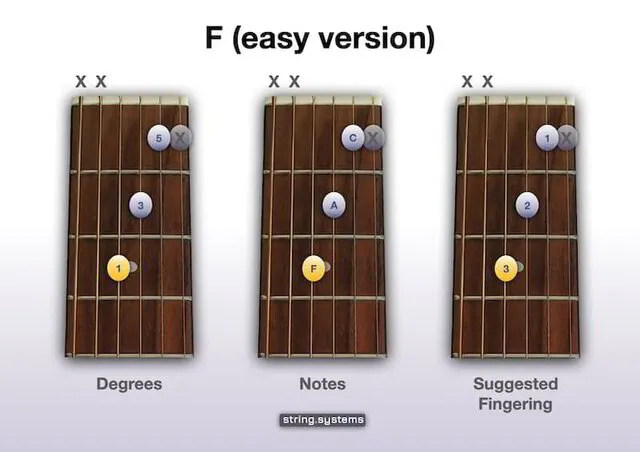
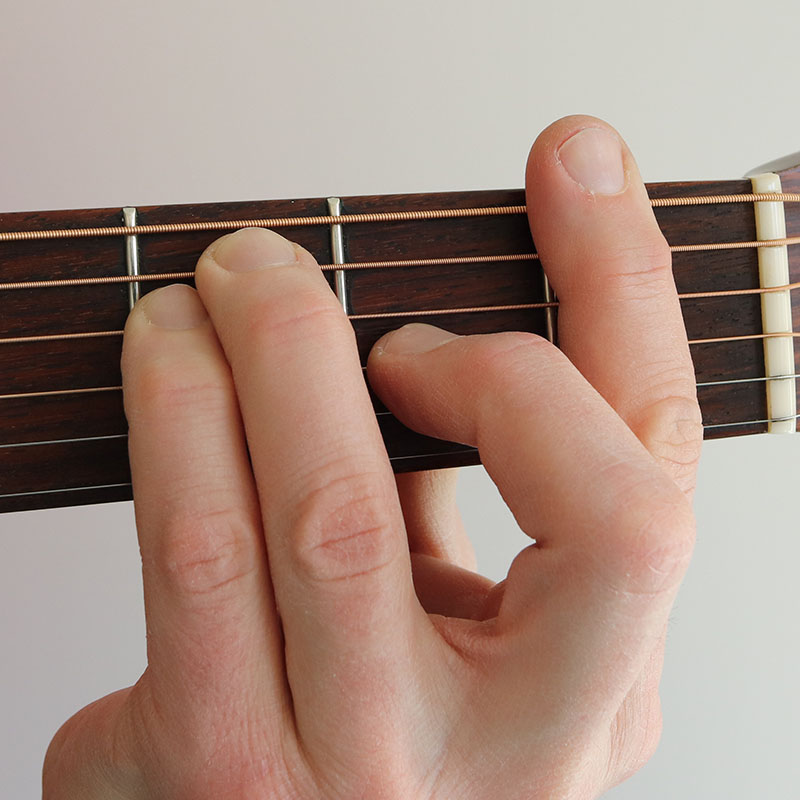
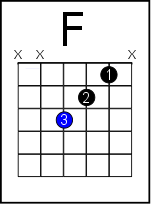
The easy F chord
This version uses the four highest strings. It is often called an F major 7 shape without the open G string when played in a simple beginner form, but the common beginner F shape includes the notes needed for an F major sound.
Place your fingers like this:
- Index finger: First fret of the B string and high E string
- Middle finger: Second fret of the G string
- Ring finger: Third fret of the D string
- Do not play the low E and A strings
The string order is:
e|--1--|  Index
B|--1--|  Index
G|--2--|  Middle
D|--3--|  Ring
A|--x--|  Do not play
E|--x--|  Do not play
Strum from the D string down to the high E string. The chord should sound like F, A, C, and F.
This is often the best answer to how do you play an f chord on guitar for a new player. It needs less pressure than a full barre and helps you build finger strength.
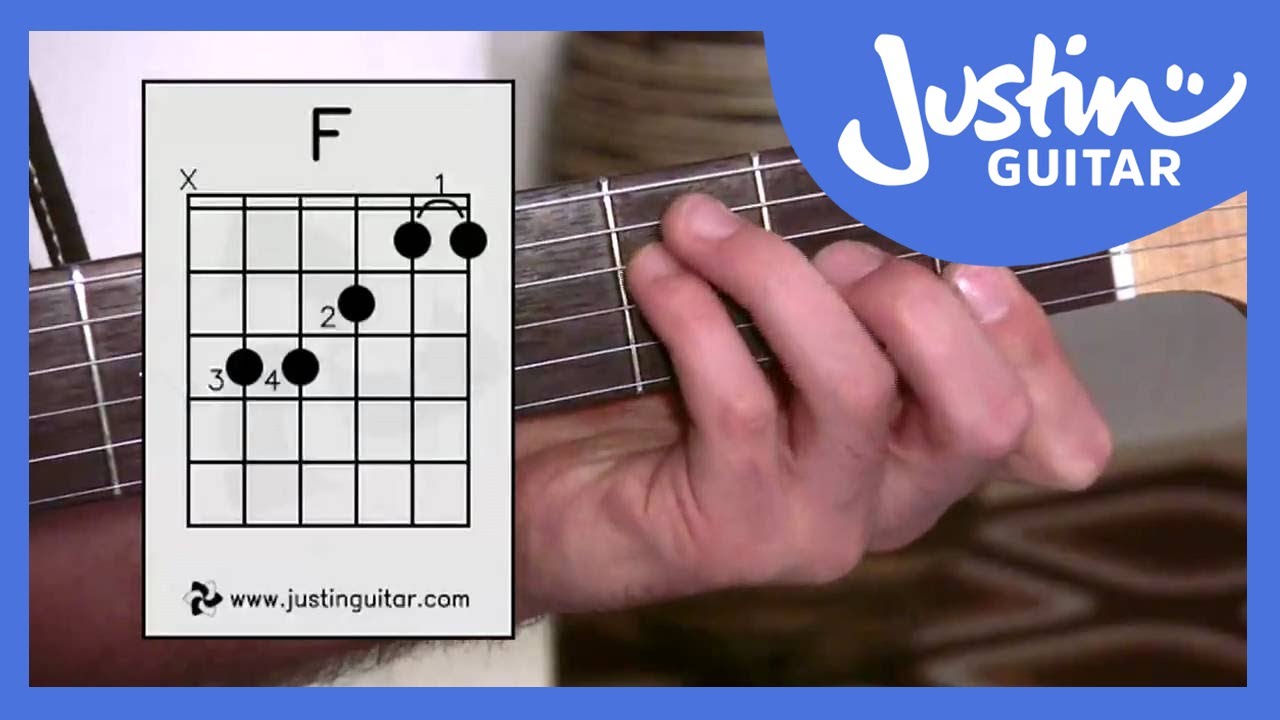
The full F major barre chord
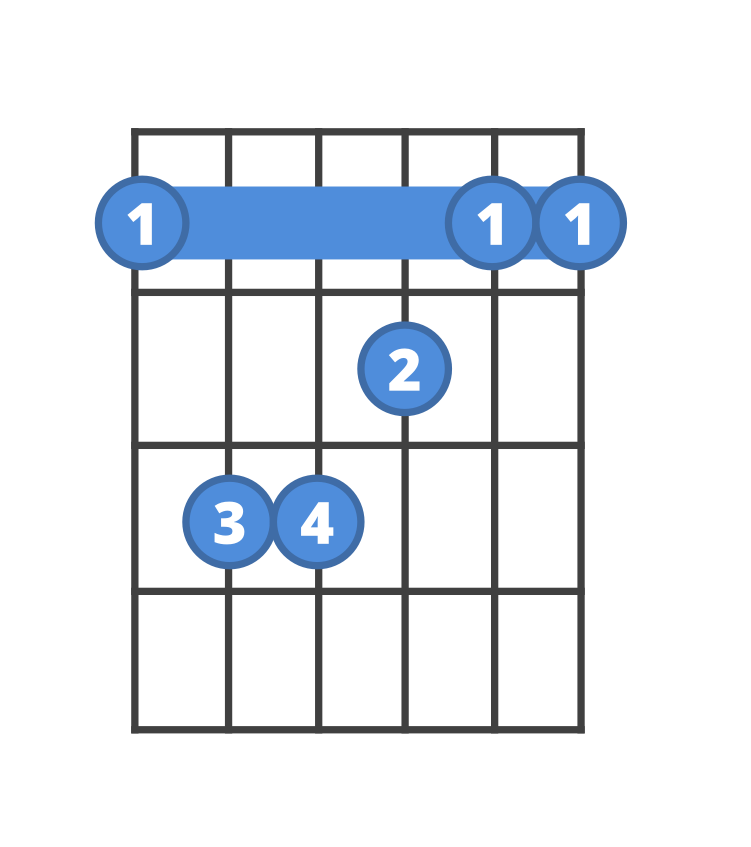
The full F major chord uses the first fret as a barre. Your index finger presses every string at the first fret.
Use this fingering:
- Index finger: Barre all six strings at the first fret
- Middle finger: Second fret of the G string
- Ring finger: Third fret of the A string
- Pinky finger: Third fret of the D string
The chord shape looks like this:
e|--1--|  Index
B|--1--|  Index
G|--2--|  Middle
D|--3--|  Pinky
A|--3--|  Ring
E|--1--|  Index
Strum all six strings. The low E string should produce an F note, which gives the chord a full and strong sound.
When people ask how do you play an f chord on guitar, they often mean this full barre shape. It is harder at first, but it is also one of the most useful shapes in guitar playing.
How to Form the Easy F Chord Step by Step
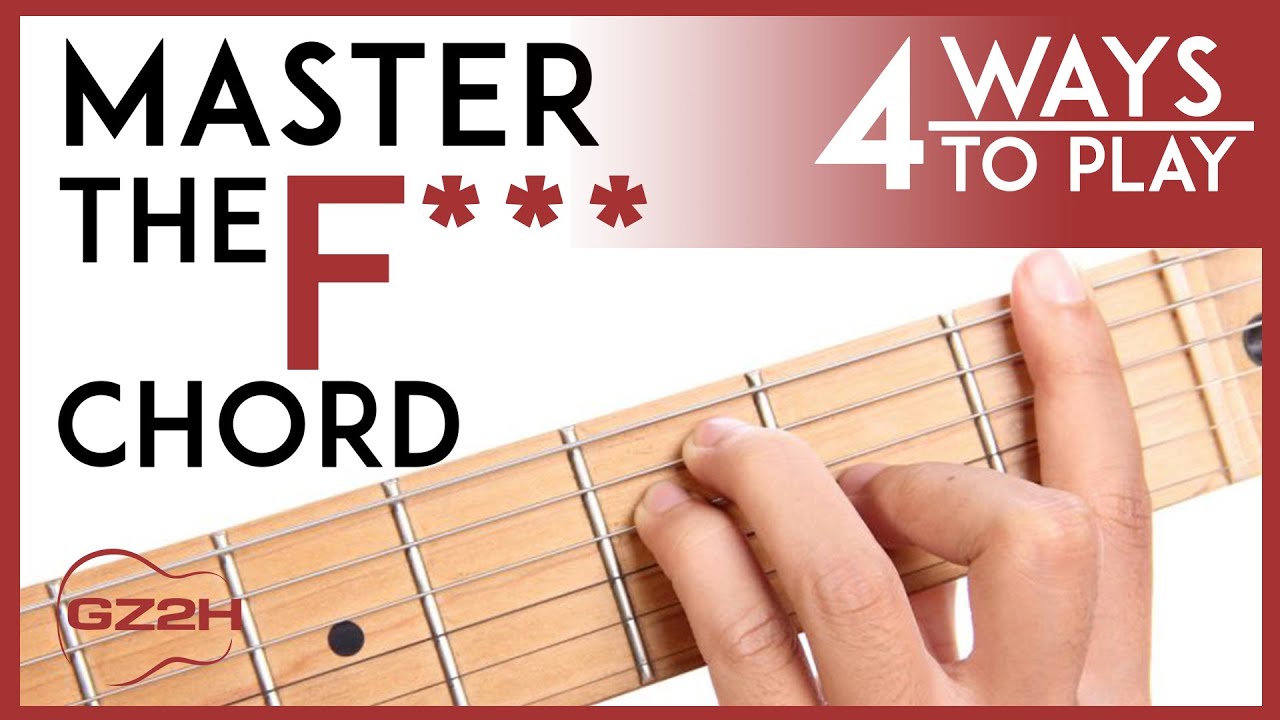
A slow setup makes the chord much easier. Follow these steps:
- Sit with the guitar in a comfortable position.
- Place your index finger across the first fret of the B and high E strings.
- Put your middle finger on the second fret of the G string.
- Place your ring finger on the third fret of the D string.
- Keep your thumb behind the neck.
- Strum only the D, G, B, and high E strings.
- Play each string one at a time to check the sound.
Your fingers should stay close to the frets. Do not place them in the middle of the fret space. A position near the metal fret wire usually needs less force and creates a cleaner note.
A common mistake is letting the index finger touch the open G string area. If the G string sounds muted, move your index finger slightly toward the floor or adjust the bend in your finger.
When learning how do you play an f chord on guitar, focus on clean notes before speed. A slow, clear chord is more useful than a fast chord that buzzes.
A quick sound check
Play the strings one by one:
- D string: clear
- G string: clear
- B string: clear
- High E string: clear
If one string buzzes, stop and adjust your hand. Do not keep strumming through the problem. Your ear will guide your fingers faster than repeated guessing.
How to Play the Full F Barre Chord
The full F chord is a major milestone for many guitarists. The key is to treat your index finger like a movable capo.
First, lay your index finger across all six strings at the first fret. Try not to squeeze with maximum force. Instead, keep your finger close to the fret and use the side of the finger, where the skin is firmer.
Next, add the other three fingers:
- Middle finger on the G string at the second fret
- Ring finger on the A string at the third fret
- Pinky on the D string at the third fret
Keep your wrist fairly straight. If your wrist bends sharply forward, your fingers may lose room to reach the strings.
Now pick each string from low E to high E. Every note should ring clearly. If several strings sound muted, move the index finger slightly. If only one note fails, adjust the finger responsible for that string.
The answer to how do you play an f chord on guitar is not just a finger chart. It also includes hand position, relaxed pressure, accurate placement, and careful listening.
How much pressure should you use?
Use only enough pressure to make the notes ring. Too much pressure can cause hand pain and make chord changes slower.
Try this test:
- Make the F shape.
- Press hard and strum once.
- Slowly reduce pressure.
- Stop when the notes begin to buzz.
- Add a small amount of pressure again.
That point is close to the pressure you need. With practice, your hand will become more efficient.

Why Is the F Chord So Difficult?
The F chord is hard because the index finger must press several strings at once. Beginners often have not yet built the strength or coordination needed for this motion.
The first fret can also feel tight. There is less space between the nut and the first fret, so your fingers must work in a small area.
Other common reasons include:
- The guitar has high string action.
- The strings are old or heavy.
- The thumb is placed too high behind the neck.
- The index finger is lying too flat in the wrong place.
- The player is pressing harder than needed.
- The fingers are not close enough to the fret.
In my own practice, the biggest improvement came from stopping whenever the chord sounded unclear. I used to repeat the shape again and again without checking each string. Picking the notes one at a time showed me that one small finger movement often fixed the whole chord.
If how do you play an f chord on guitar feels painful, take a break. Mild fingertip soreness is normal for a new player, but sharp pain in the wrist, thumb, or forearm is a sign to stop and adjust your position.
Common F Chord Mistakes and Fixes
Muting the high E string
This often happens when the index finger does not press the first fret correctly. Lift the finger slightly and place it closer to the fret wire.
Buzzing on the B string
The index finger may not be pressing evenly. Roll it slightly toward its bony side and check that the joint is not collapsing.
Playing unwanted strings
With the easy F chord, avoid the low E and A strings. Rest the edge of your strumming hand near the bridge, or practice aiming your pick at the D string.
Using too much thumb pressure
A tight thumb can make the entire hand tired. Keep the thumb behind the neck and let it move freely as you change chords.
Changing too slowly
Do not practice only the chord by itself. Practice moving between chords in short loops, such as:
- C to F
- G to F
- Am to F
- Dm to F
These changes appear in many songs and help your fingers learn useful movements.
When learning how do you play an f chord on guitar, mistakes are not proof that you are failing. They are information. Each buzz tells you which part of the shape needs attention.
Easy Exercises for Building the F Chord
The one-minute hold
Make the easy F shape. Hold it for five seconds, release it, and repeat for one minute. Rest if your hand becomes tense.
The string check
Form the chord and pick each string separately. Fix any muted or buzzing note before playing the chord again.
The silent shape exercise
Place your fingers on the F chord without strumming. Lift them away, then form the shape again. Repeat ten times.
This builds muscle memory. It also helps your fingers land together instead of arriving one at a time.
The chord change exercise
Set a timer for two minutes. Move between C and F slowly. Count each change, but only count a change when the F chord is placed correctly.
Speed should come later. Accuracy creates speed naturally.
The pressure release exercise
Hold the chord and strum once. Release most of the pressure without removing your fingers. Strum again. Continue until you can feel how little pressure is truly needed.
This exercise is especially useful for the full barre form. It teaches your hand to stay relaxed during longer playing sessions.

How Long Does It Take to Learn the F Chord?
Many beginners can play the easy F chord within a few practice sessions. The full F barre chord may take several weeks or longer, depending on practice time, hand strength, guitar setup, and past experience.
Short practice sessions often work better than one long session. Try five to ten minutes at a time, once or twice each day.
Your progress may look like this:
- Week one: Form the easy F shape and check each note.
- Week two: Change between F and simple open chords.
- Week three: Begin testing the full barre shape.
- Later weeks: Use the full F chord in songs and chord progressions.
There is no fixed deadline. A player with a well-set-up guitar may learn faster than someone using high-action strings. If your guitar feels unusually hard to fret, ask a qualified guitar technician to check the action and neck setup.
The best way to understand how do you play an f chord on guitar is to practice the shape in real music. Even one simple song can make the work feel more meaningful.
Songs and Chord Progressions That Use F
The F chord appears in thousands of songs. It often works with C, G, Am, and Dm.
Try these progressions:
C, F, G, C
This progression has a bright, familiar sound. Practice four slow downstrokes on each chord.
Am, F, C, G
This is a common modern pop progression. Start with the easy F shape, then try the full barre when the changes feel steady.
Dm, Bb, F, C
This progression is useful for practicing several shapes that require careful finger movement. Use a slow tempo and keep your strumming even.
At first, pause briefly before the F chord. That is fine. Over time, reduce the pause by moving only the fingers that need to move.
If you are still wondering how do you play an f chord on guitar, playing it inside a progression will teach you more than memorizing a diagram alone.
Choosing Between the Easy and Full F Chord
Both forms have a place in your playing.
Choose the easy F chord when:
- You are a new guitarist.
- You want a quick way to play songs.
- You are still building finger strength.
- The song does not require a low F bass note.
- You need a lighter sound.
Choose the full F barre chord when:
- You want all six strings to ring.
- You need a strong bass note.
- You want to move the shape to other frets.
- You are playing with a band.
- You want to develop barre chord skills.
The easy shape is not a shortcut to be ashamed of. It is a useful voicing. Professional guitarists often choose smaller chord shapes because they fit the song, the arrangement, and the sound they want.
The full form is valuable, but it is not always the best choice. Good guitar playing means choosing the shape that serves the music.
Tips for Better F Chord Technique
Keep your practice calm and focused. The following habits can make a major difference:
- Warm up with gentle finger movements.
- Keep your fretting hand relaxed.
- Use the tips of your fingers for the middle, ring, and pinky notes.
- Place fingers near the fret wire.
- Keep your thumb behind the neck.
- Practice with a clean tone so mistakes are easy to hear.
- Use a metronome at a slow speed.
- Stop when you feel sharp pain.
- Record yourself once a week to track progress.
Your guitar setup matters too. Light or extra-light strings may feel easier for beginners, though they can produce a slightly softer tone. A technician can also check whether the strings sit too high above the fretboard.
In my experience, guitarists often improve faster when they practice less force and more accuracy. Think of your fingers as placing small keys on a lock. Force alone does not open the lock; correct placement does.
Frequently Asked Questions About How Do You Play an F Chord on Guitar
How do you play an F chord on guitar as a beginner?
Start with the smaller F shape that uses the D, G, B, and high E strings. Place your index finger on the first fret of the B and high E strings, your middle finger on the second fret of the G string, and your ring finger on the third fret of the D string.
Why does my F chord sound muted?
A muted F chord usually means one finger is touching a nearby string or the index finger is not pressing evenly. Pick each string separately and adjust the finger that causes the muted sound.
Do I have to play the full F barre chord?
No. The easy F chord is perfectly useful for many songs. Learn the full barre chord when you need a fuller sound or want to move the shape around the neck.
How long does it take to learn the F chord?
The easy shape may become comfortable within a few days or weeks of regular practice. The full barre chord often takes longer, so focus on steady progress rather than a specific deadline.
Can I use a capo instead of playing an F chord?
A capo can change the key and let you use easier chord shapes, but it does not teach the F chord itself. It is a practical tool for songs, while learning the F shape builds lasting technique.
How do you play an f chord on guitar without pain?
Use less pressure, keep your wrist relaxed, and practice in short sessions. Stop if you feel sharp pain, numbness, or pain in the wrist or forearm.
Conclusion
The easiest way to learn how do you play an f chord on guitar is to begin with the smaller F shape, check each note, and practice slow chord changes. Once that shape feels natural, work toward the full F major barre chord with your index finger across the first fret.
Do not rush the process. Practice for a few focused minutes each day, listen for clear notes, and keep your hand relaxed. Try the F chord in a simple progression today, then explore beginner guitar lessons and songs that use it.

Senior Music Reviewer
Alex Carter is a seasoned music reviewer with over a decade of experience in the world of sound and instruments. Passionate about helping musicians and enthusiasts make informed choices, he brings sharp insights and in-depth knowledge to every review. From classical instruments to modern gear, Alex combines technical expertise with a love for music to deliver content that resonates with readers.
As a Senior Music Reviewer and expert author on Tuneluma.com, Alex is dedicated to sharing honest evaluations, practical advice, and thoughtful commentary to guide readers in their musical journey.