A Flat Major Scale Piano

A Flat Major Scale Piano: Easy Guide For Beginners

The A flat major scale piano pattern uses four flats and creates a warm, rich sound.

Learning the a flat major scale piano players use is a smart step toward better technique, key awareness, and musical expression. This guide explains its notes, fingering, chords, notation, common mistakes, and useful practice methods in a clear way. Whether you are new to scales or preparing a piece in A-flat major, you will find practical advice you can use at the keyboard today.

What Is the A Flat Major Scale on Piano?

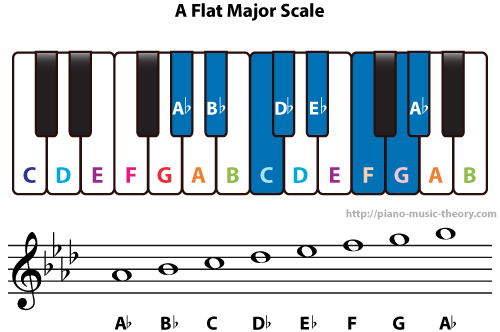
The A-flat major scale is a seven-note scale built from the A-flat major key. Its notes are:

A♭, B♭, C, D♭, E♭, F, and G

After G, the pattern begins again on A♭. On a piano, this scale uses four black keys:

• A♭
• B♭
• D♭
• E♭

The white keys are C, F, and G. This mix gives the scale a smooth shape under the fingers.

The A-flat major scale has four flats in its key signature: B♭, E♭, A♭, and D♭. It is the relative major key of F minor, which means both keys share the same notes.

When practicing the a flat major scale piano pattern, think of the scale as a musical path rather than a random group of keys. Each note has a clear place, and the correct fingering helps your hand move across that path with ease.
What Is the A Flat Major Scale on Piano?
Source: piano-music-theory.com

A Flat Major Scale Piano Notes and Key Signature

The order of notes in the A-flat major scale is:

Scale degree Note Role
1 A♭ Tonic
2 B♭ Supertonic
3 C Mediant
4 D♭ Subdominant
5 E♭ Dominant
6 F Submediant
7 G Leading tone
8 A♭ Octave

The tonic, A♭, feels like home. The dominant, E♭, creates tension that often wants to return to A♭. The leading tone, G, sits one half step below A♭ and strongly pulls the ear toward the tonic.

The key signature shows the four flats at the beginning of each staff. Once you see those flats, you know that every B, E, A, and D is lowered unless an accidental changes it.

A common mistake is to play D natural or A natural because those keys look familiar. In this key, those notes are normally D♭ and A♭. Good scale reading depends on watching the key signature before playing.
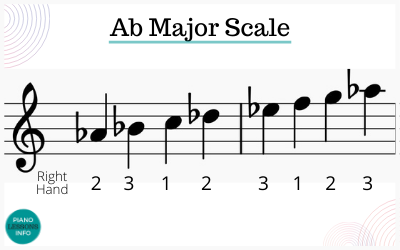
A Flat Major Scale Piano Notes and Key Signature
Source: piano-lessons-info.com

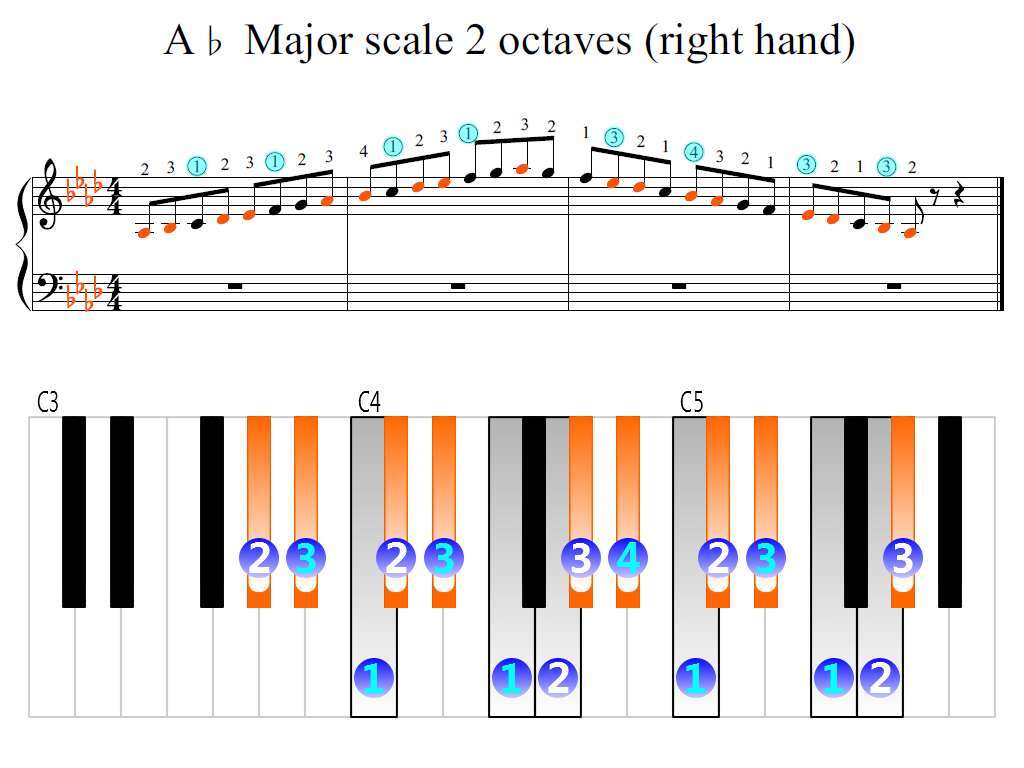
A Flat Major Scale Piano Fingering

Correct fingering makes the a flat major scale piano exercise feel balanced. It also prepares your hand for arpeggios, chords, and fast passages.

Right-hand fingering

Use this pattern for one octave:

  1. A♭ with finger 2
  2. B♭ with finger 3
  3. C with finger 1
  4. D♭ with finger 2
  5. E♭ with finger 3
  6. F with finger 4
  7. G with finger 5
  8. A♭ with finger 1

Written as a simple pattern, the right hand uses:

2-3-1-2-3-4-5-1

The thumb passes under after playing C. Do not twist the wrist or lift the elbow. Keep the movement small and relaxed.

Left-hand fingering

Use this pattern for one octave:

  1. A♭ with finger 3
  2. B♭ with finger 2
  3. C with finger 1
  4. D♭ with finger 4
  5. E♭ with finger 3
  6. F with finger 2
  7. G with finger 1
  8. A♭ with finger 3

Written simply, the left hand uses:

3-2-1-4-3-2-1-3

The left hand crosses over after G. This can feel less natural at first, so practice it slowly with a loose wrist.

For two octaves, repeat the same pattern after the first A♭. The ending fingering changes slightly depending on your method book, but the basic thumb and finger movement stays the same.

A Flat Major Scale Piano Fingering
Source: piano-fingering.org

How to Play the A Flat Major Scale Piano Exercise

Start with one hand at a time. Play each note slowly and listen for even tone. A scale should sound like a smooth row of beads, not a group of separate bumps.

Follow these steps:

  1. Place your hand in the correct starting position.
  2. Play one octave slowly.
  3. Keep every finger close to the keys.
  4. Pause at the top note.
  5. Come back down with the same relaxed motion.
  6. Repeat with the other hand.
  7. Practice both hands together only when each hand feels secure.

Begin at about 50 beats per minute. Play one note per beat. Increase the speed by small amounts only when your fingers stay even and relaxed.

Use different rhythms to improve control:

• Long-short rhythm
• Short-long rhythm
• Groups of three
• Groups of four
• Accent every second or third note

Rhythm practice helps reveal weak fingers. It also prevents the scale from becoming a mindless warm-up.

In my own teaching and practice, the biggest improvement often comes from slowing down. Many players rush the thumb crossing and then repeat the error at a faster speed. Slow practice gives the hand time to learn the right movement.
How to Play the A Flat Major Scale Piano Exercise
Source: piano-keyboard-guide.com

A Flat Major Scale Piano Chords

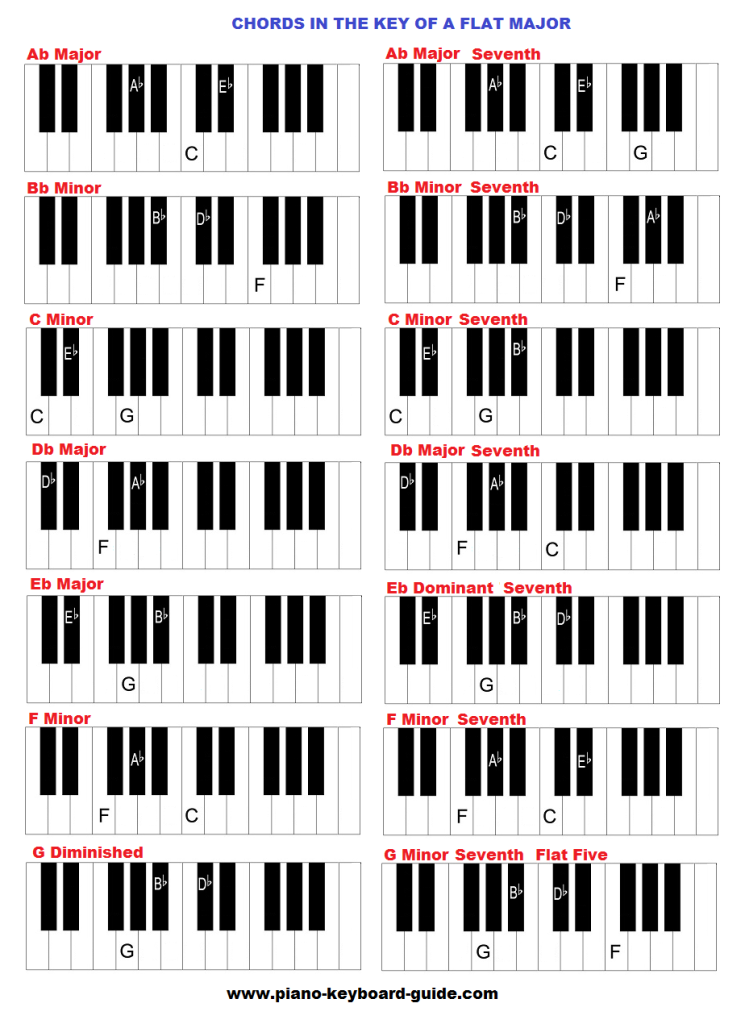
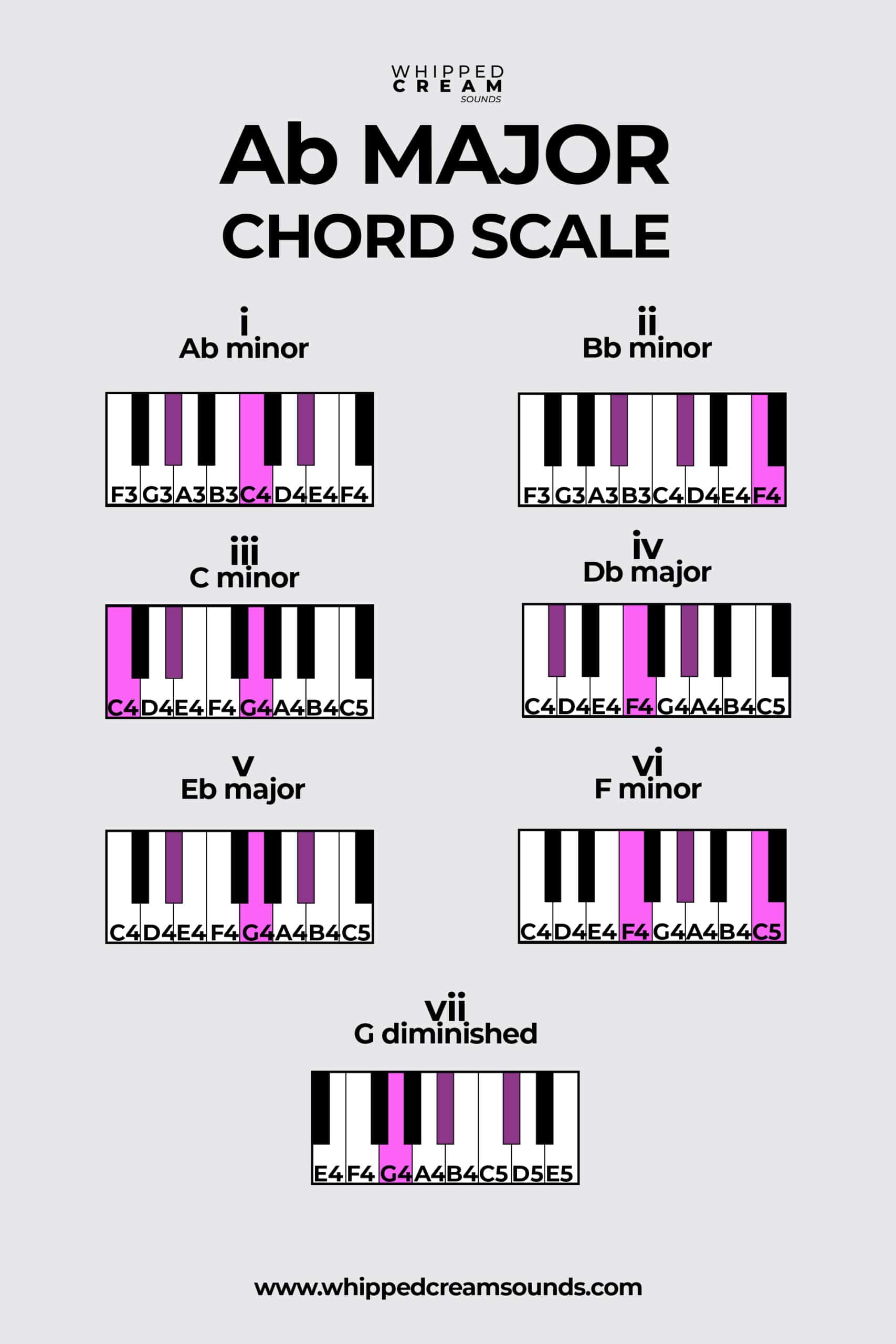
The A-flat major scale creates seven diatonic triads. Each chord uses only notes from the scale.

Degree Chord Notes Quality
I A♭ major A♭, C, E♭ Major
ii B♭ minor B♭, D♭, F Minor
iii C minor C, E♭, G Minor
IV D♭ major D♭, F, A♭ Major
V E♭ major E♭, G, B♭ Major
vi F minor F, A♭, C Minor
vii° G diminished G, B♭, D♭ Diminished

The main chords are A♭ major, D♭ major, and E♭ major. These are the one, four, and five chords, often written as I, IV, and V.

A simple progression is:

A♭ major – D♭ major – E♭ major – A♭ major

This is written as:

I – IV – V – I

Another useful progression is:

A♭ major – F minor – D♭ major – E♭ major

This pattern appears in many styles, including pop, gospel, film music, and classical music.

Practice the chords after playing the scale. This connects single-note technique with harmony and helps you understand how songs are built.
A Flat Major Scale Piano Chords
Source: piano-music-theory.com

A Flat Major Scale Piano Chords in Root Position and Inversions

Chord inversions let you move between chords without jumping across the keyboard. In an A-flat major progression, close inversions often create smoother motion.

For example, the A♭ major chord in root position is:

A♭, C, E♭

Its first inversion is:

C, E♭, A♭

Its second inversion is:

E♭, A♭, C

Try moving from A♭ major to D♭ major with the smallest possible finger movement. You do not need to move the whole hand far. Keep common notes in place when possible.

This skill is especially useful when playing the a flat major scale piano chords as accompaniment. It makes the music sound connected and helps reduce hand strain.

A useful practice routine is to play each chord in three inversions. Then connect I, IV, V, and I without stopping. Aim for a calm hand and an even tone rather than speed.
A Flat Major Scale Piano Chords in Root Position and Inversions
Source: audiblegenius.com

A Flat Major Scale Piano Exercises for Technique

Scale practice works best when it has a clear purpose. You can use the a flat major scale piano pattern to improve several skills at once.

Try these exercises:

Even notes

Play the scale slowly with a metronome. Make each note the same length and volume.

Controlled accents

Accent the first note of each group of four. Then move the accent to the second, third, and fourth notes. This builds finger control.

Staccato practice

Play each note lightly and separately. Keep the wrist flexible. Staccato work can make the fingers feel more independent.

Legato practice

Connect each note smoothly. Listen for gaps between the thumb and the next finger.

Crescendo and diminuendo

Play upward with a gentle crescendo and downward with a diminuendo. This teaches you to shape the scale like a musical phrase.

Opposite motion

Begin both hands on middle A♭ and move outward. This is harder than parallel motion because the hands use different shapes.

Do not force the fingers to stretch. A relaxed hand is more important than a large sound or fast tempo. If your wrist, thumb, or forearm hurts, stop and review your technique.

A Flat Major Scale Piano Exercises for Technique
Source: piano-keyboard-guide.com

Common Mistakes When Playing A Flat Major Scale Piano

Many errors come from ignoring the hand movement rather than from a lack of musical ability.

Watch for these problems:

• Using A natural or D natural by mistake
• Crossing the thumb too early
• Lifting the wrist during the thumb pass
• Playing the black keys only with the thumb
• Rushing the top note
• Practicing fast before learning the fingering
• Pressing too deeply into the keys
• Letting one hand play louder than the other

Black keys sit higher and farther back than white keys. Place the fingers near the front edge of the black keys, but do not reach so far that your wrist collapses.

A useful lesson I learned early is that the thumb should move under the hand, not the entire arm over the thumb. The movement is small. If your elbow swings, you are probably using too much motion.

Record yourself once in a while. A short recording can reveal uneven notes that are hard to notice while playing.

Common Mistakes When Playing A Flat Major Scale Piano
Source: piano-fingering.org

How the A Flat Major Scale Compares With Other Major Scales

The a flat major scale piano shape may seem difficult because it contains four flats. Yet many players find it comfortable once the hand learns the black-key layout.

Compared with C major, A-flat major has more black keys but fewer awkward thumb positions. The black keys can give the fingers a natural guide. Compared with G-flat major, A-flat major has fewer flats and is usually easier for beginners.

The A-flat major scale is enharmonically related to G-sharp major. These keys use notes that sound the same on an equal-tempered piano, but their written spellings differ. G-sharp major would require unusual double sharps, so A-flat major is the more practical notation in most music.

The scale also connects closely with F minor. If a piece uses the same four flats but centers on F, it may be in F minor rather than A-flat major.

When to Use the A Flat Major Scale Piano

The A-flat major scale appears in many kinds of music. It can sound warm, broad, gentle, or noble, depending on the tempo, register, and harmony.

You may encounter it in:

• Classical piano pieces
• Romantic-era works
• Jazz standards
• Gospel and church music
• Film scores
• Vocal arrangements
• Pop songs with flat-based harmony
• Music written for brass instruments

A-flat major is also friendly for some transposing instruments. Many brass instruments naturally favor flat keys, so ensembles often use music based around E-flat, B-flat, or A-flat major.

When improvising, play the A-flat major scale over a simple A-flat major chord. Then use the chord tones A♭, C, and E♭ as stable notes. The other scale notes can create movement and color.

A Simple Seven-Day Practice Plan

A short daily routine is better than one long session each week. Use this plan for the a flat major scale piano technique.

Day one

Learn the notes and key signature. Play each hand separately.

Day two

Practice the right-hand fingering slowly. Focus on the thumb crossing.

Day three

Practice the left-hand fingering. Keep the wrist loose during the crossover.

Day four

Play both hands in parallel motion at a slow tempo.

Day five

Add rhythm patterns and accents. Listen for weak fingers.

Day six

Play the related chords: I, IV, V, and vi.

Day seven

Use the scale in a short improvisation or create a four-chord progression.

Spend five to ten focused minutes on the scale. Then apply it to real music. A scale becomes more useful when you connect it to chords, melodies, and songs.

Frequently Asked Questions About A Flat Major Scale Piano

What notes are in the A-flat major scale on piano?

The notes are A♭, B♭, C, D♭, E♭, F, and G. The scale repeats with A♭ at the octave.

How many flats are in A-flat major?

A-flat major has four flats in its key signature: B♭, E♭, A♭, and D♭. These flats apply throughout the piece unless an accidental changes a note.

What is the fingering for the A-flat major scale?

The right hand commonly uses 2-3-1-2-3-4-5-1. The left hand commonly uses 3-2-1-4-3-2-1-3 for one octave.

What is the relative minor of A-flat major?

The relative minor is F minor. Both keys use the same four flats, but F minor has F as its tonal center.

Is A-flat major hard to play on piano?

It may feel unfamiliar at first because of its four flats. However, the black keys can help guide the hand, and steady practice makes the fingering comfortable.

What are the primary chords in A-flat major?

The primary chords are A-flat major, D-flat major, and E-flat major. In Roman numerals, they are I, IV, and V.

Is A-flat major the same as G-sharp major?

They sound the same on an equal-tempered piano but are spelled differently. A-flat major is usually easier and clearer to read because G-sharp major requires double sharps.

Conclusion

The a flat major scale piano players practice contains A♭, B♭, C, D♭, E♭, F, and G, with four flats in its key signature. Learning the correct fingering gives you a strong base for scales, chords, sight-reading, and improvisation.

Start slowly, keep your wrist relaxed, and connect the scale to A-flat major chords. Practice a little each day, record your progress, and use the scale in real music instead of treating it as a dry exercise. Explore more piano scale guides, try a short A-flat major improvisation, and share your progress with another player or teacher.

Similar Posts

Leave a Reply

Your email address will not be published. Required fields are marked *