The best lubricant for piano pedals is a precision instrument oil used sparingly on clean metal contact points.
A squeaky pedal can ruin an otherwise beautiful performance. The noise may come from a dry hinge, a rubbing spring, or a tight metal joint under the piano. I reviewed the listed oils and related maintenance products with that problem in mind. My top choice is the Professional Piano Tuning Lubricant with Syringe because its narrow applicator should help place a tiny amount of oil where it belongs. Still, no oil should touch felt, wood, strings, or the pedal’s visible surface. See the differences between my top picks at a glance.
| Product | Best use | Applicator | Main caution | Check price |
|---|---|---|---|---|
| Professional Piano Tuning Lubricant | Pedal joints and small piano parts | Syringe | Use only a tiny drop | View on Amazon |
| Piano Lubricant for Tuning and Pedal Systems | General piano maintenance | Product listing dependent | Confirm the label before use | View on Amazon |
| Elliptical Exercise Machine Lubricant | Exercise equipment, not piano pedals | Not stated here | Not my first piano choice | View on Amazon |
| Instrument Oil for String Saddles | Small instrument contact points | 10 ml bottles | May not suit every pedal joint | View on Amazon |
| Instrument Oil for Piano Tuning Pegs | Tuning peg workshop care | 10 ml bottles | Not made specifically for pedals | View on Amazon |
| Instrument Oil for Piano Gears | Metal gears and workshop parts | 10 ml bottles | Avoid felt and wood | View on Amazon |
| Instrument Oil for Capo and Metronome | Small metal parts | 10 ml bottles | Pedal use is not clearly stated | View on Amazon |
| HURRISE Electronic Foot Pedal | Electronic control use | Not an oil applicator | It is not a lubricant | View on Amazon |
Professional Piano Lubricant With Syringe
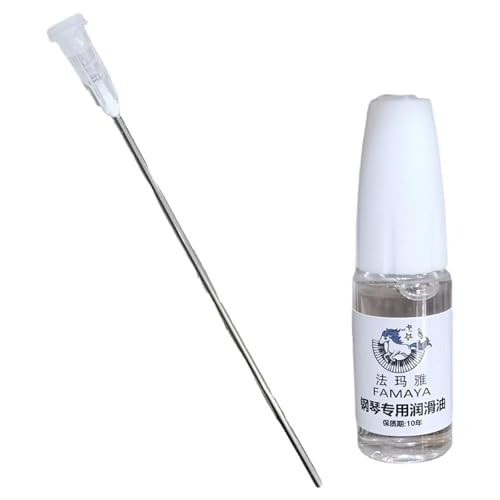
The Professional Piano Tuning Lubricant with Syringe is the strongest match for a squeaky piano pedal in this group. The product name directly points to piano work, and the syringe format can help with controlled placement. That matters because piano mechanisms need very little oil. A large drop can travel into felt or collect dust.
I like this option for careful bench work and small metal joints. I would first clean the joint and test the pedal by hand. Then I would apply the smallest amount that can reduce friction. The listing does not give enough detail to confirm the exact oil chemistry, so I would follow its label and avoid use near strings, wood, felt, and painted parts.
Pros:
- Designed and marketed for piano maintenance
- Syringe should support precise application
- Useful format for small pedal joints
- Helps limit waste during careful work
- Good fit for owners who want a focused piano product
- Less messy than pouring oil from a wide bottle
Cons:
- The exact lubricant formula is not clearly shown in the supplied listing
- It still requires careful handling around felt and wood
- A novice may apply too much pressure or too much oil
What Amazon Buyers Are Saying
The supplied product information does not include enough verified customer review detail for me to claim a clear pattern of buyer results. I would check the current Amazon review section for comments about the syringe tip, leakage, control, and use on pedal hinges. Buyers should also look for recent photos and comments from piano owners rather than relying only on the product title.
My Recommendation
I recommend this product first when the goal is precise lubrication of a piano pedal mechanism. It is not a cure for a bent pedal, loose screw, worn bushing, or a damaged spring. For a careful user, it offers the best balance of purpose and control in this review.
| Category | Rating |
|---|---|
| Pedal suitability | 4.5/5 |
| Application control | 4.5/5 |
| Product information | 3.5/5 |
| Workshop value | 4/5 |
| Overall Rating | 4.3/5 |
Piano Lubricant for Tuning and Pedal Systems
This lubricant is aimed at two areas of piano care: tuning work and pedal systems. That broader purpose may appeal to owners who want one small maintenance bottle for several metal parts. It could be useful for a pedal hinge if the product label confirms that use. The title gives better category guidance than a general household oil.
Still, I would not treat a broad label as proof that every piano part is safe. Tuning hardware, pedal joints, and action parts have different needs. Apply a very small amount to a hidden metal contact point first. If the product lacks clear directions, a piano technician should handle the repair.
Pros:
- Product title directly mentions pedal systems
- May suit more than one piano maintenance task
- Practical choice for a piano workshop kit
- Could reduce the need for several separate products
- Useful for owners who service small metal contact points
Cons:
- The available details do not confirm the formula
- Application instructions need close attention
- Its wider use claim may not fit every piano design
What Amazon Buyers Are Saying
I cannot verify a reliable set of buyer comments from the supplied product data. Before ordering, I would read current reviews for signs of smooth application, bottle quality, and clear instructions. I would give extra weight to reviews that explain the type of piano part tested and the amount used.
My Recommendation
This is a reasonable second choice for someone who wants piano lubricant that names both tuning and pedal work. I would buy it only after checking the current label and safety directions. It is more promising for piano use than general machine oil, but it does not offer the same clearly controlled syringe format as my top pick.
| Category | Rating |
|---|---|
| Pedal suitability | 4/5 |
| Versatility | 4/5 |
| Application control | 3.5/5 |
| Clarity of details | 3.5/5 |
| Overall Rating | 3.8/5 |
Elliptical Exercise Machine Lubricant

This two-piece lubricant is made for elliptical exercise machines and foot pedal exercisers. Its purpose is to help moving machine parts run with less noise and friction. That may sound useful for a piano pedal, but the product category is very different. Exercise equipment often has larger loads, exposed rails, plastics, and parts that move in a way piano pedals do not.
I would not choose this as the best lubricant for piano pedals. It may work on some metal machine joints, but the supplied information does not confirm piano compatibility. The risk is not only poor performance. An unsuitable oil can attract dust, spread to felt, or create a sticky feel under the foot.
Pros:
- Supplied as a two-piece set
- Made for reducing noise in moving equipment
- Intended for mechanical maintenance
- May be useful for an elliptical or foot exerciser
- Could offer value for users who own exercise equipment
Cons:
- Not designed specifically for piano pedals
- The supplied details do not confirm piano-safe use
- Its viscosity and residue behavior are unclear for piano work
What Amazon Buyers Are Saying
The available information does not provide verified review patterns for piano use. I would read customer feedback in its intended exercise-machine category instead. Comments about rail noise or machine motion may not predict results on a piano pedal hinge.
My Recommendation
I would pass on this product for a piano unless a technician confirms that its formula suits the exact joint. It may be a useful exercise-machine lubricant, but product-category fit matters. It earns a low score for this review because the best lubricant for piano pedals should have clear instrument or piano guidance.
| Category | Rating |
|---|---|
| Piano pedal suitability | 2/5 |
| Mechanical purpose | 4/5 |
| Instrument safety information | 2/5 |
| Value for piano owners | 2.5/5 |
| Overall Rating | 2.6/5 |
Instrument Oil for Piano String Saddles

This four-piece instrument oil set targets piano string saddles and friction reduction. The 10 ml bottle size should make it easier to store and use in a repair kit. A small bottle can also help prevent waste when a task needs only a drop. However, a string saddle is not the same part as a pedal hinge.
I see this set as a specialist workshop option rather than a direct pedal solution. A trained technician may find it useful for the parts named in the listing. For pedal work, I would confirm the oil’s material compatibility and use it only on a clean metal point. Keep it far from strings and nearby felt unless the instructions say otherwise.
Pros:
- Made for an instrument maintenance setting
- Listing names piano string saddles
- Four small bottles may help with workshop storage
- Small size supports controlled use
- Focused on friction reduction
Cons:
- It is not clearly made for pedal hinges
- Multiple bottles may be unnecessary for a casual owner
- Oil near strings or felt can cause serious problems
What Amazon Buyers Are Saying
The provided data does not show enough verified customer feedback to summarize buyer trends. I would inspect the current listing for comments about bottle seals, tip control, and the oil’s behavior after application. Reviews about string saddles should not be treated as proof of pedal performance.
My Recommendation
This set may suit a piano technician who already works on string saddles and understands small-part lubrication. I would not rank it above a product that names pedal systems. It is a possible workshop supplement, not my everyday choice for a squeaky pedal.
| Category | Rating |
|---|---|
| Pedal suitability | 3/5 |
| Instrument focus | 4/5 |
| Bottle convenience | 4/5 |
| Risk for inexperienced users | 2.5/5 |
| Overall Rating | 3.4/5 |
Instrument Oil for Piano Tuning Pegs

This four-piece set is labeled for piano tuning pegs. The small 10 ml bottles may be handy in a workshop where precise amounts matter. The listing also points to friction reduction and smooth operation. Those features can sound attractive for pedal repair, but tuning peg care and pedal lubrication are separate jobs.
I would use this only when the label or a qualified technician confirms that it fits the pedal material. A piano pedal may include brass or plated metal, steel parts, bushings, felt, and wood nearby. The correct oil must stay on the intended metal contact area. Do not put it into a tuning pin or pedal joint simply because both parts are made of metal.
Pros:
- Designed for piano-related maintenance
- Four bottles provide useful backup supply
- Small containers can support careful dosing
- Targets smooth operation and reduced friction
- May suit technicians who work on tuning hardware
Cons:
- Its named use is tuning pegs, not pedals
- Pedal compatibility is not established by the title
- More product than many owners need for one repair
What Amazon Buyers Are Saying
The supplied product details do not support a verified summary of customer experiences. I would check current reviews for bottle quality and ease of use. I would ignore any review that recommends spreading oil across a whole piano mechanism without naming the part treated.
My Recommendation
This is a fair workshop product for its stated tuning-peg purpose. It is not my preferred answer for a noisy pedal. Choose it for pedal work only after confirming the formula and application method with a piano professional.
| Category | Rating |
|---|---|
| Pedal suitability | 2.8/5 |
| Piano workshop use | 4/5 |
| Dose control | 3.5/5 |
| Label clarity for pedals | 2.5/5 |
| Overall Rating | 3.2/5 |
Instrument Oil for Piano Gears

This instrument oil is aimed at piano, guitar, and metronome maintenance. The title highlights metal gears and friction reduction. That makes it more relevant to a mechanical piano repair kit than a household spray. Its 10 ml bottles also suggest a small-part approach.
Even so, pedal mechanisms do not always use gears. Many pedals rely on a hinge, rod, spring, guide, or bushing. I would not assume that an oil made for metal gears belongs on every pedal joint. If the label approves the material, apply a tiny amount to the actual metal contact point and remove all excess.
Pros:
- Made for instrument maintenance
- Listing mentions piano use
- Targets metal parts and friction
- Small bottles may help limit over-application
- Could serve several workshop tasks
Cons:
- It focuses on gears rather than pedal hinges
- Multi-instrument use may mean less specific guidance
- Oil can harm nearby felt if it spreads
What Amazon Buyers Are Saying
I do not have enough verified review information to report common buyer outcomes. Before purchase, I would look for current comments about the bottle tip, residue, and use on small metal parts. I would treat positive comments about guitars or metronomes as useful but not conclusive for a piano pedal.
My Recommendation
This is a sensible option for a mixed instrument workshop. It ranks below the piano pedal products because the listing does not clearly focus on pedal systems. I would consider it only for a confirmed metal joint and only with very careful application.
| Category | Rating |
|---|---|
| Pedal suitability | 3/5 |
| Instrument versatility | 4/5 |
| Small-part control | 3.5/5 |
| Specific pedal guidance | 3/5 |
| Overall Rating | 3.4/5 |
Instrument Oil for Capo and Metronome

This four-piece oil set is listed for guitar, piano, capo, and metronome maintenance. Its broad instrument focus may suit a musician who handles several small repairs. The 10 ml bottles should be easy to store. The product description also points to smooth operation during workshop care.
The main concern is fit. A piano capo and a pedal assembly do not have the same job or construction. I would not apply this oil to a pedal until the label clearly allows it. For a minor squeak, cleaning and tightening a safe accessible screw may solve the issue without oil.
Pros:
- Includes piano in its listed instrument uses
- Four bottles may provide long-term workshop supply
- Compact 10 ml format is easy to store
- Made for small maintenance tasks
- May suit owners of several instruments
Cons:
- Pedal use is not clearly stated
- Broad compatibility claims need careful checking
- It may be excessive for a single pedal repair
What Amazon Buyers Are Saying
The provided details do not include enough verified buyer feedback for a fair review summary. I would read current comments about the bottle seal and oil control. I would also check whether reviewers used the product on piano parts similar to the pedal assembly.
My Recommendation
I see this as a general instrument oil set, not a dedicated pedal lubricant. It may work for a confirmed small metal contact point, but I would choose a product with clearer pedal directions first. It is best for a careful hobbyist with several maintenance needs.
| Category | Rating |
|---|---|
| Pedal suitability | 3/5 |
| Instrument range | 4/5 |
| Bottle convenience | 4/5 |
| Specific instructions | 3/5 |
| Overall Rating | 3.5/5 |
HURRISE Electronic Foot Pedal

The HURRISE product is a foot pedal accessory for electronic instruments. It is not an oil, grease, or maintenance fluid. Its purpose is to send a control signal or provide pedal input for compatible electronic equipment. That makes it unrelated to squeaking on an acoustic piano pedal.
I included it because the listing contains the words “piano” and “foot pedal,” but shoppers should not confuse a replacement pedal with a lubricant. It may help someone who needs a momentary switch or controller accessory. It cannot reduce friction inside a traditional pedal mechanism.
Pros:
- May suit compatible electronic instruments
- Useful for players who need a foot controller
- Addresses pedal input rather than lubrication
- Could be relevant to synthesizer or controller setups
- Different function may help avoid a mistaken repair purchase
Cons:
- It is not a lubricant
- It will not fix a squeaky acoustic piano pedal
- Compatibility must match the electronic instrument
What Amazon Buyers Are Saying
The supplied information does not provide verified review trends for this accessory. Buyers should check current comments about plug type, switch action, compatibility, and build quality. Those issues matter for electronic control use, not for piano pedal lubrication.
My Recommendation
Do not buy this product if you need the best lubricant for piano pedals. Consider it only when you need an electronic foot switch for compatible equipment. It earns the lowest score here because it does not perform the task in this review.
| Category | Rating |
|---|---|
| Lubricant suitability | 1/5 |
| Electronic pedal purpose | 4/5 |
| Acoustic piano repair value | 1/5 |
| Purchase clarity | 2/5 |
| Overall Rating | 2/5 |
How to Choose the Best Lubricant for Piano Pedals
Choosing the best lubricant for piano pedals takes more care than picking the thickest oil. A pedal sits inside a delicate system. It may connect to rods, springs, felt, wood, and metal brackets. The right product should reduce friction at one safe point without spreading through the piano.
1. Match the Lubricant to the Piano Part
Start with the source of the noise. Press the pedal slowly and listen. A squeak near the pedal hinge may need a small amount of instrument lubricant. A sound from inside the action may need a technician. A pedal that feels loose may need a screw or bushing repair instead of oil.
Look for a label that mentions piano mechanisms, pedal systems, or instrument maintenance. A product made for exercise equipment or large machine rails may not suit a piano. The same rule applies to tuning-peg and gear oils. Their names show intended use, but they do not prove universal compatibility.
2. Choose Precise Application Over High Volume
More oil does not mean better lubrication. In a piano, a large drop can run into felt or collect dust. It can also reach a surface that should remain dry. A syringe or narrow tip helps place a controlled amount on a small metal joint.
Before applying anything, remove dust from the accessible area. Use a clean, dry cloth. Do not spray into the piano. Do not oil strings, hammers, wood, keys, or felt. If you cannot see the exact metal contact point, stop and ask a qualified piano technician.
3. Check Safety, Value, and the Real Cause
Read the full product label before purchase. Check the material limits, storage advice, and application steps. A small bottle can offer better value than a large bottle if it prevents waste. A multi-bottle set may help a technician but may not make sense for one household repair.
Also check whether oil will solve the problem. Tight hardware, worn parts, rust, or a bent pedal can create noise and poor motion. Lubricant may hide the symptom for a short time while the damage grows. For an expensive grand piano or a pedal that feels unsafe, professional service remains the better choice.
Final Verdict: Which Should You Buy?
My top pick is the Professional Piano Tuning Lubricant with Syringe. Its piano focus and precise applicator make it the best lubricant for piano pedals in this group. The Piano Lubricant for Tuning and Pedal Systems is a solid second choice.
Use only a tiny amount on a confirmed metal joint. Keep oil away from felt, wood, strings, and finishes. If the noise continues, book a piano service rather than adding more lubricant.
FAQs Of best lubricant for piano pedals
What is the best lubricant for piano pedals?
The Professional Piano Tuning Lubricant with Syringe is my top choice from this review. Its piano focus and controlled applicator suit small metal pedal joints.
Can I use WD-40 on a piano pedal?
I do not recommend general-purpose spray products. They may spread, leave residue, attract dust, or reach felt and wood. Use a product labeled for piano or instrument work.
How much lubricant should I apply to a piano pedal?
Use the smallest amount that reaches the clean metal contact point. Start with a tiny drop, move the pedal, and wipe away any visible excess.
Can piano pedal lubricant touch felt or wood?
No. Keep lubricant on the intended metal joint only. Oil can stain felt and wood and may change how nearby parts move.
What if my piano pedal still squeaks after lubrication?
The cause may be a loose screw, worn bushing, bent rod, rust, or a deeper action problem. Stop adding oil and ask a piano technician to inspect it.

Senior Music Reviewer
Alex Carter is a seasoned music reviewer with over a decade of experience in the world of sound and instruments. Passionate about helping musicians and enthusiasts make informed choices, he brings sharp insights and in-depth knowledge to every review. From classical instruments to modern gear, Alex combines technical expertise with a love for music to deliver content that resonates with readers.
As a Senior Music Reviewer and expert author on Tuneluma.com, Alex is dedicated to sharing honest evaluations, practical advice, and thoughtful commentary to guide readers in their musical journey.