A violin bow has zero strings. It has a flat bundle of bow hair, usually made from horse-tail hair, that grips the violin’s strings and makes them vibrate.
If you meant how many hairs are on a violin bow, a typical bow has about 150 to 200 individual hairs. The exact number changes with the bow, the hair used, and the person who rehaired it.
Quick answer
In the United States, violin teachers and repair shops usually call the material on a bow bow hair, not bow strings. A standard violin bow has:
- 0 strings
- About 150–200 hairs
- A bow hair ribbon that runs from the frog to the tip
- A screw that tightens or loosens the hair
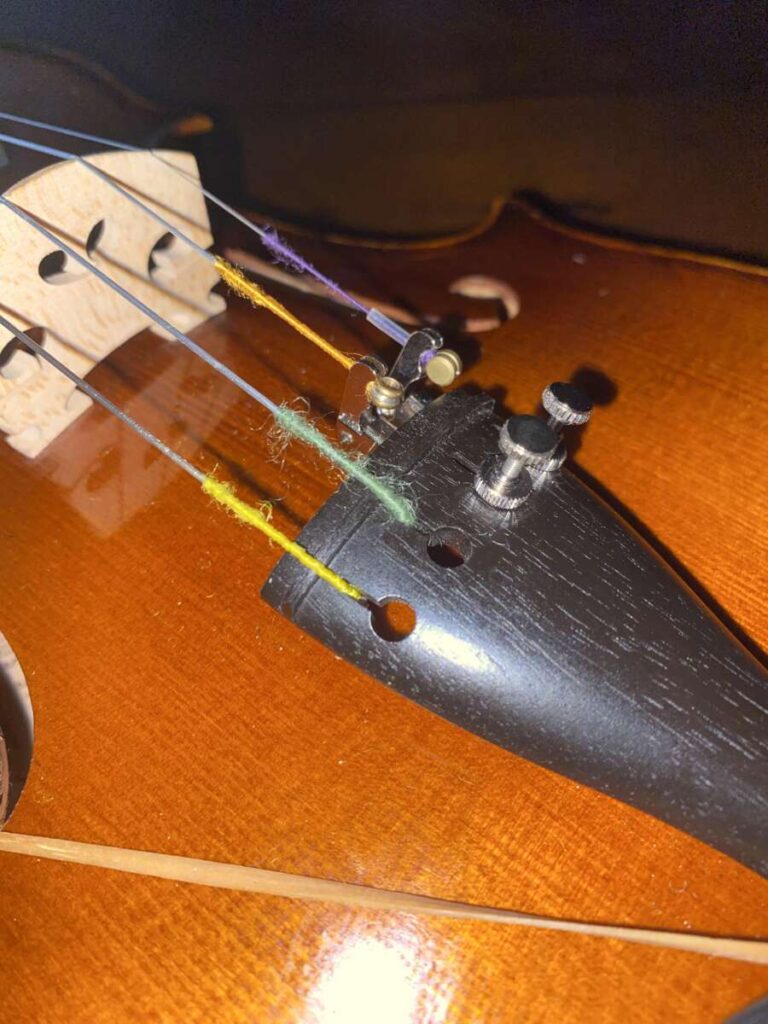
The violin itself has four strings. The bow moves across those strings, but the bow does not contain strings of its own.
What is the hair on a violin bow?
The hair on a violin bow is a long, flat bundle of strands stretched between the frog and the tip. Its job is to catch the violin strings as the player moves the bow.
Most traditional bow hair comes from the tail of a horse. The hair is cleaned, sorted, and fitted into the bow by a trained repair worker, often called a bow rehairer or archetier.
The bow hair is not one solid strip. It contains many separate strands. When tightened, those strands form a ribbon that touches the violin strings.
Why is it called bow hair instead of strings?
A string usually means one long, flexible strand that is stretched under tension. Violin bow hair works as a bundle of many strands. It is also made for friction and grip, while violin strings are made to vibrate as musical sources.
The terms describe different parts:
| Part | Usual number | Main job |
|---|---|---|
| Violin strings | 4 | Vibrate to create musical notes |
| Bow strings | 0 | A violin bow does not have strings |
| Bow hairs | About 150–200 | Grip and excite the violin strings |
| Bow ends | 2 | Hold the hair at the frog and tip |
The bow hair is coated with rosin before playing. Rosin adds controlled friction between the hair and the violin strings.
How many hairs are on a violin bow?
A typical violin bow has roughly 150 to 200 hairs, although there is no single required count for every bow.
The final number can vary because of:
- The width of the bow-hair ribbon
- The thickness and quality of the hair
- The bow’s size and design
- The rehairer’s working method
- Broken or removed hairs
- Whether the bow uses natural or synthetic hair
This range is a practical estimate, not a universal manufacturing standard. A repair shop may not count every strand during a normal rehair. Instead, the worker selects enough suitable hair to create a firm, even ribbon.
Does more bow hair make the bow better?
Not always. More hair does not automatically mean better sound, stronger grip, or higher quality.
A bow with too little hair may feel weak and may not grip the strings well. A bow with too much hair can feel stiff, heavy, or hard to control. The best amount depends on the bow’s design and the player’s needs.
Even tension matters more than simply reaching a certain number of strands. The hair should sit evenly from the frog to the tip, without large gaps or thick lumps.
How does a violin bow make sound?
A violin bow makes sound by using friction.
The basic process is:
- The player applies rosin to the bow hair.
- Rosin helps the hair grip the violin strings.
- The bow moves across a string.
- The string is pulled and released many times each second.
- The vibrating string transfers energy to the violin body.
- The violin body amplifies the sound.
Without enough friction, the bow may slide across the strings and produce a weak or whispery tone. With too much rosin or excess pressure, the sound may become rough, scratchy, or noisy.
The bow does not need to touch all four violin strings at once. Players normally bow one string at a time or play two neighboring strings together.
What are the main parts of a violin bow?
A violin bow has several parts, but only one part directly touches the violin strings: the hair.
Bow hair
The hair forms the playing surface. It runs from the tip to the frog and becomes tight when the player turns the bow screw.
Frog
The frog is the lower section held by the player’s right hand. It contains the mechanism that anchors and tightens the hair.
Bow screw
The screw controls hair tension. Turning it clockwise usually tightens the hair, while turning it counterclockwise loosens it.
Stick
The stick is the long wooden or synthetic part of the bow. It supports the hair and gives the bow its balance and spring.
Tip
The tip holds the upper end of the hair. It is delicate and should not be used to press, tap, or lean on hard surfaces.
What happens if some bow hairs break?
A few broken hairs do not always mean the bow needs immediate repair. It is normal for a small number of hairs to break over time.
However, do not pull loose hairs from the bow. Pulling can disturb the hair wedge inside the frog or tip and may cause more hairs to loosen.
Instead:
- Stop playing if a long hair is catching on your hand or instrument.
- Leave short broken hairs alone if they are not causing trouble.
- Ask a violin teacher or repair shop to trim a problematic hair.
- Have the bow rehaired if many hairs are broken, loose, dirty, or uneven.
A bow may need rehairing when the hair no longer tightens evenly, the ribbon has large gaps, or the bow feels difficult to control even after correct rosin use.
How often should a violin bow be rehaired?
Many players have a bow rehaired about once or twice a year, but the correct schedule depends on use and condition.
A student who plays a few minutes each day may need rehairing less often than a professional who practices and performs for several hours daily. Climate also matters. Dry indoor heat and seasonal humidity changes can affect both the hair and the wooden bow.
Consider professional rehairing when:
- Many hairs have broken
- The hair is stretched and does not tighten well
- The ribbon has uneven thickness
- The hair looks greasy or heavily coated with rosin
- The bow slips even with reasonable rosin use
- The bow needs excessive tightening to play normally
A trained repair professional should replace bow hair. Rehairing requires the correct hair tension, wedges, plugs, and fit. It is not the same as tying a bundle of thread onto the bow.
Can a violin bow use synthetic hair?
Yes. Some bows use synthetic or engineered hair instead of natural horsehair.
Synthetic hair can offer consistent strand size and may suit players who prefer a non-animal material. However, its grip, rosin response, feel, and sound can differ from traditional horsehair.
The choice depends on:
- The bow
- The player’s technique
- The rosin
- The desired feel and tone
- The repairer’s recommendation
A bow with synthetic hair still does not have “strings.” It has a synthetic hair ribbon made from many strands.
Common mistakes about violin bow strings
Mistake 1: Saying a violin bow has four strings
A violin has four strings, but the bow has none. The bow hair contacts those strings and sets them in motion.
Mistake 2: Counting the bow hair as one string
The hair may look like one flat band, but it contains many separate strands. It is better to call it bow hair or a bundle of bow hairs.
Mistake 3: Tightening the bow too much
The hair should be firm but not extremely tight. Over-tightening can weaken the stick and damage the bow’s shape.
As a general playing check, the stick should retain some curve when the bow is tightened for use. A teacher or repairer can show the correct tension for a particular bow.
Mistake 4: Leaving the bow tight after playing
Loosen the bow after each practice session or performance. Keeping the hair tight for long periods can strain the bow.
Mistake 5: Touching the hair
Finger oils can reduce the hair’s grip. Hold the bow by the frog and stick, not by the hair.
A simple way to remember the answer
Use this rule:
The violin has four strings. The bow has hair.
The bow’s hair is usually made of around 150 to 200 strands, but that number is an estimate rather than a fixed rule.
If someone asks, “How many strings does a violin bow have?” the most precise answer is:
None. A violin bow has bow hair, usually about 150 to 200 strands, and it is used to play the violin’s four strings.
Frequently asked questions
Does every violin bow have horsehair?
No. Many traditional bows use horsehair, but some bows use synthetic hair. The material can affect grip, response, and feel.
Are violin bow hairs real horsehair?
Traditional bow hair is usually taken from a horse’s tail. The hair is cleaned and sorted before it is installed in a bow.
Can I replace violin bow hair at home?
It is possible in theory, but it is not a good beginner repair. The hair must be fitted evenly and secured with small plugs and wedges. Poor work can damage the frog, tip, or stick. A trained bow repairer is the safer choice.
Why does my bow not grip the strings?
Common causes include too little rosin, worn or dirty hair, incorrect bow pressure, or a playing angle that reduces contact. If adding a small amount of suitable rosin does not help, ask a teacher or repair shop to inspect the bow.
Can I play a violin without a bow?
Yes. A violin can be played by plucking the strings, a technique called pizzicato. A bow is needed for normal bowed playing, but not for every violin sound.
Final answer
A violin bow has zero strings. It has a ribbon of bow hair, usually made from horse-tail hair, with about 150 to 200 individual strands in a typical setup. The bow uses friction from its rosin-coated hair to make the violin’s four strings vibrate.
For the best results, keep the bow hair clean, avoid touching it, loosen the bow after playing, and have it rehaired by a qualified repair professional when the hair becomes worn or uneven.

Senior Music Reviewer
Alex Carter is a seasoned music reviewer with over a decade of experience in the world of sound and instruments. Passionate about helping musicians and enthusiasts make informed choices, he brings sharp insights and in-depth knowledge to every review. From classical instruments to modern gear, Alex combines technical expertise with a love for music to deliver content that resonates with readers.
As a Senior Music Reviewer and expert author on Tuneluma.com, Alex is dedicated to sharing honest evaluations, practical advice, and thoughtful commentary to guide readers in their musical journey.