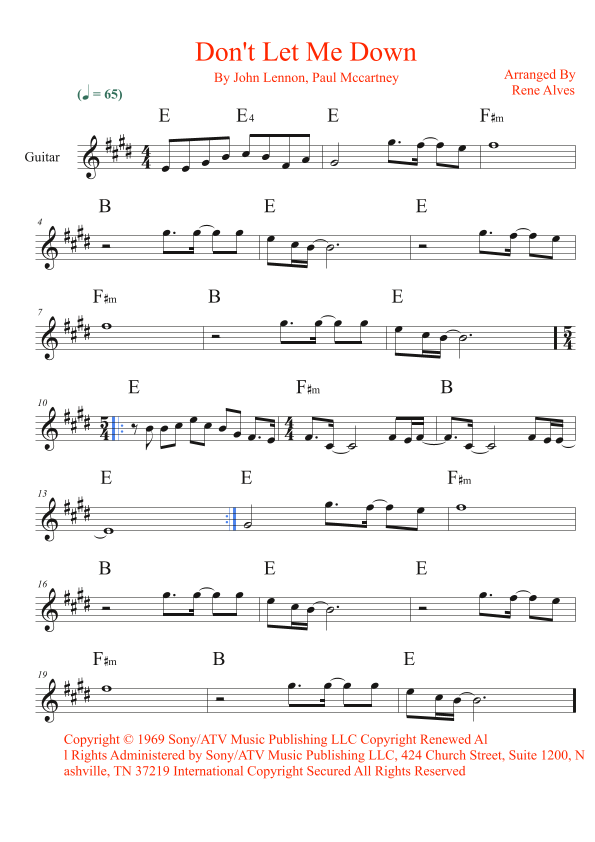
For guitar players in the United States, the easiest way to play “Don’t Let Me Down” by The Beatles is in the original key of E major. The core guitar chords are E, F#m, A, B, C#m, and G#m. Beginners can use a capo on the 2nd fret with easier shapes such as D, Em, G, A, Bm, and F#m.
This guide shows both approaches, explains the song structure, and gives you a steady strumming pattern without requiring you to read a full tab.

Chords You Need for “Don’t Let Me Down”
The song uses a small group of major and minor chords. The main progression feels repetitive, which makes it a good song for practicing timing and smooth chord changes.


Original-key chord set
| Chord | Type | Common guitar shape |
|---|---|---|
| E | Major | Open chord |
| F#m | Minor | Barre chord or simplified shape |
| A | Major | Open chord |
| B | Major | Barre chord or B7 |
| C#m | Minor | Barre chord |
| G#m | Minor | Barre chord |
The most important progression is:
E F#m A E
That pattern supports much of the verse and the repeated title line. The middle section adds more movement, often using:
C#m G#m A B
different chord charts may show small changes. Live performances, simplified arrangements, and transcriptions can vary in the final chord of a phrase or in the use of seventh chords. The basic harmony, however, remains centered around E major.
Beginner chord alternatives
If full barre chords are difficult, try these options:
- Replace B with B7.
- Use a partial F#m shape.
- Use a two- or three-finger C#m variation.
- Put a capo on the 2nd fret and use the easier shapes listed below.
Do not worry if your first version does not sound exactly like the record. Clean timing and steady changes matter more than using every original voicing.

Easy Version With a Capo
A capo on the 2nd fret lets you use familiar open-position shapes while the guitar sounds in the original key.
Capo chord conversion
| Sounding chord | Chord shape with capo 2 |
|---|---|
| E | D |
| F#m | Em |
| A | G |
| B | A |
| C#m | Bm |
| G#m | F#m |
The main progression becomes:
D Em G D
The middle section becomes:
Bm F#m G A
This version is often easier for newer players because:
- D, Em, G, and A are common open chords.
- You can avoid most full barre chords.
- The chord changes feel more natural at a moderate tempo.
- The guitar still sounds in the same key as the original arrangement.
Make sure the capo sits just behind the fret rather than directly on top of it. Press each chord slowly and check that every string rings clearly.


Capo warning
A capo changes the shape you play, not the concert pitch you hear. If you play with another musician, tell them that your shapes are different from the sounding chords. A guitarist using the original-key shapes will still be playing the same musical harmony.

“Don’t Let Me Down” Chord Progression
The song is built around a repeating verse pattern, followed by a contrasting middle section. Since performances and published charts differ slightly, use the progression below as a practical playing framework rather than a note-for-note transcription.
Verse and title refrain
In the original key:
| E | F#m | A | E |
With capo 2:
| D | Em | G | D |
Play this loop through the main verse material and the repeated title refrain. Let the final chord ring briefly before returning to the first chord.
Middle section
The contrasting section uses a minor-centered movement:
| C#m | G#m | A | B |
With capo 2:
| Bm | F#m | G | A |
This section creates more tension than the verse. The move from A to B pushes the song back toward E, while the capo version uses G to A to create the same effect.
Simple song map
A useful practice map is:
Intro
Verse
Title refrain
Verse
Title refrain
Middle section
Verse or title refrain
Outro
The exact number of repeats depends on the recording or live version you are following. Listen for the return to the main E–F#m–A–E pattern.

Strumming Pattern for Beginners
Start with a simple downstroke pattern before adding syncopation. The song works best when the rhythm has a relaxed, steady pulse rather than a rushed rock beat.
Basic pattern
Count:
1   2   3   4
D   D   D   D
Here, D means a downstroke. Use one downstroke on each beat and change chords at the start of each measure.


Once that feels comfortable, try:
1 & 2 & 3 & 4 &
D   D U   U D U
A practical version is:
D D U U D U
Keep your strumming hand moving in a steady pattern, even when you skip a stroke. The hand should act like a pendulum. This helps you keep time during the spaces.
Add emphasis
To approach the feel of the recording:
- Give the first beat a clear accent.
- Use lighter strokes on the “&” counts.
- Avoid hitting every string with the same force.
- Let the vocal phrasing guide the energy.
- Open up the strum during the refrain.
The song does not need a busy pattern. A strong groove with clean chord changes will sound better than a complex pattern played unevenly.
Optional rhythmic variation
After you can play the basic pattern, try adding a muted stroke before a chord change. Lightly rest your fretting hand on the strings and strum without producing a clear pitch. This creates a short percussive sound.
Use muted strokes sparingly. If they make the rhythm harder to follow, remove them and return to simple downstrokes.

How to Play the Chord Changes Smoothly
The most difficult changes for many beginners are E to F#m, C#m to G#m, and A to B. Practice those pairs by themselves before playing the full song.
E to F#m
If you use the original key, prepare the F#m barre chord before the final beat of the E measure. Keep your index finger close to the fretboard so the change does not require a large movement.
If the barre chord is too hard, use the capo 2 version:
D to Em
This change is much easier and still produces the original pitch when the capo is in place.
A to E
This is one of the easiest changes in the song. Keep your first finger near the third string when moving from A to E. Small movements make the change faster.
With capo 2, the same relationship is:
G to D
Practice this change without stopping the strumming hand.


C#m to G#m
These are both barre chords in the original key. Focus on moving the entire hand as one unit rather than lifting each finger separately.
With capo 2, the shapes are:
Bm to F#m
The shapes are still movable chords, but the transition may feel more natural because the hand stays in a similar area.
A to B
The A-to-B move creates forward motion into the return of the main progression. If the B barre chord is not ready, try B7. It has a different color but works well in a beginner arrangement.
A Step-by-Step Practice Plan
A short, focused practice routine can help you learn the song faster than playing the full arrangement from the start.
Step 1: Choose your key setup
Use one of these options:
- Original key: E, F#m, A, B, C#m, G#m.
- Capo version: Capo 2 with D, Em, G, A, Bm, F#m.
Choose the capo version if barre chords cause buzzing or slow changes.
Step 2: Learn the main loop
Practice:
E F#m A E
Or with capo 2:
D Em G D
Play four slow rounds without stopping. Do not increase the speed until the chords ring clearly.
Step 3: Add the middle section
Practice:
C#m G#m A B
Or:
Bm F#m G A
Play the middle section separately. It uses a different chord color, so it may feel less familiar than the verse.
Step 4: Add the strumming pattern
Begin with four downstrokes per measure. Then try the alternating pattern:


D D U U D U
Keep your hand moving evenly.
Step 5: Practice with the recording
Start with a quiet guitar part. Focus on matching the pulse and phrase length. Do not try to copy every vocal accent at once.
Step 6: Record yourself
A phone recording can reveal problems that are hard to notice while playing. Listen for:
- Chords that buzz.
- Chord changes that arrive late.
- A strumming hand that speeds up.
- Uneven volume between chords.
- Extra string noise.
A successful first performance is steady, recognizable, and comfortable. It does not need to match every detail of the studio recording.

Common Problems and Fixes
The F#m chord buzzes
A barre chord may buzz when the index finger does not apply even pressure. Move the thumb behind the neck, keep the wrist relaxed, and place the index finger close to the fret.
If the problem continues, use the capo 2 arrangement with an Em shape.
The B chord feels too difficult
Use B7 as a temporary alternative. You can also practice the B chord outside the song for a few minutes each day.
Do not squeeze the neck as hard as possible. Excess pressure can make the hand tired and pull the chord out of tune.
The rhythm sounds flat
Add a small accent to beat one and vary the strength of your strums. The song needs pulse and contrast, not constant loud volume.
Try playing the verse softly and opening the strum during the repeated title phrase.
Chord changes are late
Slow the tempo. Many players try to maintain the original speed before the hand knows the next shape.
Practice the change without strumming:
- Hold the first chord.
- Move to the next chord.
- Check each finger.
- Repeat the movement ten times.
- Add one slow strum per chord.
The guitar sounds out of tune with the recording
Check the following:
- Standard tuning: E–A–D–G–B–E.
- Capo position: 2nd fret for the easy version.
- Chord shapes: Do not mix capo shapes with original-key chord names.
- Recording version: Live performances may use a different arrangement or pitch.


Should You Use a Capo or Barre Chords?
Use the capo version when your main goal is to sing and play the song with less hand strain. Use the original-key shapes when you want to learn movable chords and keep full control over the voicings.
| Goal | Better option |
|---|---|
| Learn the song quickly | Capo 2 |
| Avoid most barre chords | Capo 2 |
| Practice barre chords | Original key |
| Play with a band using chord names | Original key |
| Sing in the original recorded key | Either option |
| Change the song to suit your voice | Transpose with a capo or new chord shapes |
A capo does not make the music “less correct.” It is simply a way to use different shapes while keeping the same sounding key.
If the original key is too high or low for your voice, move the capo or transpose the chords. The best key is the one that lets you sing without forcing your voice.

Frequently Asked Questions
What key is “Don’t Let Me Down” in?
The commonly used guitar arrangement is in E major. Some guitarists use a capo on the 2nd fret and play D-based shapes, which sound in E major.
What are the easiest chords for beginners?
Use a capo on the 2nd fret and play:
D Em G A Bm F#m
The main verse pattern is:
D Em G D
Can I play the song without a capo?
Yes. Use the original-key chord shapes:
E F#m A B C#m G#m
A B7 chord can replace B in a simplified version.
What tuning does the song use?
Standard tuning works:
E A D G B E
You do not need alternate tuning for a basic guitar arrangement.
Is the song suitable for a beginner?
Yes, especially with the capo 2 arrangement. The main challenge is keeping the rhythm steady and changing chords without pauses. Beginners may need more time to learn the original-key barre chords.
How can I sing and play at the same time?
Learn the chord loop first. Then hum the vocal rhythm while using only downstrokes. Add the full strumming pattern after the chord changes and vocal timing feel stable.
Final Takeaway
The quickest way to play “Don’t Let Me Down” on guitar is to place a capo on the 2nd fret and use:
D Em G D
For the original-key arrangement, use:
E F#m A E
Add C#m–G#m–A–B for the contrasting section, begin with simple downstrokes, and increase the detail only after your timing is steady. Clean chord changes and a relaxed groove will carry the song better than a difficult strumming pattern played unevenly.

Senior Music Reviewer
Alex Carter is a seasoned music reviewer with over a decade of experience in the world of sound and instruments. Passionate about helping musicians and enthusiasts make informed choices, he brings sharp insights and in-depth knowledge to every review. From classical instruments to modern gear, Alex combines technical expertise with a love for music to deliver content that resonates with readers.
As a Senior Music Reviewer and expert author on Tuneluma.com, Alex is dedicated to sharing honest evaluations, practical advice, and thoughtful commentary to guide readers in their musical journey.