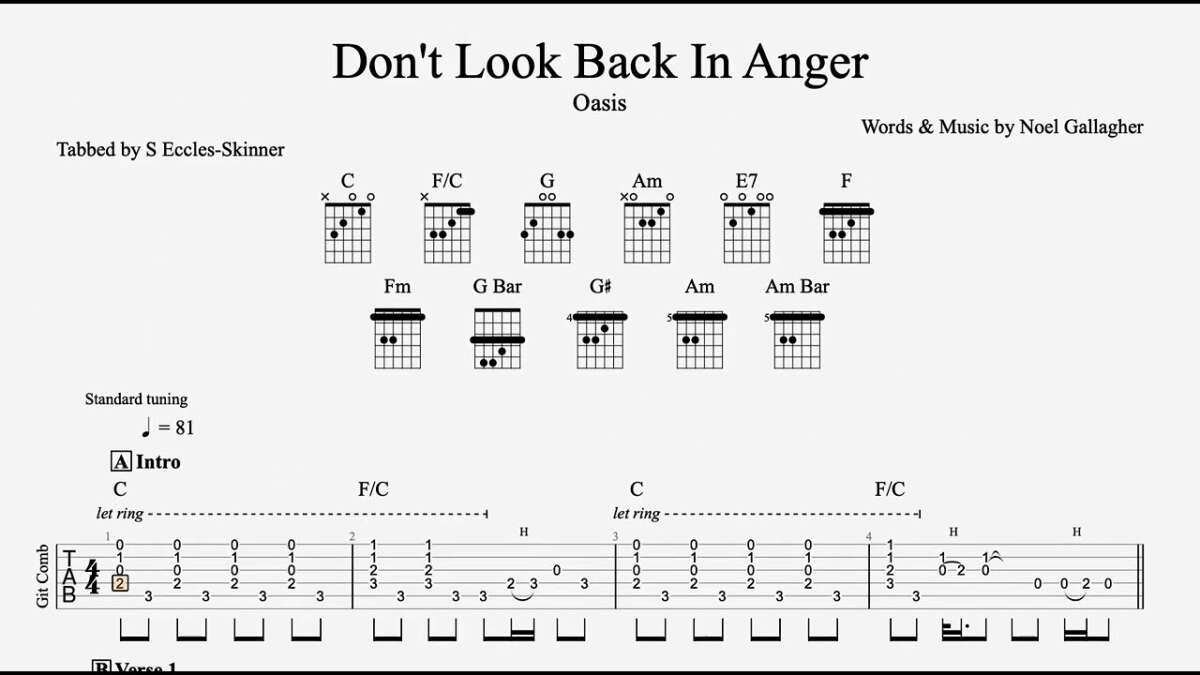
Don’t Look Back In Anger Guitar Chords: Easy Guide
The most useful “Don’t Look Back in Anger” guitar chords are C, G, Am, E, F, and a simple Dm variation.
Learning the “Don’t Look Back in Anger” guitar chords is a great way to practice steady rhythm, smooth chord changes, and expressive pop-rock playing. Oasis’ 1995 hit sounds rich, but a simplified guitar version is friendly for beginners. This guide breaks down the chord shapes, progressions, strumming, timing, and common mistakes so you can play the song with confidence.
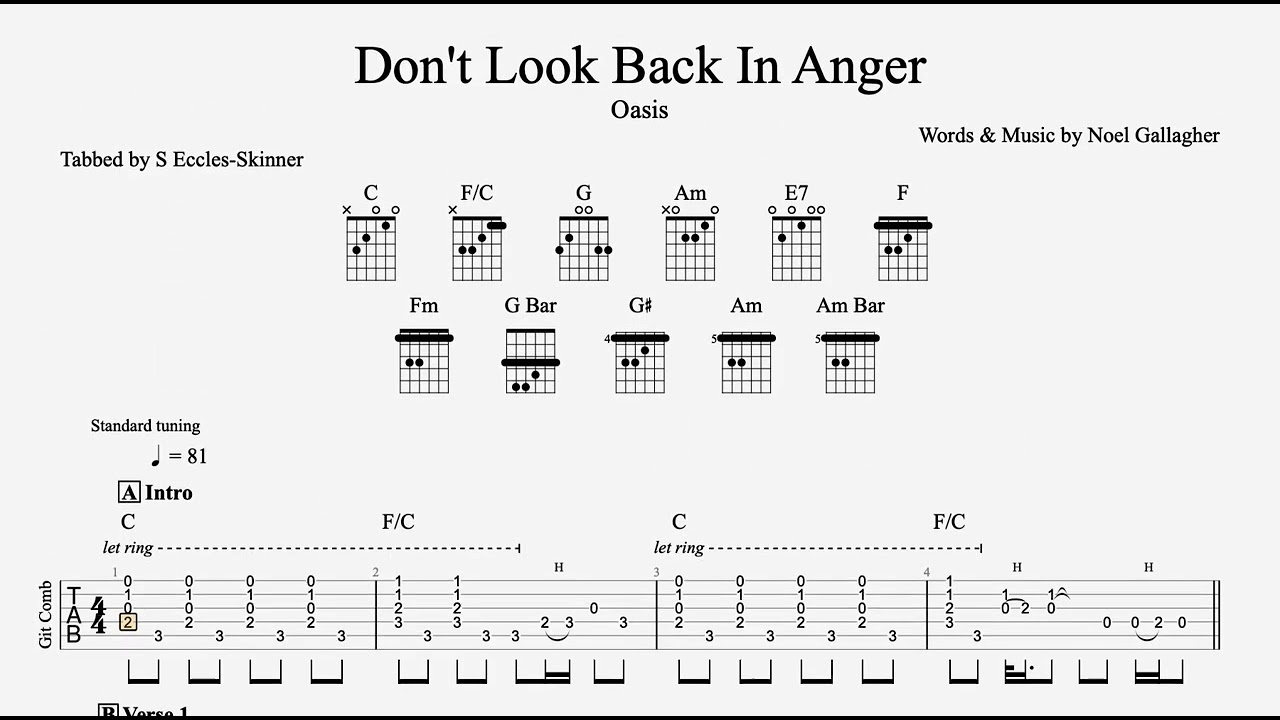
Don’t Look Back in Anger guitar chords at a glance
The song is commonly played around the key of C major. Guitar versions may use different chord shapes or capo positions, but the core harmony stays close to these chords:
• C major
• G major
• A minor
• E or E7
• F major
• D minor
A beginner-friendly version can use open chords for nearly the entire song. This keeps the sound bright and full, while also making the changes easier to learn.
The most important chord movement is not speed. It is the smooth flow from one chord to the next. Think of the progression like a calm conversation. Each chord should lead naturally into the next one.
A useful simplified progression is:
C   G   Am   E7
F   G   C    Am
F   G   C
This is a practical learning version, not a complete copyrighted transcription. It gives you the harmonic framework without reproducing the song’s full lyrics or notation.

Chord shapes for beginners
Start with open chord shapes. They are easier to play and suit the ringing sound associated with the recording.
C major

e|---0---
B|---1---
G|---0---
D|---2---
A|---3---
E|---x---
G major

e|---3---
B|---0---
G|---0---
D|---0---
A|---2---
E|---3---
A minor

e|---0---
B|---1---
G|---2---
D|---2---
A|---0---
E|---x---
E7

e|---0---
B|---0---
G|---1---
D|---0---
A|---2---
E|---0---
F major, easy version

e|---1---
B|---1---
G|---2---
D|---3---
A|---x---
E|---x---
D minor

e|---1---
B|---3---
G|---2---
D|---0---
A|---x---
E|---x---
The small F major shape is often easier than a full barre chord. If it feels uncomfortable, use the simplified shape above and focus on the top four strings.
When practicing the “Don’t Look Back in Anger” guitar chords, keep your fingers close to the fretboard. Large finger movements waste time and often cause pauses between chords.

The main chord progression
A common simplified verse pattern uses:
C G Am E7
Play each chord for four beats at first. Count evenly:
1 2 3 4
Then move to the next chord. Do not worry about matching the recording immediately. Your first goal is clean timing.
The next section can be practiced with:
F   G   C   Am
F   G   C
This movement creates a strong lift. The F and G chords build tension, while C gives the phrase a sense of home.
Here is a simple practice plan:
- Play C to G until the change feels easy.
- Add Am and repeat the four-chord loop.
- Add E7 after Am.
- Practice F to G slowly.
- Join the sections only after each change feels steady.
- Increase the speed by a small amount.
Many learners rush the G to Am change. Slow down there and keep your strumming hand moving, even if the fretting hand is still changing shape.

A simple strumming pattern
The “Don’t Look Back in Anger” guitar chords work well with a steady pop-rock pattern. Start with downstrokes:
Down   Down   Down   Down
1      2      3      4
Once that feels natural, try:
Down   Down-Up   Up-Down-Up
1      2-and     and-4-and
A common written version is:
D D-U U-D-U
The letters mean:
• D: downstroke
• U: upstroke
Keep your arm moving like a pendulum. Even when you do not strike the strings, let your hand continue the motion. This helps you stay in time.
Do not attack every stroke with the same force. Use lighter strokes in the verse and stronger strokes in the chorus. This contrast gives the arrangement shape.
A good acoustic approach is to emphasize beats two and four slightly. That backbeat helps create the relaxed rock feel of the song.

How to make the chords sound more like the recording
The original recording has piano, guitar, bass, drums, and layered vocals. A single guitar cannot copy every part at once. However, you can suggest the same mood with dynamics and chord texture.
Try these techniques:
• Let the high strings ring when possible.
• Use a gentle pick or soft thumb strokes in quieter sections.
• Play fuller strums during the chorus.
• Add a short pause before a new section.
• Avoid stopping between chord changes.
• Use a clean tone with mild overdrive for an electric guitar.
The intro is strongly linked with piano, so a guitar arrangement may sound different from the recording before the vocals begin. That is normal. The aim is to capture the harmony and feeling, not copy every studio layer.
For electric guitar, a clean amp setting with a small amount of reverb works well. Too much distortion can blur the “Don’t Look Back in Anger” guitar chords and make the changes sound muddy.

Beginner mistakes to avoid
The first mistake is trying to play at full speed too soon. Fast practice often teaches your hands to repeat errors. Slow practice gives your fingers time to learn the correct movement.
The second mistake is squeezing the neck too hard. Use only enough pressure to make each note clear. Excess pressure causes tired hands and can pull notes sharp.
The third mistake is ignoring the F chord. Many beginners stop when they see F major. Use the small F shape first. Build strength gradually before attempting the full barre chord.
Other common problems include:
• Strumming all six strings on every chord
• Letting the low E ring during C or F
• Changing chords only after the beat has passed
• Playing every section at the same volume
• Looking down constantly instead of learning the shapes
One useful habit is to practice chord changes without strumming. Place the first chord, relax your hand, and move to the next shape. Repeat the movement many times. This builds muscle memory with less noise and less pressure.

A 15-minute practice routine
A short daily routine is more useful than one long session each week. Use a metronome or a simple drum track if you can.
Minutes 1 to 3: chord review
Play C, G, Am, E7, F, and Dm. Check that every string sounds clear.
Minutes 4 to 7: chord changes
Practice these pairs:
• C to G
• G to Am
• Am to E7
• F to G
• G to C
Start with four slow beats per chord.
Minutes 8 to 11: rhythm
Use downstrokes first. Then add the D-D-U-U-D-U pattern when your timing stays even.
Minutes 12 to 15: song sections
Join the chord groups together. Keep playing if you make a mistake. Recovering without stopping is an important performance skill.
A metronome can feel strict, but it teaches the steady pulse that makes the “Don’t Look Back in Anger” guitar chords sound polished. Begin around 60 beats per minute, then increase the tempo slowly.

Playing the song with a capo
Some guitarists use a capo to make chord shapes easier or to match a preferred vocal range. A capo changes the pitch while allowing you to use familiar open shapes.
The best capo position depends on your voice and arrangement. If the song feels too low, move the capo higher. If it feels too high, remove the capo or use a lower position.
Remember that capo charts can show different chord names. A chart may list the shapes you play, while another chart lists the sounding chords. Check whether the chord names refer to finger shapes or actual concert pitch.
This is one reason online versions of the “Don’t Look Back in Anger” guitar chords may look different while still sounding correct.
How to sing while playing
Singing and playing at the same time is a separate skill. Your hands may know the chords, but your voice can change your rhythm if you are not prepared.
Start by speaking the vocal rhythm while playing one chord. Then play the chord progression without singing. Finally, add the melody at a slow pace.
Helpful steps include:
- Memorize the chord order.
- Practice the strumming without looking at your hands.
- Speak the rhythm over the chords.
- Sing only the first phrase.
- Add more of the song in small sections.
- Keep the strumming simple until the voice feels secure.
A common mistake is to use a complex strumming pattern while learning the vocal line. Use four steady downstrokes instead. Once both parts are comfortable, add the extra upstrokes.
Why these chords are useful for guitar development
The “Don’t Look Back in Anger” guitar chords teach several skills that transfer to other songs:
• Open chord control
• Chord changes in common keys
• Major and minor contrast
• Basic rock rhythm
• Dynamic playing
• Singing with an instrument
• Playing through mistakes
The song also teaches restraint. Good guitar playing is not only about adding notes. It is about choosing when to play softly, when to play strongly, and when to leave space.
The progression is useful because it combines familiar chords with a clear emotional rise. C feels stable, Am adds a darker shade, and F and G create movement toward resolution.
Frequently Asked Questions About Don’t Look Back in Anger Guitar Chords
What are the basic Don’t Look Back in Anger guitar chords?
A common beginner version uses C, G, Am, E7, F, and Dm. Different arrangements may change the voicings, add seventh chords, or use a capo.
Is Don’t Look Back in Anger easy to play on guitar?
Yes, the simplified version is suitable for beginners who know basic open chords. The F chord and the timing between sections may require extra practice.
What key is Don’t Look Back in Anger commonly played in?
The song is commonly arranged around C major. Some guitarists use a capo or transpose the chords to suit their vocal range.
What strumming pattern works for this song?
Begin with four downstrokes per bar. When that feels steady, try a pattern such as D-D-U-U-D-U and use stronger strokes in the bigger sections.
Can I play the song without using a barre F chord?
Yes. Use the small F shape that covers the top four strings. This gives you a clear sound while you build the hand strength needed for a full barre chord.
Why do chord charts show different versions?
Charts may use different capo positions, chord voicings, or simplified arrangements. They can still sound similar because the underlying harmony remains closely related.
Conclusion
The “Don’t Look Back in Anger” guitar chords are a strong choice for learning open chords, steady strumming, and expressive dynamics. Start with C, G, Am, E7, F, and Dm, then build the progression slowly with a metronome.
Focus on clean changes before speed. Use a simple rhythm while learning to sing, and add stronger strums only when the timing feels secure. Pick up your guitar today, practice one section at a time, and explore more chord guides as you build your songbook.

Senior Music Reviewer
Alex Carter is a seasoned music reviewer with over a decade of experience in the world of sound and instruments. Passionate about helping musicians and enthusiasts make informed choices, he brings sharp insights and in-depth knowledge to every review. From classical instruments to modern gear, Alex combines technical expertise with a love for music to deliver content that resonates with readers.
As a Senior Music Reviewer and expert author on Tuneluma.com, Alex is dedicated to sharing honest evaluations, practical advice, and thoughtful commentary to guide readers in their musical journey.