Introduction
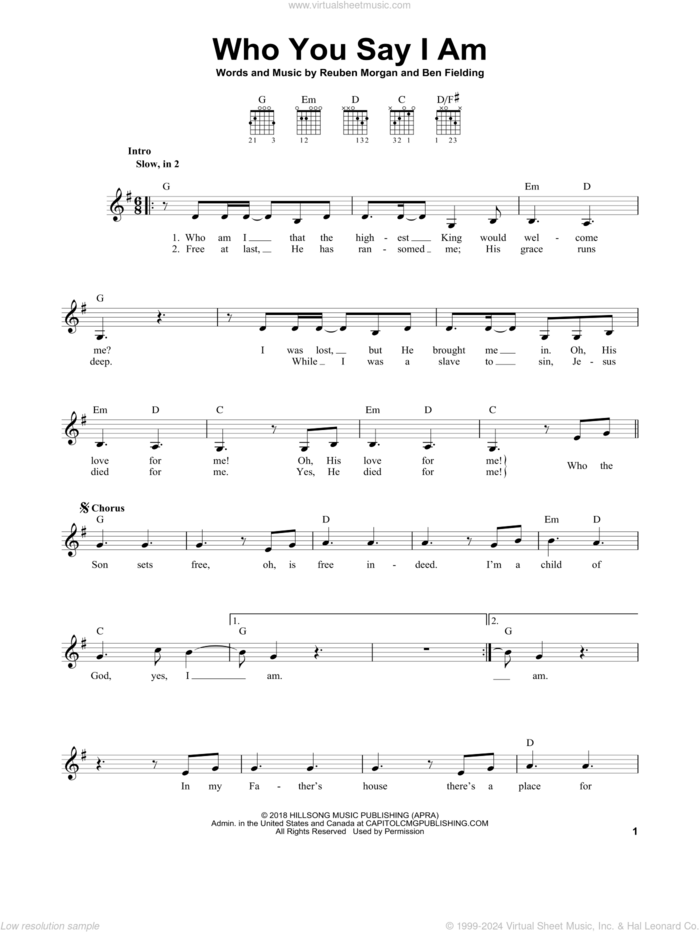
For guitarists in the United States, the easiest way to play “Who You Say I Am” by Hillsong Worship is to use the common G-major arrangement with G, C, Em, and D chords. You can play the song without a capo, or move it to another key to fit your voice or worship team.
This guide shows the main chord patterns, an easy strum, chord shapes, and ways to change the key. It does not include the song’s copyrighted lyrics.

Who You Say I Am Chords at a Glance
The most common beginner-friendly chord set is:
- G
- C
- Em
- D
The song mainly uses a repeating four-chord pattern. That makes it a good choice for new guitarists who want to practice smooth chord changes and steady rhythm.
Common chord progression
A simple version in the key of G uses:
G C G D
The bridge often uses:
Em C G D
Some worship arrangements use slightly different chord timing. Live versions may also add passing chords, pauses, or repeated sections. If you play with a church band in the United States, check the team’s chord chart before rehearsal because the chosen key may vary.
Chord shapes
Use these open chord shapes:
G     320003
C     x32010
Em    022000
D     xx0232
The numbers show the strings from low E to high E. An x means that you should not play that string.
For a fuller G chord, you can also use:
G 320033
This version keeps your ring and little fingers near the first two strings. That can make the change from G to C or D feel smoother.

How to Play the Main Sections
The song follows a simple worship-song structure. The exact order can change between studio, live, and church arrangements.
A common structure is:
- Intro
- Verse
- Chorus
- Verse
- Chorus
- Bridge
- Final chorus
- Outro
Intro and verse
Start with the main progression:
| G | C | G | D |
Play each chord for one full measure. A measure is one group of four beats.
Count it like this:
1  2  3  4
G
Then move to the next chord:
1  2  3  4
C
Keep the intro soft. This gives the singer room and helps the song build later.
Chorus
The chorus can use the same core progression:
| G | C | G | D |
You do not need a new chord shape for every vocal line. Focus on a steady pulse and let the chords ring.
A clean chorus often sounds better when you use wider strums than you used in the verse. For example, play light downstrokes in the verse, then use a full pattern in the chorus.
Bridge
The bridge commonly follows:
| Em | C | G | D |
This section changes the starting chord from G to Em. If the change feels hard, practice the two most important moves:
Em → C
G  → D
The bridge often serves as the musical lift before the final chorus. Increase the volume slowly rather than striking the strings as hard as possible.
Outro
You can finish with the same progression as the intro:
| G | C | G | D |
For a softer ending, slow down slightly and let the final G chord ring. If you play with others, watch the worship leader for the final stop.

Easy Strumming Patterns
Start with a pattern that uses only downstrokes:
↓   ↓   ↓   ↓
1   2   3   4
This is the best starting point if you are still learning the chord changes.
When that feels steady, try:
↓   ↓↑   ↑↓↑
1   2&   &4&
Written as a full eight-note pattern, it is often shown as:
↓ ↓ ↑ ↑ ↓ ↑
Do not rush the upstrokes. Your strumming hand should keep moving in a steady motion, even when you miss a string or skip a stroke.
A simple dynamic plan
Use different patterns for each section:
| Section | Suggested approach |
|---|---|
| Intro | Light downstrokes |
| Verse | Soft down-up strums |
| Chorus | Full down-up pattern |
| Bridge | Start soft, then build |
| Final chorus | Full, even strums |
| Outro | Reduce volume and let chords ring |
The key is control. A steady, quiet pattern usually sounds better than a loud pattern that speeds up.

Capo and Key Changes
You do not need a capo if the G arrangement fits your voice. A capo can help when the original key feels too low or too high.
Common capo options
| Capo position | Chord shapes | Concert key |
|---|---|---|
| No capo | G, C, Em, D | G |
| Capo 2 | G, C, Em, D | A |
| Capo 3 | G, C, Em, D | A♯/B♭ |
| Capo 5 | G, C, Em, D | C |
A capo raises the pitch while allowing you to use the same chord shapes. For example, a G shape with a capo on the second fret sounds as A.
Choosing the right key
Choose a key that lets the singer perform the highest part without strain. If the song feels too low, move the capo up one or two frets. If it feels too high, remove the capo or use a lower chord shape.
Do not choose a key only because it is common online. The best key depends on the singer, the guitar’s tuning, and the arrangement used by your group.

Transposing the Chords
If you want to play the song in another key, use the same number pattern rather than memorizing every version.
The main progression is often:
I IV I V
In the key of G, that becomes:
G C G D
The bridge uses:
vi IV I V
In G, that becomes:
Em C G D
Example: key of A
To move the song to A, use:
A D A E
The bridge becomes:
F#m D A E
Example: key of C
To move the song to C, use:
C F C G
The bridge becomes:
Am F C G
If these chords are difficult on an acoustic guitar, use a capo and keep the easier G shapes.
Common Problems and Easy Fixes
The chord changes sound late
This usually means the hand is changing after the beat. Slow the song down and change chords one beat before the next measure begins.
Practice this loop:
G → C → G → D
Play each chord four times. Do not add the full strumming pattern until the changes feel automatic.
The C chord sounds muted
Check that your index finger does not touch the open G string or high E string. Place your fingers close to the frets, but not directly on top of them.
If the full C chord is hard, try this smaller version:
Cadd9 x32033
Cadd9 works well with the G shape because your ring and little fingers can stay in place.
The D chord sounds unclear
Make sure the low E and A strings are not ringing. The D chord starts on the open D string.
A useful check is to play the strings one at a time. If one string buzzes, adjust the finger that frets that note.
The rhythm speeds up
Use a metronome or drum loop. Start at a slow tempo and increase it only when you can complete several rounds without losing the beat.
Your strumming hand should act like a pendulum. Keep the motion even, even when you leave out a stroke.
The song does not match an online chord chart
Different charts may use different keys, capo positions, or live arrangements. Compare the first chord and the progression, not just the chord names.
If one chart shows A, D, A, and E while another shows G, C, G, and D, the song may simply be transposed. Both can be correct for different singers.

A 15-Minute Practice Plan
Use this short routine to learn the song without trying to play the whole arrangement at once.
Minutes 1–3: Learn the shapes
Practice G, C, Em, and D one at a time. Check each string for a clear sound.
Minutes 4–7: Practice chord changes
Play the loop below slowly:
| G | C | G | D |
Use four downstrokes per chord.
Minutes 8–11: Add the strum
Try:
↓ ↓ ↑ ↑ ↓ ↑
Keep your arm relaxed. Stop and reset if the rhythm becomes uneven.
Minutes 12–15: Practice the form
Play:
Verse:   G  C  G  D
Chorus:  G  C  G  D
Bridge:  Em C  G  D
Repeat the sections in order. Concentrate on clean changes, not speed or volume.
Frequently Asked Questions
What are the easiest chords for “Who You Say I Am”?
The easiest common chord set is G, C, Em, and D. These are open chords and work well for beginner guitarists.
Do I need a capo?
No. You can play the song without a capo in G. Use a capo if you want to raise the key while keeping the same chord shapes.
What key is the original song in?
Arrangements of “Who You Say I Am” can appear in different keys. The key used by a worship team may also change to fit the singer. Check the specific recording or chord chart you plan to follow.
Can I play the song with only downstrokes?
Yes. Four downstrokes per chord are enough for a basic version. Add upstrokes after you can keep a steady beat.
Is “Who You Say I Am” suitable for beginners?
Yes. The song uses a small group of common open chords and a repeating progression. The main challenge is keeping the rhythm steady while changing between G, C, Em, and D.
Key Takeaways
- The common beginner arrangement uses G, C, Em, and D.
- The main progression is often G–C–G–D.
- The bridge commonly uses Em–C–G–D.
- Start with four downstrokes per chord.
- Add a down-up pattern after the chord changes feel steady.
- Use a capo to raise the key without learning new chord shapes.
- Different recordings and worship teams may use different keys or section orders.
Conclusion
To play “Who You Say I Am” on guitar, begin with the four open chords G, C, Em, and D. Practice the main loop slowly, keep your strumming hand steady, and build the song from the verse to the chorus and bridge.
Your next step is simple: play G–C–G–D for several rounds, then add Em–C–G–D for the bridge. Once the changes are clean, choose a key that fits the singer and shape the volume to match each section.

Senior Music Reviewer
Alex Carter is a seasoned music reviewer with over a decade of experience in the world of sound and instruments. Passionate about helping musicians and enthusiasts make informed choices, he brings sharp insights and in-depth knowledge to every review. From classical instruments to modern gear, Alex combines technical expertise with a love for music to deliver content that resonates with readers.
As a Senior Music Reviewer and expert author on Tuneluma.com, Alex is dedicated to sharing honest evaluations, practical advice, and thoughtful commentary to guide readers in their musical journey.