How High Should Violin Strings Be: Ideal String Height Guide
Most violins need about 3.5 mm at the E string and 5.5 mm at the G string.
Knowing how high violin strings should be helps you play with less effort and avoid needless finger pain. The correct height depends on where you measure, your playing style, the violin’s setup, and the string curve. This guide explains the accepted measurements, how to check them at home, and when a luthier should adjust the instrument.
What Does Violin String Height Mean?
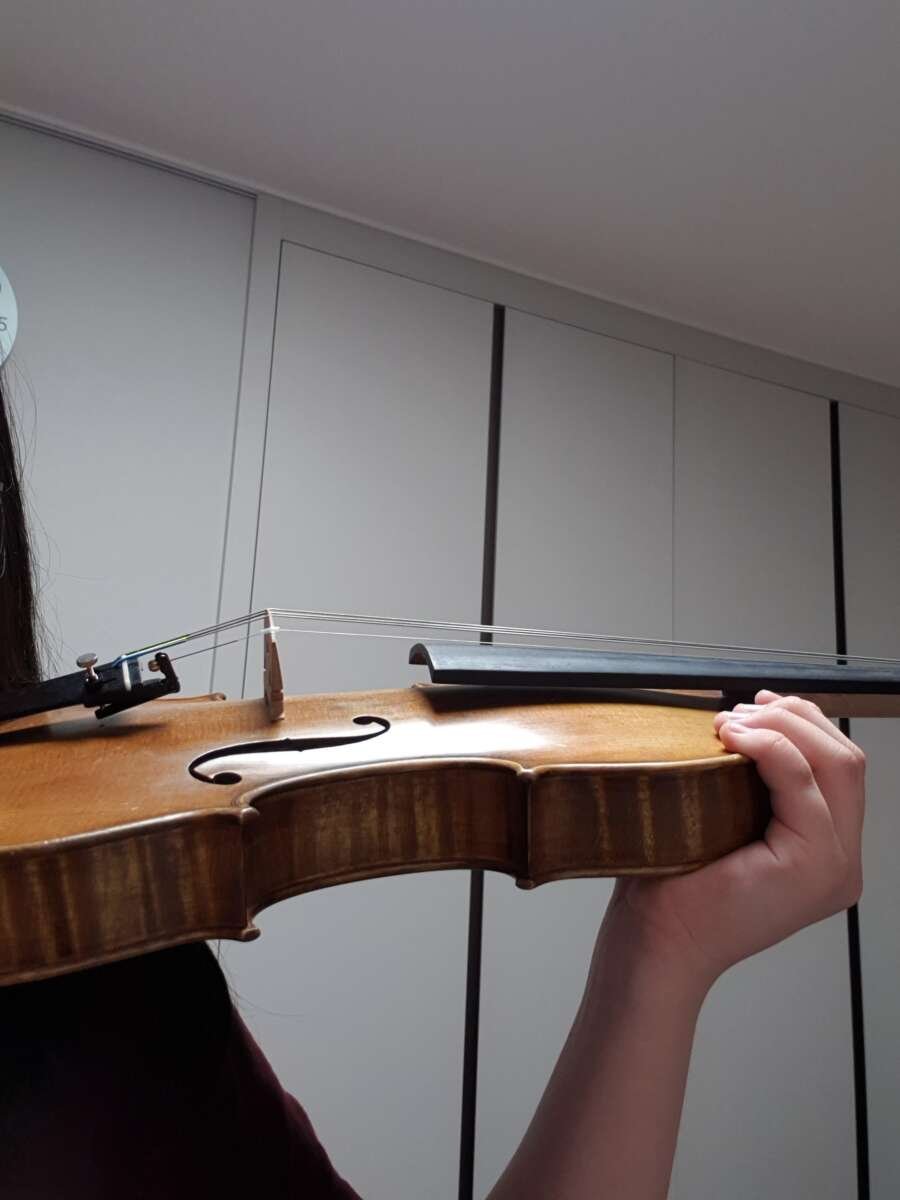
Violin string height is the distance between the bottom of a string and the top of the fingerboard. Players often call this distance the string action. It affects how easily you press the strings, how clearly notes speak, and how much buzzing the violin produces.
When people ask how high should violin strings be, they usually mean the height at the end of the fingerboard. This is the most useful place to measure because it shows how the violin feels in first position and higher positions.
The measurement is not normally taken at the bridge. The bridge supports the strings, but the fingerboard is the surface used for comparing string action. A string may look high near the bridge and still have a normal setup at the end of the fingerboard.

How High Should Violin Strings Be?
For a standard full-size violin, a common setup target is:
| String | Typical height at the end of the fingerboard |
|---|---|
| E string | About 3.5 mm |
| A string | About 4.0 mm |
| D string | About 5.0 mm |
| G string | About 5.5 mm |
These values are general guidelines, not strict laws. Many professional setups place the E string between 3.0 and 3.5 mm and the G string between 5.0 and 5.5 mm.
The G string is thicker and usually needs more room to vibrate. The E string is thinner and can work well at a lower height. The gradual rise from E to G also follows the curved shape of the bridge and fingerboard.
If you want to know how high should violin strings be for your own instrument, start with the E and G strings. They show the useful range. The A and D strings should normally fall between those two measurements.

Why Violin String Height Matters
Correct string height creates a balance between comfort and clean sound. If the strings sit too high, your left hand must press harder. This can cause sore fingertips, tense fingers, and poor intonation.
If the strings sit too low, they may buzz against the fingerboard. The sound can become thin or rough, especially when you play with strong bow pressure.
The right action also supports these benefits:
• Easier fingering in first position
• Cleaner notes during shifts
• Better control during vibrato
• Fewer false notes from pressing too hard
• More even response across all four strings
A violin is a sensitive system. A small change in string height can feel like a large change under your fingers. That is why a setup that looks acceptable on a ruler may still feel wrong to the player.

How to Measure Violin String Height at home
you can check string action with a small ruler that shows millimeters. A string action gauge is even better, but it is not required for a basic check.
Follow these steps:
-
Tune the violin to standard pitch: G, D, A, and E.
-
Place the violin in a stable playing position.
-
Measure at the end of the fingerboard, where the fingerboard meets the open area above the body.
-
Measure from the top of the fingerboard to the bottom of the string.
-
Check both the E string and the G string.
-
Write down the results before changing anything.
Measure carefully. Do not measure from the top of the fingerboard to the top of the string. That adds the string’s thickness and gives a less useful result.
You should also check the neck, bridge, and fingerboard before deciding that the string height is wrong. A warped fingerboard or badly shaped bridge can create uneven action that one simple measurement cannot explain.
 home”
style=”max-width: 100%; height: auto; border: 2px solid black; border-radius: 10px; display: block; margin: 0 auto;”
loading=”lazy”
/>
How to Tell if Violin Strings Are Too High
High strings usually make the violin feel hard to play. You may notice that your fingers tire quickly, even during simple scales.
Common signs include:
• You need unusual force to stop each note
• First-position notes feel sharp because you press too hard
• Shifting feels stiff
• Vibrato feels restricted
• Your fingertips become sore after a short practice session
• The E string feels much higher than expected
High action is not always caused by a tall bridge. Seasonal changes can affect the violin’s wooden parts. In damp weather, the top may rise slightly, which can increase string height. In dry weather, other problems may appear, including cracks or loose seams.
When checking how high should violin strings be, compare the current setup with how the violin played before. A sudden change matters more than a small difference from a general measurement.

How to Tell if Violin Strings Are Too Low
Low strings often produce a buzzing sound. The buzz may happen on open strings, stopped notes, or both.
Look for these signs:
• A rattling sound during normal bowing
• Buzzing on one section of the fingerboard
• Notes that lose power when played loudly
• A string that touches the fingerboard during vibration
• Uneven action between nearby strings
Some buzzing does not come from low string height. The cause may be a loose fine tuner, a worn nut, a loose seam, a damaged string, or a rough spot on the fingerboard.
This is why raising the bridge is not always the correct answer. A good repairer finds the source before making an adjustment. Increasing the action can hide a problem while making the violin harder to play.

What Changes Violin String Height?
Several parts of the violin affect string action. The bridge is the most visible, but it is only one part of the setup.
The Bridge
The bridge determines the string spacing and helps set the overall action. Its feet must fit the violin top well, and its curve must allow clean bowing on each string.
A bridge that is too tall can make the strings difficult to press. A bridge that is too low can cause buzzing and weak tone.
The Nut
The nut controls string height near the pegbox. If the nut slots are too high, first-position notes can feel uncomfortable even when the action at the end of the fingerboard is normal.
If the nut slots are too low, open strings may buzz. Nut work requires care because removing too much material cannot be reversed easily.
The Fingerboard
The fingerboard is not perfectly flat. It has a slight lengthwise curve called relief. It also needs the correct scoop from the nut toward the end.
A fingerboard with poor relief can cause buzzing in one area and excessive action in another. In such cases, bridge work alone will not solve the problem.
Humidity and Temperature
Wood changes with moisture. A violin may feel different in summer, winter, or during travel. Keep the instrument in a suitable case and avoid placing it near heaters, air conditioners, or direct sunlight.

Does Playing Style Affect the Correct String Height?
Yes. The best answer to how high should violin strings be depends partly on how you play.
A beginner may prefer slightly lower action because it reduces left-hand effort. However, action that is too low can buzz when the player uses strong pressure or a firm bow.
A powerful player may need a little more clearance. A soloist who uses strong bow pressure may prefer a setup that gives the strings more room to vibrate.
Your instrument also matters. A student violin, a baroque-style instrument, and a modern professional violin may use different setup choices. The scale length, neck angle, bridge design, and fingerboard shape all affect the final result.
There is no single measurement that guarantees the same feel on every violin. Measurements provide a starting point. The player’s comfort and the instrument’s sound complete the evaluation.

How String Height Affects Tone and Intonation
String height affects tone because the strings need enough space to vibrate freely. When action is too low, the vibrating string may strike the fingerboard. This creates buzz and can reduce clarity.
High action can also affect intonation. When you press a string down, you stretch it slightly. The higher the string must travel, the more its pitch may rise. This can make notes sound sharp, especially in first position.
A useful setup lets you stop notes with light pressure while keeping the sound full. Think of the string as a door. It needs enough clearance to move, but not so much that opening the door becomes difficult.
When I evaluate how high should violin strings be, I listen as well as measure. A ruler may show a normal number, but the violin can still have uneven response, a weak E string, or a harsh G string.

Should You Adjust Violin String Height Yourself?
Simple measurement is safe. Bridge cutting, nut filing, and fingerboard work are not good beginner projects.
The bridge is held in place by string tension, but it must stand at the correct angle and position. Removing wood without proper tools can permanently lower the bridge or damage the violin’s top.
Do not sand the bridge, deepen the nut slots, or adjust the neck without training. These jobs affect the violin’s value, playability, and structural safety.
A qualified luthier can:
• Check the bridge and its feet
• Inspect the fingerboard relief
• Correct nut height
• Check the neck angle
• Look for open seams or cracks
• Set the action for your playing style
• Test the instrument after each adjustment
If you are unsure how high should violin strings be, take the violin to a luthier rather than guessing with a file or knife. A short professional assessment can prevent an expensive repair.
A Practical Setup Check for Players
Before booking a repair, use this short check:
-
Tune the violin carefully.
-
Measure the E and G strings at the end of the fingerboard.
-
Check for buzzing on open strings and stopped notes.
-
Play a slow scale on each string.
-
Notice whether your left hand feels tense.
-
Check whether the action changes from one season to another.
-
Look at the bridge from the side to see whether it leans.
-
Stop if you see cracks, open seams, or a bridge that looks unstable.
This process helps you describe the problem clearly. Instead of telling a luthier that the violin feels bad, you can say that the G string measures 6.5 mm, the E string buzzes, or the action rose after a damp week.
Clear information saves time and leads to a better setup.
Common Mistakes to Avoid
Many players make setup decisions by sight alone. A string can look high because of the bridge curve, even when its measured action is normal.
Avoid these mistakes:
• Measuring at the bridge instead of the end of the fingerboard
• Measuring from the fingerboard to the top of the string
• Comparing a violin with a different size or scale length
• Lowering the bridge before checking the fingerboard
• Blaming all buzzing on low action
• Ignoring humidity and seasonal changes
• Using heavy finger pressure to compensate for poor setup
• Copying a professional player’s measurements without testing the result
Another common mistake is changing strings and setup at the same time. New strings can feel different, and some string types have different tension. Change one factor at a time when possible.
Recommended String Height by Violin Size
Full-size violins are the main reference for standard action measurements. Smaller violins may need different treatment because their scale length and body design differ.
For a 3/4, 1/2, 1/4, or 1/8-size violin, do not apply full-size measurements without professional advice. A small violin may feel comfortable with a different action, and its bridge may have a different shape.
The key question is not only how high should violin strings be. It is also whether the action is even, comfortable, and free from unwanted buzz.
A teacher can help a young player notice discomfort. A luthier can measure the instrument and check whether the setup suits the player’s hand size and strength.
Frequently Asked Questions About How High Should Violin Strings Be
How high should violin strings be at the end of the fingerboard?
A common full-size setup is about 3.5 mm for the E string and 5.5 mm for the G string. The A and D strings normally fall between those measurements.
How do I measure violin string height?
Measure from the top of the fingerboard to the bottom of the string at the end of the fingerboard. Use a millimeter ruler or a string action gauge, and measure while the violin is tuned.
Should all four violin strings have the same height?
No. The E string is usually lower than the G string because the strings differ in thickness and vibration. The action should rise gradually from E to G.
Can high violin strings cause hand pain?
Yes. High action can make you press harder, which may lead to sore fingertips, hand fatigue, and excess tension. Persistent pain should also be discussed with a qualified teacher or health professional.
Can I lower violin string height myself?
You can measure the action yourself, but bridge and nut adjustments should be done by a trained luthier. Removing too much wood can cause buzzing, poor tone, or permanent damage.
Why do my violin strings buzz even when the height seems normal?
Buzzing can come from a loose seam, worn nut, poor fingerboard relief, loose fine tuner, damaged string, or bridge problem. A normal measurement does not rule out other setup issues.
Does humidity change violin string height?
Yes. Changes in moisture can alter the shape of the violin’s wooden parts and affect action. Keep the instrument in a stable environment and have sudden changes checked by a luthier.
Conclusion
For most full-size violins, aim for about 3.5 mm at the E string and 5.5 mm at the G string, measured at the end of the fingerboard. The A and D strings should rise gradually between those points.
The best answer to how high should violin strings be is the height that gives you clear tone, easy fingering, and no unwanted buzz. Measure first, listen closely, and avoid making permanent adjustments without expert help. If your violin feels uncomfortable, ask a qualified luthier to assess the complete setup and share your measurements or playing concerns.

Senior Music Reviewer
Alex Carter is a seasoned music reviewer with over a decade of experience in the world of sound and instruments. Passionate about helping musicians and enthusiasts make informed choices, he brings sharp insights and in-depth knowledge to every review. From classical instruments to modern gear, Alex combines technical expertise with a love for music to deliver content that resonates with readers.
As a Senior Music Reviewer and expert author on Tuneluma.com, Alex is dedicated to sharing honest evaluations, practical advice, and thoughtful commentary to guide readers in their musical journey.