A Minor On Bass Guitar: Easy Guide To Play It
A minor on bass guitar uses the notes A, C, and E to create a warm, deep, and emotional sound.
Learning a minor on bass guitar gives you a strong base for scales, chords, grooves, and songwriting. With the right fretboard shapes and rhythm practice, you can use this key in rock, blues, funk, pop, jazz, and many other styles.
What Is A Minor on Bass Guitar?
A minor is a musical key and chord. Its main chord contains three notes:
• A is the root
• C is the minor third
• E is the perfect fifth
These notes form an A minor triad, written as Am. On bass, you can play the notes one at a time instead of striking them together like a pianist or guitarist.
The minor third, C, gives A minor its darker sound. A major chord uses C sharp, while A minor uses C natural. That one-note change creates a clear shift in mood.
The A minor scale contains seven notes:
A, B, C, D, E, F, and G
This is called the natural A minor scale. It uses the same notes as the C major scale, but A feels like the home note. Think of the notes as the same group of actors, with a different lead character.
On bass, your job is often to connect the harmony to the rhythm. When a song moves through A minor, your bass line can support the chord, add motion, and guide the listener through each change.

A Minor Bass Chord Notes and Fretboard positions
The easiest way to play a minor on bass guitar is to find A, C, and E across the fretboard. You do not need to play all three notes at once. Bass lines often use one note at a time, with rhythm doing much of the expressive work.
On a standard four string bass in standard tuning, the open A string gives you a useful root note. You can also find A at the fifth fret of the E string and the seventh fret of the D string.
Here are common A notes:
• Open A string
• Fifth fret on the E string
• Seventh fret on the D string
• Second fret on the G string
The note C is the minor third. Common C positions include:
• Third fret on the A string
• Eighth fret on the E string
• Tenth fret on the D string
• Fifth fret on the G string
The note E is the fifth. Common E positions include:
• Open E string
• Seventh fret on the A string
• Second fret on the D string
• Ninth fret on the G string
A simple A minor chord pattern is:
A, C, E, C
Try playing each note as a quarter note. Count “1, 2, 3, 4” and keep your timing even. This basic pattern is simple, but it teaches your hands how the A minor chord is built.
One mistake I often see from new bass players is moving too quickly between shapes. Learn one position first. Make every note clean, then add another position. A slow, clear line builds skill faster than a rushed exercise.
 positions”
style=”max-width: 100%; height: auto; border: 2px solid black; border-radius: 10px; display: block; margin: 0 auto;”
loading=”lazy”
/>
A Minor Scale on Bass Guitar
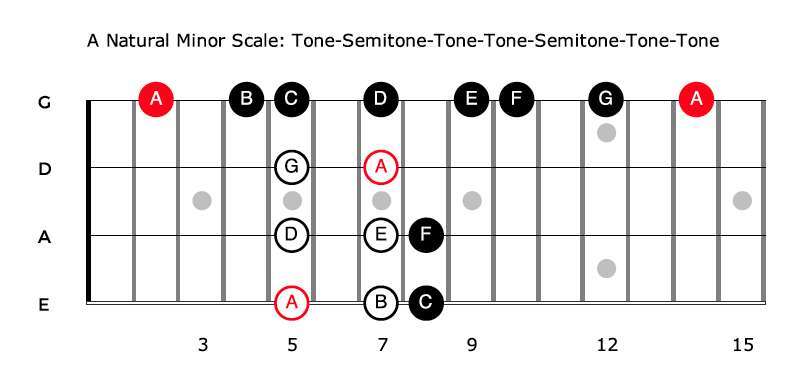
The natural A minor scale is one of the best scales for learning bass guitar. It has no sharps or flats, which makes the note pattern easy to understand.
The notes are:
A, B, C, D, E, F, G, A
A useful two octave pattern begins with A on the fifth fret of the E string:
- A at the fifth fret of the E string
- B at the seventh fret of the E string
- C at the eighth fret of the E string
- D at the fifth fret of the A string
- E at the seventh fret of the A string
- F at the eighth fret of the A string
- G at the fifth fret of the D string
- A at the seventh fret of the D string
Play the scale slowly in both directions. Use alternate plucking with your index and middle fingers. Keep your fretting fingers close to the strings so your hand stays relaxed.
A helpful practice method is to say each note aloud. This connects your ear, voice, and hands. Many players memorize shapes but cannot name the notes. Knowing both the shape and the note makes it easier to improvise.
The A minor scale also works well for creating fills. For example, you can move from A to C, walk through B, and return to A. This creates movement without losing the song’s center.

A Minor Pentatonic Scale for Bass
The A minor pentatonic scale removes two notes from the natural minor scale. Its notes are:
A, C, D, E, and G
This scale is popular because it sounds strong over many rock, blues, funk, and pop grooves. It has fewer notes, so it is easier to control.
A common A minor pentatonic shape starts at the fifth fret of the E string:
• A at the fifth fret of the E string
• C at the eighth fret of the E string
• D at the fifth fret of the A string
• E at the seventh fret of the A string
• G at the tenth fret of the A string
• A at the seventh fret of the D string
You can play these notes in many orders. Try A, C, D, E, G, E, D, C, then A. Play the pattern with a steady eighth note pulse.
The pentatonic scale is also useful when you feel unsure during a jam. If the band stays in A minor, these five notes give you a safe starting point. Still, listen closely to the chords. A note that sounds good over Am may sound less settled when the harmony changes.
From my own practice, the biggest breakthrough came when I stopped running the scale from low to high. Real bass lines rarely sound like a scale exercise. I began using short groups of two or three notes and placing them inside a groove. That made the scale sound like music.

How to Build an A Minor Bass Line
A good bass line needs more than correct notes. It also needs a strong rhythm, clear note length, and a sense of direction.
Use this process to build an A minor bass line:
- Start with the root note A.
- Match the kick drum when possible.
- Add C to show the minor quality.
- Add E to support the chord.
- Use B, D, F, or G as passing notes.
- Repeat a short idea before adding new material.
Try this simple four note idea:
A, A, C, E
You can play A on beats one and three, then C and E on beat four. This leaves space for the drums and vocals.
For a busier groove, try:
A, C, D, E, G, E, D, C
Keep the rhythm steady, but do not play every note with the same force. Accent the notes that support the groove. A bass line should feel like a firm path under the song, not a pile of random notes.
Note length matters too. Short notes can sound tight and funky. Long notes can sound smooth and powerful. Play the same A minor line with both approaches and listen to how much the mood changes.
A useful test is to record yourself. Many lines feel exciting while you play them but sound crowded during playback. Recording reveals whether your bass line supports the song or competes with it.

A Minor Chord Progressions for Bass Players
Bass players often encounter A minor in chord progressions. Learning common progressions helps you predict which notes may work next.
A common progression is:
Am, F, C, G
The roots are:
A, F, C, G
This progression appears in many pop and rock songs. Start by playing only the root notes. Then add the third or fifth of each chord.
Another useful progression is:
Am, G, F, E