What Historical Period Does Slit Drum Represent: Full Guide
The slit drum represents ancient musical traditions, with roots stretching back thousands of years across Africa, Asia, Oceania, and the Americas.
The question of what historical time period does the slit drum represent has no single answer. This percussion instrument appeared in several cultures at different times, so its history is best understood through archaeology, oral tradition, surviving instruments, and regional cultural practice.
What historical time period does the slit drum represent?
The slit drum represents ancient and prehistoric periods rather than one exact historical era. Its simple design made it possible for different societies to create similar instruments without direct contact with one another.
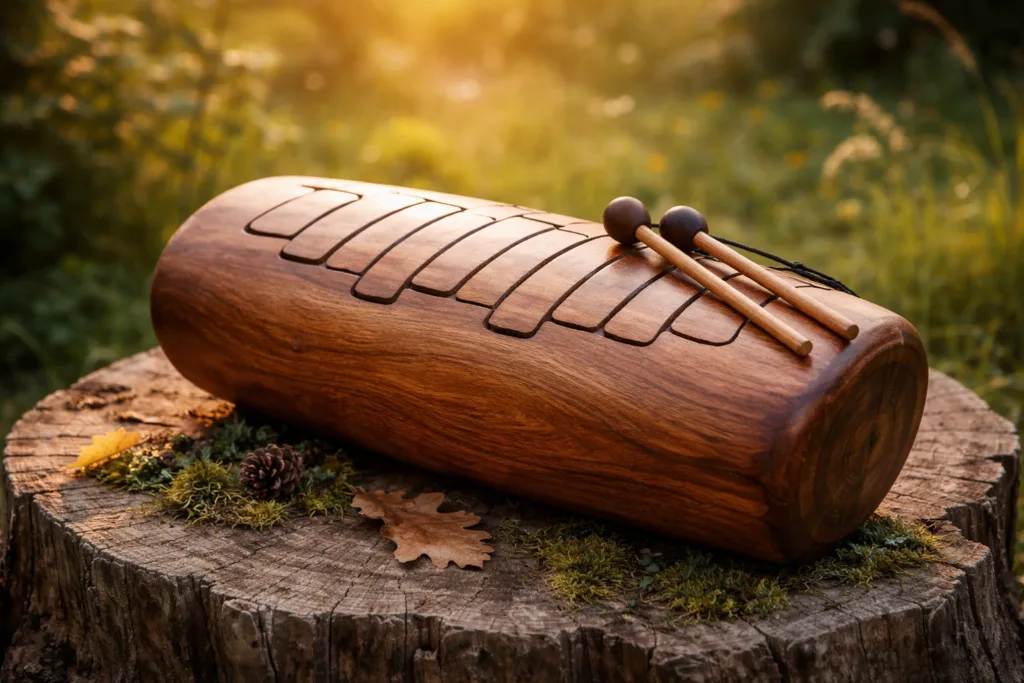
A slit drum is a hollow log or wooden body with one or more narrow cuts, or “slits,” across its surface. When a player strikes the wood with sticks, the cut edges vibrate and produce deep, bright tones.
The earliest versions likely developed when people discovered that hollow wood could make a louder sound than solid wood. Because wood decays quickly, archaeologists cannot always identify the first slit drum with certainty.
The instrument appears in traditions connected with:
• Ancient Africa
• Pre-Columbian Mesoamerica
• Southeast Asia
• Melanesia and Polynesia
• Indigenous communities in the Pacific and the Americas
This wide distribution shows why what historical time period does the slit drum represent is a complex question. It represents a long span of human history, from early societies to living musical traditions today.
The ancient origins of the slit drum
The slit drum probably began during prehistoric times, although no exact invention date exists. Early people already understood how to use caves, hollow branches, animal skins, and wood to create sound.
A hollow tree could act as a natural resonating chamber. By cutting a slit into the wood, a maker could create two vibrating tongues. Each tongue could produce a different pitch, depending on its length, thickness, and shape.
This design was practical for several reasons:
• It used local materials.
• It did not require metal tools in its earliest forms.
• It could produce sound over long distances.
• It worked as both a musical and communication instrument.
In many regions, people used drums to send signals between villages. They also used them during ceremonies, dances, funerals, royal events, and religious gatherings.
The historical evidence is uneven. Organic instruments from early periods often disappeared because of insects, moisture, fire, and decay. As a result, scholars often study later examples, oral histories, rock art, and related instruments to understand earlier traditions.
This limitation matters when answering what historical time period does the slit drum represent. The oldest surviving example is not always the date when the instrument first appeared.

Slit drums in ancient Africa
Africa has some of the strongest and most continuous slit drum traditions. In many Central and West African communities, the instrument is known by names such as log drum or talking drum, although a talking drum can also refer to a different hourglass-shaped instrument.
The slit drum often served as a communication tool. Skilled players could create patterns that carried meaning across large distances. In some societies, listeners understood these rhythms as coded messages linked to speech tones, names, warnings, ceremonies, or announcements.
African slit drums also held social and spiritual value. A drum could mark the arrival of a leader, call people to a meeting, accompany a dance, or support a rite of passage.
It is difficult to assign one date to African slit drums. Some traditions are centuries old, while their deeper roots may reach into prehistoric times. Written records from travelers and colonial observers often describe instruments that were already ancient within local culture.
When people ask what historical time period does the slit drum represent in Africa, the most accurate answer is the precolonial period and earlier, while also recognizing that the instrument remains active today.
A common mistake is to describe the slit drum as a “primitive” tool. That word is misleading. Its construction is simple, but its musical language can be highly refined. Players may control rhythm, tone, volume, and message structure with great skill.

Slit drums in the Americas
In the Americas, one of the best-known slit drums is the teponaztli. This instrument was used by cultures in central Mexico, including the Mexica, often called the Aztecs, and earlier Mesoamerican societies.
The teponaztli was usually made from a hollow log with an H-shaped slit on top. The two wooden tongues could produce different notes. Players struck them with padded beaters, creating rhythmic patterns for ceremonies, dances, processions, and court events.
Examples connected with Mesoamerican history date to the pre-Columbian era, before European contact in the late 15th and early 16th centuries. Some surviving instruments are held in museums, while historical images show musicians using similar drums in ritual and public settings.
The teponaztli helps explain what historical time period does the slit drum represent in the Americas. It strongly represents the ancient and pre-Columbian periods, but its influence continues through modern Indigenous music and cultural revival.
The instrument was not merely for entertainment. In many ceremonial settings, sound connected the human world with ancestors, rulers, deities, and the natural environment. The drum’s voice could symbolize authority and sacred order.
Researchers must still be careful. A museum object may have a known collection date but an uncertain manufacturing date. Its exact use may also be debated if no written explanation survives.

Slit drums across Asia and the Pacific
Slit drums also developed across Southeast Asia, Melanesia, and Polynesia. In these regions, the instruments often became large communal drums rather than small objects played by one person.
In Vanuatu, Papua New Guinea, the Solomon Islands, and nearby areas, monumental slit drums can stand several feet tall. Some are carved with faces, patterns, or figures that connect the instrument to ancestors, spirits, chiefs, or local history.
Players may strike these drums with heavy wooden sticks. The sound can travel through forests and villages, making the drum useful for public signals and ceremonies.
In Southeast Asia, slit drums appear in several forms and may be linked with court music, temple life, village ceremonies, and folk performance. Regional names and construction methods differ, so it is better to discuss local traditions than to treat all slit drums as one instrument.
This global spread answers what historical time period does the slit drum represent in a broader way. It represents ancient cultural development across many regions, not just one civilization or century.
The Pacific examples also show that an instrument can serve several roles at once. A drum may be a musical object, a public voice, a sacred symbol, and a work of sculpture.

How historians date a slit drum
Historians and archaeologists use several types of evidence to estimate the age of a slit drum. No single method works for every instrument.
Key evidence includes:
• Material analysis: Experts study the type of wood, tool marks, repairs, and surface wear.
• Archaeological context: The soil layer and nearby objects can help establish when an instrument was used.
• Radiocarbon dating: If enough original wood remains, testing may estimate when the tree was cut.
• Artistic comparison: Carvings and shapes can be compared with dated objects from the same culture.
• Written records: Travelers, religious texts, court documents, and colonial reports may describe older instruments.
• Oral tradition: Community knowledge can explain an instrument’s meaning, use, and lineage.
Radiocarbon dating does not always provide the exact date of construction. It usually dates the age of the wood, which may have grown many years before the drum was carved.
Another issue is repair. A slit drum may contain older wood but have been reshaped or repaired much later. This is why experts combine scientific testing with cultural and historical evidence.
From a research perspective, the best answer to what historical time period does the slit drum represent depends on the specific instrument. A teponaztli, a Vanuatu slit drum, and a Central African log drum may belong to different historical settings.

Why the slit drum matters in history
The slit drum matters because it reveals how technology, communication, music, and belief developed together. It shows that early instruments did not need complex parts to serve complex purposes.
A single drum could help a community:
• Share messages across long distances
• Organize work or public gatherings
• Support dance and storytelling
• Mark religious or seasonal events
• Honor ancestors and leaders
• Teach rhythm and cultural identity
The instrument also provides insight into local resources. Makers used the trees available in their environment and shaped them with tools suited to their technology. The design reflects both ecological knowledge and artistic skill.
From a cultural history perspective, what historical time period does the slit drum represent is less important than how communities used it. The same basic idea could carry different meanings in different places.
One practical lesson stands out: never judge an old instrument only by its appearance. A plain wooden drum may hold a complex language, sacred role, or record of community memory.
Visitors sometimes assume that a simple object must have had a simple purpose. Museum research often proves the opposite. The less decorated an instrument looks, the more important it may be to study its sound, setting, and living traditions.
Common mistakes when identifying the slit drum’s period
Several misunderstandings can lead to an inaccurate answer about what historical time period does the slit drum represent.
First, people may assume that every slit drum is prehistoric. Some are modern instruments made in traditional styles. A recent object can still preserve an ancient design.
Second, people may treat all slit drums as one cultural type. The shape may look similar, but the meaning, playing method, and history can vary greatly.
Third, people may use the word “drum” too narrowly. A slit drum has no stretched membrane. Its sound comes from vibrating wooden tongues, which places it in the idiophone family rather than the membranophone family.
To identify an instrument more carefully, ask:
-
Where was it made?
-
What wood or material was used?
-
Does it have one slit or several?
-
How was it played?
-
Was it used for music, communication, ceremony, or all three?
-
Is there archaeological, written, or community evidence for its age?
These questions create a stronger historical picture than appearance alone.
Frequently Asked Questions About What Historical Time Period Does the Slit Drum Represent
What historical time period does the slit drum represent?
The slit drum represents ancient and prehistoric musical traditions, but it does not belong to one single period. Different cultures developed and used slit drums across Africa, Asia, Oceania, and the pre-Columbian Americas.
Is the slit drum prehistoric?
Some slit drums may have prehistoric origins, but researchers cannot date the first example with certainty. Wood decays easily, so the oldest surviving instrument may be much younger than the original tradition.
Was the slit drum used by the Aztecs?
Yes. The Mexica, commonly called the Aztecs, used a slit drum called the teponaztli. It supported ceremonies, dances, public events, and other important cultural activities.
What was the original purpose of a slit drum?
A slit drum could serve several purposes. Communities used it for music, dance, religious ceremonies, public announcements, and long-distance communication.
Is a slit drum the same as a regular drum?
No. A regular drum usually has a stretched skin or synthetic membrane. A slit drum is a hollow wooden idiophone that produces sound when its carved wooden tongues are struck.
Are slit drums still used today?
Yes. Slit drums remain part of cultural, ceremonial, educational, and musical life in several regions. Modern musicians also use them in world music, sound art, and classroom performance.
How can experts tell how old a slit drum is?
Experts may study the wood, tool marks, surface wear, archaeological location, artistic style, written records, and oral history. Radiocarbon testing can help, but it must be interpreted alongside cultural evidence.
Conclusion
The slit drum represents a broad and ancient chapter of human history. Its roots likely reach into prehistoric times, while documented examples appear in pre-Columbian Mesoamerica, traditional African societies, Southeast Asia, and Pacific cultures.
The most accurate answer to what historical time period does the slit drum represent is not one date. It represents thousands of years of invention, communication, ceremony, music, and cultural memory.
When studying one, look beyond its simple wooden form. Learn where it came from, how it was played, and what its community believed it could say. Explore museum collections, trusted cultural resources, and living traditions to deepen your understanding of this remarkable instrument.

Senior Music Reviewer
Alex Carter is a seasoned music reviewer with over a decade of experience in the world of sound and instruments. Passionate about helping musicians and enthusiasts make informed choices, he brings sharp insights and in-depth knowledge to every review. From classical instruments to modern gear, Alex combines technical expertise with a love for music to deliver content that resonates with readers.
As a Senior Music Reviewer and expert author on Tuneluma.com, Alex is dedicated to sharing honest evaluations, practical advice, and thoughtful commentary to guide readers in their musical journey.