How Do You Strum A Guitar Without A Pick: Easy Tips
Use your thumb, index finger, or a relaxed combination of fingers to brush across the strings.
Learning how do you strum a guitar without a pick gives you more control, softer tone, and several new ways to express rhythm. This technique is called finger strumming, and it works for beginners, acoustic players, singer-songwriters, and anyone who wants a warmer sound. With the right hand position and a few minutes of daily practice, you can make smooth, steady rhythms without holding a pick.

How Do You Strum a Guitar Without a Pick?
The easiest way to strum without a pick is to use the side of your thumb for downstrokes and the nail of your index finger for upstrokes. Keep your wrist loose and let your hand move from the wrist rather than from your whole arm.
Start with slow quarter-note strums. Count “one, two, three, four” while brushing the strings evenly. Do not try to play loudly at first. Your first goal is a smooth motion that feels relaxed.
A simple pattern looks like this:
- Move your thumb down across the strings.
- Bring your hand back up without hitting the strings.
- Use the back of your index fingernail for the upstroke.
- Repeat the motion at a steady speed.
When learning how do you strum a guitar without a pick, many players make the mistake of using too much force. Your fingers do not need to dig into the strings. Think of your hand as a soft paintbrush moving across the guitar.

The Best Fingers to Use for Strumming
You can strum with your thumb, index finger, several fingers, or a mix of all three. Each choice creates a different sound and works well in different musical settings.
Thumb strumming
The thumb is often the best place to begin. Its larger surface gives you a soft, warm tone, and it is easy to control.
Use the fleshy part of your thumb for gentle downstrokes. You can also use the side of the thumbnail for a brighter sound. Thumb strumming works especially well for folk music, ballads, country songs, and quiet vocal work.
Index finger strumming
Your index finger gives you more attack and definition. For downstrokes, you can use the outside of the fingernail. For upstrokes, use the back of the nail or the soft fingertip.
Keep the index finger slightly curved. Do not lock it straight. A relaxed finger moves across the strings with less friction and creates a smoother rhythm.
Thumb and index combination
This is one of the most useful techniques for how do you strum a guitar without a pick. Use the thumb for downstrokes and the index fingernail for upstrokes.
This approach feels close to using a pick, but it gives you more control over volume and tone. It also makes it easier to switch between strumming and light fingerpicking.
Three-finger strumming
Some players use the thumb, index finger, and middle finger together. This creates a wider brush and can produce a full sound on an acoustic guitar.
Use this method with care. If your fingers hit the strings at different times, the strum may sound uneven. Start slowly and aim for one clean motion.
In my own practice sessions, the thumb and index method has been the most reliable starting point. It is simple, musical, and easy to adjust when a song needs either a soft touch or a stronger rhythm.

How to Position Your Strumming Hand
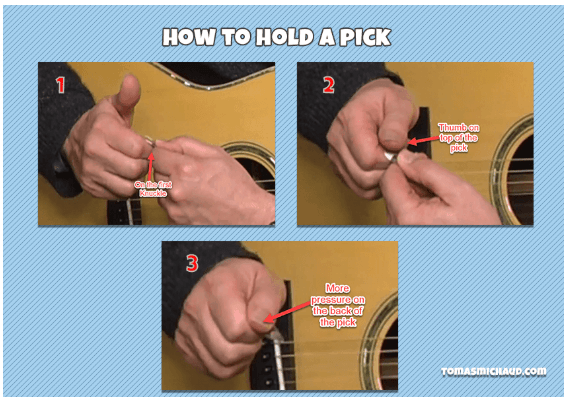
Good hand position makes how do you strum a guitar without a pick feel natural. Rest your strumming arm on the guitar body near the lower edge of the instrument. Let your hand hover above the sound hole on an acoustic guitar.
Your wrist should stay loose. Avoid pressing your palm against the bridge unless you are intentionally muting the strings. A stiff wrist often causes uneven timing, tired muscles, and a harsh tone.
Use these checks before you play:
- Keep your thumb slightly in front of your fingers.
- Let your fingers curve naturally.
- Keep your wrist neutral, not sharply bent.
- Move from the wrist with small, easy motions.
- Keep your elbow relaxed.
- Aim across the strings instead of directly down into them.
Your strumming hand should feel like it is waving goodbye in slow motion. That image helps many beginners avoid rigid movements.
The angle of your fingers also matters. If your nails catch on the strings, turn your hand slightly so the fingers glide across them. If the sound is too soft, use a little more nail or increase the speed of the motion instead of pushing harder.

Step-by-Step Method for Smooth Finger Strumming
Use this practice plan if you are still unsure how do you strum a guitar without a pick.
Step 1: Mute the strings
Place your fretting hand lightly across all six strings. Do not press them down. This creates a muted sound, so you can focus on rhythm without worrying about chord changes.
Strum down slowly with your thumb. Then return your hand to the starting position. Repeat this for one minute.
Step 2: Add the upstroke
Once the downstroke feels easy, add an upstroke with your index fingernail. Count:
“Down, up, down, up.”
Keep the motion even. The hand should continue moving even when you miss the strings on a light return stroke.
Step 3: Play a single chord
Choose an easy chord such as E minor, A minor, or C major. Play four downstrokes, then four down and up pairs.
Listen for unwanted string noise. Some noise is normal, but sharp clicks often mean your finger is catching the string instead of brushing it.
Step 4: Practice a common pattern
Try this pattern:
- Down
- Down
- Up
- Up
- Down
- Up
You can count it as “one, two, and, and, four, and.” Start at about 60 beats per minute. Increase the speed only when the rhythm stays even.
Step 5: Change chords slowly
Practice switching between two chords. For example, play G for four beats and C for four beats.
Keep strumming through the chord change, even if the new chord is not perfect yet. This teaches your hand to maintain time, which is more important than playing every chord without a small mistake.

Strumming Patterns to Try Without a Pick
Once your hand feels relaxed, try these simple patterns. Use a thumb downstroke and an index upstroke unless a pattern feels better with another finger.
Beginner pattern
Count: 1, 2, 3, 4
- Down
- Down
- Down
- Down
This pattern is ideal for slow songs. Focus on equal volume and steady timing.
Basic pop pattern
Count: 1 and 2 and 3 and 4 and
- Down
- Down up
- Up down up
Written as a continuous motion, it becomes:
Down, down-up, up-down-up.
This pattern appears in many pop, folk, and rock songs. Keep your hand moving in a steady pendulum, even when a stroke does not touch the strings.
Gentle folk pattern
Use your thumb for the first downstroke, then brush lightly with your index finger.
- Thumb down
- Index down
- Thumb down
- Index up
This creates a soft pulse that works well under singing.
Waltz pattern
For music in 3/4 time, count “one, two, three.”
- Down
- Down up
- Down up
Give the first beat a little more weight. Do not make the other beats too strong.
Percussive pattern
Mute the strings with your fretting hand and tap the guitar lightly with the side of your thumb between strums. This adds rhythm without needing a pick.
Use only gentle taps on the guitar body. Avoid hitting near delicate finishes, thin tops, switches, or controls.

How to Control Tone and Volume
Finger strumming gives you more tone choices than many beginners expect. Small changes in finger angle can make the same chord sound soft, bright, warm, or sharp.
For a mellow tone, use the fleshy part of your thumb. For a brighter tone, use the edge of your thumbnail or fingernail. For a balanced sound, combine the thumb on downstrokes with the index finger on upstrokes.
You can also change where you strum:
- Strumming near the neck creates a softer, rounder sound.
- Strumming above the sound hole creates a balanced tone.
- Strumming near the bridge creates a brighter, tighter sound.
- Strumming over the neck can produce a deep, gentle sound.
Volume comes from relaxed speed and controlled movement. It does not come only from force. If your fingers hurt, your hand feels tense, or the strings sound harsh, reduce pressure.
Players with long nails may get more volume and brightness, but long nails are not required. Short nails work well when the fingers are relaxed and the contact angle is right. Keep rough edges filed, because a sharp nail can snag the strings.
Common Mistakes to Avoid
The most common problem when learning how do you strum a guitar without a pick is tension. Beginners often curl their fingers tightly and swing the entire arm. This makes the rhythm tiring and difficult to control.
Watch for these mistakes:
- Using too much force: Brush the strings instead of attacking them.
- Locking the wrist: Keep a small, flexible motion.
- Keeping the fingers stiff: Let the index finger bend naturally.
- Strumming only from the elbow: Use the wrist for most of the movement.
- Catching the strings with the nail: Adjust your hand angle.
- Ignoring timing: Practice with a metronome or steady drum loop.
- Playing too fast: Begin slowly and build speed.
- Holding the breath: Relax your shoulders and breathe normally.
One mistake I often see in practice is trying to copy a fast song before the basic motion is stable. Slow practice can feel dull, but it builds the control that makes faster strumming possible.
If your fingertips or nails become sore, stop and rest. Mild adjustment discomfort is common, but sharp pain is not something to push through. A teacher or qualified instrument technician can help if your technique or guitar setup causes ongoing discomfort.

Benefits and Limitations of Strumming Without a Pick
Learning how do you strum a guitar without a pick has several clear benefits. It improves finger control and gives you direct contact with the strings.
Benefits include:
- Softer and more natural tone
- Better control over volume
- Easy movement between strumming and fingerpicking
- No pick to drop or replace
- More options for quiet playing
- Stronger awareness of rhythm and string contact
- Useful control for folk, blues, pop, and singer-songwriter music
There are also limits. A pick may be better for fast, loud rock rhythm, bluegrass, metal, or lead guitar lines. Picks can produce a sharper attack and may help the hand move quickly through repeated notes.
Your choice does not need to be permanent. Many skilled players use both methods. You can play a verse with your fingers, add a pick for the chorus, and return to finger strumming for a softer ending.
Steel strings can feel rough on untrained fingers, while nylon strings usually feel softer. However, nylon guitars are not required for this technique. Use light pressure, keep your nails smooth, and increase practice time gradually.
Acoustic and Electric Guitar Tips
How do you strum a guitar without a pick on an acoustic guitar? Start above the sound hole with a light touch. Acoustic strings often respond well to the thumb and index method because the guitar produces a full sound with little effort.
On an electric guitar, strum closer to the middle pickup or between the pickups for a balanced sound. Lower the volume if the tone feels too sharp, and experiment with the guitar’s tone control.
Electric guitar strings may feel easier to strum because they are often lighter. Still, the technique remains the same:
- Keep the wrist loose.
- Use small movements.
- Avoid digging under the strings.
- Control unwanted string noise.
- Adjust your amplifier for a clean tone.
If you use effects, distortion can make extra string noise more obvious. Practice clean first. Once your rhythm is controlled, add effects and learn how muting changes the sound.
A Simple Seven-Day Practice Plan
A short daily routine can help you learn how do you strum a guitar without a pick faster than occasional long sessions.
Day 1: Relaxed downstrokes
Mute the strings and play slow thumb downstrokes for five minutes. Focus on an even sound.
Day 2: Add upstrokes
Practice down and up motions with the index finger. Keep the tempo slow.
Day 3: Use one chord
Play E minor or A minor with four steady beats per measure.
Day 4: Change between two chords
Switch between A minor and C major. Keep the strumming hand moving through each change.
Day 5: Practice a pattern
Use the basic pop pattern at 60 beats per minute. Repeat it for five minutes.
Day 6: Change tone
Strum near the neck, sound hole, and bridge. Notice how each position changes the sound.
Day 7: Play a full song
Choose a simple song with two or three chords. Focus on steady time rather than perfection.
Record yourself on your phone at the end of the week. Listening back can reveal timing issues that are hard to notice while you are playing. It can also show progress that you may not feel yet.
Frequently Asked Questions About How Do You Strum a Guitar Without a Pick
Can you strum a guitar well without a pick?
Yes. Many guitarists use their thumb, fingers, or fingernails for complete songs and professional performances. Finger strumming can create a softer and more flexible tone than a pick.
Which finger is best for strumming without a pick?
The thumb is usually easiest for beginners because it creates a warm, controlled sound. A thumb and index finger combination gives you more variety and works well for both downstrokes and upstrokes.
Does strumming without a pick hurt your fingers?
Your fingers may feel mildly sore while they adjust, especially on steel-string guitars. Stop if you feel sharp pain, and keep your nails smooth to prevent snagging.
Is strumming without a pick harder?
It may feel less familiar at first because your fingers must control the contact and rhythm. With slow practice, most players develop a comfortable motion within a few practice sessions.
Can you play fast songs without a pick?
Yes, but very fast or highly aggressive styles may feel easier with a pick. Finger strumming works best when your wrist stays loose and your fingers use small, efficient movements.
Should you use your nails or fingertips?
Use fingertips or the fleshy part of the thumb for a soft tone, and use the nails for a brighter attack. Try both options and choose the sound that fits the song.
Conclusion
How do you strum a guitar without a pick? Use a relaxed thumb for warm downstrokes, add your index fingernail for clear upstrokes, and keep your wrist loose. Start with muted strings, practice simple patterns, and build speed only after your rhythm feels steady.
Finger strumming gives you control, tone, and freedom. Spend five to ten minutes a day on the exercises above, then apply them to an easy song. Keep practicing, explore different finger combinations, and share your progress or favorite strumming pattern in the comments.

Senior Music Reviewer
Alex Carter is a seasoned music reviewer with over a decade of experience in the world of sound and instruments. Passionate about helping musicians and enthusiasts make informed choices, he brings sharp insights and in-depth knowledge to every review. From classical instruments to modern gear, Alex combines technical expertise with a love for music to deliver content that resonates with readers.
As a Senior Music Reviewer and expert author on Tuneluma.com, Alex is dedicated to sharing honest evaluations, practical advice, and thoughtful commentary to guide readers in their musical journey.