How Do I Play Bass Guitar: Beginner’s Easy Guide
To play bass guitar, learn basic technique, follow simple rhythms, and practice with a steady beat every day.
Learning how do I play bass guitar starts with a few core skills: tuning, fretting clean notes, plucking with control, and locking into the drummer’s rhythm. With a short-scale practice plan and the right setup, beginners can play useful bass lines within weeks. This guide explains the method step by step, including common mistakes, practice drills, gear tips, and ways to build real musical confidence.

How do I play bass guitar as a beginner?
The bass guitar usually has four strings tuned from low to high: E, A, D, and G. These notes match the lowest four strings of a standard guitar, but the bass sounds one octave lower. Its main job is to connect rhythm and harmony.
When people ask, “How do I play bass guitar?” they often expect a list of songs or scales. Those things matter, but the first goal is control. You need to make each note sound clean, keep time, and move between notes without tension.
Start with these basic steps:
- Hold the bass in a relaxed position.
- Tune the strings to E, A, D, and G.
- Learn the names of the open strings.
- Use your index and middle fingers to pluck.
- Fret notes just behind the metal fret wire.
- Practice along with a slow metronome.
- Learn simple bass lines from real songs.
The bass is not only a guitar with thicker strings. It requires a different sense of space. A good bass player knows when to play, when to stop, and how to support the kick drum.
Learn the parts of the bass guitar
Knowing the instrument makes practice less confusing. You do not need to memorize every technical term on your first day, but you should understand the main parts.
The body
The body holds the pickups, bridge, controls, and neck. It also affects the bass’s weight, balance, and tone. Solid-body electric basses are the most common choice for beginners.
The neck and fretboard
The neck is the long part of the instrument. The fretboard contains metal frets that divide the neck into musical steps. Pressing a string behind a fret changes its pitch.
The strings
Most beginner basses have four strings:
• E is the lowest and thickest string.
• A is the next string.
• D is the next string.
• G is the highest and thinnest string.
Five-string basses add a low B string. They offer a wider range, but a four-string bass is often easier for a new player to learn.
The pickups
Pickups sense string movement and send the signal to an amplifier. A bass may have one pickup or several. Pickup placement changes the sound from warm and deep to bright and sharp.
The bridge and tuning machines
The bridge holds the strings at the body. Tuning machines sit on the headstock and help you adjust each string’s pitch. Learn to tune before every practice session.
Set up your posture and hand position
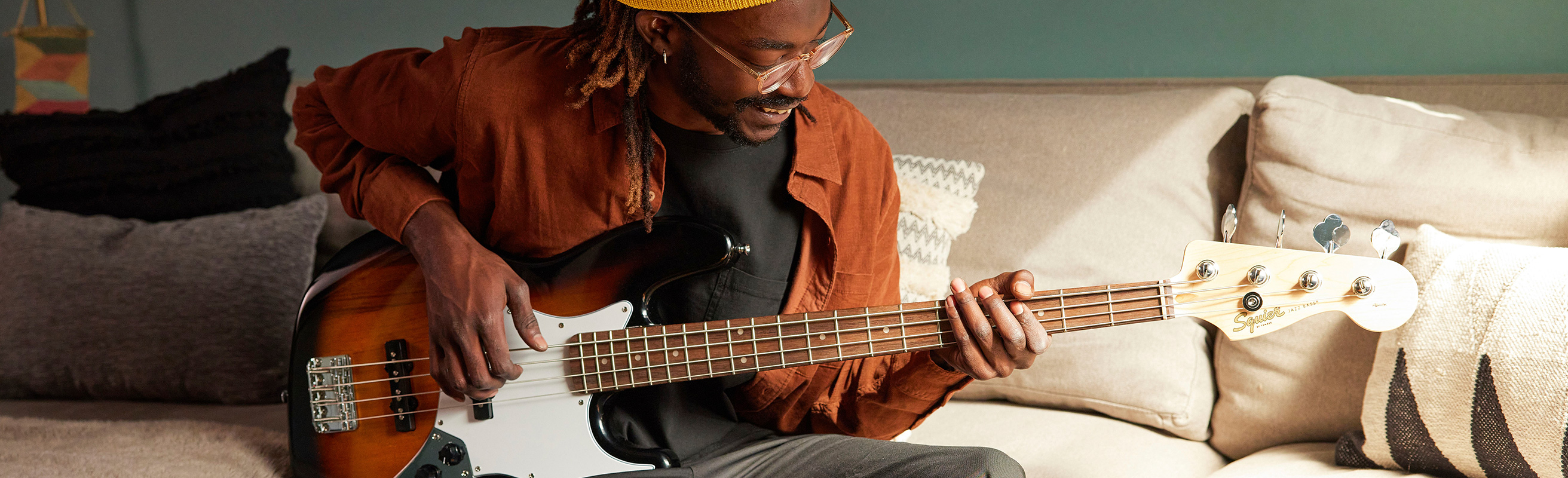
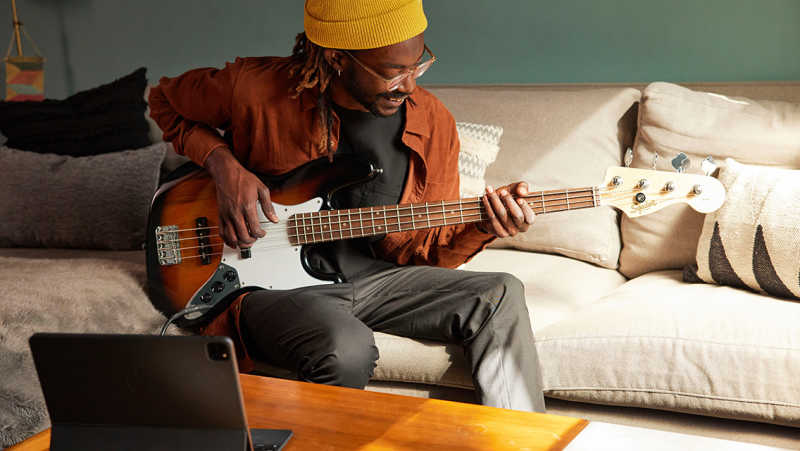
Good posture helps you play longer without pain. Sit near the front of a chair, keep both feet on the floor, and let the bass rest against your body. The neck should point slightly upward rather than dropping toward the floor.
Keep your fretting wrist fairly straight. Your thumb should rest behind the neck, near the middle. Do not squeeze the neck like a handle. A light grip is enough to produce a clear note.
Use your plucking-hand thumb as an anchor on the pickup or the lowest string. Alternate your index and middle fingers. This motion is called alternating fingerstyle, and it is the most useful starting technique for many bass players.
A simple hand check can prevent problems:
• Your shoulders should stay loose.
• Your elbows should not press tightly against your body.
• Your wrist should not bend sharply.
• Your fingers should pluck across the string, not pull far away from it.
• Your fretting fingers should stay close to the strings.
One lesson I often share with new players is that discomfort is not a badge of progress. Mild fingertip soreness can happen, but sharp wrist, hand, or shoulder pain means you should stop and adjust your position.
Tune the bass before you practice
A well-tuned bass makes your practice more useful. If the instrument is out of tune, your ear may learn the wrong pitch. Use a clip-on tuner, pedal tuner, or reliable tuning app.
The standard four-string tuning is:
• E string: lowest pitch
• A string: next-lowest pitch
• D string: next-highest pitch
• G string: highest pitch
Tune slowly. Pluck one string at a time, watch the tuner, and adjust the tuning key in small movements. If the pitch is too low, raise it. If it is too high, lower it slightly below the note, then tune upward again.
This extra movement helps the string settle. New strings may need frequent tuning for several days.
You can also tune by comparing fretted notes:
- Play the fifth fret on the E string.
- Match it to the open A string.
- Play the fifth fret on the A string.
- Match it to the open D string.
- Play the fifth fret on the D string.
- Match it to the open G string.
An electronic tuner is more accurate for beginners. Ear training becomes easier after you already know what correct pitch sounds like.
Play your first clean notes
Place your fretting finger just behind a fret, not directly on top of it. Press only as hard as needed. Pluck the string near the pickup and listen for a full, clear sound.
If a note buzzes, check these points:
• Move your finger closer to the fret.
• Press with a little more force.
• Make sure another finger is not touching the string.
• Check that the bass is tuned correctly.
• Slow down your hand movement.
Start with the open E string. Pluck four slow notes while counting “one, two, three, four.” Then try the open A string. Once those notes feel comfortable, play a simple pattern that moves between E and A.
For example:
- Play open E four times.
- Play open A four times.
- Return to open E four times.
- Repeat without speeding up.
This exercise may seem basic, but it teaches timing, consistency, and string control. Those skills remain important even for professional players.
Learn basic bass rhythm
Rhythm is the heart of bass playing. A bass line can use only two notes and still sound powerful if the timing is strong. A complex line will sound weak if the rhythm is uncertain.
Start with a metronome set between 60 and 80 beats per minute. Play one note on every click. Count out loud if needed:
“1, 2, 3, 4.”
Then try playing only on beats two and four. This helps you feel the backbeat found in many rock, pop, funk, and blues songs.
Next, practice eighth notes. Count:
“1 and 2 and 3 and 4 and.”
Play on every number and every “and.” Keep your hand moving in a steady way, even when you are not plucking. This makes your rhythm more reliable.
A useful beginner routine includes:
• Whole notes: one note per four beats
• Half notes: one note per two beats
• Quarter notes: one note per beat
• Eighth notes: two notes per beat
• Rests: planned moments of silence
Silence is part of the bass line. Leaving space can make the next note feel stronger.
Learn the major scale and root notes
The major scale gives you a map of the fretboard. You do not need to learn every scale at once. Begin with one movable pattern.
A simple major scale pattern can start from a root note on the E string:
- Play the root.
- Move up two frets.
- Move up two more frets.
- Move up one fret.
- Move up two frets.
- Move up two frets.
- Move up two frets.
- Move up one fret to reach the octave.
This pattern follows the major scale formula of whole steps and half steps. On a bass, one fret equals a half step, while two frets equal a whole step.
Root notes are especially important. The root is the note that names a chord. If a song uses a G chord, G is the root. Playing the root on the first beat of each chord can create a simple bass line that clearly supports the harmony.
To find common root notes:
• The third fret of the E string is G.
• The fifth fret of the E string is A.
• The third fret of the A string is C.
• The fifth fret of the A string is D.
Learning these notes helps answer how do I play bass guitar in a musical way rather than only a mechanical way.

Learn bass lines from real songs
Songs give your practice a clear purpose. Choose music that is slightly easier than your current level. You should feel challenged, but not lost.
Start by listening to the bass alone. Ask yourself:
• Does the bass repeat a pattern?
• Does it follow the kick drum?
• Does it play the root of each chord?
• Are there rests between notes?
• Does the player use slides, hammer-ons, or muted notes?
Then learn the line in small sections. Work on two or four beats at a time. Loop that section until it feels natural, then connect it to the next part.
Good beginner song choices often have:
• A steady beat
• Few chord changes
• Repeated bass patterns
• Moderate tempos
• Clear bass recordings
Use slowed playback when needed, but return to normal speed as soon as possible. Playing slowly builds accuracy; playing at the original tempo builds control.
A common mistake is trying to play the entire song from the start. It is better to master the verse, then the chorus, then the transition between them. This approach makes progress easier to measure.
Practice with a simple bass guitar routine
A short, regular routine works better than a long session once a week. Aim for 20 to 30 minutes on most days. Consistency helps your hands and ears develop together.
Try this beginner plan:
- Tune the bass: 2 minutes
- Warm up with open strings: 3 minutes
- Practice fretting clean notes: 5 minutes
- Play scales or root-note patterns: 5 minutes
- Practice with a metronome: 5 minutes
- Learn a song section: 10 minutes
Record yourself once or twice a week. You may notice timing issues that are hard to hear while playing. Recording is not about judging yourself; it is a practical way to track progress.
Keep a simple practice log. Write down the tempo, exercise, and song section you worked on. For example:
• Monday: E and A string exercise at 70 beats per minute
• Tuesday: G major scale at 60 beats per minute
• Wednesday: verse of a song at half speed
• Thursday: same verse at normal speed
If you miss a day, do not treat it as failure. Return to the routine at the next opportunity. Progress on bass guitar is built through repeated contact with the instrument.
Choose the right beginner gear
You do not need expensive equipment to start. A reliable bass, small amplifier, cable, tuner, strap, and comfortable picks are enough.
A four-string bass is usually the simplest choice for a first instrument. Look for a neck that feels comfortable and a body that is not too heavy. If possible, visit a music store and play several models while seated and standing.
You may also need:
• An electronic tuner
• A padded strap
• A metronome or metronome app
• Spare strings
• A small practice amplifier
• Headphones, if your amplifier supports them
• A music stand or tablet holder
Bass strings are thicker than guitar strings. They can feel stiff at first, but they should not cause severe pain. Keep your nails trimmed on the fretting hand, and clean the strings after playing.
A setup from a qualified instrument technician can improve action, tuning, and playability. However, a setup cannot replace correct technique. If you are unsure whether a problem comes from the instrument or your hands, ask an experienced teacher or technician to check it.
Avoid common beginner mistakes
Many new players focus only on learning notes. The larger challenge is making those notes fit the music.
Avoid these common problems:
Playing too hard
Plucking with excessive force creates a harsh sound and causes fatigue. Try using less force while keeping the note full.
Ignoring the metronome
A metronome may feel strict, but it teaches your internal sense of time. Start slowly and increase the tempo only when you can play without rushing.
Looking only at your hands
Your eyes should eventually move between the fretboard, the music, and the room. Practice familiar patterns without staring at every finger.
Skipping rests
Constant playing can make a bass line sound crowded. Learn where the notes stop. Good bass playing often feels strong because of the space around it.
Learning without listening
Listen to the original recording before you play. Notice the tone, timing, note length, and interaction with the drums.
Practicing only what feels easy
Repeat comfortable exercises, but spend part of each session on a small challenge. Improvement happens at the edge of your current ability, not far beyond it.
These lessons explain why how do I play bass guitar is not answered by technique alone. You also need listening skills, rhythm, patience, and musical judgment.
Use a pick or your fingers?
Both approaches are useful. Fingerstyle gives you a round, flexible tone and works well in many styles. A pick can produce a strong attack and may feel natural for rock, punk, metal, and some pop music.
For fingerstyle:
• Rest your thumb on a pickup or lower string.
• Alternate your index and middle fingers.
• Keep your fingers close to the strings.
• Practice even volume between both fingers.
For pick playing:
• Hold the pick between your thumb and index finger.
• Let only a small part of the pick extend beyond your fingers.
• Use a relaxed wrist.
• Start with steady downstrokes, then add alternating strokes.
Do not worry about choosing one method forever. Many skilled bassists use both. Your choice can change with the song, tone, and physical comfort.
You can also learn basic techniques later:
• Hammer-ons
• Pull-offs
• Slides
• Muting
• Vibrato
• Palm muting
• String crossing
Learn one technique at a time. For example, muting is often more useful early on than advanced tapping because it helps you control unwanted noise.
Play with a drummer or backing track
Bass becomes more meaningful when it interacts with drums. The kick drum often provides the main rhythmic partner. Try to hear the kick pattern and place your notes with it.
Start with a drum loop or backing track in a simple style. Play only one note at first. Your goal is to stay in time, not to create a complex line.
Then build the part gradually:
- Play the root on beat one.
- Add the root on beat three.
- Add notes that lead into the next chord.
- Add a short rhythm that matches the drum pattern.
- Remove any notes that make the line feel crowded.
This process teaches arrangement. The best bass line is not always the busiest one. It is the one that makes the song feel stable and clear.
When playing with other people, listen more than you expect. Do not turn up so loudly that you stop hearing the drummer or singer. A balanced volume helps the whole band play better.
How long does it take to learn bass guitar?
Many beginners can play simple bass lines within a few weeks of regular practice. Becoming comfortable with timing, scales, chord tones, and full songs may take several months. Advanced improvisation and professional-level control can take years.
Your progress depends on:
• Practice frequency
• Quality of feedback
• Previous music experience
• Song difficulty
• Physical comfort
• Listening habits
• Ability to maintain steady time
There is no single deadline. Someone who practices 20 minutes five days a week may progress more smoothly than someone who practices for two hours once every Sunday.
Set small goals. You might aim to play one song section at 70 beats per minute this week. Next week, you can increase the tempo or learn the chorus. Small wins create momentum.
Frequently Asked Questions About How Do I Play Bass Guitar
Is bass guitar easy for beginners?
Bass can be approachable because many songs use repeated patterns and fewer notes than guitar parts. It still requires steady rhythm, clean technique, and regular practice.
Can I learn bass guitar without knowing music theory?
Yes, you can begin by learning songs, rhythms, and basic patterns. Simple theory, such as chord names, root notes, and major scales, will help you understand the fretboard and learn faster.
Should I learn bass with a pick or my fingers?
Either method is valid. Fingerstyle is versatile and common, while a pick gives a sharper attack; try both and choose the method that feels relaxed and suits your music.
How often should I practice bass guitar?
Practice for 20 to 30 minutes on most days if possible. Short, focused sessions usually build better habits than rare, exhausting practice sessions.
Do I need an amplifier to learn bass?
An amplifier is useful because it lets you hear your tone and timing clearly. You can practice quietly with headphones if your equipment supports them, but avoid playing unplugged all the time because it may encourage overly hard plucking.
What should I learn first on bass guitar?
Begin with tuning, open-string names, relaxed posture, clean fretting, and steady quarter notes. Then learn root notes, a simple scale, and a complete beginner song.
Is a four-string or five-string bass better for a beginner?
A four-string bass is usually easier to understand and lighter to handle. A five-string bass offers a lower range, but you can add one later if your music requires it.
Conclusion
Learning how do I play bass guitar becomes much clearer when you break it into small skills. Tune the instrument, use relaxed posture, fret clean notes, practice with a metronome, learn root notes, and apply each skill to real songs.
You do not need perfect technique on day one. You need a steady routine and the patience to listen closely. Pick up your bass today, practice one simple rhythm for five minutes, and build from there. Explore beginner songs, record your progress, and share your first bass line with someone who enjoys music.

Senior Music Reviewer
Alex Carter is a seasoned music reviewer with over a decade of experience in the world of sound and instruments. Passionate about helping musicians and enthusiasts make informed choices, he brings sharp insights and in-depth knowledge to every review. From classical instruments to modern gear, Alex combines technical expertise with a love for music to deliver content that resonates with readers.
As a Senior Music Reviewer and expert author on Tuneluma.com, Alex is dedicated to sharing honest evaluations, practical advice, and thoughtful commentary to guide readers in their musical journey.