What Is Scale Length On A Guitar: A Simple Guide
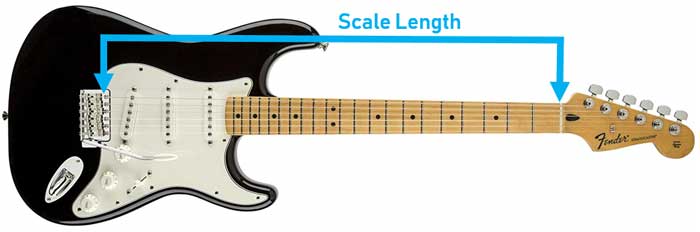
Scale length on a guitar is the distance from the nut to the bridge’s string contact point.
Understanding what is scale length on a guitar can change how you choose, set up, and play an instrument. It affects string tension, fret spacing, bending, tone, and even how comfortable the neck feels. After comparing guitars with short, medium, and long scales, I have found that a few millimeters can make a real difference in a player’s hands. This guide explains the idea in plain English and shows how to use it when buying or setting up a guitar.

What Is Scale Length on a Guitar?
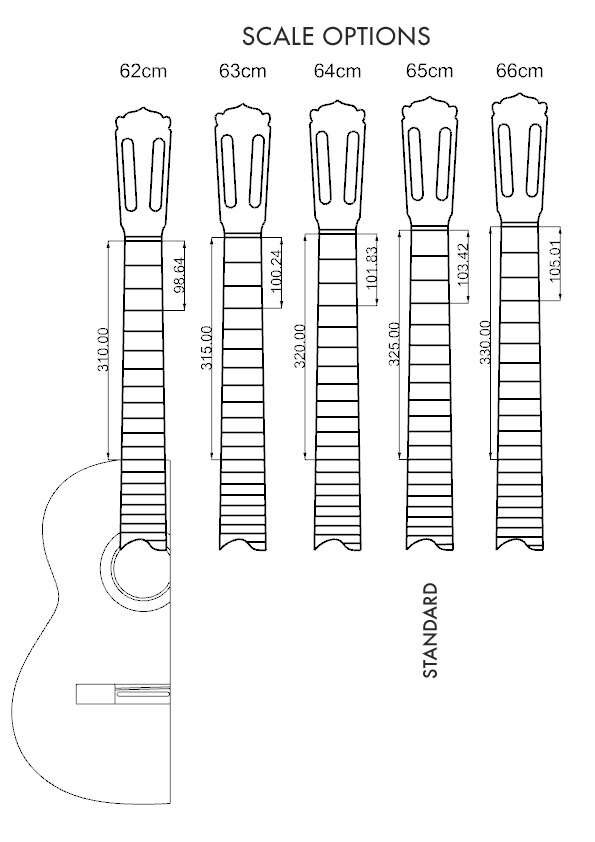
Scale length on a guitar is the vibrating length of an open string. It runs from the front edge of the nut to the point where the string rests on the bridge saddle.
The scale length is not the full length of the guitar. A large guitar can have a short scale, while a small guitar can have a longer scale. The body size, neck length, and scale length are related, but they are not the same measurement.
Think of the string like a jump rope. A longer rope needs more pull to reach the same note. A shorter rope needs less pull. Guitar scale length works in a similar way.
Common electric guitar scale lengths include:
• 24 inches, found on some short-scale and compact guitars
• 24.75 inches, common on many Gibson-style guitars
• 25 inches, used by several brands as a middle option
• 25.5 inches, common on Fender-style guitars
• 26.5 to 27 inches, often used on extended-range and baritone guitars
Acoustic guitars often use scale lengths from about 24.75 to 25.5 inches, although many other sizes exist. Bass guitars usually have longer scales, such as 30, 32, 34, or 35 inches.
How Do You Measure Guitar Scale Length?
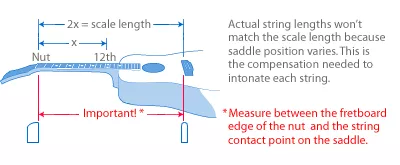
You can measure scale length on a guitar with a ruler or tape measure. For a close estimate, measure from the nut to the center of the 12th fret, then multiply that distance by two.
For example, if the nut-to-12th-fret distance is 12.75 inches, the guitar has an approximate 25.5-inch scale length.
Use these steps:
- Place the end of the ruler at the front edge of the nut.
- Measure to the center of the 12th fret.
- Multiply that number by two.
- Compare the result with the maker’s listed specification.
This method works because the 12th fret sits halfway along the theoretical string length. However, the bridge saddle is usually placed a little farther back. This extra distance is called compensation. It helps the guitar play more accurately when you fret notes.
For the most accurate result, measure from the nut to the actual string contact point on the high E saddle. Do not measure to the back of the bridge or the end of the saddle. On an acoustic guitar, the saddle may be angled, so use the point where the high E string touches it.
Manufacturers may list scale length in inches or millimeters. A 25.5-inch scale is about 648 millimeters, while a 24.75-inch scale is about 629 millimeters.

Why Does Guitar Scale Length Matter?
Scale length affects several parts of a guitar’s design and playing feel. The most important effect is string tension.
At the same pitch and with the same string gauge, a longer scale creates more tension. A shorter scale creates less tension. The difference may seem small on paper, but your fingers can feel it during bends, vibrato, and chord work.
Scale length also affects:
• The distance between frets
• How tight or loose the strings feel
• How much force is needed for bends
• The way the guitar responds to picking
• The amount of room for low tunings
• Some aspects of tone and sustain
A 25.5-inch guitar may feel firm and bright compared with a 24.75-inch guitar using the same strings and tuning. The shorter guitar may feel softer and easier to bend.
Neither choice is automatically better. The best scale length depends on your hands, playing style, tuning, string gauge, and musical goals.

Scale Length and String Tension
String tension is one of the clearest ways to understand scale length on a guitar. For the same string and pitch, tension rises roughly with the square of the scale length.
This means a small increase in scale length can create a noticeable change in feel. For example, a 25.5-inch scale is about 3 percent longer than a 24.75-inch scale, but the tension difference can be around 6 percent when all other factors stay equal.
The basic relationship depends on three main factors:
• Scale length
• String gauge
• Pitch
A thicker string creates more tension. A higher note creates more tension. A longer scale also creates more tension.
Here is a simple example. Imagine two guitars tuned to standard tuning with the same 10-gauge string set:
• A 24.75-inch guitar may feel softer.
• A 25.5-inch guitar may feel tighter.
If you put the same strings on both guitars, the shorter-scale instrument may make bends feel easier. The longer-scale instrument may feel more stable during heavy picking or lower tunings.
You can balance these differences by changing string gauge. A player who likes a short scale but wants more resistance may use slightly thicker strings. A player who finds a long scale too stiff may use lighter strings.

How Scale Length Changes Fret Spacing
Scale length determines the spacing between frets. A longer scale spreads the frets farther apart. A shorter scale places them closer together.
The difference is most noticeable near the lower frets. A player with small hands may find a short-scale guitar more comfortable for wide chords and stretches. A player with large hands may enjoy the extra room of a long scale.
The fret positions are not spaced by simple equal measurements. Each fret divides the string length by a mathematical ratio based on the twelfth root of two. This system allows each fret to raise the pitch by one semitone.
You do not need to calculate the fret positions yourself. The important point is that the scale length sets the layout of the whole fingerboard.
For example:
• A 24-inch scale can feel compact and easy to navigate.
• A 24.75-inch scale offers a familiar, slightly relaxed feel.
• A 25.5-inch scale gives more space between frets.
• A 27-inch scale can feel wide, especially near the first few frets.
When I compare guitars for beginners, I pay close attention to first-position chords. If the player struggles to reach a basic G or C chord, a shorter scale may help. Comfort often matters more than brand or appearance.
Short-Scale, Medium-Scale, and Long-Scale Guitars
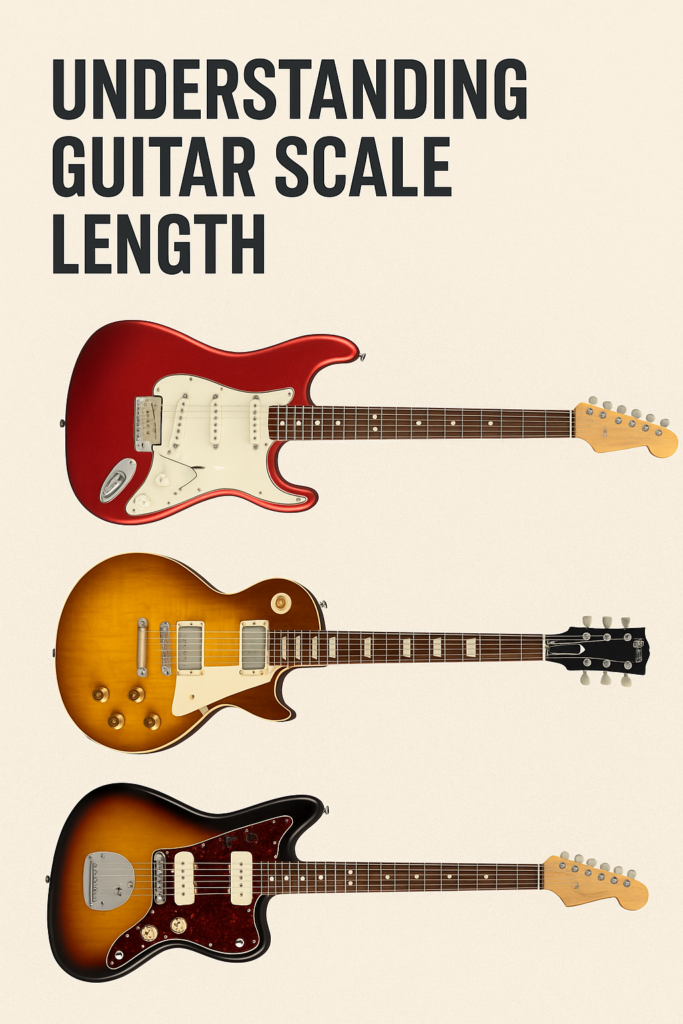
Guitar scale length is often described as short, medium, or long. These labels are useful, but they are not perfectly fixed across the industry.
Short-scale guitars
Short-scale guitars usually measure between 24 and 24.75 inches. They often feel soft, compact, and easy to bend.
They can work well for:
• Players with smaller hands
• Beginners
• Blues and rock players who use wide bends
• Children and younger players
• Players who prefer a relaxed string feel
A short scale may produce a slightly warmer or fuller sound, although pickups, wood, strings, and construction also have major effects.
Medium-scale guitars
Medium-scale guitars often fall near 25 inches. They sit between the classic short and long options.
This length can offer a balanced feel. It may provide enough tension for clear rhythm work while remaining comfortable for bends. Several modern guitar brands use a 25-inch scale to give players a middle ground.
Long-scale guitars
Long-scale guitars usually measure 25.5 inches or more. They often feel tighter and provide more space between frets.
They are useful for:
• Lower tunings
• Heavy picking
• Clear rhythm playing
• Extended-range guitars
• Players who prefer firm string tension
A long scale can make low notes feel more focused. This is one reason baritone guitars and many seven-string guitars use longer scales.

Does Scale Length Affect Guitar Tone?
Yes, scale length can affect tone, but it is only one part of the sound. The string’s tension and vibrating length change how the instrument responds.
A longer scale often gives a sound that feels tighter, clearer, and more focused. It can also provide stronger note definition in lower tunings. A shorter scale often feels softer and may produce a warmer or rounder response.
Still, do not judge tone by scale length alone. These factors can matter just as much:
• Pickup design
• Pickup height
• String material and gauge
• Bridge construction
• Neck stiffness
• Body materials
• Amp settings
• Playing technique
Two guitars with the same scale length can sound very different. In practical use, scale length often changes your touch more than it changes the basic voice of the guitar.
A useful test is to play the same riff on two guitars with the same pickups and strings. You may notice that the longer scale makes each note feel more direct, while the shorter scale responds more gently. That response can influence tone because your hands naturally adjust.

Scale Length and Alternate Tunings
Scale length becomes especially important when you tune lower than standard tuning. Lower tuning reduces string tension. A longer scale can help restore some of the firmness lost from tuning down.
For example, a 25.5-inch guitar may handle Drop D or D standard with a familiar feel. A 24.75-inch guitar may feel looser in the same tuning. That is not always a problem, but you may prefer thicker strings.
For very low tunings, players often choose:
• A longer scale
• Heavier strings
• A baritone guitar
• A multi-scale or fanned-fret guitar
A 27-inch baritone scale can make B or A tuning feel more controlled than a standard 24.75-inch guitar. However, a longer scale does not solve every low-tuning problem. Nut slots, bridge setup, intonation, pickup response, and string choice still matter.
If you change tuning often, consider a balanced string set. A balanced set keeps the bass strings from feeling too loose while preventing the treble strings from becoming unnecessarily stiff.
Multi-Scale and Fanned-Fret Guitars
A multi-scale guitar uses different scale lengths for different strings. The frets appear angled or fanned rather than straight across the neck.
The bass strings usually have a longer scale. The treble strings use a shorter scale. This design aims to give low strings better tension while keeping the higher strings comfortable.
Multi-scale guitars can offer:
• Better tension balance
• Clearer low notes
• Improved comfort in lower tunings
• More natural string-by-string control
They may take time to learn. The first few chords can feel unusual because the frets are not parallel. Most players adapt after a short practice period.
A multi-scale guitar is not automatically superior to a traditional guitar. It is a tool for a specific need, especially extended-range playing and low tunings. Try one in person if possible before buying.
How Scale Length Affects Guitar Setup
Changing scale length is not a simple replacement job. The nut, fret positions, bridge location, and intonation must all match the chosen scale.
If a guitar is built for a 24.75-inch scale, you cannot make it a 25.5-inch guitar by moving the bridge a little. The frets are already fixed. A true scale change usually requires a different neck and careful body modifications.
Scale length does affect setup choices, including:
• String gauge
• Neck relief
• Action
• Nut slot depth
• Bridge intonation
• Pickup height
When changing string gauge, the neck may need a truss rod adjustment. The bridge saddles may also need new intonation settings. Make small changes and check the guitar carefully.
One mistake I often see is judging a guitar after installing new strings without allowing for setup changes. A heavier set can raise tension and make the neck move slightly. If the guitar feels different, the scale length may not be the only cause.
For major changes, a qualified guitar technician is the safest choice. A good setup can make a guitar feel far better without changing its scale length.
How to Choose the Right Guitar Scale Length
The right scale length depends on how the guitar feels in your hands. Start by thinking about your current playing habits rather than choosing based on a label.
Ask yourself:
• Do you use wide bends?
• Do you play in low tunings?
• Do you prefer a soft or firm string feel?
• Do wide fret stretches feel difficult?
• Do you play rhythm, lead, or both?
• Do you use heavier or lighter strings?
A short scale may suit you if you want easy bends and close fret spacing. A long scale may suit you if you need strong tension for low tunings. A medium scale may be the safest choice if you want a balanced feel.
Try the same chord and riff on several guitars. Test a first-position chord, a whole-step bend, a power chord, and a fast run across the neck. These simple tests reveal more than a specification sheet.
Also compare guitars with similar string gauges. A short-scale guitar with heavy strings may feel firmer than a long-scale guitar with very light strings. Scale length is important, but the complete setup determines the final experience.
Common Mistakes About Guitar Scale Length
Many players misunderstand scale length because guitar measurements can look confusing. Avoid these common mistakes.
• Measuring the full guitar: Overall guitar length does not tell you the scale length.
• Measuring to the bridge body: Measure to the string contact point on the saddle.
• Ignoring compensation: Nut-to-12th-fret measurement is an estimate, not always the exact scale.
• Assuming longer is better: Longer scales help with tension, but they may feel less comfortable.
• Assuming shorter means poor quality: Short-scale guitars can be professional instruments with excellent tone and playability.
• Changing strings without checking setup: A new gauge can alter neck relief and intonation.
• Choosing by numbers alone: Your hands and playing style matter more than a specification chart.
Another mistake is comparing only the open-string feel. Fretted notes, bends, barre chords, and low-tuning riffs can reveal different strengths. Always test the guitar in the way you actually play.
Frequently Asked Questions About What Is Scale Length on a Guitar
What is scale length on a guitar?
Scale length on a guitar is the vibrating distance from the nut to the bridge saddle. It controls fret spacing and strongly affects string tension and playing feel.
What is the most common electric guitar scale length?
The 25.5-inch scale is common on many electric guitars, while 24.75 inches is also widely used. Some guitars use 25 inches or longer scales for a different balance of comfort and tension.
Is a shorter guitar scale easier to play?
A shorter scale often feels easier because the frets are closer together and the strings have less tension. However, comfort depends on hand size, string gauge, neck shape, action, and personal preference.
Does a longer scale improve guitar tone?
A longer scale can create a tighter response and clearer low notes, especially in lower tunings. Tone also depends heavily on pickups, strings, construction, amplification, and playing technique.
Can I change the scale length of my guitar?
You usually cannot change a guitar’s scale length without replacing or modifying the neck and relocating the bridge. The fret positions and bridge placement must match, so this work is best handled by an experienced repair technician.
What scale length is best for Drop D tuning?
Many players enjoy a 25.5-inch scale for Drop D because it keeps the lowest string reasonably firm. A 24.75-inch guitar can also work well with a suitable string gauge and a proper setup.
How do I measure guitar scale length?
Measure from the front edge of the nut to the center of the 12th fret, then multiply the result by two. For a more exact measurement, measure from the nut to the string contact point on the bridge saddle.
Conclusion
Scale length on a guitar is the distance from the nut to the bridge’s string contact point. It affects fret spacing, string tension, bending, low-tuning stability, and the way the instrument responds under your fingers.
Short scales often feel softer and more compact. Long scales usually provide firmer tension and stronger support for lower tunings. Medium scales offer a useful balance, while multi-scale designs give each string a different length.
Use the measurements as a guide, but let your hands make the final decision. Try several guitars, compare the same strings and tunings, and get a proper setup after major string changes. Explore more guitar setup guides, test scale lengths in person, and share your preferred guitar scale in the comments.

Senior Music Reviewer
Alex Carter is a seasoned music reviewer with over a decade of experience in the world of sound and instruments. Passionate about helping musicians and enthusiasts make informed choices, he brings sharp insights and in-depth knowledge to every review. From classical instruments to modern gear, Alex combines technical expertise with a love for music to deliver content that resonates with readers.
As a Senior Music Reviewer and expert author on Tuneluma.com, Alex is dedicated to sharing honest evaluations, practical advice, and thoughtful commentary to guide readers in their musical journey.