What Is Guitar Standard Tuning: Easy EADGBE Guide
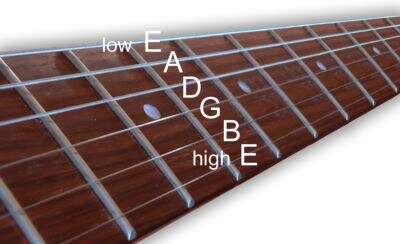
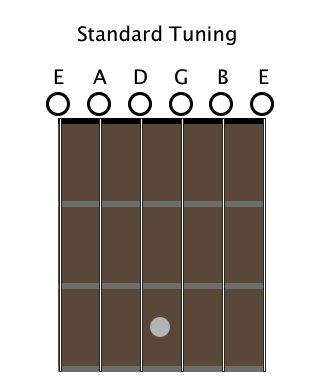
Guitar standard tuning uses the notes E, A, D, G, B, and E, from the lowest string to the highest.
If you are learning guitar, guitar standard tuning is the first tuning to understand. It gives you a common pitch system for lessons, chord charts, tabs, songs, and band practice. Once you know the string notes, how to tune them, and why this setup works, the fretboard becomes much easier to navigate.
What Is Guitar Standard Tuning?
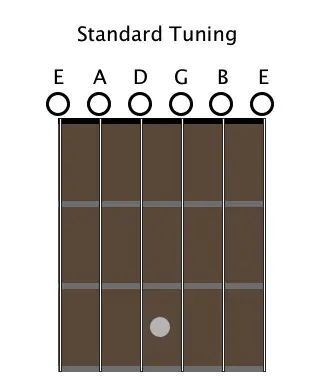
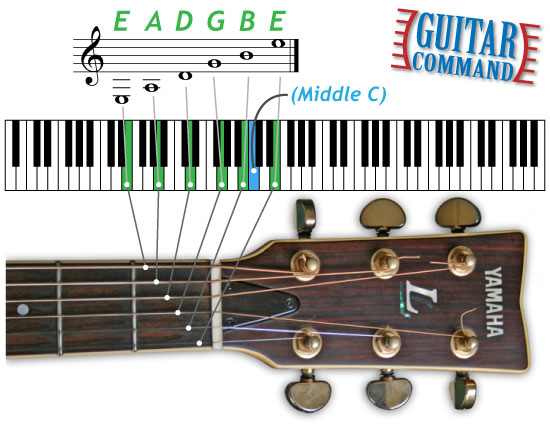
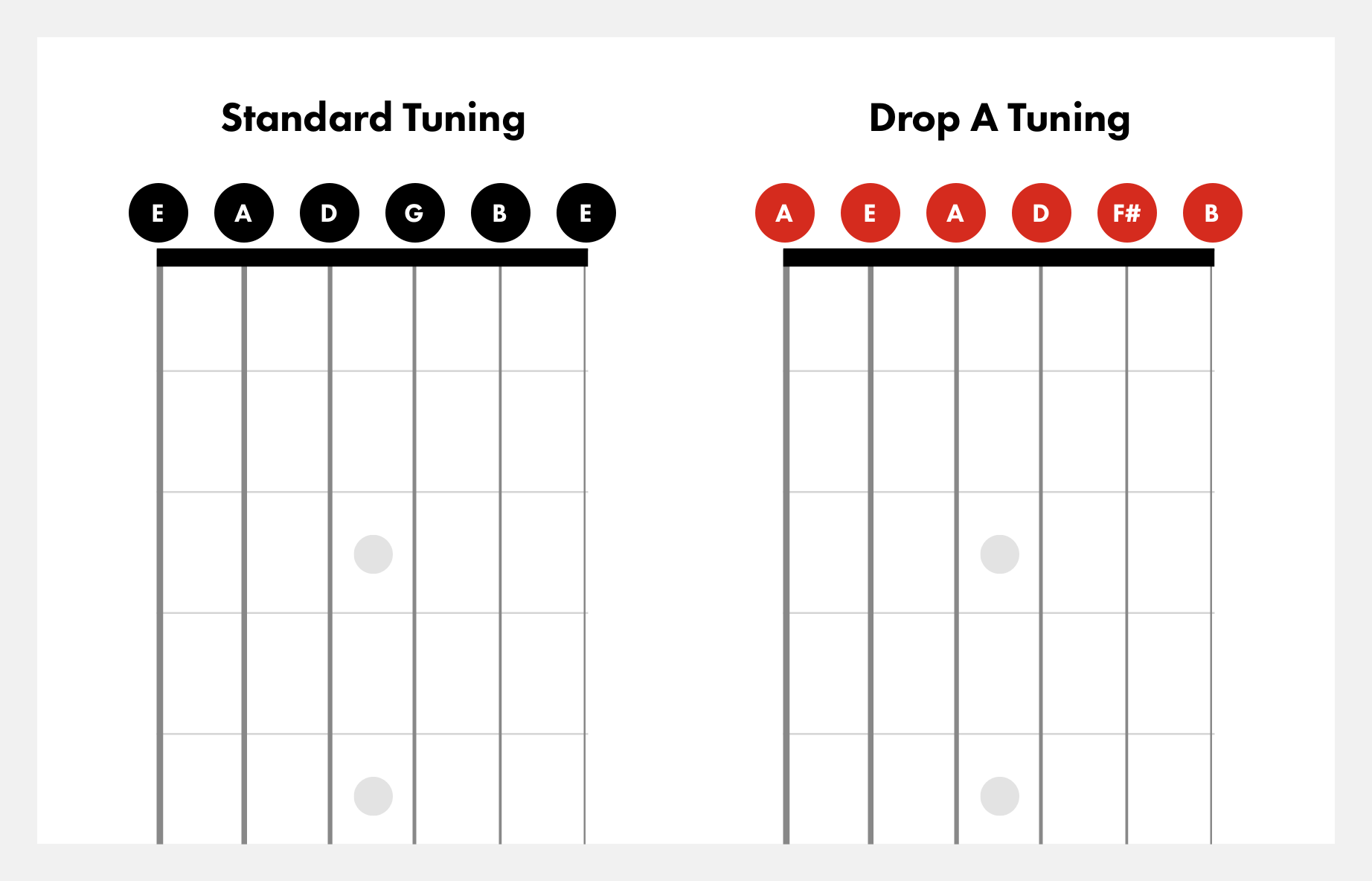
Guitar standard tuning is the most common tuning used for six-string guitars. From the thickest string to the thinnest string, the notes are:
• 6th string: E2, low E
• 5th string: A2
• 4th string: D3
• 3rd string: G3
• 2nd string: B3
• 1st string: E4, high E
The number shows the octave. The low E string is E2, while the high E string is E4. Both strings share the letter E, but the high E sounds two octaves above the low E.
You may see guitar standard tuning written as E–A–D–G–B–E. Many players remember it from the thickest string to the thinnest string. A useful phrase is “Eddie Ate Dynamite, Good Bye Eddie,” although making your own memory phrase can work just as well.
Guitar standard tuning uses the pitch reference A4 = 440 Hz. This means the A note above middle C vibrates at 440 cycles per second. Most electronic tuners use this reference unless you change the calibration.

Why Is Standard Tuning Used?
Guitar standard tuning became popular because it offers a practical balance between comfort, chord shapes, scales, and musical range. The first four string changes follow perfect fourths:
• E to A
• A to D
• D to G
The change from G to B is a major third. The change from B to high E returns to a perfect fourth.
This pattern helps your hand form many movable chord shapes. It also lets guitarists play a wide range of scales and melodies without extreme stretches. The tuning is not perfectly symmetrical, but that small break between the G and B strings makes many common chord shapes easier to play.
Standard tuning also works well in groups. If a teacher says to play a G chord, most players know the same shape. If a song tab shows the open strings, you can usually play it without changing your setup.
In my experience helping new players, confusion often begins when they learn a chord shape without learning the string names. Guitar standard tuning is more than a setting on a tuner. It is the map that gives every fret and string its pitch.

Guitar Standard Tuning Notes and Frequencies
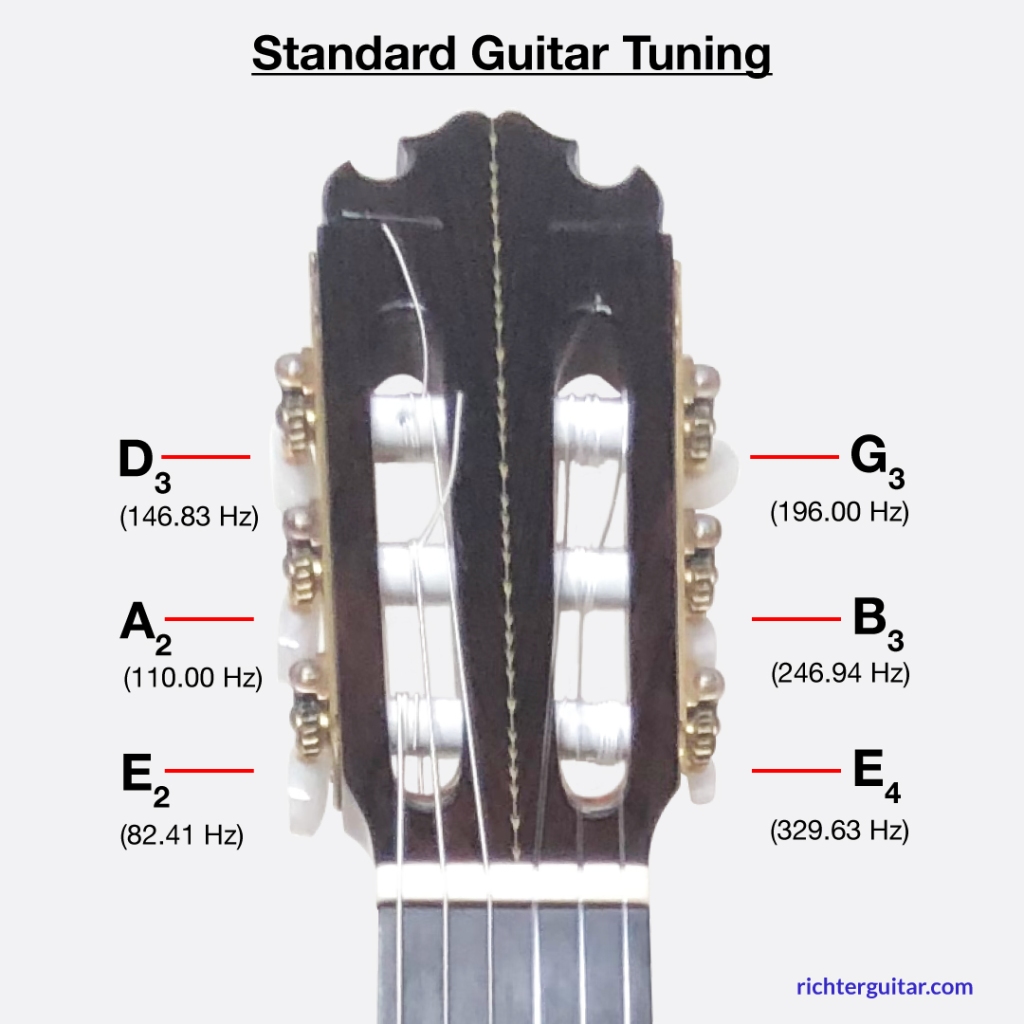
The open strings in guitar standard tuning have these approximate frequencies:
| String | Note | Scientific pitch | Frequency |
|---|---|---|---|
| 6th | Low E | E2 | 82.41 Hz |
| 5th | A | A2 | 110.00 Hz |
| 4th | D | D3 | 146.83 Hz |
| 3rd | G | G3 | 196.00 Hz |
| 2nd | B | B3 | 246.94 Hz |
| 1st | High E | E4 | 329.63 Hz |
These values assume equal temperament, the tuning system used by most modern Western instruments. A guitar may not sound perfectly in tune at every fret because of string stiffness, action height, fret placement, and intonation.
The open-string frequencies explain why the lowest string feels much deeper than the highest string. The low E vibrates more slowly, while the high E vibrates much faster. Think of the strings as six lanes on a musical road, each starting at a different pitch.
You do not need to memorize the frequencies to tune your guitar. Still, knowing them can help you understand what a tuner is measuring and why small pitch changes matter.
How to Tune a Guitar to Standard Tuning
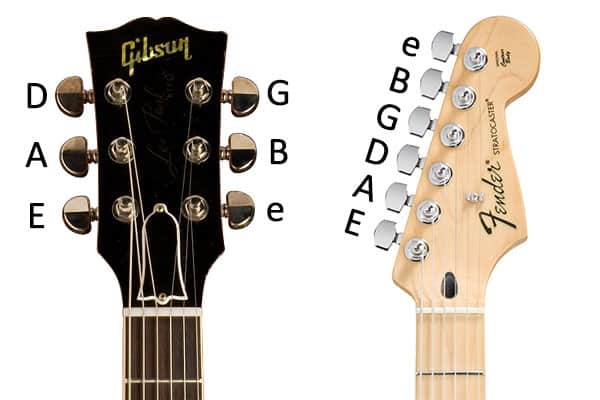
The easiest way to tune guitar standard tuning is with a chromatic tuner. A clip-on tuner reads the vibration from the headstock, so it works even in a noisy room. Phone tuner apps can also work well, but they may struggle near loud instruments.
Follow these steps:
- Turn on the tuner and set it to chromatic mode if needed.
- Play the 6th string by itself.
- Adjust the tuning peg until the tuner reads E.
- Tune the 5th string to A.
- Tune the 4th string to D.
- Tune the 3rd string to G.
- Tune the 2nd string to B.
- Tune the 1st string to E.
- Play a few chords and check the strings again.
Tune upward into the note when possible. If you tune past the target, loosen the string below the note, then raise it slowly. This helps reduce slack around the tuning post.
New strings often go flat for the first several minutes. Stretch them gently by lifting each string a little above the fretboard, then tune again. Never pull hard, especially with thin strings.
One mistake I often see is tuning by memory alone. Experienced players can estimate pitch, but even they use a tuner for accuracy. Your ear becomes stronger when you compare it with a reliable reference.
How to Tune by Ear
You can tune guitar standard tuning without an electronic tuner by using the fifth-fret method. This method compares one string with the next open string.
Use these notes:
• 6th string, 5th fret = open 5th string
• 5th string, 5th fret = open 4th string
• 4th string, 5th fret = open 3rd string
• 3rd string, 4th fret = open 2nd string
• 5th string, 5th fret = open 1st string
The third string uses the fourth fret because the G-to-B interval is different. This is the detail many beginners miss.
To tune, play the fretted note and the open note together. If you hear a pulsing or wavering sound, the notes are not equal. Turn the tuning peg slowly until the pulsing becomes slower and disappears.
This method can make the strings match each other, but it does not guarantee concert pitch. The whole guitar may be sharp or flat if your first reference note is inaccurate. For playing alone, that may be fine. For playing with a piano, backing track, or other musicians, use a tuner set near A = 440 Hz.
How to Check Guitar Standard Tuning Without a Tuner
A quick check starts with the open low E and high E strings. They should sound like the same note at different octaves. The high E should sound brighter and higher, but it should not sound sour or unrelated.
You can also check common octaves:
• Play the 6th string at the 12th fret and compare it with the open 1st string.
• Play the 5th string at the 7th fret and compare it with the open 1st string.
• Play the 4th string at the 2nd fret and compare it with the open 1st string.
• Play the 3rd string at the 9th fret and compare it with the open 1st string.
These checks can reveal a string that drifted out of tune. However, they do not replace a tuner when exact pitch matters.
If a guitar sounds wrong even after tuning, the issue may be poor intonation. Intonation controls whether notes stay accurate as you move up the fretboard. A guitar technician can adjust the bridge saddles when this problem is severe.
Standard Tuning and Common Guitar Chords
Guitar standard tuning supports many familiar open chords. Chords such as C, G, D, E, A, and Em are built around the open-string notes and common fret patterns.
For example, an open E minor chord uses the low E, B, and high E strings as part of its sound. An open A major chord uses the A string as its root. These open notes give beginner chords a full, ringing quality.
Standard tuning also makes barre chords movable. An E-shape barre chord can move up the neck because the low E string gives a clear root note. An A-shape barre chord uses the A string in the same way.
This is one reason guitar standard tuning is so useful for songwriting. You can learn one shape, move it to another fret, and create a new chord. The pattern stays familiar while the pitch changes.
Standard Tuning for Scales and Music Theory
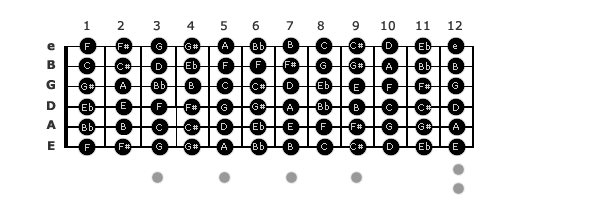
The open strings in guitar standard tuning help you locate notes across the fretboard. Each fret raises a note by one semitone, also called a half step. For example, the low E string produces F at the first fret, F-sharp at the second fret, and G at the third fret.
The 12th fret repeats the open string one octave higher. This gives you a useful landmark. The 12th fret on the low E string is another E, while the 12th fret on the high E string is also E.
The tuning interval between strings also explains why scale shapes change when they cross the G and B strings. A pattern that works across the low E, A, D, and G strings may need a small adjustment on the B string.
Many guitar lessons teach patterns instead of note names. Patterns are useful, but understanding guitar standard tuning helps you connect those shapes to real notes, keys, and chords. That knowledge becomes valuable when you improvise or write music.
Benefits and Limitations of Standard Tuning
Guitar standard tuning has several clear benefits:
• It matches most beginner lessons, chord books, and guitar tabs.
• It works well for solo playing and group performance.
• It supports a wide range of chords, scales, and melodies.
• It makes it easy to share songs with other guitarists.
• It keeps string tension within a normal range for most guitars.
It also has limits. Some songs sound deeper or more powerful in a lower tuning. Other songs use open tunings to create rich chords with fewer fingers. Standard tuning can also make certain voicings harder than they would be in an alternate tuning.
Players sometimes use drop D, where the low E string is lowered to D. Other common choices include half-step-down tuning, which lowers every string by one semitone, and open G, where the open strings form a G chord.
Alternate tunings are not better or worse. They are tools for different sounds. Learn guitar standard tuning first, then explore other tunings when you understand how the changes affect chords and string tension.
Guitar Standard Tuning Compared With Alternate Tunings
Standard tuning keeps the strings at E–A–D–G–B–E. Alternate tuning changes one or more strings to create a new musical layout.
Here are a few popular examples:
• Drop D: D–A–D–G–B–E. The lowest string drops from E to D.
• Eb tuning: Eb–Ab–Db–Gb–Bb–Eb. Every string goes down one semitone.
• D standard: D–G–C–F–A–D. Every string goes down one whole step.
• Open G: D–G–D–G–B–D. The open strings create a G major chord.
• Open D: D–A–D–F-sharp–A–D. The open strings create a D major chord.
Drop D is common in rock because it gives easy access to a low D power chord. Half-step-down tuning can make bends feel slightly looser and can suit singers who need a lower key.