How To Read Quad Drum Music: Easy Step-By-Step Guide
Read quad drum music by matching each note to a numbered drum, counting the rhythm, and following the written sticking.
Learning how to read quad drum music can feel hard at first because one staff often controls four different drums. Once you understand the drum numbers, note positions, rhythms, and movement patterns, the page becomes much easier to follow. This guide explains the system step by step, with clear examples and practice tips used in marching percussion.
What Quad Drum Music Represents
Quad drums, also called quads or tenor drums, are a set of four drums played by one percussionist. Each drum has a different pitch, and the player moves across the set to create musical patterns.
Most quad parts use these drum numbers:
• Drum 1 is the highest-pitched drum.
• Drum 2 is the second-highest drum.
• Drum 3 is the second-lowest drum.
• Drum 4 is the lowest-pitched drum.
On many marching quad sets, Drum 1 sits closest to the player’s left side, while Drum 4 sits closest to the player’s right side. However, layouts can vary by instructor, arranger, or drum model. Always check the legend at the beginning of the music.
Quad music combines three main types of information:
• Rhythm tells you when to play.
• Drum numbers or staff positions tell you where to play.
• Sticking tells you which hand to use.
Think of the music as a map. The rhythm is the road, the drum numbers are the locations, and the sticking shows which foot to use at each turn.

Learn the Quad Drum Notation System
Before playing a full exercise, learn how the written notes connect to the physical drums. This is the most important step in learning how to read quad drum music.
Drum numbers and staff spaces
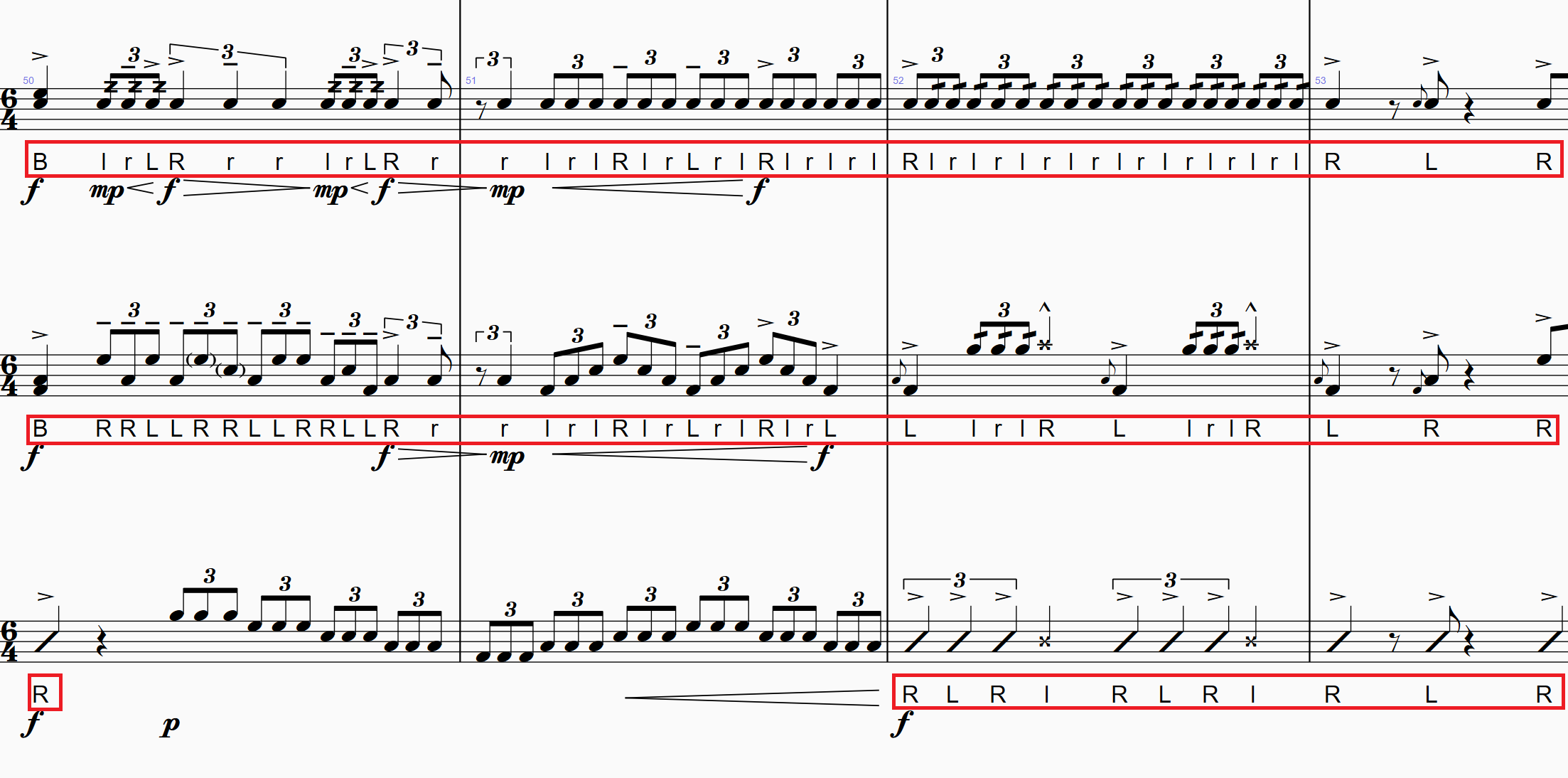
Many quad arrangements use a single staff with different spaces or lines assigned to each drum. The exact layout is not universal, so never assume that every book uses the same system.
A common layout places the drums from higher to lower on the staff:
• The highest note position represents Drum 1.
• The next position represents Drum 2.
• The next position represents Drum 3.
• The lowest position represents Drum 4.
Some charts reverse the direction or use special noteheads. Others write small numbers above the notes. If the music includes a key, study it before playing.
Note direction and movement
A note on Drum 1 followed by a note on Drum 2 creates a movement toward the center of the set. A note on Drum 4 followed by Drum 3 creates movement in the opposite direction.
For example:
• 1–2–3–4 moves from high to low.
• 4–3–2–1 moves from low to high.
• 1–3–2–4 creates a split pattern that skips across the set.
The number pattern matters because it affects both sound and motion. A clean quad part should sound even and look controlled. Large movements should not cause your shoulders to rise or your wrists to lock.
Rests and ties
A rest means you do not play during that part of the beat. Keep counting during the rest so you enter at the correct time.
A tie connects two notes across a beat or bar line. You play the first note, then let it continue. Do not strike the tied note again unless the notation shows a new attack.
Grace notes and accents
Grace notes are small notes placed before a main note. In marching percussion, they may be played as quick embellishments or part of a diddle pattern.
Accents show that a note should be louder or more pronounced. An accent does not mean you should tense your arms. Use a controlled stroke with a clear height difference between accented and unaccented notes.
Read the Rhythm Before the Drum Changes
One of the most common mistakes in quad drum music is focusing on the drum movement before understanding the rhythm. The pattern may look complex, but the timing often uses familiar rhythms.
Start by reading only the rhythm. Ignore the drum numbers for a moment and clap, speak, or tap the notes.
Count common note values
In 4/4 time, quarter notes are often counted as:
1, 2, 3, 4
Eighth notes can be counted as:
1 and 2 and 3 and 4 and
Sixteenth notes can be counted as:
1 e and a, 2 e and a, 3 e and a, 4 e and a
Triplets can be counted as:
1 trip let, 2 trip let, 3 trip let, 4 trip let
Use the counting system your instructor or ensemble uses. The exact words matter less than keeping a steady pulse.
Understand subdivisions
A quad line may move between drums on every eighth note or sixteenth note. If you cannot speak the subdivision, your hands will likely rush or drag.
For example, a pattern written as four sixteenth notes across the drums might be:
1 e and a
You could play:
• Drum 1 on “1”
• Drum 2 on “e”
• Drum 3 on “and”
• Drum 4 on “a”
The hands must move evenly. Do not speed up just because the notes travel across the drums.
Identify the beat structure
Look for the time signature at the beginning of the line. Common signatures include:
• 4/4, which has four quarter-note beats per measure
• 2/4, which has two quarter-note beats per measure
• 6/8, which often feels like two groups of three eighth notes
• 3/4, which has three quarter-note beats per measure
The bar line divides the music into measures. Use it as a checkpoint. If you lose your place, stop at the next bar line and restart with a steady count.
Use a metronome
A metronome helps you hear whether your timing is stable. Begin at a slow tempo, such as 60 beats per minute, and increase the speed only when the notes sound even.
In my teaching and rehearsal experience, players often improve faster by practicing slowly with a metronome than by repeating the part at full speed. Slow practice exposes uneven spacing before it becomes a habit.
Learn Proper Quad Drum Sticking
Sticking tells you which hand plays each note. Most quad music uses R for right hand and L for left hand.
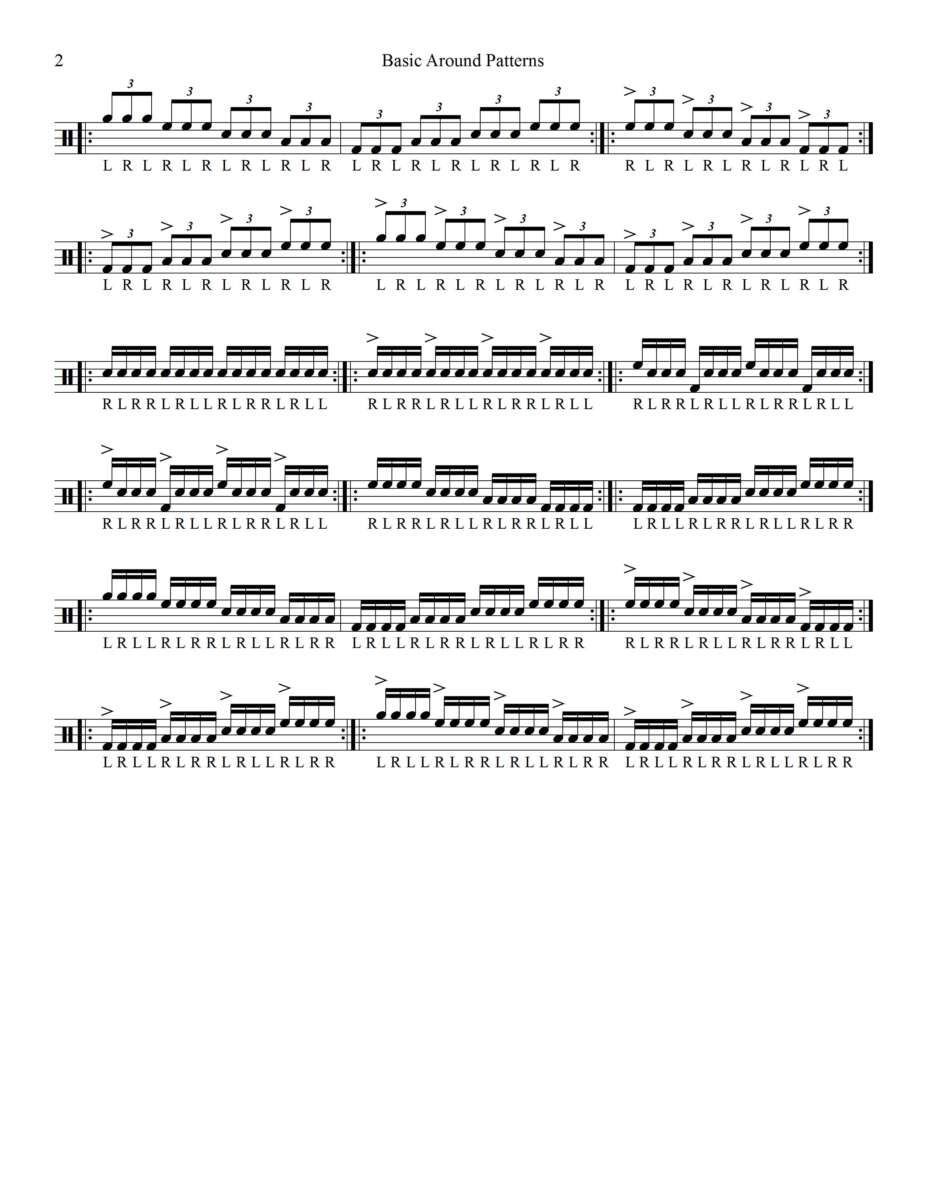
A basic alternating sticking looks like this:
R L R L
You may also see patterns such as:
R R L L
or:
R L L R
The correct sticking depends on the phrase, the movement, and the arrangement.
Why sticking matters
Sticking is not only about choosing a hand. It helps you control sound, speed, movement, and consistency.
A good sticking can:
• Reduce unnecessary motion
• Keep accents on the correct hand
• Make crossovers easier
• Improve speed across multiple drums
• Help the entire section match
If you change the written sticking without a clear reason, you may create a difficult movement or place an accent on the weaker hand.
Basic alternating strokes
For a simple four-note pattern, use:
R L R L
If the notes move from Drum 1 to Drum 4, you might play:
• R on Drum 1
• L on Drum 2
• R on Drum 3
• L on Drum 4
Practice this slowly. Keep both sticks at the same height unless the music includes dynamics.
Double strokes
A double stroke uses two hits with the same hand:
R R L L
Double strokes are common in fast passages and repeated notes. Keep the two notes even. Avoid squeezing the stick or forcing the second hit.
Crossovers
A crossover happens when one hand moves over the other to reach a different drum. Crossovers are common in quad music, especially in wide patterns.
For example, a passage may require the right hand to reach Drum 4 while the left hand remains near Drum 1. Move from the wrist and forearm, not only from the fingers.
Practice the crossover without playing first. Move the sticks slowly through the path, then add the notes at a low tempo.
Sweeps
A sweep is a connected movement across several drums. Depending on the arrangement, one hand may play a series of notes across the set.
A sweep can look like:
• Right hand on Drum 1
• Right hand on Drum 2
• Right hand on Drum 3
• Right hand on Drum 4
Sweeps should sound connected and even. Do not swing the arm in a large arc. Use small, efficient motions.

Use a Step-by-Step Method for Reading Quad Music
The most reliable way to learn how to read quad drum music is to break each line into small parts.
Step 1: Check the key
Find the drum assignment chart. Confirm which staff space, line, or number represents each drum.
Step 2: Mark the drum numbers
If the music does not show numbers clearly, write them above the notes. This may seem slow, but it prevents confusion during early practice.
Step 3: Speak the rhythm
Count the measure aloud. Use a metronome and keep your voice steady.
Step 4: Add the sticking
Write R and L above the notes if the sticking is not already included. Look for repeated patterns instead of treating every note as a new problem.
Step 5: Practice on one surface
Tap the rhythm on a practice pad or pillow while using the correct sticking. This separates rhythm problems from movement problems.
Step 6: Add the drum movement
Play the same rhythm on the correct drums. Start with very small motions.
Step 7: Practice short loops
Choose one beat or one measure. Repeat it several times without stopping. Then connect it to the next measure.
Step 8: Add dynamics
Once the notes are accurate, add accents, taps, crescendos, and other markings.
Step 9: Raise the tempo
Increase the metronome by small amounts. If the sound becomes uneven, slow down again.
This process may feel basic, but it works. Many players try to perform the entire page before they understand the first measure. That approach creates tension and confusion.
Read Quad Drum Movement Patterns
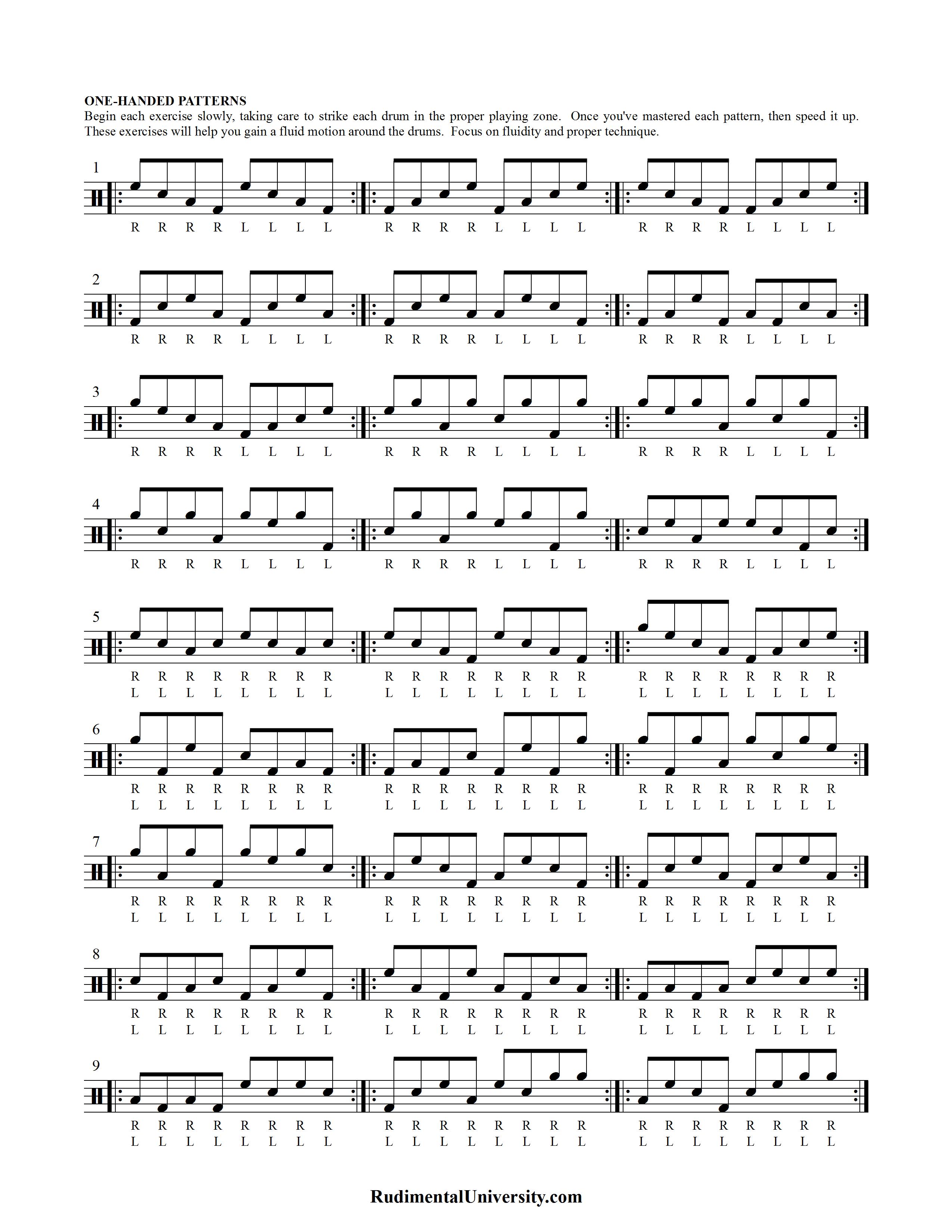
Quad parts often use repeated shapes. Learning these shapes helps you read faster.
Straight patterns
A straight pattern moves through the drums in order:
1–2–3–4
or:
4–3–2–1
These patterns are usually easy to identify. Focus on even spacing and relaxed movement.
Inside patterns
An inside pattern uses the middle drums:
2–3–2–3
This pattern tests your control because the hands must stay close together. Keep the sticks from colliding, and aim for the center of each drum.
Outside patterns
An outside pattern moves between the first and fourth drums:
1–4–1–4
This pattern requires wider travel. Keep your elbows relaxed and use the smallest motion that reaches the correct playing zones.
Split patterns
A split pattern skips between drums:
1–3–2–4
or:
4–2–3–1
Split patterns can feel difficult because the hand must move farther than expected. Read the numbers first, then practice the motion without worrying about speed.
Repeated drum patterns
A pattern such as:
1–1–2–2–3–3–4–4
uses repeated notes on each drum. Keep the sound even between the first and second hit on each drum.
Mirror patterns
Some phrases move outward and then inward:
1–2–3–4–3–2–1
This is a useful shape to practice because it combines travel, control, and direction changes.

Improve Your Quad Drum Technique
Good notation reading becomes much easier when your playing position is stable.
Set the drums correctly
The drum set should sit at a comfortable height and angle. You should be able to reach every drum without lifting your shoulders.
Check these points:
• Your wrists should remain fairly straight.
• Your elbows should stay relaxed.
• Your shoulders should not rise during wide movements.
• The sticks should strike near the playing zones.
• Your torso should remain balanced.
Poor setup can make a simple quad line feel impossible.
Use efficient motion
Quad players need to travel across several drums, but the motion should stay compact. Think of moving the stick along a smooth path instead of throwing it from drum to drum.
Large arm movements may look dramatic, but they often create slow timing and extra tension. Let the wrist control short distances and allow the forearm to help with wider moves.
Keep the sound consistent
Each drum has a different size and tone. A strong player makes the volume feel balanced as the notes move across the set.
Practice the same rhythm on each drum. Then play it across all four drums while keeping the stroke height consistent.
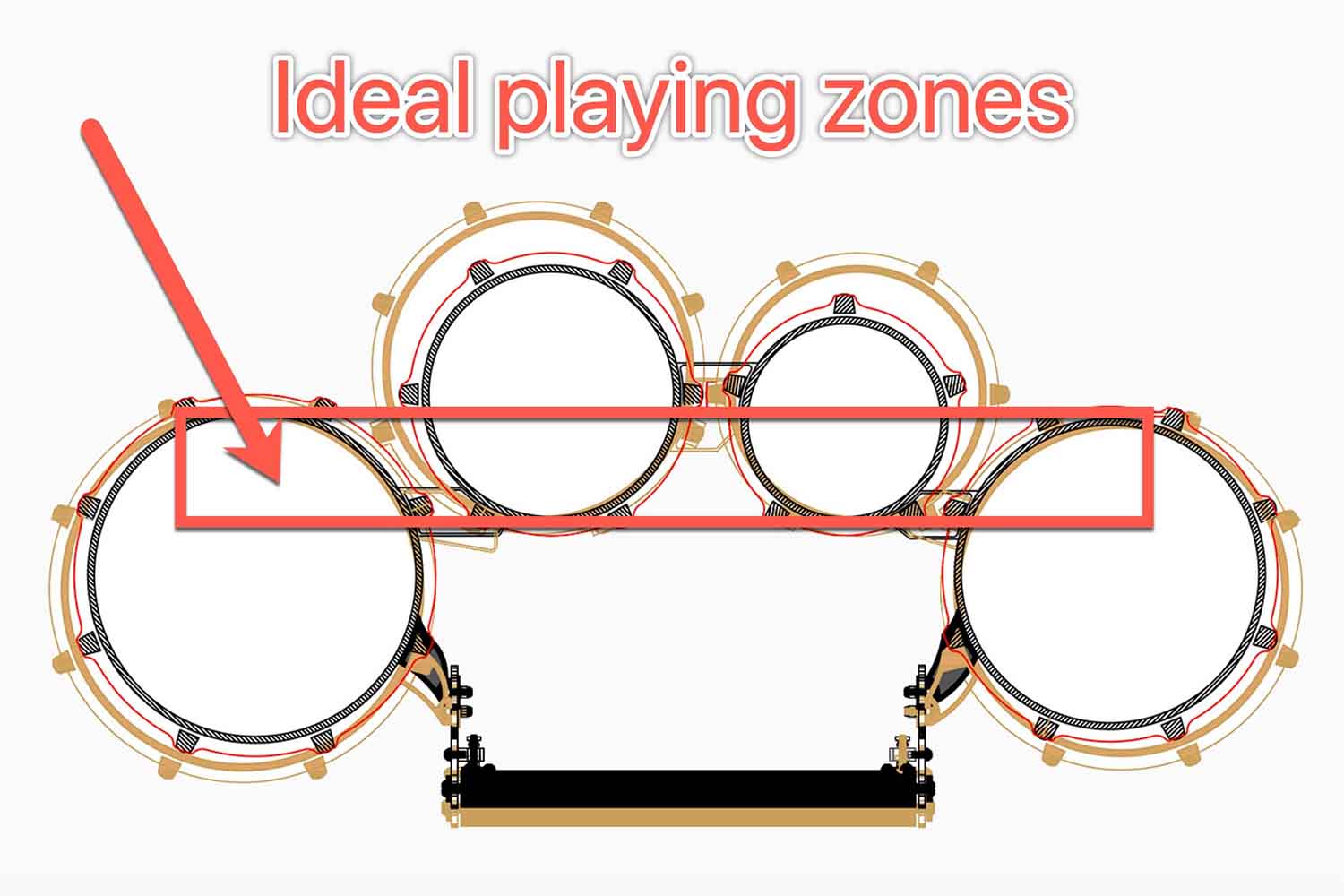
Find the playing zones
Most quad drums have a preferred area that produces a clear, focused sound. Avoid striking too close to the rim unless the music requests a rim sound.
Your instructor or drum manufacturer may recommend a specific zone. Follow that guidance, especially when preparing for an ensemble performance.
Watch for tension
Tension often appears when a passage feels fast. Common signs include raised shoulders, tight fingers, and stiff forearms.
Stop and shake out your hands. Return to a slower tempo. Relaxation is not separate from speed; it supports speed.
Practice Exercises for Reading Quad Drum Music
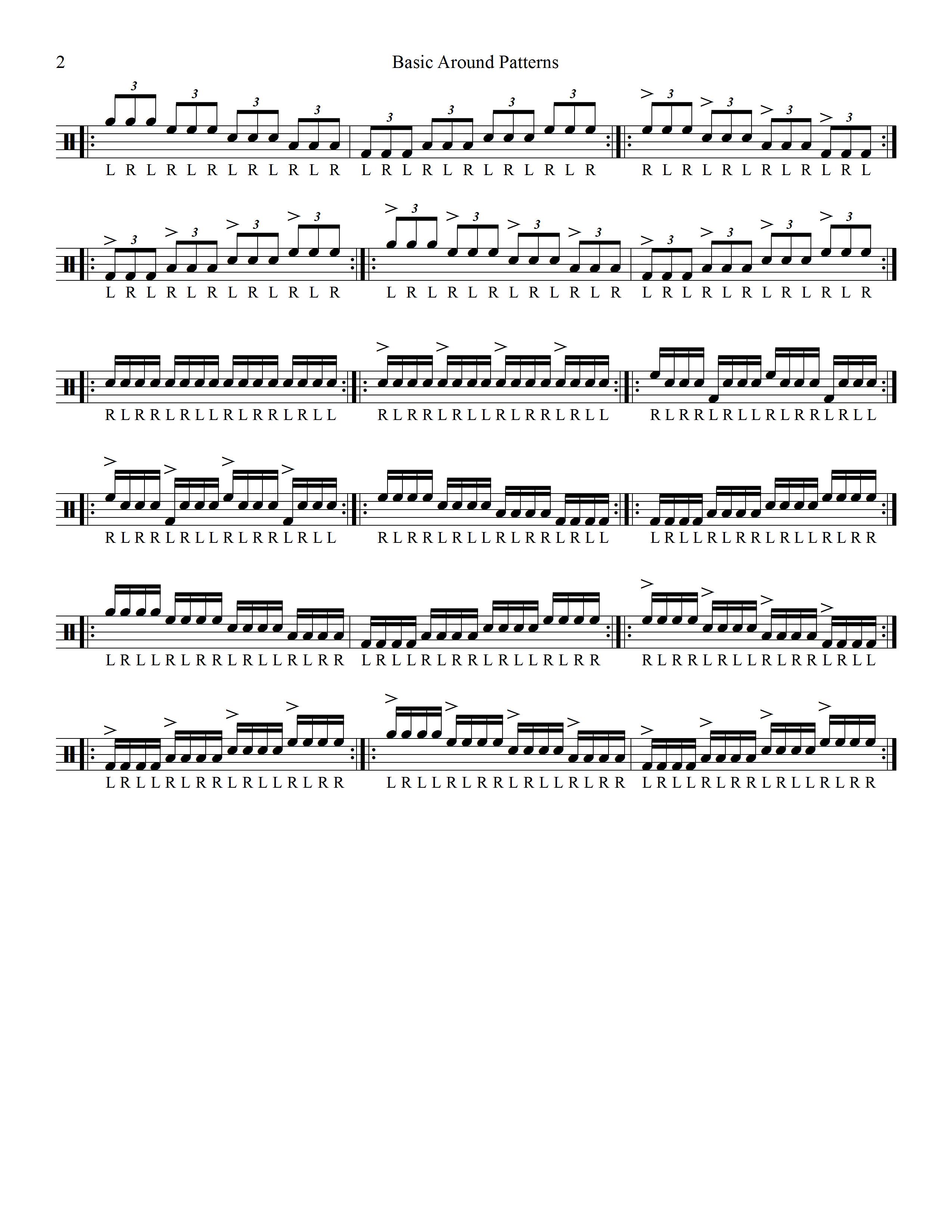
These exercises build the main skills needed for quad playing. Use a metronome and begin slowly.
Exercise 1: Number reading
Play one note on each drum:
1–2–3–4
Then reverse it:
4–3–2–1
Use alternating sticking:
R L R L
Focus on even sound and smooth movement.
Exercise 2: Inside and outside
Practice:
1–4–1–4
Then:
2–3–2–3
Keep the tempo steady. Do not allow the wide pattern to become louder than the inside pattern.
Exercise 3: Four-drum grid
Play these patterns as sixteenth notes:
1–2–3–4
1–3–2–4
4–2–3–1
2–4–1–3
Use alternating sticking first. Then try the same patterns with different stickings if your instructor approves.
Exercise 4: Accent control
Play eight notes with an accent on the first note of each group:
1 2 3 4 | 1 2 3 4
Make the first note clear, but keep the other notes relaxed. This teaches you to separate dynamics from tension.
Exercise 5: Rhythm without movement
Choose a difficult quad passage. Play the rhythm on one drum only. Once the timing is secure, return the notes to their correct drums.
This is one of the most useful methods for learning how to read quad drum music. It shows whether the real problem is rhythm or movement.
Exercise 6: Add one measure at a time
Practice the first measure until you can play it three times correctly. Add the second measure and connect them. Continue this process through the phrase.
Do not define success only by speed. Accuracy, sound quality, and relaxed movement matter just as much.

Common Mistakes When Reading Quad Drum Music
Many beginners make the same errors. Recognizing them early can save weeks of frustration.
Looking only at the hands
If you stare at your hands, you may lose your place on the page. Learn to read slightly ahead of where you are playing.
Use your eyes to scan the next beat while your hands play the current beat. This skill improves with slow, repeated practice.
Ignoring the drum key
A player may learn the notes incorrectly if the drum assignment is unclear. Always confirm the staff position before memorizing a passage.
Different books may use different notation systems. A pattern that means 1–2–3–4 in one method may not use the same visual layout in another.
Playing too fast
Speed can hide mistakes during practice. At performance tempo, those mistakes become harder to fix.
Start at a tempo where you can play every note with control. Increase the speed only after the rhythm and movement remain consistent.
Using too much arm motion
Large movements can make the player tired and cause late notes. Keep the path direct and relaxed.
A quad part should feel like drawing small lines through the air, not swinging a baseball bat.
Changing sticking without a plan
Some stickings feel easier at first but create problems later. Follow the written sticking when possible, especially in an ensemble setting.
If you need to change it, discuss the choice with your instructor or section leader.
Practicing only from the beginning
Always practice difficult spots separately. Starting at the beginning every time can make the opening strong while leaving the ending weak.
Try beginning at the second half of the phrase. This builds confidence across the entire part.

How to Read Quad Drum Music in an Ensemble
Individual practice is only one part of marching percussion. Quad players must also match the section’s timing, sound, and movement style.
Listen to the snare line and bass line. Your part may be written with different drums, but it still needs to fit the ensemble pulse.
Watch for these details:
• Match the section’s tempo.
• Keep note spacing even.
• Follow the agreed sticking.
• Use the same accent height as the rest of the line.
• Keep visual motions consistent.
• Listen for balance between drums.
A quad part can sound correct alone but still fail in an ensemble if it is too loud, too soft, or slightly late. Record yourself during practice when possible. A recording often reveals timing issues that are hard to feel while playing.
During rehearsals, ask focused questions. Instead of saying, “Why does this feel wrong?” ask, “Am I rushing the last two sixteenth notes?” Clear questions lead to useful corrections.
Helpful Tools for Learning Quad Music
You do not need expensive equipment to improve. A few simple tools can make practice more focused.
• A metronome helps develop steady time.
• A practice pad lets you work on rhythm and sticking away from the drums.
• A printed drum key prevents note confusion.
• A pencil lets you mark counts, stickings, and reminders.
• A phone recording shows posture, sound, and movement.
• A mirror helps you check shoulder and arm tension.
• Slow-motion video can reveal inefficient crossovers.
Use technology as a tool, not a replacement for listening. Your ears should guide your sound, while the metronome and video provide useful feedback.
Reliable marching percussion methods consistently stress slow practice, clear subdivisions, and relaxed technique. These ideas apply across many drum lines, although the exact notation and sticking rules may differ by instructor or ensemble.
Frequently Asked Questions About How to Read Quad Drum Music
What do the four drums mean in quad music?
The four drums usually represent different pitches, with Drum 1 as the highest and Drum 4 as the lowest. The exact physical layout and staff assignment can vary, so check the notation key provided with the music.
How do you know which drum to play?
Look at the note’s position on the staff, its number, or the drum label above it. Match that symbol to the drum assignment chart before practicing the passage.
What does R and L mean in quad drum music?
R means play with the right hand, and L means play with the left hand. These markings create a planned sticking pattern that supports timing, movement, and consistent sound.
Should beginners use a practice pad when learning quad music?
Yes. A practice pad is useful for learning rhythm, counting, and sticking before adding drum movement. Once those skills feel secure, transfer the same pattern to the quads.
Why is quad drum music harder than snare drum music?
Quad music adds horizontal movement across several drums. You must read rhythm and sticking while also choosing the correct drum and controlling the distance between each note.
How can I play quad drum music faster?
First, practice the passage slowly with a metronome and relaxed hands. Increase the tempo in small steps only after the notes sound even and the movement stays efficient.
Do all quad drum parts use the same notation?
No. Many arrangements use similar ideas, but staff positions, drum numbers, noteheads, and sticking marks may differ. Always read the notation guide for the specific book or ensemble.
Conclusion
Learning how to read quad drum music becomes much simpler when you separate the task into rhythm, drum location, sticking, and movement. Start by checking the drum key, count the rhythm aloud, mark the sticking, and practice small sections at a slow tempo.
Clean quad playing is built through patience and control. Use a metronome, record your practice, and focus on smooth motion rather than speed alone. Pick one short exercise today, work through it carefully, and explore more marching percussion resources as your confidence grows.

Senior Music Reviewer
Alex Carter is a seasoned music reviewer with over a decade of experience in the world of sound and instruments. Passionate about helping musicians and enthusiasts make informed choices, he brings sharp insights and in-depth knowledge to every review. From classical instruments to modern gear, Alex combines technical expertise with a love for music to deliver content that resonates with readers.
As a Senior Music Reviewer and expert author on Tuneluma.com, Alex is dedicated to sharing honest evaluations, practical advice, and thoughtful commentary to guide readers in their musical journey.