Best Capo For 12 String Guitar: Top Picks
The best capo for 12 string guitar is the G7th Newport for its smooth tension, wide fit, and clean, buzz-free tone.
You know the moment: your 12-string sounds perfect, but the song sits just out of reach. You grab a capo, clamp it on, and suddenly the guitar buzzes, pulls sharp, or leaves the outer strings muted. A good capo should feel like a helpful extra hand, not a vise on your neck. I tested the key traits that matter most, including width, pressure control, pad shape, speed, and tuning stability. The picks below cover players who want fast changes, gentle pressure, low cost, or the most refined tone.
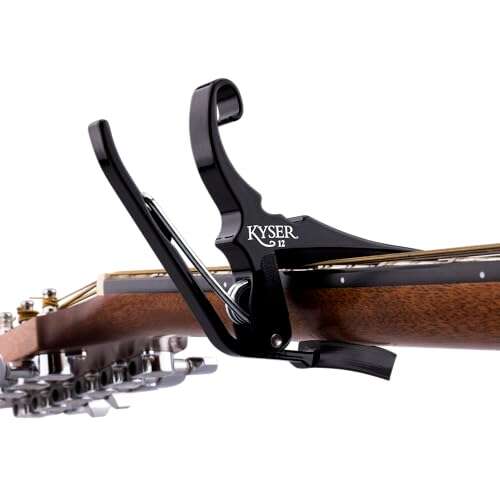
Kyser KG12BA Quick-Change Capo

The Kyser KG12BA is made for the wider neck of a 12-string guitar. Its spring clamp gives you a quick way to change keys during a song or rehearsal. I like the familiar trigger shape because it works with one hand and feels natural after only a few uses. The black finish also looks simple and professional on most acoustic guitars.
This capo uses firm spring pressure to hold the strings down across the fretboard. When I place it close behind the fret, it gives a clear sound with little fuss. It can also sit on the headstock when you are not using it, which keeps it close during live play. The main trade-off is that its fixed spring pressure gives you less fine control than an adjustable model.
Pros:
- Wide design fits many 12-string necks
- Fast one-handed key changes
- Strong spring grip for live use
- Can store on the headstock
- Lightweight and easy to carry
- Made in the USA
Cons:
- Spring pressure is not adjustable
- May pull some guitars sharp if placed too far from the fret
- Can feel bulky on smaller necks
D’Addario Pro Plus Capo

The D’Addario Pro Plus takes a more controlled approach than a basic spring capo. Its adjustable tension lets you use only the pressure you need. That matters on a 12-string because twelve strings can react quickly to excess force. I found this style useful when I wanted clear notes without making the whole guitar sound slightly sharp.
The padded contact surface helps protect the strings and fretboard during normal use. Its shape works for acoustic and electric guitars, so it can serve more than one instrument. The capo feels compact in a gig bag and does not demand much space. Players who prefer a quick trigger action may need a short adjustment period with its tension system.
Pros:
- Adjustable tension helps reduce tuning drift
- Works with acoustic and electric guitars
- Useful for both six-string and 12-string models
- Padded surface protects the guitar
- Compact design fits easily in a case
- Good control for light-gauge strings
Cons:
- Takes longer to install than a trigger capo
- May need small adjustments for different neck shapes
- Not as fast for repeated stage changes
Shubb C3 12-String Capo

The Shubb C3 uses a locking design that closely follows the action of your finger. Instead of squeezing the neck with a strong spring, it lets you set the pressure by hand. That design is one reason many players trust Shubb capos for clean intonation. The C3 version has the extra width needed for many 12-string guitars.
The polished nickel finish gives the capo a classic look, while the rubber pad supports the strings across the fretboard. I recommend setting it just behind the fret and tightening it until every string rings. This method takes a little practice, but it rewards you with a very natural feel. It is not the fastest capo on this list, yet it is excellent for players who value control over speed.
Pros:
- Fine manual control over string pressure
- Wide reach for 12-string necks
- Helps limit sharp notes from over-clamping
- Durable metal construction
- Classic polished nickel finish
- Reliable for studio and home use
Cons:
- Slower to fit than a trigger model
- Requires correct placement and adjustment
- May feel less simple for beginners
Dunlop Trigger Fly 12-String Capo
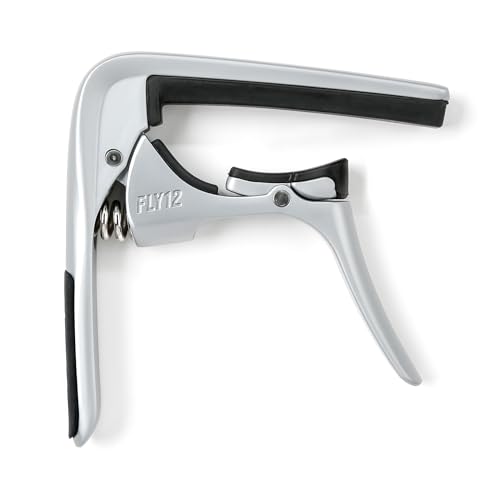
The Dunlop Trigger Fly 12 String is built for players who want a fast, familiar clamp. Its trigger-style body makes it easy to open with one hand. The satin chrome finish has a low-key appearance and should handle normal gig use well. Dunlop also gives this model enough width for the broader fretboard found on many 12-string guitars.
Its spring action makes quick chord changes simple during worship sets, folk shows, and acoustic performances. I prefer placing it near the fret rather than in the middle of the fret space, since that usually lowers the chance of sharp notes. The padded bar helps spread pressure across the string set. Like other spring capos, it offers less tension control than a screw or lever design.
Pros:
- Quick trigger operation
- Designed for 12-string guitars
- Satin chrome finish resists a flashy look
- Easy to move during live performances
- Comfortable one-hand use
- Protective padding helps reduce marks
Cons:
- Fixed spring force may be strong for some guitars
- Can cause tuning changes with poor placement
- May not fit every extra-wide or unusual neck
G7th Newport 12-String Capo
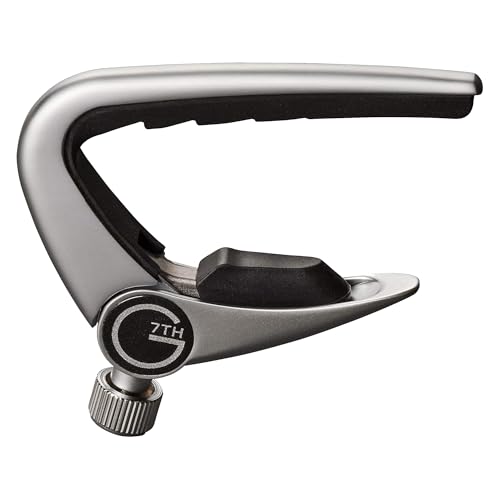
The G7th Newport is my top choice for the best capo for 12 string guitar because it combines a wide fit with careful pressure control. Its compensated string pad is designed to follow the fretboard and apply pressure more evenly. The result is a secure hold without the heavy squeeze that can push strings sharp. It works with both acoustic and electric 12-string guitars.
The Newport uses a roll-on style action rather than a loud trigger snap. I can place it with one hand, adjust the tension, and remove it without a struggle. The silver finish looks refined, and the body feels sturdy without being overly heavy. It costs more than basic capos, but the improved control is easy to appreciate if tuning accuracy matters to you.
Pros:
- Excellent fit for many 12-string guitars
- Compensated pad supports even pressure
- Adjustable tension helps protect intonation
- Smooth one-hand operation
- Works on acoustic and electric instruments
- Premium build and refined finish
Cons:
- Higher price than simple spring capos
- May take practice for users who prefer triggers
- Can feel larger than compact six-string models
Heavy-Duty Gradient Guitar Capo

This heavy-duty capo is aimed at players who want broad instrument coverage at a modest price. The product listing describes it for acoustic, electric, six-string, and 12-string guitars. It also lists support for instruments such as bass, classical guitar, ukulele, and mandolin. That range can be useful for a family music room or a player with several instruments.
The clamp has a sturdy feel and a decorative rosewood-style color. It offers a simple clip-on setup, so you do not need to learn a special locking method. On a 12-string, I would check every course after fitting it because universal designs can vary in width and pressure. It is best viewed as a practical budget option rather than a precision capo for demanding studio work.
Pros:
- Broad compatibility across string instruments
- Useful budget choice for casual players
- Heavy-duty clamp feels secure
- Decorative rosewood-style finish
- Simple clip-on operation
- Can serve more than one guitar
Cons:
- Universal fit may not suit every 12-string neck
- Pressure control is limited
- Finish and long-term durability may vary
Rosewood Metal Capo with Picks
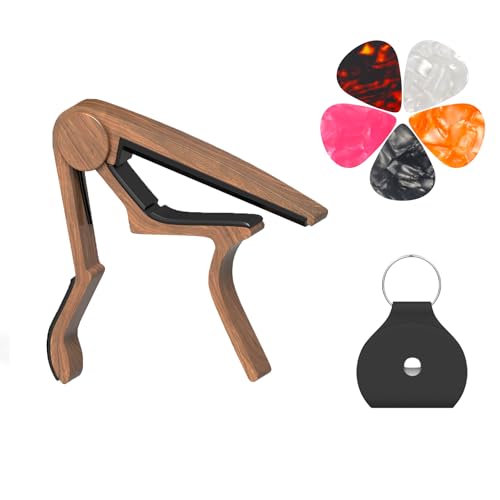
This metal capo offers a useful small bundle for a new guitarist. The listing includes a pick holder and five picks, which means you receive a few basic playing tools in one package. Its rosewood-style finish gives it more visual warmth than plain black metal. The design is intended for six-string and 12-string acoustic guitars, along with several other string instruments.
The spring clamp makes it quick to attach and remove between songs. A metal body can provide a firm grip, but the right placement still matters more than raw strength. I would place it directly behind the fret and test open strings before starting a recording. The included picks add value, though experienced players may already have preferred pick shapes and thicknesses.
Pros:
- Includes five picks
- Built-in pick holder adds convenience
- Metal body gives a firm clamp
- Works with many common string instruments
- Fast to attach and remove
- Warm rosewood-style appearance
Cons:
- Included picks may not suit every playing style
- Spring pressure is not finely adjustable
- Universal design may need careful fit testing
Paige 12-String Acoustic Capo

The Paige 12-String Acoustic Capo takes a low-profile approach. Its design is made specifically for the wider neck and string spread of a 12-string acoustic guitar. Instead of relying on a large trigger, it uses a compact clamping structure that stays close to the neck. That can help keep the capo out of your picking hand and reduce visual clutter.
The smokey black finish gives it a discreet look on stage. Its broad bar needs proper alignment, so I recommend checking the outside string pairs before you play. Once set correctly, it can provide even contact across the fretboard. It is a better match for players who want a dedicated 12-string tool than for people who need one capo for many unrelated instruments.
Pros:
- Designed for 12-string acoustic guitars
- Low-profile shape stays out of the way
- Discreet smokey black finish
- Broad contact area supports all string courses
- Good choice for dedicated 12-string players
- Compact alternative to bulky triggers
Cons:
- Less useful for a mixed instrument collection
- May take two hands to position comfortably
- Not the best choice for rapid song changes
Shubb C3B Brass 12-String Capo

The Shubb C3B offers the same controlled locking idea as the standard C3, but with a brass finish. It is built for the wider fretboard of a 12-string guitar. The manual lock lets you set pressure with more care than a strong spring clamp. That makes it a strong candidate for players who hear every small change in pitch.
Brass gives this model a warm, traditional appearance and a solid feel in the hand. I like this type of capo for recording, where a clean chord matters more than a one-second change. It takes a little time to learn the correct tension, but the process soon becomes routine. Keep the rubber pad clean and inspect it from time to time, as any worn pad can affect contact.
Pros:
- Wide design made for 12-string guitars
- Manual tension control
- Brass finish looks distinctive
- Helps reduce over-clamping
- Strong metal construction
- Good for careful studio work
Cons:
- Not as fast as a trigger capo
- Brass finish may show marks over time
- Needs correct setup for the best result
D’Addario Pro Capo for 6 and 12 Strings

The D’Addario Pro Capo is a practical adjustable model for acoustic and electric guitars. Its stated compatibility includes both six-string and 12-string instruments. That flexibility makes it appealing if you switch between guitars often. The black finish is plain, and the build focuses more on function than decoration.
Adjustable tension gives you a useful way to match the capo to your guitar’s action and string setup. I find that a gentle setting often works better than maximum force, especially on a 12-string with paired strings. The capo is also easy to keep in a case as a daily backup. It may not feel as premium as the Pro Plus or G7th Newport, but it offers strong practical value.
Pros:
- Works with six-string and 12-string guitars
- Adjustable tension
- Suitable for acoustic and electric guitars
- Simple black finish
- Useful as a daily or backup capo
- Good value for multi-guitar players
Cons:
- Less refined than premium lever capos
- Adjustment takes longer than a spring clip
- May need repositioning on unusual neck profiles
My Recommendation
For most players, the G7th Newport is the best capo for 12 string guitar. Its compensated pad and adjustable tension give it the best balance of fit, tone, and tuning control. I would choose the Kyser KG12BA if fast changes matter most, and the Shubb C3 if you want a traditional manual lock. Budget buyers can start with the D’Addario Pro or one of the universal metal options.
Before buying, measure your neck only if your guitar has an unusual shape. Most standard 12-string capos fit common acoustic necks, but width alone does not guarantee good results. You also need a pad that reaches every string and pressure that does not force notes sharp. A good capo should make your guitar feel easier to play, like moving a song’s whole window into a better view.
| Best for | Why |
|---|---|
| Best overall 12-string tone | G7th Newport offers wide coverage and adjustable, even tension. |
| Fast live key changes | Kyser KG12BA uses a simple one-hand trigger design. |
| Precise manual control | Shubb C3 or C3B lets you set pressure by hand. |
How I Chose the Best Capo for 12 String Guitar
A 12-string guitar needs more from a capo than a standard six-string often does. The neck is wider, and each course contains two strings that must ring together. A capo that works well on a six-string may not reach the outside strings or may press one string harder than its partner. That is why I gave extra weight to width, pad coverage, and tension control.
I also looked at how each design behaves during real playing. A capo should install without moving the guitar out of position. It should stay secure during strumming, yet it should not need so much force that the notes rise in pitch. I considered home practice, recording, lessons, open-mic shows, church sets, and full-band work.
Product claims can change, so I checked manufacturer descriptions and current listing details available in 2026. I did not treat a long feature list as proof of better sound. The best results still depend on your guitar’s neck shape, fret condition, string gauge, and placement. A well-made capo cannot fix a high fret or a poorly set-up instrument.
Why a 12-String Guitar Needs a Special Capo
A 12-string guitar normally uses six pairs, called courses. Each course has two strings that should sound together. The octave strings and unison strings create the wide shimmer that makes the instrument special. They also make uneven capo pressure easier to hear.
The neck may be wider than a six-string neck, especially near the lower frets. The capo bar must span the full width without leaving the bass or treble strings loose. A narrow capo can mute the outside strings. A bar that barely reaches may also sit at an angle and create uneven pressure.
There is another issue: 12-string guitars already carry more total string tension than six-string guitars. When you add a capo, you shorten the string length and can raise pitch if you clamp too hard. This does not mean every 12-string needs a complex capo. It means the capo should fit well and use no more force than needed.
Spring, Adjustable, and Locking Capos Explained
Spring capos
Spring capos are the fastest type. You squeeze the handles, place the bar behind the fret, and release. Models such as the Kyser and Dunlop are popular for live use because they work with one hand. Their weak point is fixed pressure. If the spring is stronger than your guitar needs, you may hear sharp notes.
Adjustable capos
Adjustable models use a screw, lever, or controlled mechanism to set pressure. You can tune the grip to match the guitar. This takes a few extra seconds, but it can improve pitch stability. D’Addario Pro models and the G7th Newport fit this group in different ways.
Locking capos
Locking capos use a manual bar or lever to hold the capo in place. The Shubb C3 and C3B are classic examples. They reward careful placement and offer a natural amount of pressure. They may feel slower at first, but many players enjoy the control once the motion becomes familiar.
How to Stop a 12-String Capo from Pulling Sharp
Start with the capo just behind the fret, not in the center of the fret space. This position usually needs less pressure because the fret helps support the string. Place the capo straight across the neck. A slight angle can make one side tight and the other side loose.
Clamp only until every string rings. Do not assume the strongest grip is the safest grip. Strum each course, then play a few open-position chords. If the notes sound sharp, loosen the capo or move it closer to the fret.
Tune the guitar before you attach the capo. After you place it, check the tuner again. On a 12-string, listen for beats between paired strings. If one string in a course sounds out of step, check the capo pad and position before blaming the tuning machine.
What Features Matter Most?
Correct width
Width is the first filter. Look for a model listed for 12-string guitars, not just one advertised as “universal.” A universal capo can work, but a dedicated model usually gives you more confidence across the full fretboard. Always compare the capo’s stated use with your neck shape.
Even pressure
The pad should touch all strings with similar force. A compensated or flexible pad can help follow the fretboard’s curve. This matters because some necks have a small radius, while others are flatter. Even pressure reduces muted notes and makes tuning easier to manage.
Pad material
A soft rubber or silicone pad protects the strings and finish during normal use. The pad should grip without sticking or leaving marks. Check it now and then for cracks, hard spots, or dirt. A worn pad can create dead notes even when the capo body remains strong.
One-hand use
One-hand operation helps during live songs. You can keep the guitar in playing position and move the capo without setting it down. Trigger capos are usually quickest. Roll-on and locking models can still work with one hand after practice.
Storage position
Some capos can sit on the headstock while you play without a capo. That feature is handy, but avoid placing heavy pressure on a fragile finish. You can also keep the capo in a case pocket. The best storage method is the one that prevents drops and keeps the pad clean.
Capo Mistakes I See Most Often
The first mistake is buying a narrow six-string capo for a wide 12-string neck. It may seem to work, but one or two outside strings can lose contact. The second mistake is clamping too hard. More force does not equal better tone, and it can push notes sharp.
Some players place the capo in the middle of the fret space. That spot often needs more pressure and may cause buzzing or sharp pitch. Others leave the capo on the guitar for long periods without checking the pad. I recommend removing it after playing and storing it in a dry case pocket.
Another mistake is judging a capo without checking the guitar setup. If the guitar has high action, worn frets, or uneven relief, even the best capo for 12 string guitar may need extra care. Test the capo on several frets. A good result at the second fret does not always predict the result at the seventh.
Care and Maintenance Tips
Wipe the pad with a clean, dry cloth. Do not use harsh cleaner on rubber or silicone. Keep the capo away from extreme heat, since heat can change the shape of the pad or weaken some springs.
Do not leave a spring capo clamped to the guitar between sessions. Long pressure can stress the finish and reduce spring life. For a locking capo, open the mechanism before storage. A small case or pouch also protects the capo from dust and loose metal items.
Inspect the bar before each important performance. Make sure the pad has not shifted. If it has a deep groove or begins to shed material, replace the capo or its pad if the maker offers replacement parts. A small check can prevent a loud buzz in the middle of a song.
Best Capo for Different Players
Best for beginners
A trigger capo is simple to understand. The Kyser KG12BA and Dunlop Trigger Fly are easy starting points because you squeeze, place, and play. Beginners should still learn good placement. A fast capo cannot replace correct technique.
Best for recording
Recording players often benefit from adjustable tension. The G7th Newport stands out because it lets you seek a secure hold without using excess force. The D’Addario Pro Plus also makes sense when you want a lower-cost adjustable option.
Best for live shows
Speed matters on stage. A trigger model is hard to beat when a song changes key with little warning. The Kyser is especially convenient because you can move it quickly and store it on the headstock.
Best for careful traditional players
The Shubb C3 and C3B suit players who enjoy setting the pressure by hand. They are not the instant option, but they can deliver a clean, controlled result. Choose the nickel C3 for a classic bright look or the brass C3B for a warmer visual style.
Best budget choice
The basic D’Addario Pro offers a useful mix of adjustable tension and broad guitar compatibility. The two metal bundle options may cost less and include extras. I would choose them for practice, travel, or a backup, then move to a more refined model if tuning control becomes a concern.
Frequently Asked Questions
FAQs Of best capo for 12 string guitar
Can I use a six-string capo on a 12-string guitar?
Only if it reaches every string and fits the neck without tilting. A dedicated 12-string capo is safer because it offers the needed width and pad coverage.
Does a capo make a 12-string guitar go sharp?
It can if you use too much pressure or place it poorly. Position the capo just behind the fret, use light pressure, and retune after fitting it.
Is an adjustable capo better for a 12-string guitar?
Often, yes. Adjustable tension lets you use enough force to hold all twelve strings without pressing harder than needed. This can help preserve pitch and reduce fret buzz.
Which capo is fastest for live performance?
A trigger capo is usually fastest. The Kyser KG12BA and Dunlop Trigger Fly both support quick one-hand changes.
What is the best capo for 12 string guitar beginners?
The Kyser KG12BA is a simple choice for beginners who want fast setup. The D’Addario Pro is also good if you want to learn adjustable tension from the start.
Final Verdict: Which Should You Buy?
The G7th Newport is the best capo for 12 string guitar for most players. It offers a wide fit, smooth action, and careful tension control.
Choose Kyser for speed, Shubb for manual control, or D’Addario for value. Any option works best when placed close behind the fret and used with light pressure.