A Major Scale Chords Piano

A Major Scale Chords Piano: Easy Chord Guide

A major scale chords piano players use create bright harmony from seven simple notes and familiar chord shapes.

Learning a major scale chords piano approach gives you more than a list of chords. It helps you understand why songs sound joyful, stable, tense, or ready to resolve. The A major scale is an excellent starting point because its seven diatonic chords work well in pop, rock, worship, jazz, classical music, and songwriting. This guide explains the theory, piano shapes, chord progressions, practice methods, and common mistakes in clear terms.
A Major Scale Notes on Piano
Source: audiblegenius.com

A Major Scale Notes on Piano

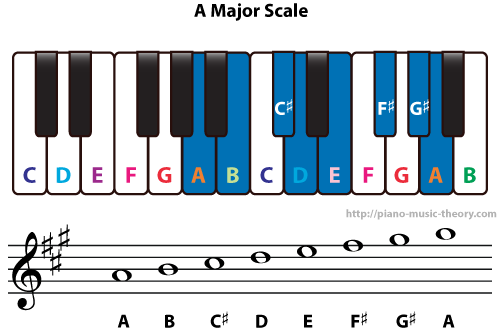
The A major scale has seven notes:

A, B, C#, D, E, F#, and G#

On a piano, these notes include three black keys: C#, F#, and G#. The scale starts on A and follows the major scale pattern of whole steps and half steps:

Whole, whole, half, whole, whole, whole, half

A simple way to play the A major scale is to use this fingering:

• Right hand ascending: 1, 2, 3, 1, 2, 3, 4, 5
• Left hand ascending: 5, 4, 3, 2, 1, 3, 2, 1

The numbers represent your fingers. In the right hand, your thumb passes under after playing C#. In the left hand, your third finger helps you move smoothly after B.

The A major scale chords piano students learn come directly from these seven scale notes. You build each chord by stacking notes in thirds, using only notes from the scale.

For example, the first chord begins on A. Take A, skip B, play C#, skip D, and play E. This creates the A major chord: A, C#, and E.

A Major Scale Chords Piano Chart
Source: schoolofrock.com

A Major Scale Chords Piano Chart

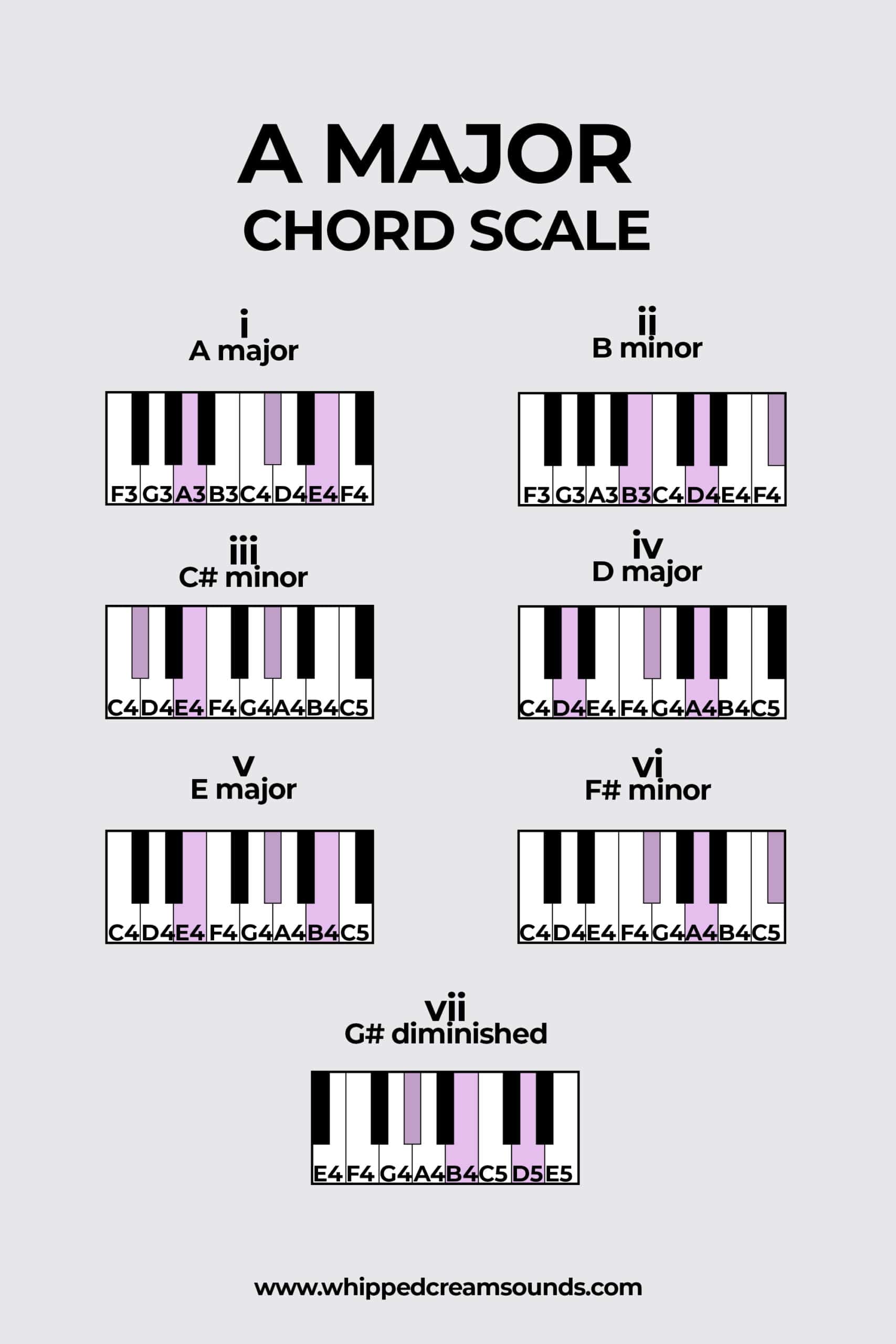
The table below shows the seven basic triads in the A major scale.

Scale degree Chord Notes Quality
I A major A, C#, E Major
ii B minor B, D, F# Minor
iii C# minor C#, E, G# Minor
IV D major D, F#, A Major
V E major E, G#, B Major
vi F# minor F#, A, C# Minor
vii° G# diminished G#, B, D Diminished

The chord qualities follow a pattern found in every major key:

Major, minor, minor, major, major, minor, diminished

In Roman numeral form, the pattern is:

I, ii, iii, IV, V, vi, vii°

Uppercase numerals represent major chords. Lowercase numerals represent minor chords. The small circle shows a diminished chord.

This chart is the heart of a major scale chords piano theory. Once you know the pattern, you can build diatonic chords in any major key.
How to Build Each A Major Chord
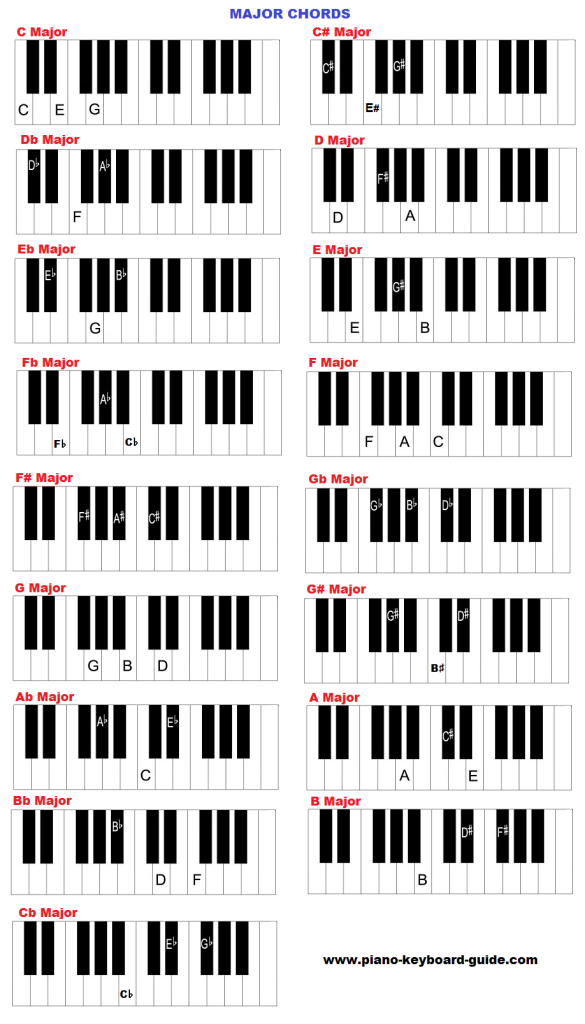
Source: piano-keyboard-guide.com

How to Build Each A Major Chord

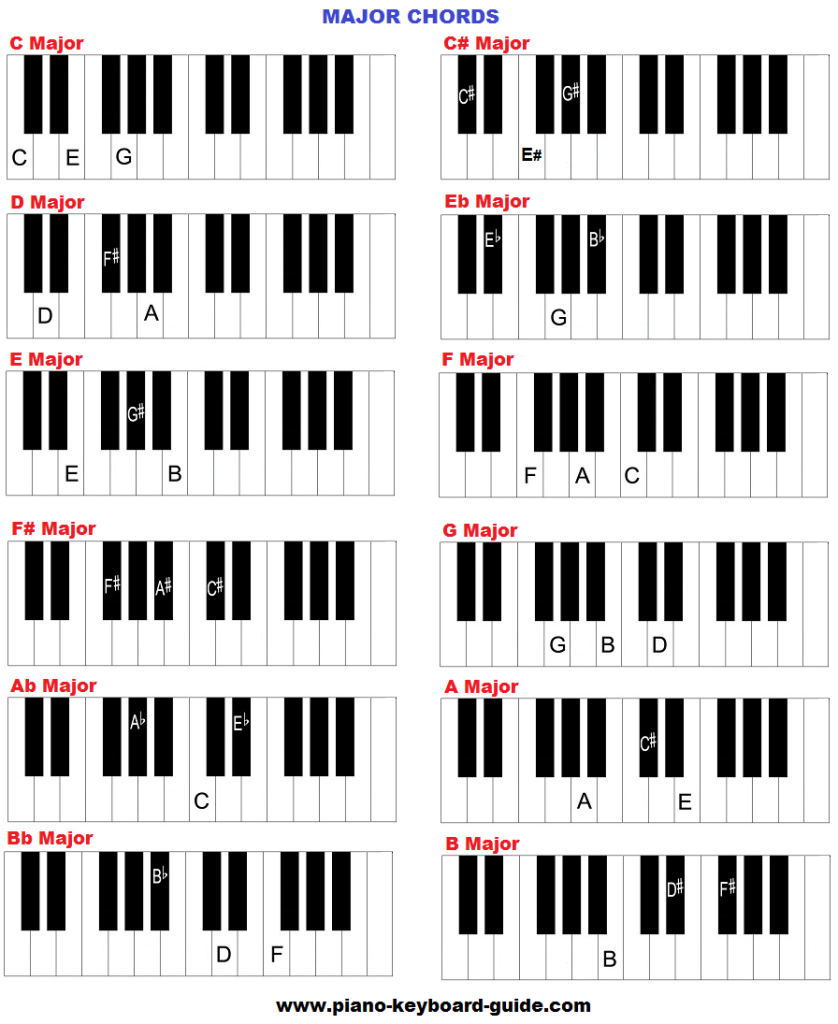
A Major Chord: I

The A major chord is the tonic chord. Its notes are A, C#, and E.

This chord feels like home. Many songs begin and end with it because it provides a strong sense of rest.

B Minor Chord: ii

The B minor chord contains B, D, and F#.

It has a darker sound than A major, but it still belongs naturally to the key. The ii chord often moves toward the V chord, E major.

C# Minor Chord: iii

The C# minor chord uses C#, E, and G#.

This chord can sound thoughtful or emotional. It often appears in pop ballads and songs that need a softer minor color.

D Major Chord: IV

The D major chord contains D, F#, and A.

The IV chord sounds open and uplifting. It is one of the most useful chords in the A major scale chords piano family.

E Major Chord: V

The E major chord uses E, G#, and B.

This is the dominant chord. It creates musical tension and often wants to return to A major. That movement from V to I is one of the strongest sounds in tonal music.

F# Minor Chord: vi

The F# minor chord contains F#, A, and C#.

The vi chord is the relative minor chord of A major. It shares two notes with A major, which helps it sound closely related while adding emotion.

G# Diminished Chord: vii°

The G# diminished chord contains G#, B, and D.

This chord has a tense, unstable sound. It often resolves to A major because G# sits only one half step below the tonic note A.

The diminished chord is useful, but beginners do not need to use it in every progression. You can first master the other six chords and add it later.
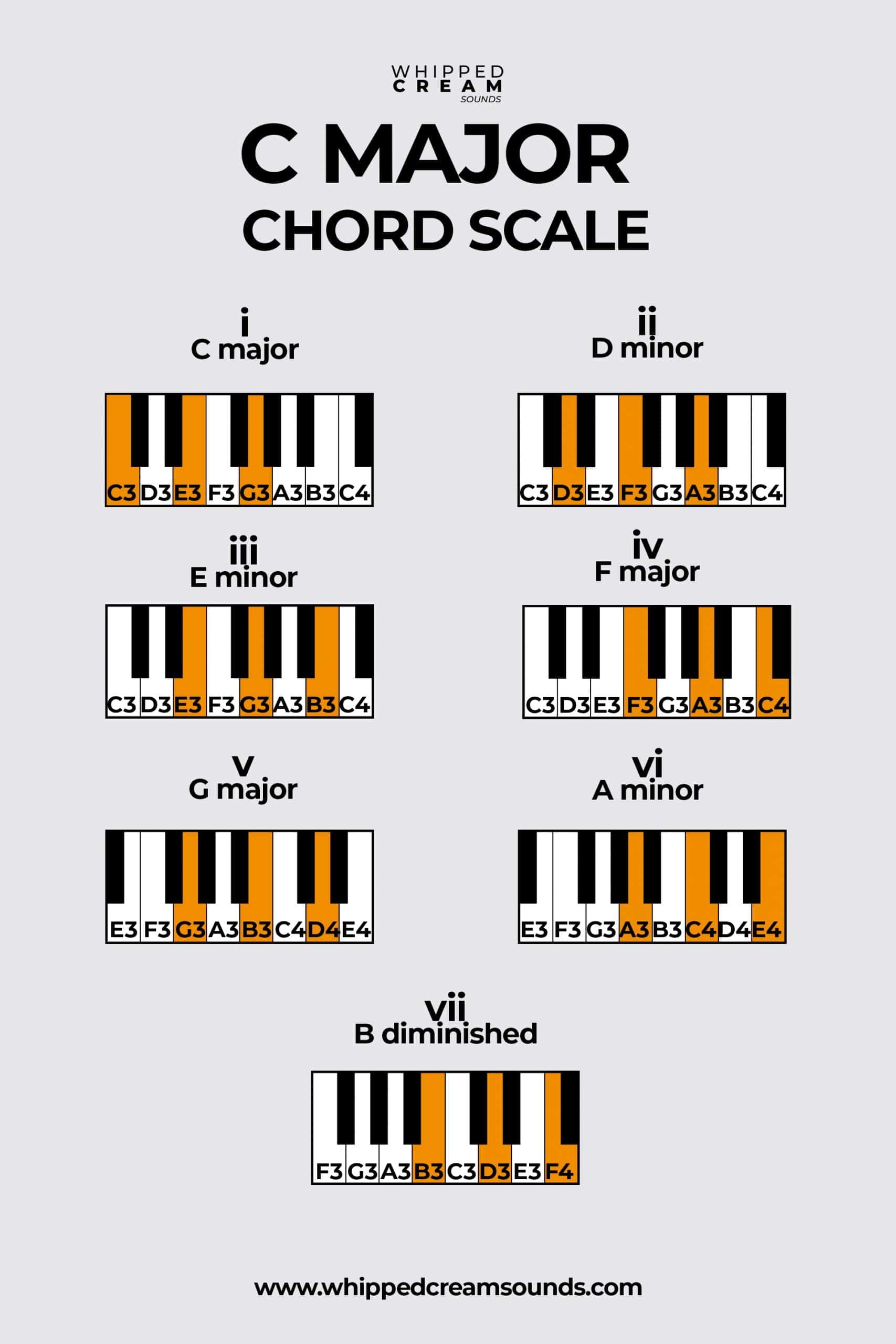
Major Scale Chords Piano Progressions
Source: audiblegenius.com

Major Scale Chords Piano Progressions

Chord progressions are groups of chords played in a planned order. They give a song its movement and emotional shape.

Here are several useful progressions in the key of A major.

I–V–vi–IV

A major, E major, F# minor, D major

This is one of the most common progressions in modern music. It sounds bright, emotional, and complete.

Try these notes:

• A major: A, C#, E
• E major: E, G#, B
• F# minor: F#, A, C#
• D major: D, F#, A

Play each chord for four beats. Keep your fingers relaxed and listen for smooth movement between chords.

I–IV–V

A major, D major, E major

This simple progression works well for rock, country, blues, and folk music. It is easy to remember and strong enough to support a full melody.

vi–IV–I–V

F# minor, D major, A major, E major

Starting on the vi chord gives the progression a more emotional opening. The final E major chord creates a desire to return to A major.

ii–V–I

B minor, E major, A major

This is a core progression in jazz, gospel, and many traditional styles. It moves from gentle tension to stronger tension, then resolves to the tonic.

I–vi–IV–V

A major, F# minor, D major, E major

This progression has a warm, classic sound. Try playing it with simple triads first, then add seventh chords as your control improves.
Piano Chord Inversions in A Major
Source: piano-keyboard-guide.com

Piano Chord Inversions in A Major

An inversion changes the order of notes in a chord without changing its basic identity.

The A major chord in root position is:

A, C#, E

Its first inversion is:

C#, E, A

Its second inversion is:

E, A, C#

All three shapes are A major chords. The lowest note changes, but the chord quality stays the same.

Inversions make a major scale chords piano progression sound smoother. For example, play these chords:

• A major: A, C#, E
• E major: E, G#, B
• F# minor: F#, A, C#
• D major: D, F#, A

The hand may jump between positions. Instead, use nearby inversions. You might play:

• A major: A, C#, E
• E major: G#, B, E
• F# minor: A, C#, F#
• D major: A, D, F#

The notes move less. Your fingers stay closer together, and the progression sounds more connected.

One lesson that becomes clear during practice is that correct harmony is only half the job. Good voicing matters too. A chord can be technically right but still sound awkward if the hand leaps too far between shapes.

A Major Seventh Chords on Piano
Source: jadebultitude.com

A Major Seventh Chords on Piano

You can expand triads by adding a seventh note from the scale. This creates richer harmony.

Scale degree Seventh chord Notes
I Amaj7 A, C#, E, G#
ii Bm7 B, D, F#, A
iii C#m7 C#, E, G#, B
IV Dmaj7 D, F#, A, C#
V E7 E, G#, B, D
vi F#m7 F#, A, C#, E
vii G#m7♭5 G#, B, D, F#

The dominant seventh chord, E7, is especially important. Its notes are E, G#, B, and D. The interval between G# and D creates tension that strongly pulls toward A major.

Seventh chords are common in jazz, blues, soul, worship, and R&B. If they sound too full at first, play only the root, third, and seventh. This gives you the chord’s main color without crowding the sound.

How to Practice A Major Scale Chords Piano
Source: hoffmanacademy.com

How to Practice A Major Scale Chords Piano

A clear practice plan helps you learn faster than random repetition.

Step 1: Learn the scale

Play the A major scale slowly with both hands. Say each note aloud as you play it.

Focus on even timing rather than speed. A slow, clean scale builds better habits than a fast scale with missed notes.

Step 2: Play the triads

Build each chord from the scale. Play them in root position first.

Say the chord names:

A major, B minor, C# minor, D major, E major, F# minor, G# diminished

Step 3: Add inversions

Practice each chord in root position, first inversion, and second inversion.

Move slowly. Check that each chord contains the correct notes before increasing your tempo.

Step 4: Practice progressions

Start with I–V–vi–IV. Play each chord for four beats, then two beats, then one beat.

Use a metronome. A steady pulse teaches your hands to change chords with control.

Step 5: Add rhythm

Try several patterns:

• Four steady quarter notes
• One chord on beat one
• Broken chords from low to high
• Repeated eighth-note patterns
• A bass note followed by the full chord

Step 6: Add a melody

Play the A major scale with your right hand while playing simple chords with your left hand. This connects theory to real music.

A useful beginner goal is to play a four-chord progression while keeping the rhythm steady. Accuracy and musical timing matter more than speed.

Common Mistakes to Avoid
Source: piano-music-theory.com

Common Mistakes to Avoid

Confusing the key signature

A major has three sharps: C#, F#, and G#.

Forgetting one sharp changes the sound of the key. A natural C, F, or G can make the chord or scale incorrect.

Treating every chord as major

The A major scale chords piano system includes major, minor, and diminished chords. Do not assume that every chord built from the scale is major.

The correct quality pattern is:

I major, ii minor, iii minor, IV major, V major, vi minor, vii diminished

Ignoring finger position

Many beginners use only their thumb and index finger. This can cause tension and make chord changes slow.

Use a relaxed hand shape. Let each finger rest over a nearby key.

Playing too loudly

Strong playing does not always sound confident. It can create harsh tone and stiff movement.

Practice softly first. When your hands are relaxed, add volume without pressing harder than needed.

Using only root position

Root position is useful for learning, but it can make progressions sound jumpy.

Use inversions to keep the notes close. This is one of the fastest ways to make beginner piano playing sound more polished.

Practicing without a pulse

A chord change may sound correct alone but fall apart in a song.

Use a metronome, drum loop, or simple backing track. Rhythm turns isolated chords into music.

A Major Scale Chords Piano for Songwriting
Source: piano-play-it.com

A Major Scale Chords Piano for Songwriting

The chords in A major offer many songwriting options. The major chords bring brightness, while the minor chords add contrast.

You can create different moods by changing the order:

• Bright and strong: A, D, E
• Reflective: F# minor, D, A, E
• Gentle: A, F# minor, B minor, E
• Tense and resolving: B minor, E, A
• Dramatic: C# minor, D, A, E

A melody does not need to use every scale note equally. Chord tones usually sound stable over their matching chord. Non-chord tones can create movement when they resolve to nearby chord tones.

For example, over A major, the notes A, C#, and E sound stable. The note B may sound less settled but can move nicely to A or C#.

When writing a song, begin with a short progression. Record it on your phone and hum over it. This simple method often reveals melodic ideas that are hard to find by staring at the keyboard.

Benefits and Limits of Learning in A Major

A major is a useful piano key for several reasons:

• It has a bright and clear sound.
• Its chords appear in many popular styles.
• It teaches the standard major-key chord pattern.
• Its three black keys help students practice mixed white-key and black-key shapes.
• Its dominant chord, E major, is easy to hear resolving to A major.

There are also limits. A major may feel less comfortable for some beginners because the right-hand scale requires a thumb crossover after C#. Hand size, technique, and musical style all affect which key feels easiest.

Do not judge progress only by how quickly you can play the scale. Chord knowledge should support timing, listening, voicing, and musical expression.

A Simple 10-Minute Practice Routine

Use this routine several times each week.

  1. Play the A major scale for two minutes with each hand.
  2. Play the seven diatonic triads for two minutes.
  3. Practice I–V–vi–IV with root positions for two minutes.
  4. Repeat the progression with inversions for two minutes.
  5. Improvise a short melody over the chords for two minutes.

Keep the tempo slow enough to avoid mistakes. If a chord change feels difficult, isolate that change and repeat it ten times.

A useful practice rule is to stop while your playing still feels focused. Short, regular sessions often produce better results than one long session filled with tension.

Frequently Asked Questions About A Major Scale Chords Piano

What are the chords in the A major scale on piano?

The chords are A major, B minor, C# minor, D major, E major, F# minor, and G# diminished. They are built from the notes A, B, C#, D, E, F#, and G#.

What is the most common chord progression in A major?

I–V–vi–IV is one of the most common progressions. In A major, that means A, E, F# minor, and D.

What notes are in the A major chord?

An A major chord contains A, C#, and E. These notes form the root, major third, and perfect fifth.

Why is G# diminished in the A major scale?

G# diminished uses G#, B, and D. The interval pattern creates a tense chord that often resolves upward to A major.

Is A major easy to play on piano?

A major is manageable for beginners, but its scale requires careful thumb movement and includes three black keys. The chords themselves are often comfortable once you learn their shapes and inversions.

What is the relative minor of A major?

F# minor is the relative minor of A major. Both keys use the same notes, but F# minor begins and feels centered on F#.

How can I make A major chord progressions sound smoother?

Use chord inversions and keep nearby notes between changes. A metronome, relaxed fingers, and steady rhythm will also make the progression sound more connected.

Conclusion

The A major scale chords piano players use come from seven notes and follow a clear pattern: major, minor, minor, major, major, minor, and diminished. The main chords are A, B minor, C# minor, D, E, F# minor, and G# diminished.

Start with the scale, learn each triad, practice common progressions, and then add inversions and seventh chords. Keep your tempo steady and your hands relaxed. Spend ten focused minutes today playing I–V–vi–IV in A major, then share your progress or explore another key for your next practice session.

Similar Posts

Leave a Reply

Your email address will not be published. Required fields are marked *