Best Isolated Power Supply For Guitar Pedals: Top Picks
The best isolated power supply for guitar pedals is the Donner DP-1 for quiet, flexible, budget-friendly pedalboard power.
A buzzing pedalboard can ruin an otherwise great tone. I have seen players swap cables, move amps, and blame their pickups when the real problem was shared pedal power. An isolated supply gives each output its own clean path, which helps cut ground noise and protects sensitive effects. The right unit also needs enough current, the correct voltage, and plugs that fit your board. I tested these choices by looking at output count, isolation claims, current range, protection, size, and value. Here are the best isolated power supply options for guitar pedals in 2026.
Donner DP-1 Isolated Guitar Pedal Power Supply

The Donner DP-1 is the unit I would place first on a short list for most home players. It offers 10 isolated DC outputs, which gives a medium or large pedalboard room to grow. The output options cover common 9V pedals and also include 12V and 18V choices for compatible effects. That mix makes it more useful than a simple daisy-chain adapter.
Its main strength is practical value. You get many outlets in a compact pedalboard-friendly box, plus circuit protection that can help limit trouble from a shorted cable or overloaded pedal. I still check every pedal’s voltage, polarity, and current draw before connecting it. For players building a first serious board, the DP-1 feels like a steady bridge between low-cost power and a more polished rig.
Pros:
- Ten isolated outputs support larger pedalboards
- 9V, 12V, and 18V options add useful flexibility
- Helps reduce noise from shared pedal power
- Compact shape fits under or beside many boards
- Protection features add peace of mind
- Strong value for players on a practical budget
Cons:
- It may not provide enough current for every modern digital pedal
- Players must confirm the correct voltage before use
- The included leads may not suit unusual pedal jack layouts
My Recommendation
I recommend the Donner DP-1 for guitarists who need many outputs without paying premium boutique prices. It suits home studios, rehearsal boards, and gig rigs with a mix of tuners, drives, delays, and modulation pedals. It is also a strong choice when you want the best isolated power supply for guitar pedals but do not need a rechargeable battery. Its ten outlets give you useful space for future upgrades.
Buy it if your board uses common center-negative DC pedals and you want a clean, organized setup. Check high-current digital pedals carefully, since an output rating matters as much as the number of jacks. Overall, the DP-1 offers excellent value and is widely available through Amazon.
RVONE 10-Output Isolated Pedal Power Supply

The RVONE power supply targets players who want broad output support and added protection. It has 10 isolated DC outputs for 9V, 12V, and 18V pedals. The listing also identifies 100mA and 500mA output choices, which can help when a board includes both simple analog effects and hungrier digital units. A USB port adds another useful way to power or charge small devices.
I like the way this model covers the needs of a growing board. Its circuit protection and noise-reduction design show that RVONE understands the problems caused by weak or shared power. Still, I would not assume every 500mA outlet works for every pedal; the voltage and polarity must match too. The RVONE is a sensible all-rounder for players who want more flexibility than a basic nine-volt brick.
Pros:
- Ten isolated outputs offer room for many effects
- Supports common 9V, 12V, and 18V pedal needs
- Includes 100mA and 500mA output options
- USB port helps with small accessories
- Protection features support safer everyday use
- Good fit for mixed analog and digital boards
Cons:
- Output labels require careful reading before setup
- It may be larger than a supply for a small board
- USB power does not replace a high-current pedal output
My Recommendation
The RVONE is best for guitarists who own several pedal types and want flexible current choices. It fits a player who uses a digital delay, reverb, looper, or multi-effect beside standard overdrive and tuner pedals. For that kind of board, the best isolated power supply for guitar pedals must do more than offer many jacks. The RVONE answers that need with multiple current levels, several voltage choices, and a USB port.
I would choose it for a home studio or a gigging board that may change over time. It offers useful features at a competitive price, but the owner should label each cable after checking the pedal manual. That small step makes the system safer and faster to use.
Mosky 10-Output Isolated Pedal Power Supply

The Mosky power supply is made for players who want many isolated outputs in a straightforward package. It provides 10 DC outputs and supports 9V, 12V, and 18V operation for compatible pedals. The listing also notes 300mA and 500mA outputs, which gives it more range than a supply built only for low-draw analog effects. A USB port adds convenience for small electronic gear.
In use, the appeal is simple: one box can replace several wall adapters and reduce cable clutter. Short-circuit and overcurrent protection are valuable when you change pedals often or build a board in a hurry. As with any multi-voltage unit, I would inspect each pedal label before plugging it in. Mosky makes a strong budget case for players who want broad support without a high-end price.
Pros:
- Ten isolated DC outlets suit medium and large boards
- 9V, 12V, and 18V support handles varied pedal needs
- 300mA and 500mA outputs help with higher-draw effects
- USB port adds useful charging flexibility
- Short-circuit protection improves setup confidence
- Overcurrent protection helps guard the power system
Cons:
- It can be more capacity than a small board needs
- Users must match polarity as well as voltage
- Some pedals may still require a dedicated adapter
My Recommendation
I recommend the Mosky to budget-minded players who want a versatile board supply. It is especially useful for guitarists adding modern delay, reverb, or looping pedals that draw more current than a basic stompbox. The multiple current choices make it a candidate for the best isolated power supply for guitar pedals when flexibility is the main goal. It also suits players who want a USB port for a small accessory.
This is a good fit for a changing pedalboard, but it rewards careful planning. Write the voltage and current needs of every pedal on a small card before installation. If the outputs match your gear, the Mosky delivers a lot of practical power for the money.
LEKATO 10-Port True Isolated Power Supply

The LEKATO 10-port model focuses on clean separation and broad pedal support. It offers 10 ports, a USB port, and DC outputs for 9V, 12V, and 18V effects. That combination can serve a compact board today and a larger board later. The true-isolated design is the main reason to consider it over a low-cost daisy chain.
I find this model appealing for players who want a tidy setup with fewer shared electrical paths. Short-circuit protection can help isolate a problem when one pedal or cable fails. It is important to remember that “isolated” does not mean a pedal can accept any voltage; every effect still needs the correct setting. With the right match, this LEKATO can provide a quiet foundation for a varied rig.
Pros:
- Ten true-isolated ports reduce shared-power problems
- Supports 9V, 12V, and 18V compatible pedals
- USB port adds convenience for small devices
- Compact design keeps the board neat
- Short-circuit protection adds a useful safety layer
- Good option for players moving beyond a daisy chain
Cons:
- It may not meet the current needs of every digital pedal
- Voltage selection requires close attention
- The USB port is not a substitute for a dedicated DC outlet
My Recommendation
The LEKATO 10-port supply is best for a player who wants true isolation in a clean, simple format. It suits home recording, practice rooms, and small gig boards where noise control matters. If you are searching for the best isolated power supply for guitar pedals because your daisy chain hums, this model offers a sensible upgrade path. Its extra voltage options also help support pedals that do not use standard nine-volt power.
I would choose it for an organized board with common DC connectors. It offers a strong mix of capacity, protection, and value. Before buying, count your high-current pedals and compare their needs with the listed output limits.
Hiree 7-Output Supply With AC Outlets

The Hiree model takes a different approach by combining seven isolated DC outputs with two AC outlets. The DC section supports common 9V pedals and also offers 12V and 18V choices for compatible effects. The AC outlets can power or charge other gear, such as a speaker, instrument device, or small amplifier accessory. That makes this unit more like a compact power station than a pedal-only brick.
I see real value here for musicians who carry several pieces of equipment to rehearsal. The extra AC outlets can reduce the need for a separate power strip and keep the stage area less cluttered. Seven pedal outputs are enough for many traditional boards, although players with ten or more pedals may need another solution. The Hiree is not the smallest pick, but its range can be useful when one board supports a full playing setup.
Pros:
- Seven isolated DC outputs cover many standard boards
- 9V, 12V, and 18V support add versatility
- Two AC outlets power related musical equipment
- Can replace a pedal supply and small power strip
- Useful for rehearsals, stage setups, and mobile rigs
- Reduces the number of separate wall adapters needed
Cons:
- Seven outputs may not suit a very large pedalboard
- AC outlets make the unit less compact than a basic brick
- Users must follow safe load limits for the AC section
My Recommendation
The Hiree is best for musicians who power more than pedals. It suits a guitarist who carries a small speaker, wireless receiver, instrument accessory, or other AC-powered item to practice. It may not be my first pick for the best isolated power supply for guitar pedals alone, but it becomes very attractive when extra AC access matters. Seven isolated outputs will handle many classic pedal layouts.
Choose it when convenience and central power control matter more than minimum size. It is a practical travel and rehearsal tool, especially for players tired of carrying several adapters. Check the total AC load and keep ventilation clear during use.
Voodoo Lab Pedal Power X8

The Voodoo Lab Pedal Power X8 is a compact, high-current option from a respected pedal-power maker. Its eight outputs are designed for boards that need dependable power without a large supply taking up valuable space. The high-current design is especially relevant for modern digital pedals, which often need more power than a basic overdrive or tuner. It is a focused product rather than a feature-packed power station.
What stands out is the balance between size and serious pedalboard use. Voodoo Lab has long built products around stable pedal power, and the X8 follows that practical approach. It may not offer the largest number of outlets in this group, but eight good outputs can be better than ten poorly matched ones. Players should still check the exact voltage, polarity, and current needs of each effect before building the final layout.
Pros:
- High-current outputs suit many modern digital pedals
- Compact design saves valuable pedalboard space
- Eight outputs fit many medium-sized rigs
- Built by a well-known pedal power specialist
- Focused design avoids unnecessary extra features
- Strong choice for players who value reliable stage power
Cons:
- Eight outlets may limit very large pedalboards
- It may cost more than several budget alternatives
- Players needing 12V or 18V must check the output details
My Recommendation
I recommend the Voodoo Lab X8 for serious players who prefer compact, high-current power. It is best for a medium board with digital delay, reverb, modulation, wireless, or other current-hungry effects. When people ask me to name the best isolated power supply for guitar pedals for a reliable gigging setup, this is one of the safest names to consider. Its appeal comes from focused design, useful current capacity, and a small footprint.
Choose it when you trust a proven specialist more than extra USB or AC features. It is a strong investment for players who gig often and want a clean, professional board. The higher price can make sense if stable power saves even one failed soundcheck.
Caline Mini 9V Isolated Pedal Power Supply
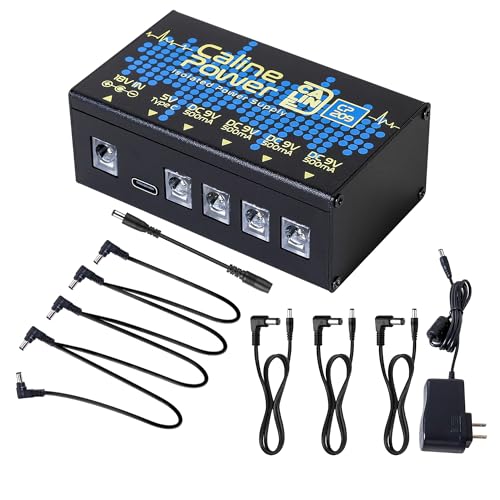
The Caline mini power supply is made for small pedalboards and players who use standard 9V effects. It provides 9V 500mA pedal power, a Type-C outlet, and a four-way daisy-chain option. Its small shape makes it easy to hide beneath a compact board or carry in a gig bag. This is a more specialized choice than the larger ten-output supplies.
I like this unit for a simple board with a tuner, drive, compressor, chorus, and delay. The 500mA rating gives useful headroom for many effects, while the Type-C port can help charge a modern accessory. The four-way daisy chain adds output reach, but it also means those pedals share a power path. For the lowest possible noise, I would reserve the daisy chain for low-draw pedals and use isolated outlets for sensitive effects.
Pros:
- Very small footprint suits compact pedalboards
- 500mA 9V power supports many common pedals
- Type-C outlet adds modern charging convenience
- Four-way daisy chain helps power several low-draw pedals
- Simple layout is easy for beginners to understand
- Light weight makes it useful for travel
Cons:
- It focuses on 9V rather than 12V and 18V options
- Daisy-chained pedals do not receive fully separate isolation
- It may not power a large board with many digital effects
My Recommendation
The Caline mini is best for a small board and a player who values space. It is a smart pick for bedroom practice, coffeehouse gigs, and simple direct-to-amp setups. If you want the best isolated power supply for guitar pedals in a tiny format, this model deserves a close look. Just remember that the daisy-chain section is best for pedals with modest and similar power needs.
I would buy it for a focused 9V board, not a complex system with many voltage types. It gives useful current, a modern Type-C port, and easy installation at a low burden. Its value is strongest when small size matters more than maximum output count.
LEKATO 12-Port Isolated Pedal Power Supply

The 12-port LEKATO is the choice for a crowded pedalboard. It offers more outlets than most options in this group and supports 9V, 12V, and 18V DC output. The listed current range runs from 100mA to 500mA, so it can cover basic analog pedals and many higher-draw effects. Extra ports also let you leave space for the next pedal instead of replacing the supply later.
Large boards often turn into a nest of adapters and extension cords. This LEKATO gives the system one central power point, which makes troubleshooting much easier. The trade-off is size: twelve outlets require more room, and a full board still needs careful cable routing. I would check the current draw of every digital pedal because a high outlet count does not automatically mean every port has unlimited power.
Pros:
- Twelve isolated outputs support large pedalboards
- 9V, 12V, and 18V choices add broad compatibility
- 100mA to 500mA range covers varied pedal demands
- Leaves spare outputs for future board upgrades
- Central power design reduces adapter clutter
- Useful for studio boards with many signal effects
Cons:
- Larger size may not fit under a narrow board
- It can be excessive for a four-pedal setup
- Users must carefully match current and voltage output
My Recommendation
The LEKATO 12-port model is best for guitarists with big boards or many planned upgrades. It suits studio players, worship rigs, and cover-band setups that use several delays, reverbs, drives, and utility pedals. For a large rig, the best isolated power supply for guitar pedals should offer room to grow, and twelve outlets provide exactly that. It also helps keep a complex system easier to service.
Choose this model if you have enough board space and want to avoid buying a second supply soon. It offers strong flexibility for the price. Before mounting it, measure the space under the board and plan cable exits so the extra capacity does not create a new mess.
LEKATO PS-01R Rechargeable Pedal Power Supply

The LEKATO PS-01R adds a built-in 10,000mAh rechargeable battery to a 10-output isolated pedal supply. Its outputs are designed for 9V pedals, with listed 300mA and 100mA options. A 5V/1A USB port gives you a way to charge or power a small accessory. The battery can be a major help when you play outdoors or work in a place with limited AC access.
A battery-powered board feels freeing. There is no wall hum from a nearby outlet, and the setup becomes faster for street performance, pop-up sessions, and remote recording. Battery life depends on the combined load, so I would not treat the 10,000mAh figure as a fixed number of playing hours. Recharge the unit before a show and carry the proper backup plan for important gigs.
Pros:
- Built-in 10,000mAh battery supports portable playing
- Ten isolated 9V outputs fit many pedalboards
- 300mA and 100mA outputs cover different pedal loads
- 5V/1A USB port adds extra utility
- No AC connection can help avoid outlet-related hum
- Excellent for outdoor, mobile, and remote setups
Cons:
- Battery runtime changes with the total pedal load
- It needs regular charging before important performances
- It does not offer the same voltage range as 12V/18V models
My Recommendation
The PS-01R is best for mobile musicians who cannot always rely on a wall outlet. It fits street performers, outdoor players, remote studio users, and anyone who wants a clean battery-powered board. It can be the best isolated power supply for guitar pedals when portability and freedom from AC noise matter most. The ten outlets also make it more useful than a small rechargeable adapter.
I would choose it for rehearsals in unusual places and as a handy backup for a standard board. It is less ideal if your pedals need 12V or 18V power. Treat battery level as part of your pre-show checklist, and this LEKATO becomes a very flexible tool.
Hiree 10-Output Supply With Four AC Outlets

This larger Hiree power station combines 10 isolated DC pedal outputs with four AC outlets. The DC side supports 9V, 12V, and 18V effects, while the AC section can serve speakers, instruments, chargers, and other equipment. It is designed for musicians who want one central place to manage power around a full rig. For a busy rehearsal or stage setup, that can make a real difference.
The biggest benefit is organization. Instead of running several adapters into a separate strip, I can place one unit near the board and connect related gear in one location. The trade-off is bulk, since four AC outlets need more housing and space than a pedal-only supply. I would also follow the safety label and never exceed the rated AC load.
Pros:
- Ten isolated DC outputs support large pedalboards
- 9V, 12V, and 18V choices handle varied effects
- Four AC outlets power nearby musical equipment
- Can replace a separate power strip in many setups
- Helps organize complex rehearsal and stage systems
- Useful for players with pedals and powered accessories
Cons:
- It is larger and heavier than a pedal-only supply
- Four AC outlets may be unnecessary for simple boards
- Users must observe the total AC load and cable safety
My Recommendation
The Hiree 10-output station is best for a full music setup rather than a pedalboard alone. It suits bands, rehearsal rooms, home studios, and guitarists who power a speaker or several accessories beside their effects. If your definition of the best isolated power supply for guitar pedals includes whole-rig convenience, this Hiree offers a strong feature set. Its ten DC outputs also leave room for a large effects chain.
Choose it when one central power station will simplify your gear. Do not choose it only because it has more outlets; measure your board and check your equipment load first. For the right user, its convenience can justify the larger footprint.
How I Chose the Best Isolated Power Supply
Power supplies look simple, but they control the base of your entire signal chain. A weak or poorly matched unit can add hum, cause digital pedals to reboot, or leave an effect working below its full potential. I judged these products by the details that matter after the pedalboard leaves the bedroom. Those details include true isolation, current, voltage, protection, size, cable reach, and daily value.
True isolation matters
A daisy chain sends several pedals through one shared output. That can work with a few simple analog pedals, but it may also create ground noise. A true isolated supply gives each output a separate power path. This helps prevent one pedal from sending unwanted noise into the rest of the chain.
Isolation does not fix every noise problem. Bad patch cables, poor guitar wiring, fluorescent lights, gain staging, and amp loops can still create hum. However, isolated power removes one of the most common causes. It is a strong first step when a board sounds like bees in a jar.
Current draw is easy to miss
Current is measured in milliamps, or mA. A pedal may say 100mA, 250mA, or 500mA on its label or manual. The power supply output should meet or exceed that number. A 500mA output can usually power a 100mA pedal, but a 100mA output cannot safely replace a 500mA requirement.
Digital delays, loopers, amp modelers, multi-effects, and some reverbs often draw more current than old analog pedals. I always check the maker’s manual rather than guess from the pedal size. A larger current rating gives headroom, but it does not make the wrong voltage safe.
Voltage and polarity must match
Most guitar pedals use 9V DC with center-negative polarity. That is common, not universal. Some pedals use 12V or 18V, and some rare units use center-positive power or AC power. Plugging in the wrong setting can damage an effect.
Before connecting a cable, I check three things: voltage, polarity, and current. I also confirm the connector size. This simple habit protects both the pedal and the power supply. A product cannot be called the best isolated power supply for guitar pedals if it does not match the board’s electrical needs.
Protection helps during real setup work
Short-circuit protection can shut down or limit an affected output when a cable or pedal causes a fault. Overcurrent protection can help protect the supply when a pedal asks for more power than the output should provide. These features do not replace careful setup, but they add a useful safety net.
I value protection most on a board that changes often. Every unplugged cable creates a chance for a mistake. A supply that responds well to a fault can make troubleshooting less stressful. Still, I never use protection as a reason to ignore the manual.
Why an Isolated Supply Can Improve Guitar Tone
A power supply does not add a magic layer of tone. Its job is more basic and more important: deliver stable power without adding unwanted noise. When the supply works well, the guitar signal can sound cleaner because the noise floor drops. That is especially clear with high-gain amps, single-coil pickups, delay repeats, and large pedal chains.
Think of your signal as a quiet conversation. A poor shared power setup can put a loud fan beside that conversation. Isolation moves the fan away. It does not change the words, but it makes them easier to hear.
Players often hear the biggest improvement when they replace a cheap daisy chain. The difference may appear as less hum, fewer whines, and cleaner repeats. Some boards will sound nearly the same because their pedals already share power well. The benefit depends on the pedals, cables, amp, and electrical environment.
Is More Output Count Always Better?
No. More outputs help only when you need them. A 12-port supply can be a waste of space and money for a board with four pedals. A compact eight-output model may be the better choice for a tight board or a player who carries gear by hand.
Output count becomes valuable when you use many digital pedals or plan future upgrades. Spare outlets also let you power a tuner, wireless receiver, switcher, or expression accessory. I prefer leaving one or two spare outputs when possible. That saves the cost and hassle of replacing the supply after one new pedal arrives.
Do not count outlets without checking their current ratings. Ten 100mA outputs may not be as useful as eight outputs with higher current capacity. The best isolated power supply for guitar pedals balances output number with the real needs of your effects.
How to Install a Pedal Power Supply
Start by unplugging the guitar, amplifier, and wall power. Place the supply where its vents stay clear and where the cables can reach without sharp bends. Many units fit under a pedalboard, but measure the height before using mounting tape or brackets.
Next, write down the power needs of every pedal. Use the pedal label or official manual. Match voltage, polarity, and current. Connect one pedal at a time, then test it before adding the next one.
Keep power cables separate from audio cables when you can. Parallel cable runs can sometimes increase noise, while a short crossing at a right angle often works better. Use cable ties or hook-and-loop strips, but do not pull hard on the pedal jacks.
Finally, turn on the amplifier at a low volume. Test each effect and listen for hum, whine, dropouts, or unusual heat. If a problem starts after adding one pedal, remove that pedal and check its cable and power requirements first.
Common Mistakes to Avoid
The first mistake is assuming that every pedal uses the same nine-volt setting. Many do, but some do not. The second mistake is confusing a daisy chain with true isolation. A supply may have many plugs while still sharing one electrical path.
Another mistake is ignoring current draw. A pedal can turn on and still behave badly if the supply cannot provide enough current. Digital units may freeze, restart, or make noise. Check the specification before deciding that the pedal itself has failed.
Players also forget cable quality. A damaged DC cable can cause intermittent power and strange crackles. Keep spare cables in your gig bag, and replace any lead with a loose plug or bent tip.
Finally, avoid placing a power supply where drinks, rain, or loose metal objects can reach it. A neat board is safer than a tangled one. Good power begins with good habits.
Best Uses for Each Power Supply
| Best for | Why |
|---|---|
| Most players and medium boards | Donner DP-1 offers ten isolated outputs, multiple voltage choices, and strong value. |
| High-current digital pedals | Voodoo Lab X8 focuses on compact, dependable high-current pedal power. |
| Outdoor and mobile playing | LEKATO PS-01R uses a built-in rechargeable battery and ten isolated outputs. |
How These Supplies Compare
The Donner DP-1 is the balanced choice. It has enough outlets for most growing boards and does not focus on features that only a small group of players need. The RVONE and Mosky models compete closely by offering multiple current levels, USB access, and several voltage choices. They are appealing when flexibility matters more than brand history.
The two LEKATO standard supplies cover different needs. The 10-port model is a sensible general option, while the 12-port version targets large boards. The rechargeable PS-01R stands apart because it can operate away from a wall outlet. It gives up 12V and 18V support, but it gains genuine portability.
The Hiree products are best viewed as power stations. Their AC outlets make them useful for complete music setups, but they take more room. Caline goes in the opposite direction with a small 9V design for compact boards. Voodoo Lab X8 is the focused premium-style pick for players who want compact high-current performance.
Buying Guide for 2026
Start with the number of pedals on your board. Count every effect, tuner, wireless unit, switcher, and accessory that needs power. Add one or two spare outlets if you expect your board to grow.
Then list the electrical needs. Most effects will use 9V DC center-negative power, but confirm that fact. Mark pedals that need more than 100mA. A board with several high-current devices should use a supply with suitable high-current outputs.
Next, decide whether portability matters. A standard AC supply is best for a fixed board, studio, rehearsal room, or normal stage. A rechargeable unit is better for street playing, remote sessions, and places with uncertain power access. Remember that battery products need a charge plan.
Finally, check physical fit. Measure the area under the board and note where the AC inlet sits. A supply that fits electrically but not physically is not a good buy. The best isolated power supply for guitar pedals should fit your board, your pedals, and your routine.
FAQs Of best isolated power supply for guitar pedals
What does isolated mean on a guitar pedal power supply?
It means the outputs use separate power paths instead of sharing one common output. This can reduce ground loops and noise between pedals. It does not remove every possible source of hum.
Can I use a 500mA output for a 100mA pedal?
Usually, yes, if the voltage, polarity, and connector size match. The pedal draws the current it needs. Never use a higher voltage just because the current rating is higher.
Do all guitar pedals use 9V center-negative power?
No. Many standard pedals do, but some use 12V, 18V, center-positive polarity, or AC power. Read the pedal label or manual before connecting it to any supply.
Will an isolated power supply remove all pedalboard noise?
No. It can reduce noise caused by shared pedal power, but cables, pickups, lighting, gain, grounding, and the amplifier can also cause hum. Test the board one pedal at a time to find the source.
How much current does a digital pedal need?
It depends on the pedal. Some digital effects need 100mA, while loopers, modelers, and advanced delays may need 250mA, 300mA, or more. Always use the maker’s stated current requirement.
Final Verdict: Which Should You Buy?
For most players, the Donner DP-1 is the best isolated power supply for guitar pedals. It offers ten outputs, useful voltage choices, protection, and strong value. Choose the Voodoo Lab X8 for compact high-current use, or the LEKATO PS-01R for battery-powered playing.
Match voltage, polarity, current, and connector size before buying. A properly matched isolated supply can make your board quieter, safer, and easier to expand in 2026.

Senior Music Reviewer
Alex Carter is a seasoned music reviewer with over a decade of experience in the world of sound and instruments. Passionate about helping musicians and enthusiasts make informed choices, he brings sharp insights and in-depth knowledge to every review. From classical instruments to modern gear, Alex combines technical expertise with a love for music to deliver content that resonates with readers.
As a Senior Music Reviewer and expert author on Tuneluma.com, Alex is dedicated to sharing honest evaluations, practical advice, and thoughtful commentary to guide readers in their musical journey.