Introduction
For guitar players in the United States, the F chord is one of the first major chords that feels hard. It often appears in songs that use the common C, G, Am, and F chord family. The full version uses a barre, which means one finger presses several strings at once.
An F chord is a major chord made from the notes F, A, and C. On guitar, you can play it in several ways. Beginners often start with an easier version before learning the full F major barre chord.

What does the F chord sound like?
The F chord has a bright, firm, and stable sound. It is a major chord, so it often feels clear and resolved rather than dark or tense.
Music theory names the F major triad from its three notes:
- F — the root
- A — the major third
- C — the perfect fifth
These notes can appear more than once in a guitar chord. A full F chord contains several F, A, and C notes across the strings.
The F chord often works with these common chords:
- C major
- G major
- A minor
- D minor
- B-flat major
You may see F in songs written in the keys of C major and F major. It also appears in many pop, rock, country, folk, and worship songs used by guitar players in the United States.
The chord name may appear in chord charts as:
- F
- F major
- Fmaj
These names usually mean the same basic major chord. A symbol such as Fmaj7 is different because it adds the note E.
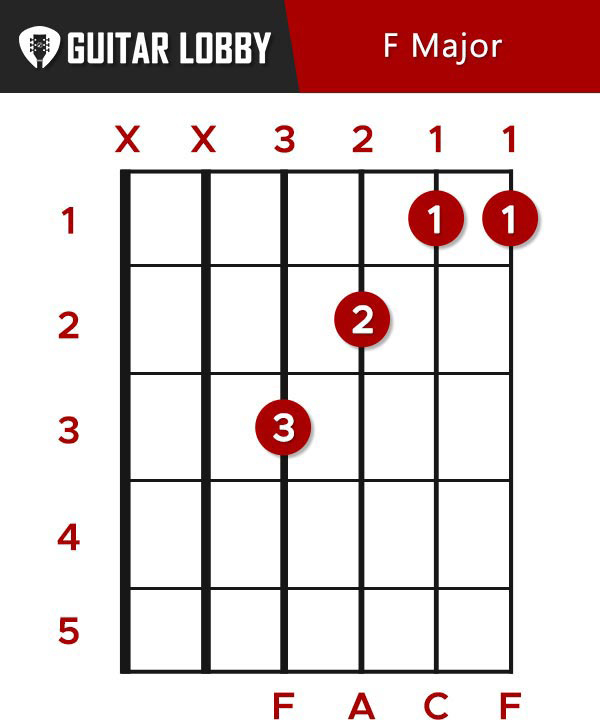
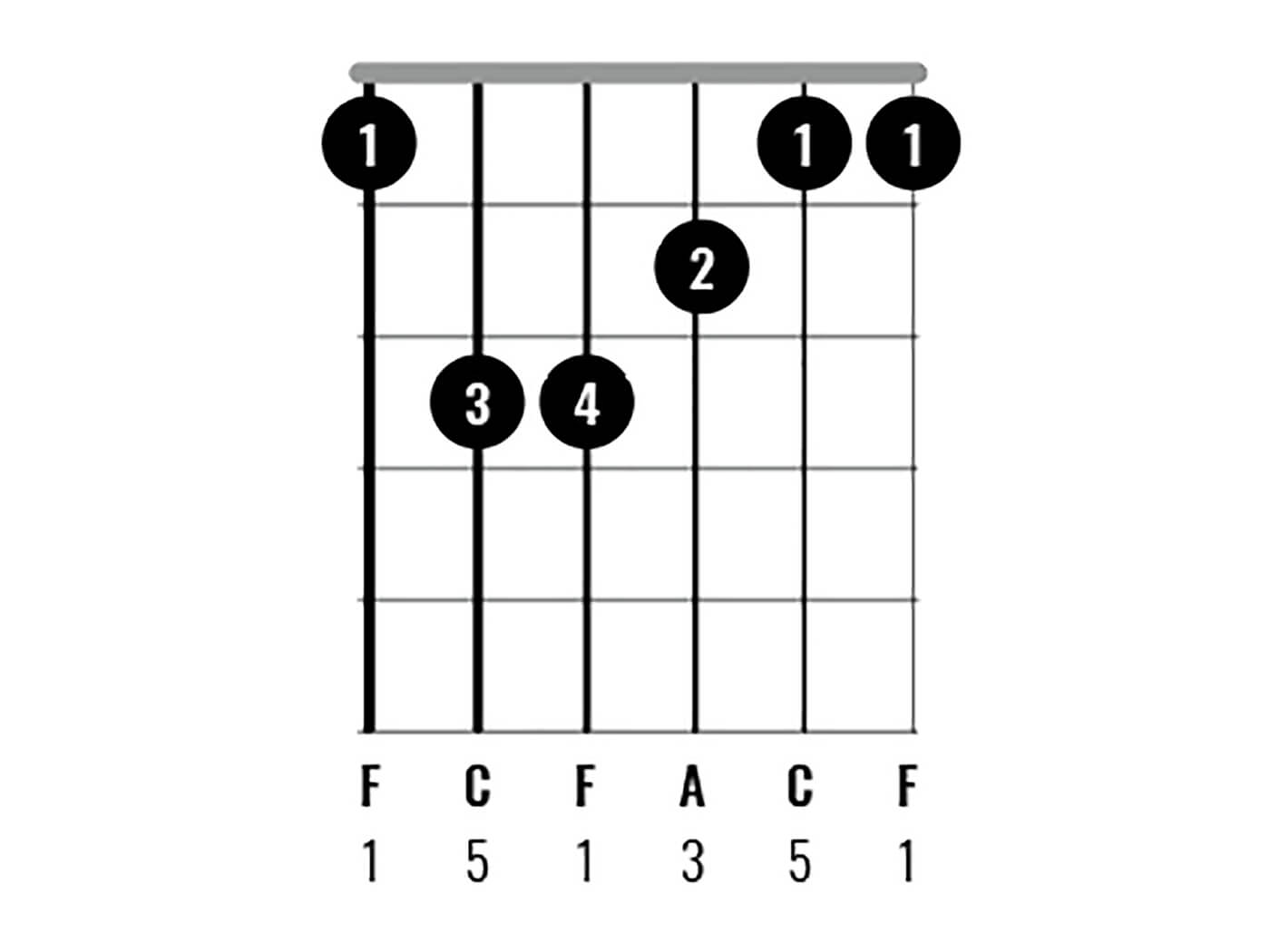
How to play the full F major barre chord
the standard full F chord uses this shape:
e|--1--
B|--1--
G|--2--
D|--3--
A|--3--
E|--1--
The numbers show the frets. The strings are shown from the thick low E string at the bottom to the thin high e string at the top in most chord charts. In the text diagram above, the low E string is the first line and the high e string is the last line.
A common fingering is:
- Index finger: press all six strings at fret 1
- Middle finger: press the G string at fret 2
- Ring finger: press the A string at fret 3
- Pinky: press the D string at fret 3
This shape is called an E-shape barre chord because it is based on the open E major chord shape. Moving the shape up the neck changes the chord. At fret 1, the root note is F, so the shape becomes F major.
Step-by-step method
- Tune the guitar to standard tuning: E–A–D–G–B–E.
- Place your index finger across all six strings at fret 1.
- Put your middle finger on the G string at fret 2.
- Put your ring finger on the A string at fret 3.
- Put your pinky on the D string at fret 3.
- Strum all six strings slowly.
- Check each string one at a time.
The goal is not to squeeze as hard as possible. Place your index finger close to the fret wire, keep your thumb behind the neck, and use only enough pressure to make each note ring.
Easier ways to play an F chord
The full barre chord is useful, but it is not the only valid F chord. These smaller shapes can help new players build strength and learn songs sooner.
The small F chord
Use this shape:
e|--1--
B|--1--
G|--2--
D|--3--
A|--x--
E|--x--
The x means do not play that string. This shape uses the notes F, A, C, and F. It is a true F major chord, even though it does not use all six strings.
A simple fingering is:
- Index finger: fret 1 on the B and high e strings
- Middle finger: fret 2 on the G string
- Ring finger: fret 3 on the D string
You can also use your index finger to press both first-fret strings. This version is often much easier than the six-string barre.
The three-finger F shape
Another useful version is:
e|--1--
B|--1--
G|--2--
D|--3--
A|--x--
E|--1--
This shape includes the low F on the sixth string but still avoids the open A string. It can sound fuller than the small F shape.
Some players use the index finger to cover the low E, B, and high e strings. Others use separate fingers. Choose the method that gives you clean notes without pain.
The Fmaj7 chord
You may also see this beginner-friendly shape:
e|--0--
B|--1--
G|--2--
D|--3--
A|--x--
E|--x--
This is Fmaj7, not plain F major. Its notes are F, A, C, and E. The open high e string adds E, which gives the chord a softer and more open sound.
Fmaj7 can replace F in some songs, but not all. If the song needs the strong sound of F major, the added E may sound different. Use the chord shown in the song chart unless the substitution fits the music.
F chord fingering comparison
The best shape depends on the song, your skill level, and the sound you need.
| Chord shape | Frets, low to high | Strings played | Main benefit |
|---|---|---|---|
| Full F major | 133211 | All six | Full sound and movable shape |
| Small F | xx3211 | Four highest strings | Easier barre and less hand strain |
| Three-finger F | 1×3211 | Five strings | Adds a low F for a fuller sound |
| Fmaj7 | xx3210 | Four highest strings | Easy shape with an open sound |
The full 133211 shape is the most useful long term because you can move it to play other major chords. The small xx3211 shape is often the best first step. The Fmaj7 xx3210 shape is the easiest for many beginners, but it has a different chord quality.
A capo can also help. If you place a capo on the first fret and play an open E major shape, the guitar sounds an F major chord. This avoids the first-fret barre, but it does not replace learning the F shape when you need to play without a capo.

How to make the F chord sound clean
A clean F chord needs three things: correct finger placement, enough pressure, and accurate strumming.
Use this short check:
- Form the chord without strumming.
- Pick the sixth string.
- Pick the fifth string.
- Continue through the first string.
- Listen for muted, buzzing, or dead notes.
- Adjust one finger at a time.
This method helps you find the problem. Full strums can hide which string is not working.
If the strings buzz
A buzzing note often means a finger is too far from the fret, not pressing firmly enough, or touching a nearby string. Move the finger closer to the metal fret wire and lift the other fingers slightly.
Do not press harder right away. First check your position. Too much force can make your hand tired and can pull the note sharp.
If some strings sound muted
Your index finger may not be lying flat enough for the barre. Rotate it slightly toward its bony side. Keep the finger straight, but do not force it into an uncomfortable position.
Check that the middle, ring, and pinky fingers are not touching nearby strings. Even a small amount of contact can stop a string from ringing.
If the chord sounds sharp
Pressing too hard can raise the pitch. This is common when you are still building hand control. Reduce pressure until the notes nearly stop ringing, then add only enough pressure to make them clear.
If your hand hurts
Stop if you feel sharp pain, numbness, or tingling. Mild fingertip pressure can be normal for a new player, but pain is not a goal. Shake out your hand, rest, and try again later with shorter practice periods.
A guitar with very high string action can make barre chords harder. If the strings sit far above the fretboard, ask a qualified guitar technician to check the setup. Do not try to adjust the truss rod without knowing the correct procedure.

How to practice the F chord
Practice the F chord in short blocks. Five focused minutes can be more useful than a long session that leaves your hand tense.
Try this routine:
- Hold the small F shape.
- Pick each string slowly.
- Release your hand.
- Form the chord again.
- Repeat 10 times.
- Strum four slow downstrokes.
- Switch between F and C.
- Switch between F and G.
- Repeat the changes at a slow speed.
For chord changes, do not stop after every chord. Use a steady count:
C - 2 - 3 - 4
F - 2 - 3 - 4
Start slowly enough that you can place the fingers with control. Increase speed only when most changes are clean.
A useful transition drill
Practice the movement between C and F:
C: x32010
F: xx3211
The middle and ring fingers can stay close to the fretboard while your index finger moves to the first fret. This teaches your hand the small F shape without the full difficulty of the barre.
Later, practice:
C: x32010
F: 133211
Use a metronome if you have one. Start around 50–60 beats per minute and play one chord per four beats. This number is a practice example, not a required speed.

Common mistakes when learning F
The most common mistake is trying to master the full barre chord before learning a smaller version. A partial F chord can help you play real songs while your hand builds strength.
Other common problems include:
- Strumming the open A string by accident
- Placing the index finger in the middle of the fret
- Squeezing the neck too hard
- Bending the wrist sharply
- Letting the thumb rise over the top of the neck
- Practicing only the chord and not the chord change
- Ignoring buzzing because the whole strum sounds acceptable
The open A string is a frequent problem with the small F shape. If you use xx3211, aim your pick or strumming hand at the top four strings. If you use 1×3211, avoid the A string but play the low E only if your fingering makes it ring clearly.
The full F chord may also sound bad because the guitar itself needs attention. Old strings, poor tuning, high action, or a neck that needs adjustment can make any barre chord harder. Check the instrument before assuming the problem is only your technique.

What is the difference between F, Fmaj7, and F7?
These chord names describe different note groups.
| Chord | Basic notes | General sound |
|---|---|---|
| F | F, A, C | Clear and stable |
| Fmaj7 | F, A, C, E | Soft and smooth |
| F7 | F, A, C, E♭ | Tense and bluesy |
The plain F chord is a major triad. Fmaj7 adds the major seventh note, E. F7 adds the minor seventh note, E-flat.
These chords are not always interchangeable. A song may need the tension of F7 or the gentle color of Fmaj7. If a chord chart says F, begin with F major.

When should you use a capo instead of the F chord?
Use a capo when it lets you play the song in an easier key shape or sing more comfortably. For example, a capo on fret 1 lets you use an open E shape to produce the sound of F major.
A capo changes the pitch of open and fretted notes. It does not change the written chord shapes in the same way as learning movable barre chords. You still need to understand the song’s sounding chords if you are playing with other musicians.
A capo is helpful when:
- You need the sound of F but want to avoid a barre
- The song uses several open chords
- You want a brighter guitar sound
- You need to change the song’s key for your voice
Learn the F shape as well when you want more control, want to play with no capo, or need to move major chord shapes around the neck.

Key takeaways
- The F chord is an F major chord made from F, A, and C.
- The common full shape is 133211.
- The easier small shape is xx3211.
- Fmaj7, xx3210, is easier but is not the same chord as F major.
- Practice clean notes first, then practice changes into and out of F.
- Stop if you feel sharp pain, numbness, or tingling.
- A capo can help you play an F sound before your barre chord is ready.
FAQs
Is the F chord the hardest beginner guitar chord?
It is one of the first difficult chords for many beginners because the full version needs a barre. It is not always the hardest chord, but it often requires more control than open C, G, or A chords.
Can I play an F chord without a barre?
Yes. Use the small shape xx3211, the five-string shape 1×3211, or Fmaj7 xx3210. These shapes can work well in many songs.
Why does my F chord buzz?
Your index finger may not press the strings evenly, or another finger may touch a nearby string. Move your fingers close to the fret wire, check each string alone, and use less force if your hand feels tense.
Can I substitute Fmaj7 for F?
Sometimes. Fmaj7 has an added E note, so it sounds softer and more open. It may work in a relaxed song, but use the written F chord when the stronger sound of F major matters.
How long does it take to learn the F chord?
The time varies by player, guitar setup, and practice routine. Many players can learn an easier F shape quickly, while the full barre may take regular practice over several weeks or longer. Clean, short practice sessions usually work better than forcing the chord for a long time.
Conclusion
The F chord on guitar is an F major chord built from F, A, and C. Start with xx3211 if the full barre feels difficult. Once that shape sounds clear, work toward 133211 with slow chord changes and light, controlled pressure.
Your next step is simple: form the small F chord, pick each string, and practice changing between F and C for five minutes.

Senior Music Reviewer
Alex Carter is a seasoned music reviewer with over a decade of experience in the world of sound and instruments. Passionate about helping musicians and enthusiasts make informed choices, he brings sharp insights and in-depth knowledge to every review. From classical instruments to modern gear, Alex combines technical expertise with a love for music to deliver content that resonates with readers.
As a Senior Music Reviewer and expert author on Tuneluma.com, Alex is dedicated to sharing honest evaluations, practical advice, and thoughtful commentary to guide readers in their musical journey.