Introduction
A sus chord on piano is a chord that replaces its third with another note. The third normally tells us whether a chord is major or minor. A sus chord leaves that note out, so the chord sounds open, tense, and not fully settled.
For piano players in the United States, the most common symbols are sus2 and sus4. For example, Csus2 uses C, D, and G. Csus4 uses C, F, and G. Both chords often move to a regular C major chord, which gives the ear a clear sense of release.
What Does “Sus” Mean in Music?
“Sus” is short for suspended. In a suspended chord, the third is replaced by another chord tone.


A standard three-note major or minor chord has:
- A root
- A third
- A fifth
A sus chord changes the middle note:
- Sus2: The third moves down to the second.
- Sus4: The third moves up to the fourth.
This creates a chord that sounds neither clearly major nor clearly minor. The missing third is the key reason for this effect.
Sus2 chord formula
A sus2 chord uses:
- Root
- Major second
- Perfect fifth
The formula is:
1–2–5
For example:
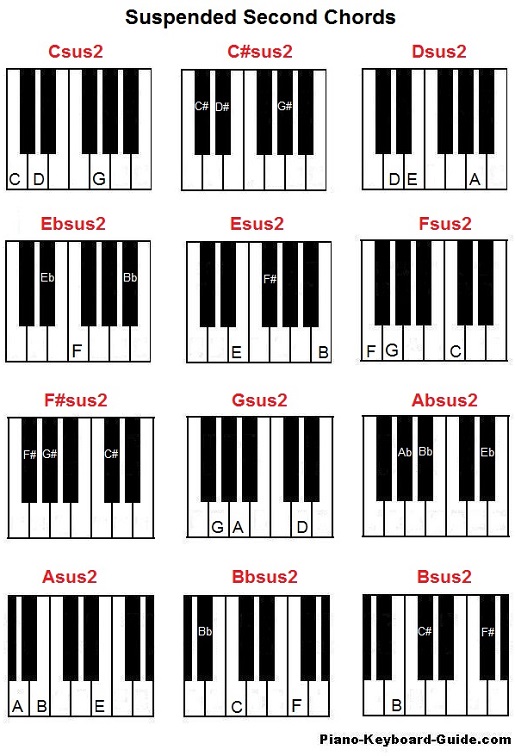
Csus2 = C–D–G
The notes C, D, and G form the chord. There is no E, so the chord is not clearly C major. There is also no E-flat, so it is not C minor.
Sus4 chord formula
A sus4 chord uses:
- Root
- Perfect fourth
- Perfect fifth
The formula is:


1–4–5
For example:
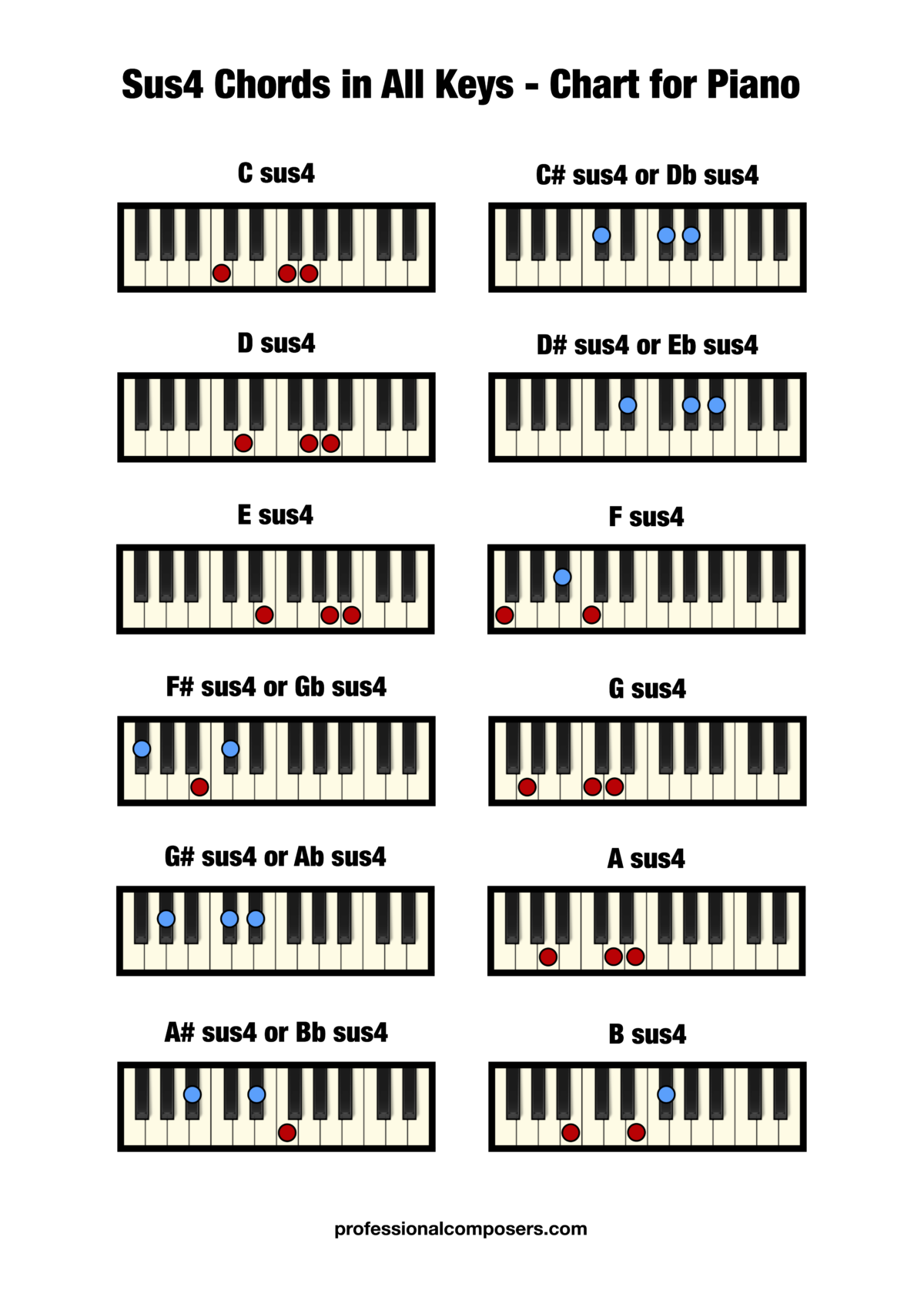
Csus4 = C–F–G
There is no E or E-flat. The F takes the place that E would have in a C major chord.
Sus chords are not usually minor chords
A common mistake is to treat a sus chord as a type of minor chord. It is not. A minor chord contains a minor third, while a sus chord normally has no third at all.
For example:
- C major: C–E–G
- C minor: C–E-flat–G
- Csus2: C–D–G
- Csus4: C–F–G
The chord quality changes because the third changes or disappears.

How to Play Sus Chords on Piano
To play a sus chord, find the root, skip the third, and play either the second or fourth instead.
How to play Csus2
Start with the C major chord:
- C
- E
- G
Replace E with D:
- C
- D
- G
That gives you Csus2.
How to play Csus4
Start with the C major chord again:
- C
- E
- G
Replace E with F:
- C
- F
- G
That gives you Csus4.


The same process works in every key.
Sus chord examples in common keys
| Chord | Sus2 notes | Sus4 notes |
|---|---|---|
| C | C–D–G | C–F–G |
| D | D–E–A | D–G–A |
| E | E–F-sharp–B | E–A–B |
| F | F–G–C | F–B-flat–C |
| G | G–A–D | G–C–D |
| A | A–B–E | A–D–E |
| B | B–C-sharp–F-sharp | B–E–F-sharp |
These examples show the basic root-position shapes. On piano, you can move notes into other octaves or use inversions to make the chord easier to play.
A quick method for any sus chord
- Find the root note.
- Find the normal major chord.
- Remove the third.
- For sus2, add the major second.
- For sus4, add the perfect fourth.
- Play the chord in a comfortable register.
For a quick result, count semitones from the root:
- Sus2: 0, 2, 7
- Sus4: 0, 5, 7
For example, from C:
- C to D is two semitones.
- C to G is seven semitones.
- C to F is five semitones.
Sus2 vs. Sus4: What Is the Difference?
The main difference is the note that replaces the third.
| Chord type | Formula | C example | Common sound |
|---|---|---|---|
| Sus2 | 1–2–5 | C–D–G | Open, light, spacious |
| Sus4 | 1–4–5 | C–F–G | Tense, strong, ready to resolve |
These descriptions are useful, but they are not fixed rules. The final sound depends on the octave, rhythm, bass note, melody, and surrounding chords.
What does a sus2 chord sound like?
A sus2 chord often sounds open and airy. The second sits close to the root, but it does not create the same major or minor color as a third.
A common movement is:
Csus2 → C major
The D moves to E. This creates a gentle upward motion.
What does a sus4 chord sound like?
A sus4 chord often sounds more tense because the fourth sits one half step above the major third.
A common movement is:
Csus4 → C major
The F moves down to E. This is one of the most familiar suspended chord resolutions in popular music.
Which one should you use?
Use sus2 when you want:


- A soft, open sound
- A wide or modern texture
- Less obvious tension
- A smooth step into a major chord
Use sus4 when you want:
- Clear musical tension
- A strong pull toward a major chord
- A hymn-like or pop-rock sound
- A chord that feels ready to resolve

Why Do Sus Chords Sound Unresolved?
Sus chords sound unresolved because the third is missing or replaced. The third usually gives the ear a strong clue about the chord’s identity.
In a C major chord, E tells us that the chord is major. In a C minor chord, E-flat tells us that it is minor. In Csus2 or Csus4, neither note appears.
The ear hears the chord as balanced but incomplete. That feeling often encourages a move to a regular major or minor chord.
The classic sus4 resolution
The most common sus4 movement is:
Csus4 → C major
Notes:
- Csus4: C–F–G
- C major: C–E–G
Only one note changes. F moves down to E while C and G remain in place.
This small movement is called voice leading. Voice leading describes how individual notes move from one chord to the next. Good voice leading can make a simple chord change sound smooth and natural.
The common sus2 resolution
A sus2 chord can resolve in several ways. One common pattern is:
Csus2 → C major
Notes:
- Csus2: C–D–G
- C major: C–E–G
Here, D moves up to E. The root and fifth stay the same.
A sus2 chord does not always resolve to a major chord. It may move to another chord, remain in place, or support a melody note.


How Sus Chords Work in Chord Progressions
Sus chords can add motion without changing the root. This makes them useful in piano accompaniment, songwriting, worship music, pop, rock, film music, and many other styles.
Example 1: C major with a suspended color
Try this progression:
C → Csus4 → C
Play:
- C major: C–E–G
- Csus4: C–F–G
- C major: C–E–G
The F creates tension, then returns to E.
Example 2: G sus4 resolving to G
Try:
G → Gsus4 → G
Play:
- G major: G–B–D
- Gsus4: G–C–D
- G major: G–B–D
The C moves down to B.
Example 3: D sus2 in a pop-style progression
Try:
D → Dsus2 → G → A
The Dsus2 chord adds movement without introducing a new root. It can make a basic progression feel more active while keeping the harmony simple.
Example 4: A suspended chord before a dominant chord
Try:
Dsus4 → D → G
The Dsus4 chord creates tension, D major releases it, and G continues the progression.


The best choice depends on the melody. If the melody plays the suspended note, the chord may sound especially natural.
What Does “Csus” Mean Without a Number?
When a chord symbol says Csus without a number, it most often means Csus4. This is common in chord charts and lead sheets.
However, notation is not always fully consistent. Some writers use “sus” as a general label for a suspended chord. Others use it specifically for sus4.
When you see Csus, check:
- The notes in the arrangement
- The melody
- The recording, if one exists
- The chord symbols before and after it
If the chart gives no further information, Csus4 is usually the safest first interpretation. Still, the musical context has the final say.
What Is a 7sus4 Chord?
A 7sus4 chord combines a suspended fourth with a dominant seventh.
Its formula is:
1–4–5–flat 7
For example:
C7sus4 = C–F–G–B-flat
The third, E, is left out. F takes its place.
A C7sus4 chord may resolve to F major:
C7sus4 → F major
This works because C7 is the dominant seventh chord of F. The suspended fourth adds tension before the chord moves forward.
C7sus4 compared with C9sus4
A C9sus4 chord adds the ninth:
C9sus4 = C–F–G–B-flat–D
On piano, you may not need to play every note. A practical voicing could use:
- Left hand: C and B-flat
- Right hand: F, G, and D
The exact voicing depends on the style and the other instruments. In a band, the bass player may already play the root, so the pianist can use a lighter shape.

How to Voice Sus Chords on Piano
A chord shape is not limited to one octave. You can spread the notes across the keyboard, double selected notes, or place the chord in an inversion.
Root-position voicing
A root-position Csus4 chord is:
- C
- F
- G
The root is the lowest note. This voicing is easy to understand and useful for learning.
Open voicing
An open voicing spreads the notes apart:
- Left hand: C
- Right hand: F and G
You can also place the G above the next C:
- Left hand: C
- Right hand: F–G–C
This creates more space and may sound clearer than a close three-note shape.
Two-hand voicing
Try:
- Left hand: C
- Right hand: G–C–F
This arrangement keeps the root low and spreads the upper notes. It can work well for slow songs and piano accompaniment.
Inversions
An inversion changes which chord note is on the bottom. For Csus4, you could play:
- F–G–C
- G–C–F
These shapes contain the same notes, but they do not sound identical. The bass note changes the chord’s weight and may affect how it connects to the next chord.
Should you double the root?
You can double the root, especially in the left hand. For example:
- Left hand: C and C
- Right hand: F and G
Avoid doubling every note without a reason. Too many low notes can make the sound muddy, especially on an acoustic piano or in a dense arrangement.
Sus Chords and Slash Chords Are Not the Same
A sus chord changes the third. A slash chord tells you which note should be in the bass.
For example:
- Csus4: C–F–G
- C/F: C major over an F bass
C/F normally contains the notes of C major, including E, but places F below the chord. Csus4 normally replaces E with F.
These chords may sound related, but they have different structures.
Compare them:
- Csus4: C–F–G
- C/F: F–C–E–G
The second chord includes E. That note makes a major-chord quality possible. The first chord does not.
A slash chord can contain a suspended chord, too. For example, Gsus4/C would need to be read in context because chord-chart conventions vary. When the notation becomes unclear, listen to the recording or check the full score.

Common Mistakes When Playing Sus Chords
Playing the third by accident
If you play C–E–F–G, you are adding both the third and the suspended fourth. That can be a useful color, but it is no longer a basic Csus4 chord.
For a clear Csus4 sound, leave out E.
Confusing sus2 with add2
These symbols are related but not identical.
- Csus2: C–D–G
- Cadd2: C–E–G–D
Csus2 removes the third. Cadd2 keeps the third and adds the second.
The same idea applies to sus4 and add4:
- Csus4: C–F–G
- Cadd4: C–E–F–G
Assuming every sus chord must resolve
A suspended chord often resolves, but it does not have to. A songwriter may use it as a stable color for several beats or for an entire section.
The label “suspended” describes the chord’s note structure. It does not require a specific next chord.
Playing the wrong fourth
A sus4 chord uses the perfect fourth above the root. In most keys, this means the fourth is five semitones above the root.
For example:
- Dsus4 uses G.
- Esus4 uses A.
- Asus4 uses D.
Do not choose the note by using the major third. Count from the root or use the scale of the chord.
Using too many low notes
Low clusters can sound unclear. If a sus chord feels muddy:
- Move the upper notes higher.
- Play only the root in the left hand.
- Remove a doubled note.
- Leave more space between the bass and the right hand.

A Short Practice Routine for Sus Chords
Use this five-minute routine to learn the shapes in every key.
Minute 1: Learn the formula
Say the formulas aloud:
- Sus2: 1–2–5
- Sus4: 1–4–5
Then build them from C, G, and F.
Minute 2: Resolve sus4 chords
Play each chord twice:
- Gsus4 → G
- Csus4 → C
- Fsus4 → F
Listen for the fourth moving down to the third.
Minute 3: Resolve sus2 chords
Try:
- Csus2 → C
- Gsus2 → G
- Dsus2 → D
Listen for the second moving up to the third.
Minute 4: Use inversions
Play Csus4 as:
- C–F–G
- F–G–C
- G–C–F
Then move to C major with as little hand movement as possible.
Minute 5: Add rhythm
Play a simple pattern such as:
- Beat 1: sus chord
- Beat 2: regular chord
- Beats 3 and 4: repeat
Try the same pattern with different keys. This connects the chord shape to real piano playing instead of isolated theory drills.
A sign of success is that you can identify the suspended note by ear and move it to the third without searching for each key.
Frequently Asked Questions
Is a sus chord major or minor?
A basic sus chord is neither clearly major nor minor because it does not contain a third. Its root and fifth remain, but the third is replaced by the second or fourth.
Is Csus2 easier than Csus4 on piano?
Neither is difficult. Csus2 uses C, D, and G. Csus4 uses C, F, and G. The easier shape depends on the chord before and after it, as well as the hand position.
Can a sus chord have a seventh?
Yes. Common examples include 7sus4 and 9sus4. These chords combine the suspended structure with a seventh or ninth. The third is usually omitted in the basic suspended voicing.
Can I use a sus chord in a minor progression?
Yes. A sus chord can appear in a progression that also contains minor chords. Since the sus chord has no third, it can act as a neutral color before moving to a major or minor chord.
What is the easiest way to remember sus2 and sus4?
Remember:
- Sus2: Replace the third with the note below it.
- Sus4: Replace the third with the note above it.
In C major, E becomes D for Csus2 and F for Csus4.
Final Takeaway
A sus chord on piano replaces the third with another note. Sus2 uses the second, while sus4 uses the fourth.
The basic formulas are:
- Sus2: 1–2–5
- Sus4: 1–4–5
To play one, start with a major chord, remove its third, and add the second or fourth. Then listen to how the chord sounds alone, in a progression, and when it resolves to a regular major or minor chord.

Senior Music Reviewer
Alex Carter is a seasoned music reviewer with over a decade of experience in the world of sound and instruments. Passionate about helping musicians and enthusiasts make informed choices, he brings sharp insights and in-depth knowledge to every review. From classical instruments to modern gear, Alex combines technical expertise with a love for music to deliver content that resonates with readers.
As a Senior Music Reviewer and expert author on Tuneluma.com, Alex is dedicated to sharing honest evaluations, practical advice, and thoughtful commentary to guide readers in their musical journey.