A double stop on guitar is a technique where you play two notes at the same time. The two notes may be on nearby strings, separate strings, or even the same string with a special technique. Double stops are common in American blues, country, rock, jazz, and worship guitar.
Unlike a full chord, a double stop uses only two notes. This gives it a clear, focused sound. You can use double stops to add fills, make riffs sound fuller, or create moving parts behind a singer.

What Does “Double Stop” Mean on Guitar?
A double stop means that two guitar notes sound together as one musical event. You can pick both notes at once or play them in quick succession so they blend.
The notes can be:
- Fretted on two strings
- Played with one open string and one fretted note
- Played as two open strings
- Played as an octave shape
- Played as part of a slide, bend, hammer-on, or pull-off
The word stop comes from the idea of stopping or holding two notes at once. It does not mean that you must stop the strings after playing them.
A double stop is not always a full chord. A chord usually contains three or more different notes, although some players use “chord” loosely for any group of notes. A double stop has two sounding pitches.
Double stop versus single-note playing
A single-note line sounds one pitch at a time:
e|----------------|
B|--3--5--7--5----|
G|----------------|
A double-stop line sounds two pitches together:
e|--3--5--7--5----|
B|--3--5--7--5----|
G|----------------|
The second example has a thicker sound because each position contains two notes.
Double stop versus a chord
A chord may include three or more notes:
e|--0--
B|--1--
G|--0--
D|--2--
A|--3--
E|-----
A double stop uses only two notes:
e|--3--
B|--3--
G|-----
D|-----
A|-----
E|-----
Both can support harmony, but a double stop usually leaves more space in the music.

How Do You Play a Double Stop?
To play a double stop, choose two strings, fret the notes cleanly, and pick both strings without hitting unwanted strings.
Follow these steps:
-
Choose two strings.
Start with the B and high E strings because they are easy to see and control. -
Place your fingers behind the frets.
Put each fingertip close to the fret wire without sitting directly on top of it. -
Check both notes.
Play each string alone. Each note should ring without buzzing. -
Pick both strings together.
Use one downstroke, one upstroke, or a small sweep across the two strings. -
Control the sustain.
Let the notes ring for a set length, or mute them with your picking hand or fretting hand. -
Add movement.
Try sliding the shape, bending one note, or using a hammer-on.
Your goal is not just to play two strings. Your goal is to make the two notes sound intentional and balanced.
A simple double stop in standard tuning
Standard tuning in the United States is:
E A D G B E
This example uses the B and high E strings:
e|--3--
B|--3--
G|-----
D|-----
A|-----
E|-----
Play both notes at the same time. The notes are G and D, which form a perfect fourth. You can move the same shape along the two highest strings.
A double stop with open strings
Open strings can also form double stops:
e|--0--
B|--0--
G|-----
D|-----
A|-----
E|-----
This produces the notes E and B. Because the strings are open, this shape is easy to play but may be harder to move around the neck.

What Are the Main Types of Guitar Double Stops?
The most useful way to classify double stops is by the interval between the two notes. An interval is the distance in pitch between two notes.
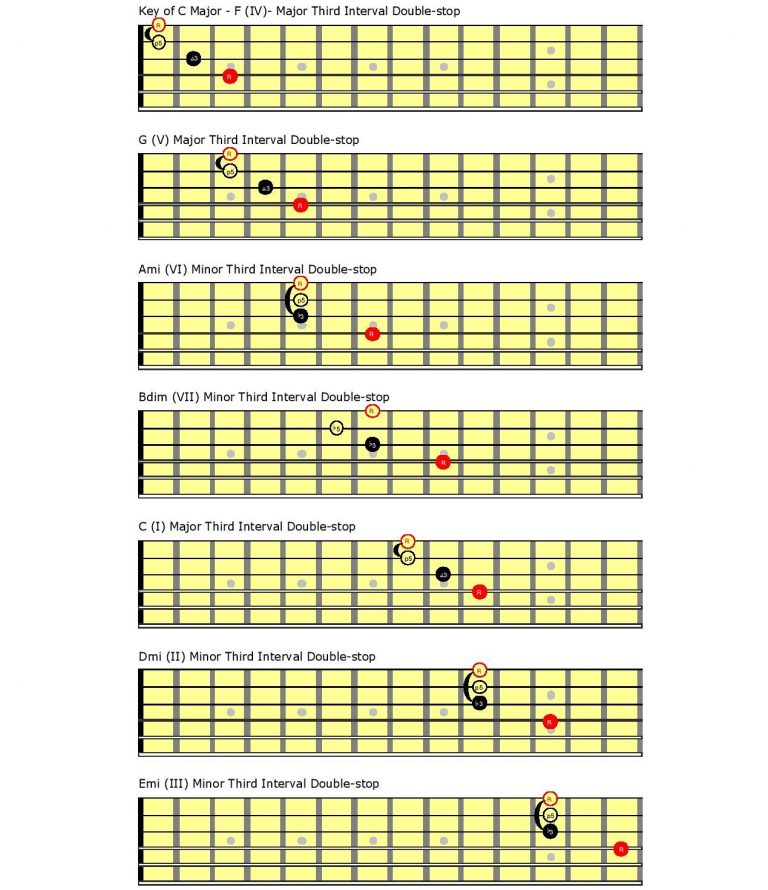
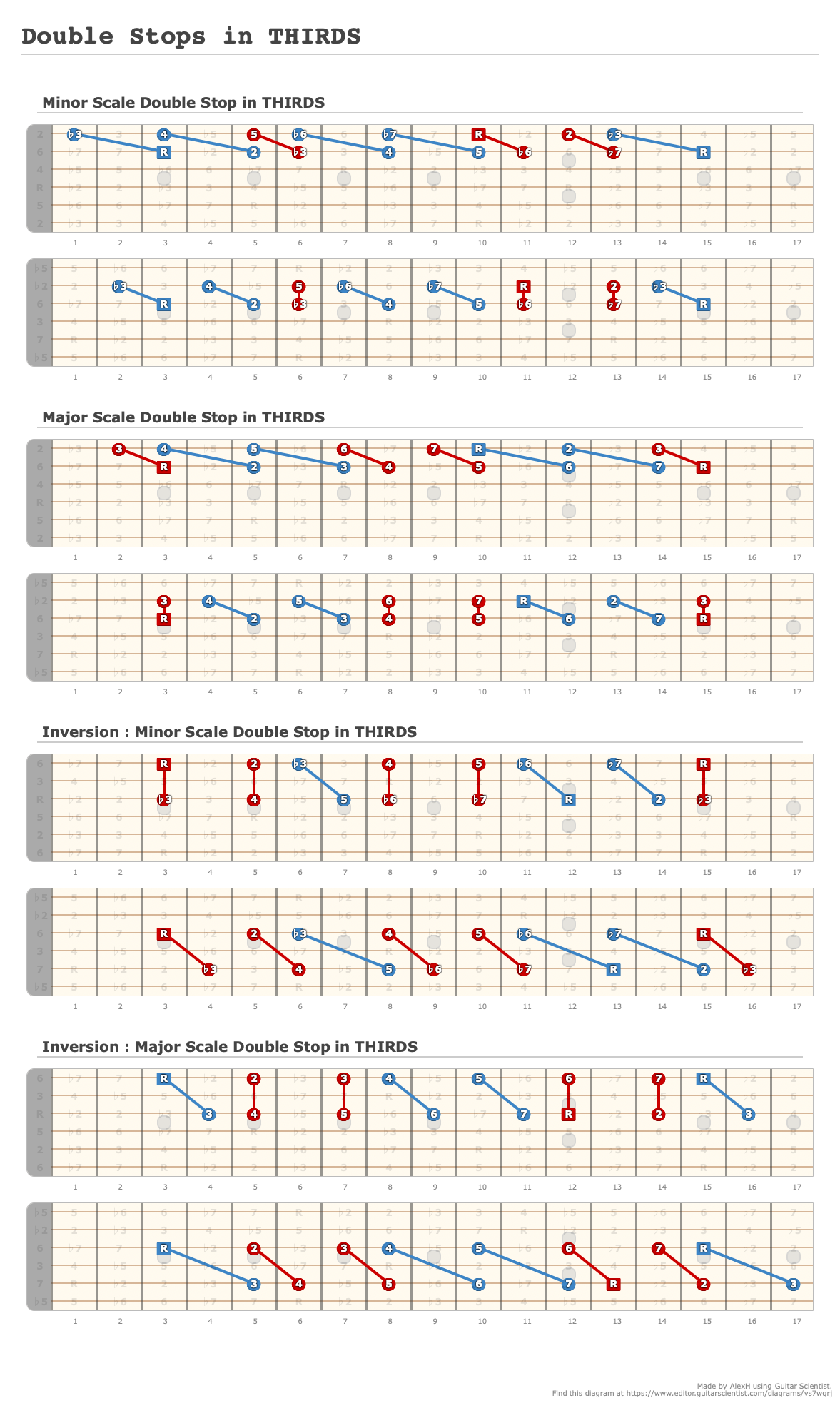
Thirds
Thirds often sound melodic and bright. Country guitarists, rock players, and blues musicians use them to harmonize melodies.
A simple example is:
e|--3--
B|--3--
This particular shape creates a fourth, not a third, so the exact interval depends on the string pair and fret spacing. On guitar, you must account for the tuning between the strings.
The B and high E strings are tuned a perfect fourth apart. The G and B strings are tuned a major third apart. That tuning difference changes the shape of many double-stop patterns.
Sixths
Sixths are common in country, rockabilly, blues, and clean electric guitar parts. They can sound wide and smooth.
A sixth double stop often uses the G and high E strings. One note may move while the other stays still. This creates a strong melody-with-harmony effect.
Fourths and fifths
Fourth and fifth double stops sound open and strong. They work well in rock, folk, blues, and alternative music.
A fifth-based double stop is closely related to a power chord. The difference is often voicing and context. A power chord usually emphasizes a root and fifth, while a double stop can use any two-note interval.
Octaves
An octave double stop uses two notes with the same letter name at different pitches. Octaves sound clear and focused because the notes share the same basic pitch identity.
Here is an E octave:
e|---------
B|---------
G|--9------
D|--x------
A|--7------
E|---------
The “x” means to mute the D string. The note on the A string is E, and the note on the G string is also E one octave higher.
Octave shapes are common in blues, funk, jazz, rock, and melody lines.
Unisons
A unison uses the same pitch twice. On guitar, this may involve two strings that produce the same note at different locations.
Unisons can create a strong, doubled sound. They also make useful exercises for timing and pitch control.
Where Are Double Stops Used?
Double stops are useful whenever a single-note line needs more weight or harmony.
Blues guitar
Blues players often combine a fretted note with a bent or sliding note. The two notes may move together or create tension before resolving.
A common blues approach is to:
- Pick two notes together
- Bend one note slightly
- Release the bend
- Add vibrato
- Move the shape to another fret
The small difference in pitch during a bend can create an expressive, vocal sound.
Country guitar
Country guitar uses double stops for bright fills and harmonized melodies. Players often pick two notes, slide into a position, and release them quickly.
A country-style double stop may appear between vocal lines. It fills the space without competing with the singer as much as a large chord might.
Rock guitar
Rock players use double stops in riffs, intros, and lead parts. Fifths and octaves are especially common because they remain clear under distortion.
Double stops can also make a simple riff sound larger without adding a full chord.
Jazz guitar
Jazz players use two-note shapes to outline chord changes. A double stop may contain guide tones, such as the third and seventh of a chord.
These notes help identify whether a chord is major, minor, dominant, or altered. Jazz double stops often move smoothly from one chord to the next.
Funk and rhythm guitar
Funk players use short, muted double stops. The notes may last only a fraction of a beat.
The key is strong timing. Release the pressure after the pick attack so the sound becomes short and percussive.

Easy Double-Stop Exercises for Beginners
Start slowly. Clean timing matters more than speed.
Exercise 1: Two-string control
Use the B and high E strings:
e|--3--3--5--5--7--7--|
B|--3--3--5--5--7--7--|
G|--------------------|
D|--------------------|
A|--------------------|
E|--------------------|
Play each pair four times. Keep your fingers close to the strings as you move.
Listen for:
- Both notes starting together
- Equal volume
- No open-string noise
- No buzzing
- Consistent rhythm
Exercise 2: Move an octave shape
Use this octave shape:
e|------------------------|
B|------------------------|
G|--9--7--5--4------------|
D|--x--x--x--x------------|
A|--7--5--3--2------------|
E|------------------------|
Mute the D string each time. Start with quarter notes, then try eighth notes.
This exercise trains your fretting hand and picking hand to move as one unit.
Exercise 3: Add a slide
Play a double stop at the fifth fret and slide to the seventh fret:
e|--5/7--|
B|--5/7--|
G|-------|
Pick the notes once at the fifth fret. Keep your fingers pressed down as you slide to the seventh fret.
Use light pressure. Too much force can pull the notes sharp.
Exercise 4: Practice short rhythm hits
Play the shape below as short, even hits:
e|--5-x-5-x-7-x-7-x--|
B|--5-x-5-x-7-x-7-x--|
G|-------------------|
The “x” marks muted strokes. This is useful for rock and funk rhythm practice.

How Do You Keep a Double Stop Clean?
Clean double stops depend on accurate fretting and string control.
Fret close to the fret wire
Place your finger just behind the fret. If your finger sits too far back, the string may buzz. If it sits directly on the fret, the note may sound weak or muted.
Use the smallest amount of pressure needed
Press until the note rings clearly. Extra pressure can make your hand tense and may pull the note sharp.
Mute unused strings
Your picking hand can mute strings below the ones you play. Your fretting hand can lightly touch nearby strings above them.
For octave shapes, muting is essential. One unwanted string can turn a clear octave into a muddy chord.
Keep both notes balanced
One note may sound louder because of your finger angle or pick path. Pick through both strings with a controlled motion.
If one note disappears, play each string alone. This helps you find whether the problem comes from fretting, picking, or muting.
Watch for the B-string tuning change
The G-to-B string pair is tuned to a major third. Most other neighboring string pairs are tuned to a perfect fourth.
This means a shape may change when it crosses from the G string to the B string. Do not assume that one pattern works unchanged across the whole neck.
Common Double-Stop Mistakes
Most double-stop problems come from noise, weak timing, or poor note balance.
Hitting too many strings
A wide pick stroke may catch strings that should stay silent. Use a smaller motion and mute the unwanted strings.
Letting notes ring too long
Long sustain is not always a mistake. It becomes a problem when it blurs the rhythm or clashes with the next chord.
Use palm muting or release your fretting pressure after the attack.
Bending both notes by accident
When you bend one string, the other note should stay stable unless you want both notes to move. Keep the second finger relaxed and use the correct bend technique.
Playing too hard
Hard picking can make notes sharp, harsh, or uneven. Begin with a light touch and increase force only when the music needs it.
Ignoring intonation
A guitar with poor setup or incorrect intonation may sound out of tune higher on the neck. If the open strings are in tune but double stops sound sour at higher frets, the instrument may need professional adjustment.
Practicing too fast
Speed can hide uneven timing and muted notes. Slow practice lets you hear whether both notes begin and end together.

Double Stops, Dyads, and Two-Note Chords
A dyad is a musical term for two notes played together. In many guitar lessons, “dyad” and “double stop” overlap.
The terms are not always used in exactly the same way:
- Double stop: Often describes a guitar technique or performance gesture.
- Dyad: Describes the two-note musical unit.
- Two-note chord: A general phrase for two notes played together.
- Power chord: Usually a root, fifth, and sometimes an octave.
A double stop may be a dyad, but not every dyad is used as a dramatic double-stop lick. The meaning depends on the musical setting.
For practical guitar playing, you can treat a double stop as two notes played together with a clear musical purpose.

When Should You Use a Double Stop Instead of a Chord?
Use a double stop when you want harmony without filling the entire sonic space.
A double stop can work well when:
- A singer needs room
- A riff needs a wider sound
- A lead line needs simple harmony
- A rhythm part must stay light
- Distortion makes full chords too thick
- You want a short, rhythmic accent
Use a fuller chord when the music needs more harmonic information or a sustained background.
The best choice depends on the arrangement. A double stop is not automatically better than a chord. It is simply a smaller and more focused sound.

Key Takeaways
- A double stop is two guitar notes played at the same time.
- The notes can be fretted, open, bent, slid, or played as octaves.
- Double stops are common in blues, country, rock, jazz, funk, and rhythm guitar.
- A dyad is the music-theory term for two notes together.
- Clean double stops require accurate fretting, controlled picking, and string muting.
- The G-to-B tuning change affects many movable shapes.
- Start with two adjacent strings and practice slowly.
Frequently Asked Questions
Is a power chord a double stop?
A power chord can be a double stop when it contains only two sounding notes. Many power chords include a third note, such as an octave, so they are not always technically double stops.
Can a double stop use two notes on one string?
Yes, but both notes cannot normally sound at the exact same moment through ordinary fretting. Players may use tapping, legato, harmonics, or other techniques to create a two-note effect on one string.
Do I need to use a pick for double stops?
No. You can use a pick, your fingers, hybrid picking, or a thumb-and-finger technique. Choose the method that gives you the best control over timing and string noise.
Why do my double stops sound out of tune?
Possible causes include bending one note unintentionally, pressing too hard, using a wrong fret, or playing a guitar with intonation problems. Check each note alone, then play them together.
What is the easiest double stop to learn?
Two notes on the B and high E strings at the same fret are a simple starting point. Octave shapes are also useful, but they require muting the string between the two notes.
Conclusion
A double stop on guitar is a simple but flexible technique: two notes played together. It can sound soft and melodic, sharp and rhythmic, or powerful enough for a rock riff.
Begin with two adjacent strings. Practice clean attacks, mute the strings you do not need, and move the shape slowly. Once the basic shape feels comfortable, add slides, bends, vibrato, and rhythmic accents to make the double stop part of your own playing.

Senior Music Reviewer
Alex Carter is a seasoned music reviewer with over a decade of experience in the world of sound and instruments. Passionate about helping musicians and enthusiasts make informed choices, he brings sharp insights and in-depth knowledge to every review. From classical instruments to modern gear, Alex combines technical expertise with a love for music to deliver content that resonates with readers.
As a Senior Music Reviewer and expert author on Tuneluma.com, Alex is dedicated to sharing honest evaluations, practical advice, and thoughtful commentary to guide readers in their musical journey.