What Is A Capo For Guitar: Beginner’s Guide
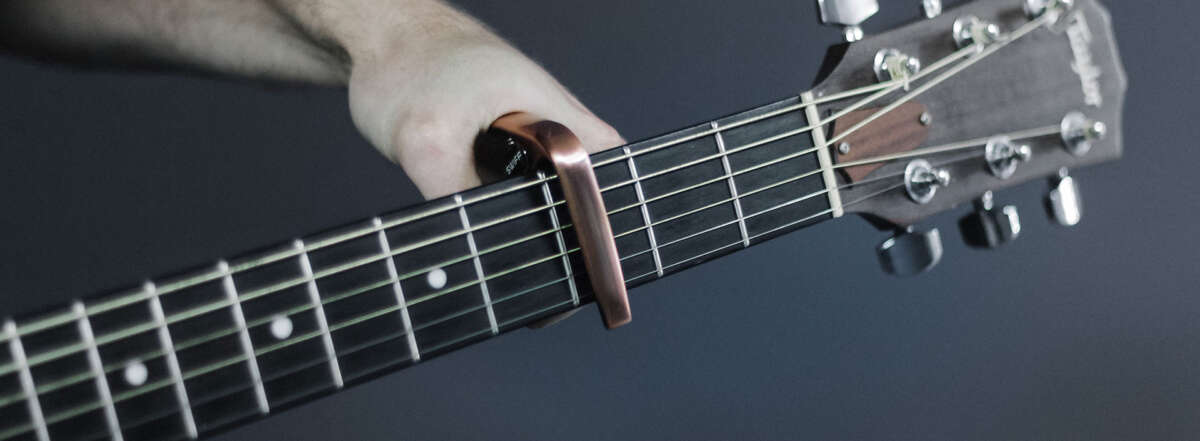
A capo for guitar is a small clamp that raises the pitch of every open string without changing chord shapes.
If you have ever watched a guitarist place a small device across the neck, you may have wondered, “What is a capo for guitar?” This simple tool can make songs easier to sing, change a song’s key, and add a brighter sound without learning new chord shapes. In this guide, you will learn how a capo works, how to use one correctly, its benefits and limits, and how to choose the right type for your guitar.
What Is a Capo for Guitar?
A capo for guitar is a device that clamps across the fretboard. It presses the strings against a fret, much like your finger does when you play a chord. This shortens the vibrating length of every string and raises the pitch.
The word “capo” comes from the Italian word for “head.” On a guitar, the capo acts like a movable nut. The nut is the small strip near the headstock that guides the strings at the start of the fretboard.
For example, place a capo on the second fret and play a regular G chord shape. Your fingers still use the G shape, but the guitar sounds two half steps higher. The chord you hear is A.
A capo does not retune the strings in the usual sense. Instead, it changes the pitch of the strings by placing all of them at a higher fret.
How Does a Capo Work?
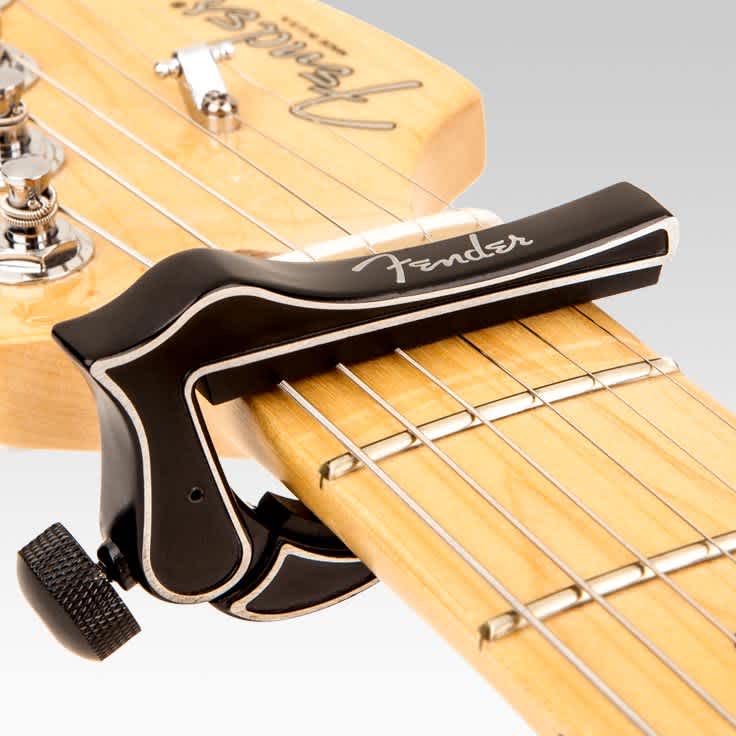
A capo for guitar applies even pressure across the strings. When you attach it behind a fret, each open string now starts at that fret instead of at the nut. The result is a higher pitch for every string.
Each fret raises a note by one half step. This means:
• Capo on the first fret raises the pitch by one half step.
• Capo on the second fret raises the pitch by one whole step.
• Capo on the third fret raises the pitch by three half steps.
The fret itself matters. Place the capo close behind the fret, not in the center of the fret space. This position often gives cleaner notes and reduces buzzing.
A capo should hold the strings firmly, but it should not crush them. Too much pressure may pull the strings sharp. This is one of the most common mistakes new players make.
A simple key example
Suppose a song uses the chord shapes G, C, and D. With no capo, those shapes produce the key of G. Place a capo on the second fret, and the same shapes produce the key of A.
The shapes stay the same, but the sound moves higher:
| Chord shape | Capo on second fret | Sounding chord |
|---|---|---|
| G | G shape | A |
| C | C shape | D |
| D | D shape | E |
This is why a capo for guitar is so useful for singers and beginners.

Why Do Guitarists Use a Capo?
The main reason to use a capo for guitar is to change a song’s key while keeping familiar chord shapes. This can make a song much easier to play and sing.
A capo can also change the tone. Open chord shapes often use ringing strings, which create a bright and full sound. Even when the song is in a higher key, the open shapes can sound more open than barre chords.
Common reasons to use a capo include:
• To match a singer’s vocal range.
• To avoid difficult barre chords.
• To play a song with easier chord shapes.
• To create a brighter or more ringing tone.
• To copy the sound of a studio recording.
• To make a song fit another instrument.
For instance, a singer may find a song in G too low. Rather than learning new chord shapes, the guitarist can use a capo on the second fret and play the same shapes in A.
A capo can also help a beginner build confidence. It lets the player focus on rhythm, chord changes, and singing instead of struggling with advanced shapes.

How to Use a Capo Correctly
Using a capo for guitar is easy, but small details affect tuning and sound. Follow these steps:
-
Tune the guitar without the capo.
-
Choose the fret that matches the song’s key.
-
Open the capo and place it just behind the chosen fret.
-
Check that the capo covers all strings.
-
Play each string one at a time.
-
Retune if any string sounds sharp or flat.
-
Play the song and listen for buzzing.
The best position is usually just behind the fret. Avoid placing the capo far from the fret because this may require more pressure and create tuning problems.
Check the low E string and high E string carefully. If either string is not held firmly, it may buzz. If the strings sound sharp, reduce the capo tension or move it closer to the fret.
How to remove a capo safely
Do not pull the capo sideways across the strings. Open it fully, then lift it straight away from the neck. This helps protect the finish and prevents sudden string noise.
When you finish playing, remove the capo from the guitar. Leaving it clamped on for long periods can add unnecessary tension to the neck and strings.

How to Find the Right Key With a Capo
A capo for guitar raises the key by one half step for every fret. This makes key changes simple to calculate.
Use this basic guide:
• Open position: original key.
• First fret: up one half step.
• Second fret: up one whole step.
• Third fret: up three half steps.
• Fourth fret: up four half steps.
• Fifth fret: up five half steps.
For example, if you play an E chord shape:
• Capo on the first fret produces F.
• Capo on the second fret produces F-sharp or G-flat.
• Capo on the third fret produces G.
• Capo on the fifth fret produces A.
The chord shape name and the sounding chord are not always the same. If you play a D shape with a capo on the second fret, your fingers are using a D shape, but the guitar sounds an E chord.
This distinction matters when you play with other musicians. Tell the group both the chord shapes and the capo position. Saying “I am playing G shapes with capo two” gives everyone useful information.
A practical singer example
Imagine a song feels comfortable in the key of G, but the singer needs the song one step higher. Put the capo on the second fret and use the same G, C, and D shapes. The song now sounds in A.
This approach is often easier than changing every chord to A, D, and E.
Types of Guitar Capos
Several types of capo for guitar are available. Each style works well in different situations.
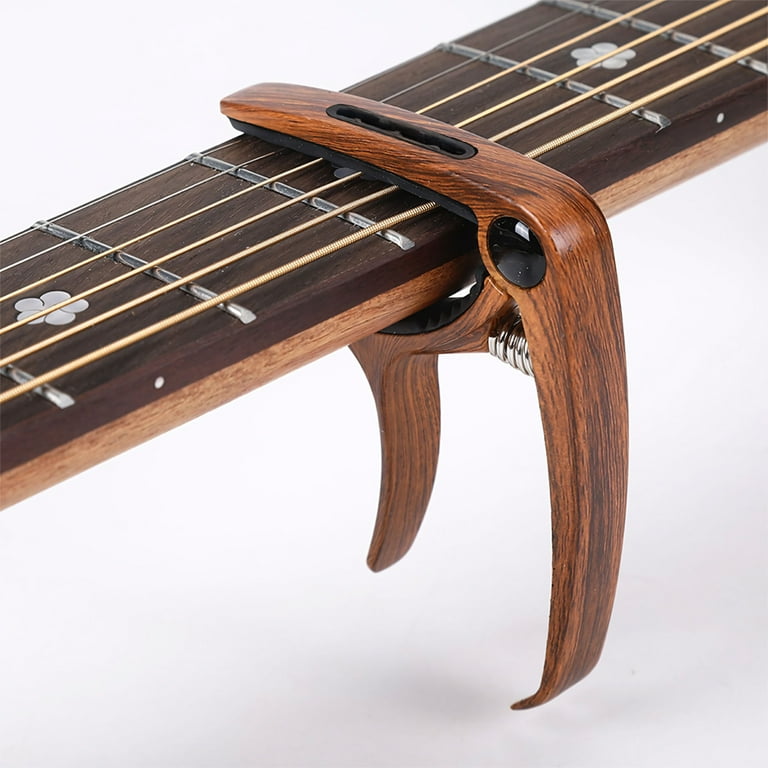
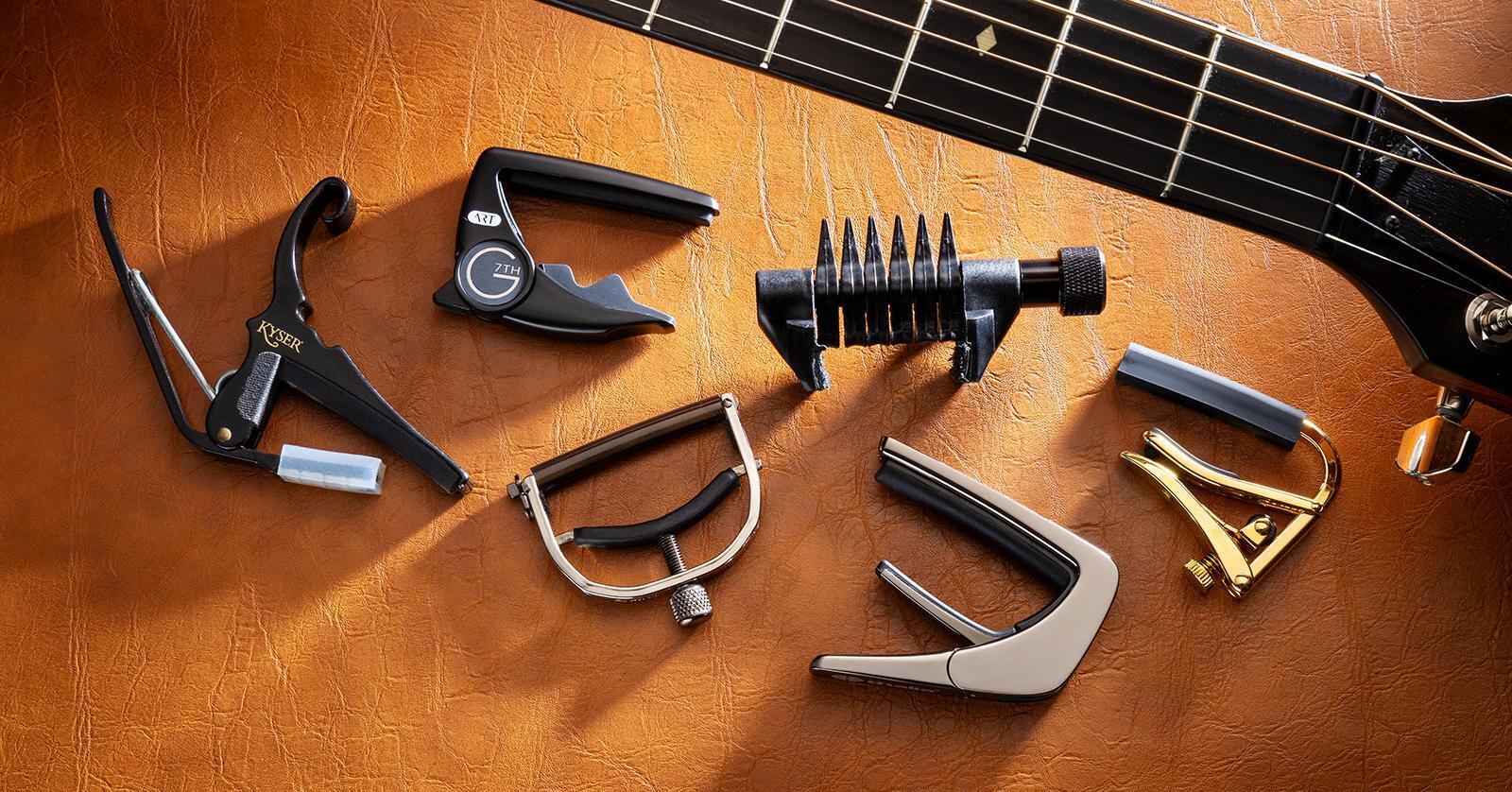
Spring-loaded capo
A spring-loaded capo uses a strong spring and handles. It is fast to attach and remove. This style is popular for live playing because it can be moved with one hand.
Its main weakness is pressure. Some spring capos press harder than needed and may pull the guitar sharp.
Trigger capo
A trigger capo has a clamp-like design. It works much like a spring-loaded model and is simple for beginners. It is often affordable and easy to find.
Choose a model with smooth padding. Poor padding may scratch the finish or fail to hold the strings evenly.
Screw-adjusted capo
A screw-adjusted capo lets you control the pressure. This can improve tuning accuracy, especially on guitars with sensitive strings or low action.
The tradeoff is speed. It takes longer to attach than a spring model.
Partial capo
A partial capo covers only some strings. It can create alternate tunings and unusual chord sounds. These capos are more advanced and require a clear understanding of harmony.
A partial capo is not the best first choice for most beginners. Start with a full capo and learn how it changes standard chords.

How a Capo Affects Tuning and Tone
A capo for guitar can affect tuning because it adds pressure to the strings. If the pressure is too strong, the strings may stretch slightly and sound sharp.
The effect is often more noticeable on guitars with:
• High action.
• Thick strings.
• A sensitive bridge or nut.
• Poor fret leveling.
• A neck with setup problems.
To reduce tuning issues, place the capo close behind the fret. Use only enough tension to hold the strings. After attaching it, check the tuning with an electronic tuner.
A capo also changes tone. The guitar may sound brighter because the strings have less vibrating length. The sound can feel tighter, lighter, and more focused.
This tone change is not automatically better. Some players prefer the deeper sound of open-position chords. Others like the crisp sound produced by a capo high on the neck.
Can a capo damage a guitar?
A quality capo used correctly should not damage a guitar. Problems are more likely when a capo is left on for long periods, clamped too tightly, or used with damaged padding.
Check the capo from time to time. Replace it if the rubber or silicone pad becomes hard, cracked, or rough.

Capo vs. Barre Chords
A capo for guitar and barre chords can both help you play in different keys, but they work in different ways.
A barre chord uses one finger to press several strings. It gives you movable chord shapes, but it can be tiring for new players. A capo lets you use open chord shapes while changing the key.
Here is a simple comparison:
| Capo | Barre chords |
|---|---|
| Easy to move between keys | Requires more finger strength |
| Keeps familiar open shapes | Offers more control over chord changes |
| Creates a bright, open sound | Often creates a fuller, tighter sound |
| Useful for beginners | Important for advanced rhythm playing |
| May affect tuning | Does not require a separate device |
A capo is not a replacement for learning barre chords. It is a practical tool that solves a different problem. As your technique improves, learn both methods.
One useful habit is to practice the song with a capo first, then try it with barre chords. This builds comfort without slowing your progress.

Common Capo Mistakes to Avoid
Many capo problems are easy to fix. The most common mistake is placing the device too far from the fret. This can cause buzzing or require excessive pressure.
Avoid these errors:
• Placing the capo directly on top of the fret.
• Using more pressure than needed.
• Forgetting to retune after attaching it.
• Covering only part of the fretboard.
• Leaving the capo on the guitar after playing.
• Assuming the chord name stays the same.
• Using a damaged capo pad.
Another mistake is choosing a capo without considering the guitar’s neck shape. A capo made for a standard six-string acoustic guitar may not fit a classical guitar or a twelve-string guitar well.
I also recommend testing the capo on every string before starting a performance. A single buzzing string can distract from an otherwise strong song. This quick check takes only a few seconds.
How to Choose the Best Capo for Your Guitar
The best capo for guitar should fit the instrument, hold the strings evenly, and allow easy adjustment. Price matters, but design and pressure control matter more.
Consider these points:
• Guitar type: Acoustic, electric, classical, and twelve-string guitars may need different designs.
• Neck width: The capo must span the full fretboard.
• Neck shape: A flat classical neck differs from a rounded steel-string neck.
• Pressure control: Adjustable models can help prevent sharp notes.
• Padding: Soft, smooth padding protects the finish and strings.
• Ease of use: A fast spring model suits live players.
• Size: A compact capo is easy to store in a gig bag.
For most beginners, a reliable spring or trigger capo is a good starting point. Players who care deeply about tuning may prefer a screw-adjusted model.
Do not judge a capo only by appearance. Test it on the guitar when possible. The right model should feel secure without forcing the strings far below the fret.
Capo Alternatives and Related Tools
A capo for guitar is one way to change a song’s key, but it is not the only way. You can also transpose the chords, use barre chords, or retune the guitar.
Transposing means changing each chord to a new chord. This gives you full control, but it may create harder shapes. Retuning changes the pitch of individual strings and can produce special sounds, but it may require new chord patterns.
A digital tuner is also useful with a capo. Many tuners can detect the small pitch changes caused by capo pressure. Always tune first, attach the capo, and check again.
A capo should not be confused with a slide. A slide moves along the strings to create smooth pitch changes. A capo stays in one position and raises all covered strings at once.
Frequently Asked Questions About What Is a Capo for Guitar
What is a capo for guitar used for?
A capo for guitar raises the pitch of all open strings while allowing you to keep the same chord shapes. Guitarists use it to match a singer’s range, avoid difficult chords, or create a brighter tone.
Does a capo change the key of a song?
Yes. Each fret raises the song by one half step. For example, familiar G, C, and D shapes with a capo on the second fret sound in the key of A.
Should I tune before or after putting on a capo?
Tune the guitar before placing the capo, then check the tuning again afterward. The capo can pull strings slightly sharp, especially when it applies too much pressure.
Can beginners use a capo?
Yes. A capo is very helpful for beginners because it lets them play familiar open chord shapes in different keys. It should support learning, not replace learning basic chord theory and barre chords.
Where should a capo be placed?
Place the capo just behind the fret you want to use. Avoid placing it directly on top of the fret or too far away, since both positions can cause buzzing or tuning problems.
Can a capo damage guitar strings?
A good capo should not damage healthy strings when used correctly. Excessive pressure, rough padding, or leaving the capo attached for long periods can increase wear.
Can I use one capo on an electric and acoustic guitar?
Sometimes, but not every capo fits every neck. Check the capo’s width and shape before using it on an electric, acoustic, classical, or twelve-string guitar.
Conclusion
A capo for guitar is a small but powerful tool. It raises the pitch of every open string, lets you keep familiar chord shapes, and can make a song easier to sing or play. Place it close behind the fret, use moderate pressure, and retune after attaching it.
A capo will not replace good technique or music theory, but it can make practice more enjoyable and performances more flexible. Try one on a song you already know, compare several fret positions, and listen to how the tone changes. Explore more guitar guides, practice with confidence, and share your favorite capo songs in the comments.

Senior Music Reviewer
Alex Carter is a seasoned music reviewer with over a decade of experience in the world of sound and instruments. Passionate about helping musicians and enthusiasts make informed choices, he brings sharp insights and in-depth knowledge to every review. From classical instruments to modern gear, Alex combines technical expertise with a love for music to deliver content that resonates with readers.
As a Senior Music Reviewer and expert author on Tuneluma.com, Alex is dedicated to sharing honest evaluations, practical advice, and thoughtful commentary to guide readers in their musical journey.