What Guitar Did John Lennon Play: His Iconic Guitars
John Lennon played several famous guitars, especially his Rickenbacker 325 and Epiphone Casino.
The answer to what guitar did John Lennon play depends on the Beatles era, recording, and performance. Lennon used bright Rickenbacker guitars, warm Gibson acoustics, and versatile Epiphone Casinos, each helping shape the sound of The Beatles. This guide explains his main guitars, how he used them, and which modern model best matches his tone and feel.
What guitar did John Lennon play most famously?
The guitar most closely linked with John Lennon is the Rickenbacker 325 Capri. He bought his first one in Hamburg, Germany, in 1960. The short-scale guitar became part of his early Beatles image and appeared during the band’s rise at The Cavern Club, on television, and during early tours.
Lennon’s original Rickenbacker 325 had a 30-inch scale, a compact body, and three pickups. Its short neck made it easy to play fast rhythm parts, while the pickups gave it a sharp and clear sound.
The guitar was not known for a huge low end. Instead, it had a tight, cutting tone that worked well with Lennon’s strong rhythm style. In the early Beatles recordings, that bright sound helped the guitars remain clear beside Paul McCartney’s bass and Ringo Starr’s drums.
The main features of Lennon’s famous Rickenbacker 325 included:
• A short 30-inch scale length
• A semi-hollow maple body
• Three Rickenbacker pickups
• A distinctive “R” tailpiece
• A small, rounded body shape
• A bright tone with strong treble detail
Lennon later used modified versions of the 325, including a 325/12 twelve-string model. These instruments looked similar but offered different textures for studio work and live performances.
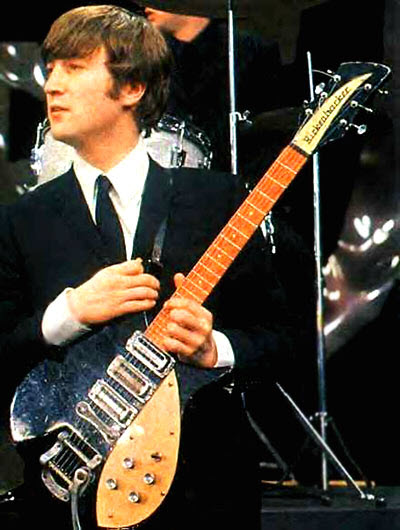
John Lennon’s Rickenbacker 325
Lennon’s first Rickenbacker was a 1958 325 Capri. He bought it while The Beatles were performing in Hamburg. The guitar originally had a natural finish, but Lennon later had it refinished in a darker color.
The instrument went through several changes. Lennon added and adjusted parts over time, including the bridge, knobs, and other hardware. This matters because photographs may show slightly different versions of what appears to be the same guitar.
Lennon used the Rickenbacker 325 during the early Beatles period, especially from 1960 through 1964. It became one of the defining guitars of the British beat sound.
The Rickenbacker’s character came from more than its pickups. Its short scale made the strings feel soft under the fingers. That allowed Lennon to bend notes and play strong chord patterns without the resistance found on many full-scale guitars.
A useful lesson for players is that a guitar’s scale length can change your style. A short-scale guitar may feel relaxed and quick, while a longer-scale guitar can feel firmer and more focused. When people ask what guitar did John Lennon play, they often focus on the brand and miss this important physical detail.
Lennon also owned and played a Rickenbacker 325/12. The twelve-string version added shimmer and width, although it was less central to his public image than the six-string 325.

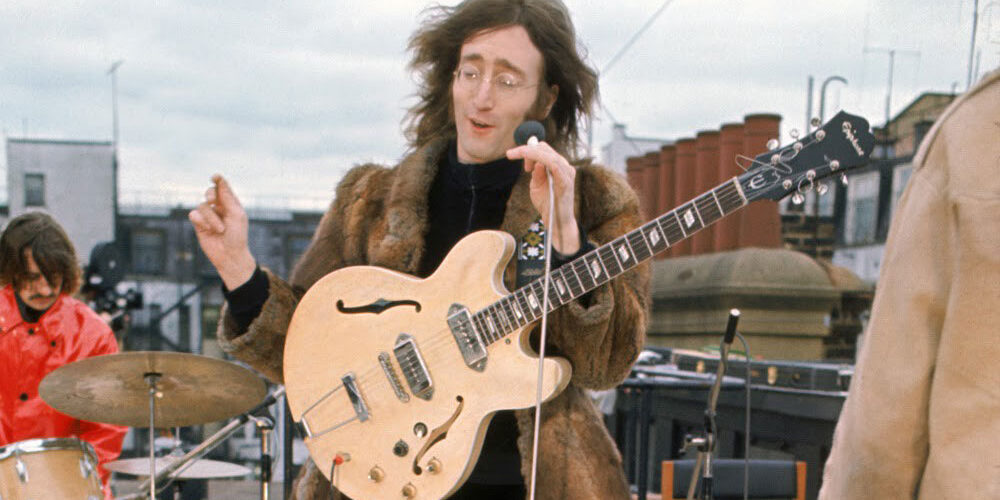
The Epiphone Casino: Lennon’s most important later guitar
The Epiphone Casino became one of John Lennon’s most important guitars during The Beatles’ studio years. Lennon, McCartney, and George Harrison each used Casino guitars after the band moved toward a more experimental sound.
The Casino is a fully hollow electric guitar. It has a thin body, two P-90 pickups, and a lively acoustic response. Unlike a solid-body guitar, it can sound open and airy. It can also produce controlled feedback at high volume.
Lennon used a sunburst Epiphone Casino during the Revolver, Sgt. Pepper, Magical Mystery Tour, White Album, and Abbey Road periods. He later stripped the finish from the guitar, leaving a more natural appearance.
The Casino suited Lennon’s changing role in the band. During the early years, he was known mainly for rhythm guitar. Later, he used more aggressive tones, unusual textures, feedback, and lead parts. The Casino could handle all of these jobs.
Its P-90 pickups gave Lennon a thicker sound than the Rickenbacker. The tone could be clean and bright, but it could also become gritty when connected to a loud amplifier.
The Casino is especially important when answering what guitar did John Lennon play after the early Beatles years. The Rickenbacker defined his early image, but the Epiphone Casino became a major tool for his mature studio sound.
Why Lennon removed the finish
Lennon and Harrison both removed the finishes from their Casinos. The change was partly visual, but it also reduced the weight of the instruments.
Removing a finish does not automatically make a guitar sound better. The final tone depends on the wood, pickups, bridge, strings, amplifier, and playing technique. Still, the stripped Casino became strongly associated with Lennon’s late Beatles period.
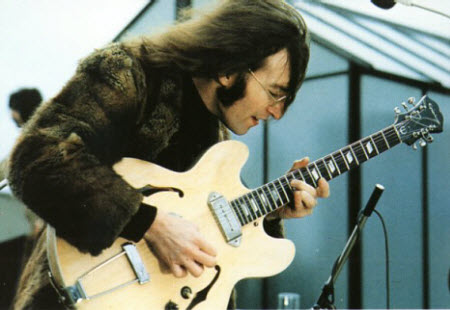
John Lennon’s Gibson J-160E acoustic guitar
John Lennon also played a Gibson J-160E, an acoustic electric guitar. This model had a spruce top, a round sound hole, a short-scale design, and a magnetic pickup mounted near the neck.
Lennon and Harrison each acquired Gibson J-160E guitars in 1962. These instruments were used for songwriting, recording, and live performances.
The Gibson J-160E helped create the acoustic sound heard on many early Beatles recordings. It was not simply a quiet acoustic guitar. Its pickup allowed Lennon to plug it into an amplifier and blend it with the band’s electric instruments.
This guitar was valuable in the studio because it could sound focused and direct. A microphone captured the natural body sound, while the pickup added a sharper electric edge. Engineers could then mix the two sounds to create more depth.
When researching what guitar did John Lennon play on acoustic Beatles songs, the Gibson J-160E is often the most important answer. It helped provide the rhythmic pulse behind several classic recordings.
The guitar also shows why identifying an instrument by appearance can be difficult. A Gibson J-160E may look like a standard acoustic guitar in a photograph, but its built-in pickup gives it a very different recording role.
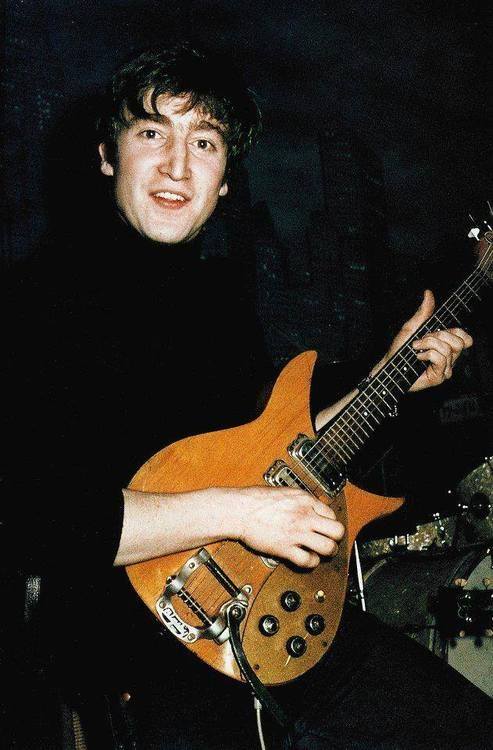
Other guitars John Lennon used
Lennon played more guitars than the Rickenbacker 325, Epiphone Casino, and Gibson J-160E. Some instruments were used for specific songs, studio effects, or visual reasons.
Important examples include:
Framus Hootenanny 12-string
Lennon used a Framus Hootenanny twelve-string acoustic guitar during the Beatles period. The instrument produced a bright, jangling sound and was useful for layered acoustic parts.
Twelve-string guitars naturally create a wider tone because paired strings ring together. They can make simple chords sound rich without using heavy effects.
Rickenbacker 325/12
The twelve-string Rickenbacker gave Lennon another way to create a ringing electric sound. It was not used as often as his main six-string 325, but it remains part of his documented guitar collection.
Fender Bass VI
Lennon was also seen using a Fender Bass VI in the studio. This instrument looks like a guitar but is tuned one octave below a standard guitar. It can fill the space between a guitar and a bass.
The Bass VI was useful for unusual low parts and studio experiments. It should not be confused with Paul McCartney’s regular bass guitars.
Gibson Les Paul
Lennon owned and used a Gibson Les Paul at times, although it was not as closely connected to his Beatles identity as the Rickenbacker or Casino. The Les Paul offered a thicker, more sustained sound because of its solid body and humbucking pickups.
These examples show that the answer to what guitar did John Lennon play is not limited to one model. His guitar choices changed as his music became more varied.
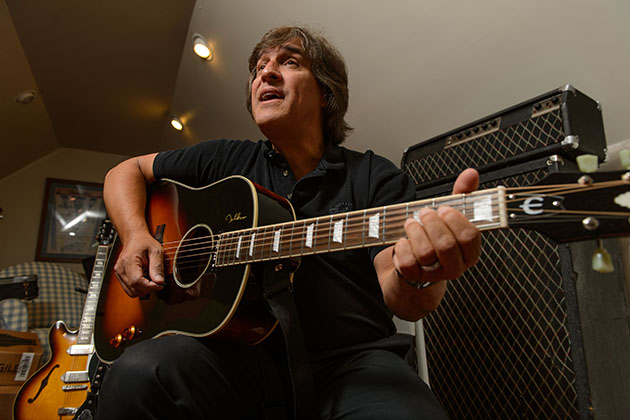
How John Lennon used his guitars
Lennon’s guitar work was built around rhythm, timing, and song structure. He did not need complex solos to make a part memorable. His strength came from choosing the right chord shape, attack, and tone.
His main approaches included:
• Strong downstrokes that supported the beat
• Open chords with clear changes
• Short rhythmic patterns between vocal lines
• Double-tracked acoustic parts
• Controlled feedback on the Epiphone Casino
• Bright electric tones that cut through the band
Lennon often treated the guitar like a second drummer. His strumming helped define the feel of a song, much like a snare drum helps define a groove.
That approach is useful for modern players. A rhythm guitar part does not need to be busy. It needs to support the vocal, leave space for other instruments, and make the beat feel strong.
A common mistake is to copy Lennon’s guitar model but ignore his technique. A Rickenbacker will not automatically produce a Beatles sound. The player’s attack, chord voicings, amplifier settings, and timing matter just as much.
A practical exercise is to play a simple song with only downstrokes. Keep the wrist loose and focus on even timing. Then add light upstrokes without changing the tempo. This teaches the controlled rhythm that made Lennon’s playing so effective.

What amplifiers and effects shaped Lennon’s sound?
Lennon’s guitars were only one part of his sound. He also used British amplifiers, including Vox models, during The Beatles’ live and studio years.
Vox amplifiers helped produce the bright, slightly compressed sound heard in early Beatles performances. At higher volume, the Epiphone Casino could create natural feedback and controlled distortion.
Lennon’s sound was generally less effect-heavy than many modern guitar tones. His core setup often depended on:
• A bright electric guitar
• A clean or slightly overdriven amplifier
• Firm pick attack
• Moderate treble
• Clear midrange
• Natural amplifier compression
The right settings depend on the guitar and amplifier. A modern Casino with P-90 pickups may sound more powerful than Lennon’s original setup. A Rickenbacker may also have different pickups and wiring from the vintage models.
To approach the early Lennon tone, start with a clean amplifier. Set the treble high enough for clarity, keep the bass controlled, and add only a small amount of overdrive. Let your hands create the attack instead of relying on heavy distortion.
For the later Casino sound, increase the amplifier gain and play closer to the bridge for a sharper tone. Move toward the neck for a rounder sound. Use feedback carefully, and always control the volume before standing close to the speaker.
How to choose a John Lennon-style guitar today
If you want to play like Lennon, choose a guitar based on the period and tone you enjoy.
Choose a Rickenbacker 325-style guitar for early Beatles sounds
This type of guitar suits bright rhythm parts, short-scale comfort, and classic British pop tones. It is a good choice for players who enjoy compact bodies and clear chord work.
A Rickenbacker 325-style model may feel unusual at first. Its short scale and narrow neck can take time to adjust to. Try one before buying if possible.
Choose an Epiphone Casino for later Beatles sounds
The Casino is the better match for Lennon’s later electric tone. Its hollow body and P-90 pickups work well for rhythm, blues, rock, and feedback-based textures.
A standard Casino can be more affordable than a high-end vintage-style model. Check the neck, fret condition, bridge stability, and electronics before buying a used guitar.
Choose a Gibson J-160E-style guitar for acoustic Beatles parts
This option works well if you want an acoustic guitar with a built-in electric voice. It can cover songwriting, recording, and amplified rhythm work.
Do not expect every J-160E-style guitar to sound identical. Body construction, pickup design, strings, and amplification all affect the result.
Before choosing, ask yourself:
-
Do I want a bright electric tone or a warm acoustic tone?
-
Will I play mostly at home, on stage, or in a studio?
-
Do I prefer a short neck or a full-scale neck?
-
Can I manage the feedback of a hollow-body guitar?
-
Is vintage appearance more important than modern reliability?
The best guitar is the one that encourages you to play. A less expensive model with a comfortable neck can be more useful than a costly replica that stays in its case.
Common mistakes when copying John Lennon’s guitar sound
Many players make the same mistakes when trying to recreate Lennon’s tone. The first is assuming that the guitar alone creates the sound.
Another mistake is using too much distortion. Lennon’s rhythm tone often had space and definition. Excess gain can blur the chords and remove the clean attack that makes the part work.
Players also tend to overlook strings. Fresh strings can add brightness, while older strings may produce a softer and darker sound. Medium or light-gauge strings can change the feel of a short-scale guitar.
Avoid copying Lennon’s setup without considering your own playing environment. A loud hollow-body guitar may feed back in a small room. A bright Rickenbacker tone may also sound harsh through an amplifier with too much treble.
The most useful lessons are simple:
• Learn the rhythm part before chasing the exact tone.
• Use moderate gain.
• Keep the picking hand relaxed.
• Listen to the full band arrangement.
• Test your sound at the volume you will actually use.
• Choose comfort and reliability over celebrity branding.
When studying what guitar did John Lennon play, it helps to separate historical accuracy from practical use. A faithful replica may be exciting, but a comfortable modern guitar may help you make better music.
Frequently Asked Questions About What Guitar Did John Lennon Play
What was John Lennon’s main guitar?
John Lennon’s best-known early guitar was a Rickenbacker 325 Capri. In the later Beatles years, his Epiphone Casino became one of his most important electric guitars.
Did John Lennon play an Epiphone Casino?
Yes. Lennon played an Epiphone Casino during much of The Beatles’ studio period. Its hollow body and P-90 pickups helped create his thicker, more aggressive electric guitar sound.
What acoustic guitar did John Lennon play?
Lennon commonly played a Gibson J-160E acoustic electric guitar. He also used a Framus Hootenanny twelve-string for selected acoustic parts.
Did John Lennon play a Rickenbacker?
Yes. He famously played a Rickenbacker 325, including a 1958 325 Capri. He also used a Rickenbacker twelve-string model.
What guitar did John Lennon use on “Revolution”?
Lennon used his Epiphone Casino for the distorted guitar sound associated with “Revolution.” The guitar’s hollow body and P-90 pickups responded well to the loud, aggressive amplifier tone.
Was John Lennon a lead guitarist?
Lennon was primarily known as a rhythm guitarist, but he also played lead parts and experimental guitar textures. His value came from strong timing, memorable chord work, and arrangements that served the song.
Is the John Lennon Rickenbacker 325 easy to play?
Its short scale can feel comfortable, but the compact body and narrow neck may feel unusual. Players should try the design first because comfort depends on hand size and playing style.
Conclusion
John Lennon played many guitars, but three stand out: the Rickenbacker 325, the Epiphone Casino, and the Gibson J-160E. The Rickenbacker shaped his early Beatles image, the Casino powered his later electric sound, and the Gibson acoustic helped define important rhythm parts.
The deeper lesson is that Lennon’s sound came from the complete setup. Guitar choice mattered, but so did timing, touch, chord selection, amplifier volume, and restraint. Start with the style you want to play, choose a comfortable instrument, and build the tone with your hands before adding effects.
Explore recordings from each Beatles era, compare the guitar sounds, and try the rhythm parts yourself. Share your favorite Lennon guitar or explore more classic guitar guides to keep developing your playing.

Senior Music Reviewer
Alex Carter is a seasoned music reviewer with over a decade of experience in the world of sound and instruments. Passionate about helping musicians and enthusiasts make informed choices, he brings sharp insights and in-depth knowledge to every review. From classical instruments to modern gear, Alex combines technical expertise with a love for music to deliver content that resonates with readers.
As a Senior Music Reviewer and expert author on Tuneluma.com, Alex is dedicated to sharing honest evaluations, practical advice, and thoughtful commentary to guide readers in their musical journey.