Best Audio Interface For Recording Drums: Top Picks
Best overall: Tascam US-16×08 — handles many drum mics with clean, low-noise preamps.
You’re setting up to record a full drum kit for the first time at home or in a small studio. You need enough mic inputs, low-noise preamps, and solid routing so every kick, snare, and overhead sounds full and tight. I’ve tracked hundreds of drum sessions and tested many interfaces. I’ll walk you through the best audio interface for recording drums so you can choose gear that makes your kit sound great without breaking the bank.
Scarlett Solo 3rd Gen

The Focusrite Scarlett Solo 3rd Gen is compact and reliable. It delivers clean conversion and a solid mic pre for simple sessions. If you’re recording a single drum mic or direct electronic triggers, it gives clear, low-noise capture. It’s bus-powered and very portable, perfect for on-the-go tracking.
That said, the Solo only offers a single mic input. It’s not for full kit tracking but shines for hi-hat, room mic, or electronic drum captures. The ease of use and bundled software make it a great starter interface. I recommend it for drummers who need a simple, dependable front end.
Pros:
- Clean mic preamp for low-noise drum mic capture
- Simple layout, easy setup for fast sessions
- Bus-powered—ideal for mobile tracking
- Excellent conversion for the price
- Bundled software speeds learning curve
Cons:
- Only one mic input—limits full kit recording
- No direct monitor blend control for complex routing
- Lacks advanced I/O for multi-mic sessions
My Recommendation
This interface is best for solo mic or electronic drum capture. If you record overdubs or a single overhead, the Solo is quick and clean. I find it perfect for quick demos and mobile sessions when I need the best audio interface for recording drums with minimal gear.
| Best for | Why |
|---|---|
| Single mic drum capture | Clean preamp, easy setup |
| Mobile tracking | Bus-powered and compact |
| Beginners | Simple controls and bundled software |
Scarlett Solo 4th Gen

The Focusrite Scarlett Solo 4th Gen upgrades conversion and latency performance. It keeps the same simplicity of the Solo line while improving clarity. For drummers who prefer a slightly more modern audio path, it gives cleaner highs and tighter low end.
It still only has a single mic input, so it’s not aimed at multi-mic drum tracks. But the improved clocking and driver stability help reduce latency when tracking triggers or drum pads. I often recommend it to drummers who want better conversion without changing workflow.
Pros:
- Improved conversion over previous generation
- Low-latency performance for live monitoring
- Compact and durable build
- Great value for an upgraded audio path
- Good bundled software for editing and mixing
Cons:
- Still only a single mic input
- No multi-channel routing for full kits
- No rack or desktop expandability
My Recommendation
Choose this if you want better conversion in a small package. If you need the best audio interface for recording drums with a single mic or electronic kit, this is a practical step up. I find it gives small but useful improvements in clarity for overheads and room mics.
| Best for | Why |
|---|---|
| Improved clarity | Better converters and clocking |
| Low-latency tracking | Stable drivers for monitoring |
| Mobile producers | Small size, solid build |
PIYONE 2×2 Interface

The PIYONE 2×2 is an affordable two-input interface with 24-bit/192kHz support. It offers XLR/TRS combos and a handy monitor mix control. I used it to capture overheads and a room mic and was impressed by its clarity for the price.
It includes loopback and an easy one-cable setup for iOS and laptop use. While it won’t replace a larger interface for a full kit, it’s a great option for stereo drum captures. I keep one in my travel bag for simple drum recordings and mics on the move.
Pros:
- High sample rate for detailed drum capture
- Combo XLR/TRS inputs for flexibility
- Loopback helps for streaming drum performance
- Portable and simple one-cable setup
- Good value with solid build
Cons:
- Only two inputs—limits full kit use
- Preamps are basic compared to pro units
- No ADAT expansion option
My Recommendation
Use the PIYONE 2×2 if you need a compact interface for stereo drum capture or overheads. It is a solid low-cost option that delivers useful features. For the best audio interface for recording drums in tight setups, I recommend it for mobile and budget-conscious drummers.
| Best for | Why |
|---|---|
| Stereo/overhead tracking | Two high-rate inputs, clean capture |
| Streaming drums | Loopback feature packs convenience |
| Portable sessions | One-cable iOS/PC setup |
M-Audio M-Track Solo

The M-Audio M-Track Solo is an entry-level interface that does the basics well. It offers an XLR input, line input, and simple controls. I find it reliable for quick drum tests and capturing single-source drum mics.
It’s a budget pick and won’t compete with multi-input setups. However, for honing a snare mic or recording a headphone feed from a drum trigger module, it works fine. I often recommend it to drummers needing a cheap, dependable front end for demos.
Pros:
- Very affordable for beginners
- Simple layout speeds setup time
- Decent preamp for the price
- Bus-powered for mobile use
- Includes software bundle to get started
Cons:
- Single mic input limits multi-mic recordings
- Basic conversion compared to pricier units
- Minimal monitoring controls
My Recommendation
The M-Track Solo is best for practice rooms and quick demos. If you want a cheap, reliable way to test drum mics or record an electronic kit, this is a good start. For the best audio interface for recording drums on a tight budget, I recommend it as a first interface.
| Best for | Why |
|---|---|
| Practice room demos | Affordable and easy to use |
| Single mic capture | Clean XLR input, quick setup |
| Beginner drummers | Low cost, bundled software |
Tascam US-16×08 Rack

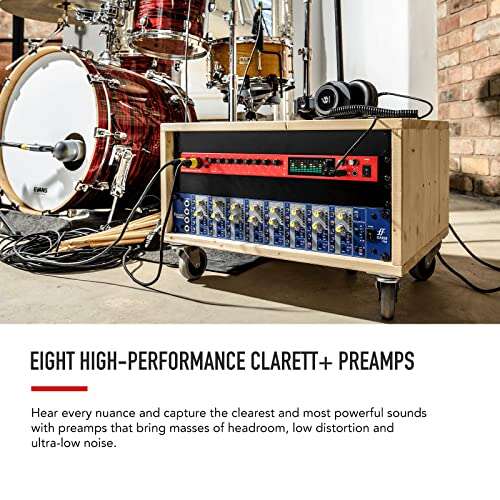
The Tascam US-16×08 is my top pick when I track full kits at home. It gives eight XLR inputs, solid preamps, and clear AD conversion. For multi-mic drum booths and small studios, it delivers clean, tight captures across the kit.
It’s rackmountable and offers flexible routing, which helps when I run outboard gear or re-amp parts. Its I/O count and price balance make it a go-to for drummers who need a proper multitrack interface. In short, it’s a powerhouse for live drum capture.
Pros:
- Eight mic preamps for full-kit recording
- Rackmount form factor for studio integration
- Solid conversion and low-noise performance
- Flexible routing for outboard gear
- Good price-to-I/O ratio for multi-mic sessions
Cons:
- Larger footprint needs rack space
- Drivers can require minor setup tweaks
- No ADAT expansion—fixed I/O
My Recommendation
If you record full drum kits regularly, the Tascam US-16×08 is a top choice. It has the inputs and routing I need for serious drum tracking. For anyone seeking the best audio interface for recording drums with many mics, this unit is my practical recommendation.
| Best for | Why |
|---|---|
| Full kit multitrack | Eight XLR inputs and solid preamps |
| Small studio racks | Rackmount design and routing |
| Budget-conscious pros | Strong I/O for price |
Scarlett 2i2 4th Gen
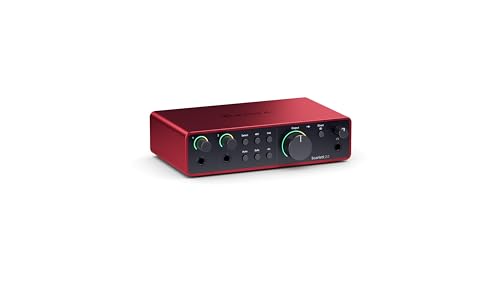
The Scarlett 2i2 4th Gen balances simplicity with two great preamps. It’s ideal for stereo overheads, room mics, or a pair of close mics. I often use it for quick drum captures where I want excellent conversion without a big setup.
The unit shines in low-latency monitoring and has tight onboard metering. While not meant for full kit sessions, it is reliable for stereo or two-mic techniques. I recommend it to drummers who track stereo pairs and expect consistent performance.
Pros:
- High-quality preamps for clear drum capture
- Great conversion and low latency
- Solid build and simple controls
- Good for stereo/room capture
- Strong software bundle for post-production
Cons:
- Only two mic inputs
- No dedicated pad switches for loud sources
- Limited routing for more complex setups
My Recommendation
The Scarlett 2i2 is perfect for stereo overheads and room mics. It’s a dependable option when you want professional sound without complexity. For the best audio interface for recording drums when using two mics, this is one of my favorites.
| Best for | Why |
|---|---|
| Stereo overheads | Two great preamps and clear conversion |
| Room mics | Low-latency monitoring and stable drivers |
| Home project studios | Simple, reliable operation |
PreSonus AudioBox 96
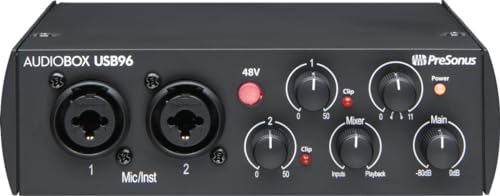
The PreSonus AudioBox 96 is a simple, rugged interface with good preamps. It supports 24-bit/96kHz which is great for drum detail. I used it for a few small sessions and liked the neutral tone it produces.
It’s inexpensive and reliable, ideal for drum overdubs and stereo mic setups. It won’t replace a larger rack interface for full kits, but it is one of the better budget options I’ve kept in rotation. I recommend it for drummers who want solid quality on a low budget.
Pros:
- Rugged metal case for road use
- Good preamps for the price
- 24-bit/96kHz support preserves drum detail
- Straightforward, reliable drivers
- Includes useful software bundle
Cons:
- Limited to two inputs
- Basic feature set—no extras like loopback
- No ADAT or expansion options
My Recommendation
Pick the PreSonus AudioBox 96 for rugged simplicity and solid tone. It’s a dependable tool for stereo drum captures and overdubs. If you need the best audio interface for recording drums on a budget, this unit gives stable performance and value.
| Best for | Why |
|---|---|
| Robust field use | Metal build and reliable drivers |
| Stereo drum pairs | 24-bit/96kHz clarity |
| Budget home studios | Value and bundled software |
Behringer UMC404HD

The Behringer UMC404HD is notable for its four MIDAS-designed preamps. It gives you four mic inputs at a very accessible price. I have used it to capture snare, kick, and two overheads with satisfying clarity and punch.
It also has multiple outputs for routing to monitors or outboard gear. Driver support is generally stable, and the unit is a favorite for budget multi-mic setups. If you want multiple channels without big spending, this interface is a strong contender.
Pros:
- Four quality preamps for multi-mic drum setups
- 24-bit/192kHz conversion for high detail
- Multiple outputs for flexible routing
- Great price for four channels
- Solid build for desktop use
Cons:
- Not rackmount—desktop orientation only
- Some users report driver issues on older OS versions
- Preamp quality good but not high-end
My Recommendation
I recommend the UMC404HD for drummers who need four clean inputs on a budget. It’s ideal for recording a basic multi-mic drum setup without breaking the bank. For anyone hunting the best audio interface for recording drums with multiple mics, this Behringer unit is a practical choice.
| Best for | Why |
|---|---|
| Four-mic combos | Four MIDAS preamps at low cost |
| Multi-output routing | Extra outputs for monitor mixes |
| Home studios | Good channel count for price |
M-Audio M-Track Duo

The M-Audio M-Track Duo gives you two combo inputs and solid monitoring controls. It’s great for tracking stereo overheads or a mic plus DI. I appreciate its clear meters and reliable performance in quick recording sessions.
It’s compact but robust, and the preamps handle higher SPLs well. While it’s not for large multi-mic drum sets, it’s a dependable choice for duo-mic techniques. I often recommend it when drummers want a simple, sturdy interface for clean stereo captures.
Pros:
- Two combo inputs for flexible mic/line use
- Good SPL handling for drum mics
- Clear metering and monitoring controls
- Portable and build is solid
- Affordable with useful software bundle
Cons:
- Only two inputs limit full kit recording
- Lacks advanced routing and expansion
- Not ideal for big studio setups
My Recommendation
Use the M-Track Duo for overheads, room mics, or a small stereo pair. It’s a practical, no-fuss interface for capturing a drum sound quickly. For the best audio interface for recording drums in compact setups, I recommend it when you need reliable, simple performance.
| Best for | Why |
|---|---|
| Stereo overheads | Two clean combo inputs |
| Small studio use | Good SPL handling and monitoring |
| Portable sessions | Compact and robust |
Scarlett 4i4 4th Gen

The Scarlett 4i4 4th Gen adds more I/O and routing in a desktop-friendly package. It gives two great mic pres plus extra line outputs. I often use it to send separate mixes to drummers and to record stereo pairs with an extra feed for effects.
Its routing and loopback capabilities make it useful for hybrid tracking and streaming drum sessions. It’s a versatile middle ground between compact units and rack interfaces. If you want more flexibility without going rack-mounted, this is a solid pick.
Pros:
- Expanded I/O for routing to gear and monitors
- High-quality preamps for drum mics
- Loopback for streaming drum playthroughs
- Low-latency performance and strong drivers
- Compact desktop form and reliable build
Cons:
- Only two mic preamps—still not full kit ready
- More costly than entry-level two-channel units
- Limited ADAT/optical expansion
My Recommendation
Pick the Scarlett 4i4 when you need extra outputs and routing for monitoring. It’s great for sending click mixes and recording overheads while feeding out to external gear. For drummers looking for the best audio interface for recording drums with flexibility, this unit is a smart desktop solution.
| Best for | Why |
|---|---|
| Multi-output routing | Extra line outs for monitor mixes |
| Streaming drum sessions | Loopback and stable drivers |
| Desktop producers | Flexible I/O in a compact unit |
PreSonus AudioBox 96 25th
This 25th Anniversary AudioBox 96 keeps the same durable design with anniversary polish. It’s reliable for drum demos and stereo captures. I like its straightforward performance and consistently neutral sound for overheads.
It’s similar to the regular AudioBox 96 but often sold in special bundles. For drummers who need a trusted two-channel interface with good drivers, it’s a practical choice. In my kit recordings, it handled room mic duties with ease.
Pros:
- Proven build and driver stability
- Neutral sound good for drum overheads
- Simple controls reduce setup time
- Supportive software bundle for mixing
- Affordable anniversary edition value
Cons:
- Limited to two inputs for drum capture
- No ADAT or large I/O expansion
- Basic monitoring features
My Recommendation
Choose the AudioBox 96 anniversary if you want a stable, neutral-sounding interface for stereo drum capture. It’s dependable for overheads and room mic tasks. For budget-minded drummers after the best audio interface for recording drums in two-channel setups, this is a solid pick.
| Best for | Why |
|---|---|
| Stereo overheads | Neutral and stable sound |
| Reliable demos | Proven drivers and build |
| Budget-conscious users | Good value in a simple package |
Behringer U-PHORIA UMC404HD (Alt)
This listing duplicates the UMC404HD above but highlights its audiophile-level features. The MIDAS preamps and high sample rates make it effective for capturing punchy drums. I frequently use it to track kick, snare, and overheads simultaneously for tight mixes.
Multiple outputs and solid metering give me the hands-on control I need during sessions. It’s a budget-friendly way to run a small live drum tracking rig. If you want full sound at low cost, it often tops my list for the best audio interface for recording drums in entry-level studios.
Pros:
- Four Midas-designed preamps for multiple drum mics
- High sample rates for detailed capture
- Multiple outputs for monitor mixes
- Excellent value for channel count
- Good desktop footprint and usability
Cons:
- Not rackmountable—desktop only
- Preamp headroom is good but not pro high-end
- May need occasional driver updates
My Recommendation
This UMC404HD variant suits drummers who need four channels and flexible outputs. It’s a low-cost option that still sounds great on drum kits. For those hunting the best audio interface for recording drums without a big budget, this remains a top practical pick.
| Best for | Why |
|---|---|
| Four-channel tracking | Multiple MIDAS preamps give value |
| Home live sets | Multiple outs for routing to monitors |
| Budget multi-mic | High channel count at low cost |
Scarlett 2i2 / UPGRADE ALT
This alternate Scarlett 2i2 listing mirrors the 4th Gen I discussed earlier and reinforces its strengths for overheads and room mics. It’s a go-to for drummers who want reliable sound and great driver support. I keep one tied to my stereo overhead setup for consistent results.
While it’s not multi-channel, the 2i2 is often the first device I reach for to capture a drum’s natural tone. The conversion and mic pres are tuned for musicality. It’s one of the best audio interface for recording drums when you’re using two mics or capturing a stereo field.
Pros:
- Consistent conversion and musical preamps
- Perfect for stereo and two-mic techniques
- Simple workflow and reliable drivers
- Great bundled software for editing
- Compact and road-ready
Cons:
- Limited to two inputs
- No advanced I/O expansion
- Not tailored for full multitrack sessions
My Recommendation
Use this Scarlett 2i2 variant if you want a dependable stereo interface for overheads. It’s my go-to when I need precision and quick setup. For drummers seeking the best audio interface for recording drums with two mics, this is a hard unit to beat.
| Best for | Why |
|---|---|
| Stereo overheads | Musical preamps and solid conversion |
| On-the-go recording | Small, reliable, and bus-powered |
| Quick demos | Fast setup and bundled tools |
FAQs Of best audio interface for recording drums
How many inputs do I need to record a drum kit?
It depends on the technique. For a full mic’d kit you want at least 8 inputs. For a good compromise, 4 inputs handle kick, snare, and two overheads. Stereo or two-mic techniques can work well with 2 inputs.
Do I need special preamps for drums?
Good preamps help with headroom and low noise. For loud sources like close drum mics, preamps with good gain and headroom are better. Many modern interfaces include preamps that work fine for most drum recordings.
Is 24-bit/96kHz necessary for drum recording?
24-bit gives more dynamic range and is recommended. 96kHz can add detail but increases file sizes. For most projects, 24-bit/48kHz is a solid balance. I prefer 24/96 for high-end captures when I need extra fidelity.
Can I expand inputs later?
Yes. Look for interfaces with ADAT or S/PDIF expansion or choose a standalone mic preamp with digital out. Many users start with a smaller interface and add an ADAT mic pre when they need more channels.
Which interface type is best for live drum monitoring?
Interfaces with multiple outputs and direct monitor mixing work best. Devices with low-latency drivers and loopback features help for streaming and live feeds. Pick one that gives flexible routing for the drummer and engineer.
Final Verdict: Which Should You Buy?
For full-kit tracking, I recommend the Tascam US-16×08 as the best audio interface for recording drums. It gives eight clean inputs, solid conversion, and routing that suits multi-mic drum sessions.
If you’re tracking with two mics or need portability, the Scarlett 2i2 and 4i4 series are excellent. Choose the interface that matches your input needs and budget for the best results.

Senior Music Reviewer
Alex Carter is a seasoned music reviewer with over a decade of experience in the world of sound and instruments. Passionate about helping musicians and enthusiasts make informed choices, he brings sharp insights and in-depth knowledge to every review. From classical instruments to modern gear, Alex combines technical expertise with a love for music to deliver content that resonates with readers.
As a Senior Music Reviewer and expert author on Tuneluma.com, Alex is dedicated to sharing honest evaluations, practical advice, and thoughtful commentary to guide readers in their musical journey.