A Sharp Chord On Guitar: Easy Shapes And Tips
An A-sharp guitar chord uses A-sharp as its root and often appears as a movable barre shape.
Learning a sharp chord on guitar can feel harder than learning open chords, but the theory is simple once you understand barre shapes, enharmonic notes, and clean fretboard movement. This guide explains the most useful A-sharp chord shapes, how to play them, when to use A-sharp instead of B-flat, and how to avoid common mistakes.
What Is an A-Sharp Chord on Guitar?
A sharp chord on guitar is a chord built from a note raised by one half step. A-sharp, written as A#, is one semitone above A and one semitone below B.
The phrase “A-sharp chord” may describe several chord types, including:
• A# major
• A# minor
• A#7
• A#maj7
• A#sus4
• A# diminished
• A# augmented
The chord quality changes the other notes, but A# remains the root. Think of the root as the chord’s home base. Every other note helps define the chord’s mood.
A# major contains A#, C##, and E#. On guitar, musicians usually call these notes B, D, and F because A# major sounds the same as B-flat major. This spelling difference is called enharmonic equivalence.
In practical guitar charts, you will often see B♭ instead of A#. That does not mean the sound changes. It means the chord is written in a way that is easier to read in many musical settings.

A-Sharp Major Chord Guitar Shapes
The most useful A# major chord shapes come from movable barre chords. Since A# does not use many convenient open strings, barre chords are usually the best option.
A# major using the sixth-string root
This shape is based on the E major form. Place your index finger across the sixth fret, then form an E major shape with your other fingers.
A# major

e|---6---
B|---6---
G|---7---
D|---8---
A|---8---
E|---6---
Chord formula:
6 8 8 7 6 6
The lowest note is A# on the sixth string, sixth fret. This makes the shape easy to move. Move it up one fret, and you have B major. Move it down two frets, and you have G major.
A# major using the fifth-string root
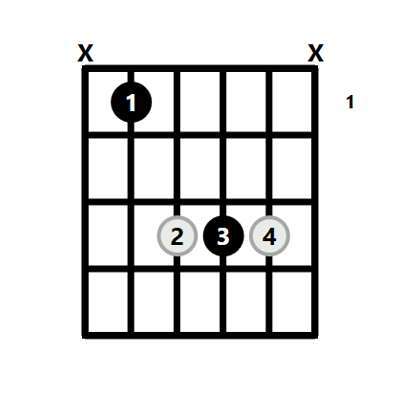
This shape comes from the open A major chord. Your index finger bars the first fret from the fifth string down, while your other fingers form the major shape.
A# major

e|---1---
B|---3---
G|---3---
D|---3---
A|---1---
E|---x---
Chord formula:
x 1 3 3 3 1
This version has a slightly lighter sound because the lowest string is not played. It works well when you want less bass or when the song already has a bass player.
How to make the A# major barre chord cleaner
Barre chords often buzz at first. That is normal. Use these steps:
- Place your thumb behind the neck.
- Keep your index finger close to the fret.
- Roll the index finger slightly toward its outer edge.
- Press only as hard as needed.
- Pick each string one at a time.
- Adjust any finger that blocks a note.
A common mistake is squeezing the neck with too much force. That can tire your hand and still produce a dull sound. A relaxed hand usually gives better control.

A-Sharp Minor Chord Guitar shapes
a# minor has a darker and more reflective sound than A# major. Its notes are A#, C#, and E.
The most common guitar shape uses the sixth-string root.
A# minor sixth-string shape
This form is based on the open E minor chord. Your index finger bars the sixth fret, while your other fingers create the minor shape.
A# minor

e|---6---
B|---6---
G|---6---
D|---8---
A|---8---
E|---6---
Chord formula:
6 8 8 6 6 6
This is one of the easiest ways to play a sharp chord on guitar once your barre technique improves. The shape moves to any fret without changing its structure.
A# minor fifth-string shape
You can also use the A minor barre form:
A# minor

e|---1---
B|---1---
G|---2---
D|---3---
A|---1---
E|---x---
Chord formula:
x 1 3 3 2 1
This shape can feel cramped because the first fret is close to the nut. If it feels uncomfortable, use the sixth-string shape higher on the neck or play the same chord as B-flat minor.
A personal practice tip
When I teach barre chords, I ask players to hold the shape without strumming first. They pick each string slowly and fix only the notes that buzz. This works better than strumming repeatedly and hoping the chord becomes clean.
Practice A# minor for 30 seconds, relax your hand, and repeat. Short practice blocks often build strength faster than one long session.
 shapes”
style=”max-width: 100%; height: auto; border: 2px solid black; border-radius: 10px; display: block; margin: 0 auto;”
loading=”lazy”
/>
A-Sharp 7 and Other Useful Chords
A# major and A# minor are the main shapes, but other chord types add color and movement.
A#7 guitar chord
A#7 has a bluesy, tense sound. It often leads to D# or D#7 in a progression.
A#7

e|---6---
B|---6---
G|---7---
D|---6---
A|---8---
E|---6---
Chord formula:
6 8 6 7 6 6
The dominant seventh sound creates tension. In many songs, that tension resolves into another chord.
A#maj7 guitar chord
A#maj7 sounds smooth and open. It is common in jazz, soul, pop, and R&B.
A movable version can be difficult at first, so many players use a partial shape:
A#maj7

e|---5---
B|---6---
G|---7---
D|---7---
A|---x---
E|---x---
Play only the top four strings. This gives a soft, clean sound without forcing your hand into a large barre.
A#sus4 guitar chord
A#sus4 replaces the third with a fourth. It sounds suspended, as if it wants to resolve back to A# major.
A#sus4

e|---6---
B|---6---
G|---8---
D|---8---
A|---8---
E|---6---
Move from A#sus4 to A# major to create a simple resolution. This sound appears in rock, worship music, folk, and pop.
A# diminished and augmented chords
A# diminished and A# augmented chords are less common in basic guitar songs. They are useful for passing movement and advanced harmony.
• A# diminished sounds tense and unstable.
• A# augmented sounds bright, wide, and unsettled.
• Both chords need careful voicing because each note affects the chord’s character.
Use a chord chart or notation when learning these shapes. Different voicings can produce very different results.

A-Sharp or B-Flat: Which Name Should You Use?
A# and B♭ are enharmonic equivalents. On a standard-tuned guitar, they use the same pitch, but the best name depends on the key and chord progression.
Use A# when:
• The song is written in a key that uses A#
• The chord movement clearly rises toward B
• The chart uses sharp symbols throughout
Use B♭ when:
• The song is in B-flat major or E-flat major
• The chart uses flats
• The chord name is easier for the player to read as B♭
For example, the A# major chord and B♭ major chord sound the same. However, B♭ major is usually the clearer choice in the key of F major.
This matters most when reading music, communicating with other musicians, or studying harmony. For casual guitar playing, choose the name that helps you understand the progression quickly.

How to Practice a Sharp Chord on Guitar
A sharp chord on guitar becomes much easier when you practice the hand movements instead of only repeating full songs.
Try this routine:
- Form the chord without strumming.
- Pick each string slowly.
- Fix muted or buzzing notes.
- Release your hand.
- Form the shape again.
- Strum down slowly.
- Switch to a nearby chord.
- Repeat the change for one minute.
Start with A# major and move to D# major. Then try A# minor and F# minor. These changes help you learn how movable shapes work across the fretboard.
You can also practice this progression:
A# major | D# major | F minor | C minor
Use a slow metronome at about 60 beats per minute. Change chords every four beats. Speed should come after accuracy.
Common mistakes to avoid
• Playing the low E string when using the fifth-string shape
• Placing the finger too far from the fret
• Pressing with the thumb instead of the whole hand
• Strumming before checking each note
• Practicing only one chord change
• Ignoring tension in the wrist or shoulder
If your hand hurts, stop and rest. Mild effort is normal, but sharp pain is a warning sign. Good technique should feel controlled, not forced.

How to Use A-Sharp Chords in Songs
A sharp chord on guitar can serve many roles. It may act as the main chord, a passing chord, or a dominant chord that leads somewhere else.