Introduction
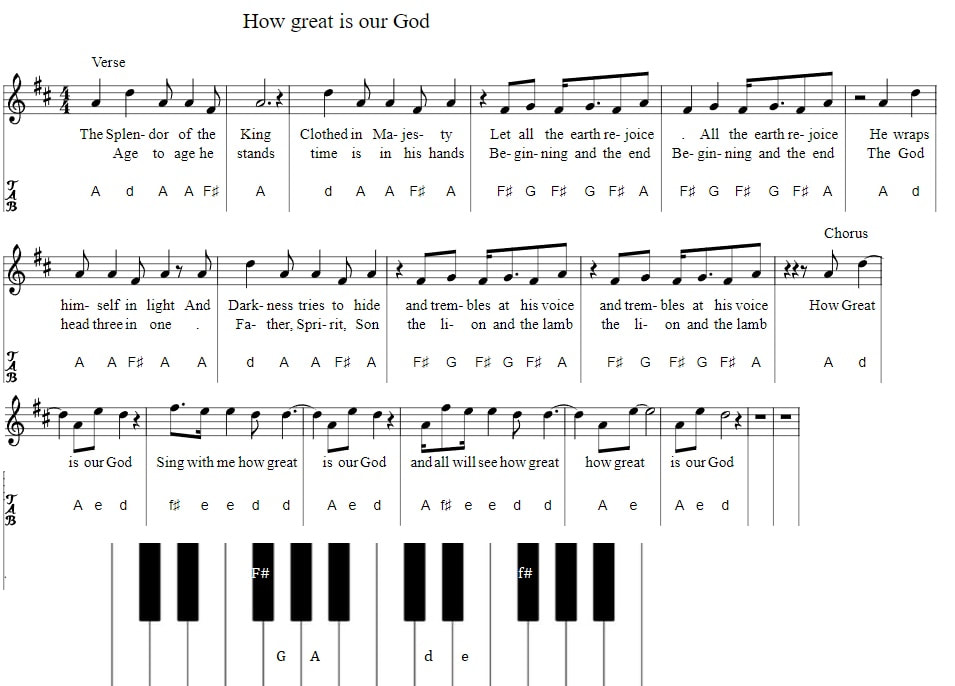
For pianists in the United States, “How Great Is Our God” is a common worship song in churches, youth groups, and home practice sessions. The song is easy to start but can sound rich when you use smooth chord changes, steady rhythm, and simple dynamics.
A beginner can play a useful version with four main chords: C, G, Am, and F. The guide below shows how to play the song on piano, how to choose a key, and how to make a basic arrangement sound more full without making it hard to play.

Quick Answer: What Chords Do You Need?
The easiest starting key is C major. In that key, the main chords are:
| Chord | Notes |
|---|---|
| C | C–E–G |
| G | G–B–D |
| Am | A–C–E |
| F | F–A–C |
Many simple piano charts use these chords in patterns such as:
- C–Am–G–F
- C–G–Am–F
- F–C–G–Am
The exact order can change by section and arrangement. A licensed chart should be your final source for the official structure, melody, and words. Chord websites may simplify the song or place it in a different key.
For a first practice version, use one chord per measure. Keep the rhythm even and let the melody or singer carry the song.
What “How Great Is Our God” Means for Piano Players
“How Great Is Our God” is a modern Christian worship song associated with American worship artist Chris Tomlin. It was released in the mid-2000s and became widely used in churches across the United States.
On piano, the song works well because its harmony is simple and familiar. The emotional effect comes less from complex chords and more from:
- A clear melody
- Smooth chord changes
- A steady pulse
- Gradual changes in volume
- Space between musical phrases
This makes the song useful for beginners. It also gives experienced players room to add richer voicings, passing chords, and a stronger worship-style arrangement.

How to Play the Basic Chords
Start with root-position triads. A triad is a three-note chord built from the root, third, and fifth.
C major
Play:
- Right hand: C–E–G
- Left hand: C
G major
Play:
- Right hand: G–B–D
- Left hand: G
A minor
Play:
- Right hand: A–C–E
- Left hand: A
F major
Play:
- Right hand: F–A–C
- Left hand: F
If large jumps feel hard, keep the right hand near the middle of the keyboard. The left hand can play only the root note at first.
Use inversions for smoother changes
An inversion changes the order of the notes but keeps the same chord. Inversions reduce hand movement.
Try these shapes:
| Chord | Easy right-hand shape |
|---|---|
| C | C–E–G |
| G | B–D–G |
| Am | A–C–E |
| F | A–C–F |
The right hand now moves only a short distance between many chords. This creates a smoother sound and helps the song feel calm and connected.

A Simple Piano Pattern for Beginners
The easiest pattern is to play one chord at the start of each measure.
Count:
1–2–3–4
Play the chord on beat 1, then let it ring. This works well when:
- You are still learning the chord changes.
- You are accompanying one singer.
- The song begins softly.
- You need time to learn the melody.
Once this feels easy, try playing the chord on beats 1 and 3. You can also repeat the chord on every beat with a light touch.
Basic four-beat pattern
use this pattern:
- Beat 1: Play the chord
- Beat 2: Hold
- Beat 3: Play the chord again
- Beat 4: Hold
Keep your wrist loose. Do not strike each chord too hard.
Broken-chord pattern
For a softer sound, play the notes one at a time:
- Beat 1: Bass note
- Beat 2: Third
- Beat 3: Fifth
- Beat 4: Third
For a C chord, this could be:
C–E–G–E
Repeat the same shape for each chord. This pattern works well during a quiet verse or prayerful section.
Eighth-note pattern
For a stronger section, count:
1 and 2 and 3 and 4 and
Play a light repeated pattern on the right hand while the left hand plays the root notes. Do not rush. A steady pulse matters more than speed.

How to Build a Full Piano Arrangement
A good worship piano arrangement usually grows in stages. You do not need to play every note from the first measure.
Intro
Begin with:
- Left-hand root notes
- Soft right-hand chords
- A slow broken-chord pattern
Leave space. A quiet intro gives the singer room to enter.
Verse
Use simple chords and a light touch. You can play:
- Root notes in the left hand
- Inverted triads in the right hand
- One chord per measure
- Little or no pedal at first
The verse should leave room for the vocal line.
Chorus
Add more energy by using:
- Octave roots in the left hand
- Fuller right-hand chords
- Chords on beats 1 and 3
- A wider dynamic range
Avoid playing so loudly that the singer must push to be heard.
Bridge or final section
Many worship arrangements grow near the final section. You can add:
- Octave bass notes
- Repeated eighth notes
- Higher chord tones
- Suspended chords
- A short instrumental fill between phrases
Build the sound in steps. Sudden volume changes can feel harsh, especially in a small church or home setting.

How to Use the Sustain Pedal
The sustain pedal can make the song sound warm, but too much pedal can blur the chords.
Use this basic method:
- Play the chord.
- Press the sustain pedal.
- Change to the next chord.
- Lift and press the pedal as the new chord begins.
This is called changing the pedal with the harmony. The goal is to connect the chords without mixing unrelated notes.
Use less pedal when:
- The song is fast.
- You are playing broken chords.
- The room has a lot of echo.
- The harmony sounds muddy.
Use more pedal when:
- You play a slow intro.
- You use wide chord shapes.
- The room is dry.
- You want a smooth, sustained sound.
A digital piano may respond differently from an acoustic piano. If the pedal feels too strong, check the instrument settings or use shorter pedal changes.
How to Choose the Best Key
The best key depends on the singer, not only on the pianist.
C major is often a useful starting key because it has no sharps or flats. However, a singer may need a higher or lower key.
| Key choice | When it may help |
|---|---|
| C major | Easy for beginners and simple charts |
| D major | May suit a higher vocal range |
| E major | Often useful for a bright, strong sound |
| G major | Comfortable for many guitar-based arrangements |
| A major | May fit some worship teams and singers |
| B-flat major | Can work well for a lower vocal range |
Do not change the key just because one key feels easier on piano. If the singer strains on high notes, lower the key. If the melody sounds too low, raise it.
Use a transpose function carefully
A digital keyboard can transpose the song without changing your finger shapes. This is useful for practice, but it can hide your understanding of the key.
Learn the chords in at least one real key. Then use transpose when:
- You need a fast change for a service.
- You are accompanying a singer.
- You are practicing with a recording in another key.
Write down the sounding key so the singer and other musicians know what they are hearing.

A Useful Roman Numeral View
Roman numerals show how chords relate to the key.
In C major:
- C = I
- Dm = ii
- Em = iii
- F = IV
- G = V
- Am = vi
- Bdim = vii°
The common chords in this song often center on I, IV, V, and vi. This helps you move the song to another key.
For example, the pattern C–G–Am–F is:
I–V–vi–IV
In G major, the same pattern becomes:
G–D–Em–C
The numbers stay the same even though the letter names change. This is one of the most useful ways to transpose worship music.

How to Add Better Chord Voicings
Once the basic triads feel easy, add notes with care.
Add the seventh
You can change some major chords to seventh chords:
- Cmaj7: C–E–G–B
- Fmaj7: F–A–C–E
- G7: G–B–D–F
- Am7: A–C–E–G
Seventh chords add color. Use them in quiet sections or transitions. They may sound too jazzy if used on every chord.
Use suspended chords
A suspended chord replaces the third with the second or fourth.
Examples:
- Csus2: C–D–G
- Csus4: C–F–G
- Gsus4: G–C–D
A suspended chord creates a feeling of motion. It often resolves back to the main chord.
For example:
Gsus4 → G
The note C moves down to B. Keep the change slow and clear.
Add the ninth
A ninth chord adds a note above the seventh:
- Cadd9: C–E–G–D
- Gadd9: G–B–D–A
- Fadd9: F–A–C–G
These chords can sound open and modern. They work well when the singer is not using the same added note in the melody.

Common Problems and Simple Fixes
The chords sound disconnected
Likely cause: Your hand jumps between root-position chords.
Fix: Use inversions. Keep common notes in place when you change chords.
The song sounds flat
Likely cause: You play every section at the same volume.
Fix: Start softly. Add notes, bass, and rhythm as the song develops.
The piano covers the singer
Likely cause: You are playing too many notes or using too much volume.
Fix: Reduce the left hand to single roots. Use lighter right-hand chords and leave space during vocal lines.
The pedal makes a blur
Likely cause: You hold the pedal through several chord changes.
Fix: Change the pedal with each new chord. Use less pedal in rooms with strong natural echo.
You lose the beat
Likely cause: The pattern is too complex for your current level.
Fix: Return to one chord on beat 1. Count out loud until the pulse feels stable.
The key does not fit the singer
Likely cause: You chose the key from the chart rather than from the vocal range.
Fix: Move the song up or down. Test the highest and lowest parts before the performance.
A 15-Minute Practice Plan
A short plan can produce better results than playing the whole song without focus.
Minutes 1–3: Learn the chords
Play C, G, Am, and F in root position. Say each chord name as you play it.
Minutes 4–6: Practice inversions
Move between the closest shapes. Keep your fingers relaxed and avoid large jumps.
Minutes 7–9: Add the left hand
Play single bass notes with the left hand. Keep the right-hand chords simple.
Minutes 10–12: Practice the rhythm
Use one chord per measure. Then try chords on beats 1 and 3.
Minutes 13–15: Practice dynamics
Play a quiet verse, a stronger chorus, and a soft ending. Record yourself if possible.
Listen for three things:
- Is the beat steady?
- Are the chord changes clean?
- Can a singer be heard?
Copyright and Chart Accuracy
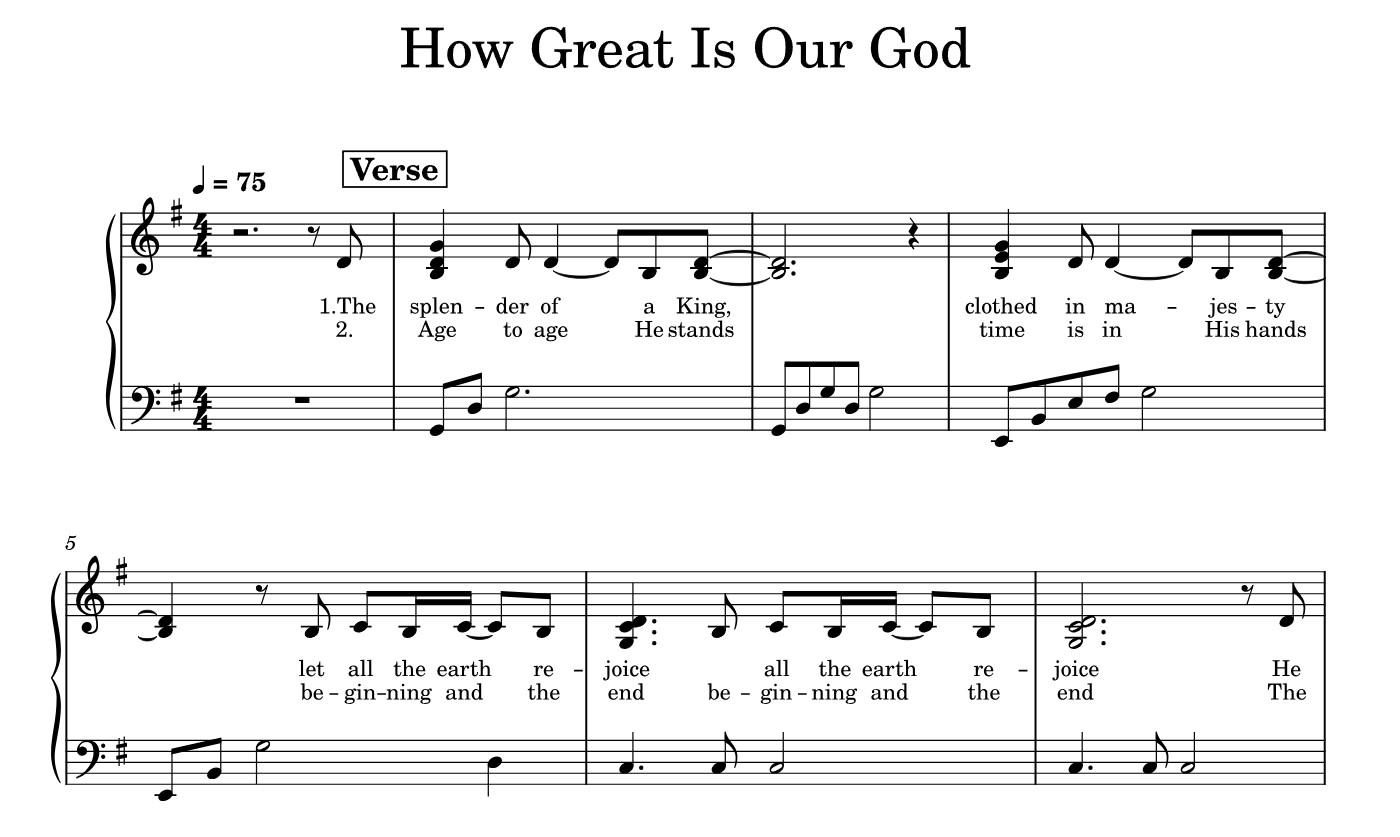
“How Great Is Our God” is a copyrighted song. Chord names and basic musical ideas are not a substitute for a licensed lead sheet or official arrangement.
For church use in the United States, the church or organization may need the correct license for projected lyrics, printed music, or recorded performance. Licensing needs can vary by use and organization.
Use a licensed chart when you need:
- The exact words
- The official melody
- The correct section order
- A specific recorded arrangement
- Permission to print or display the song
Online chord charts can help with practice, but they may contain errors, simplified changes, or user-created transpositions.

Frequently Asked Questions
Is “How Great Is Our God” easy to play on piano?
Yes. A beginner can start with four basic chords in C major: C, G, Am, and F. The main challenge is not the chord count. It is keeping a steady beat and changing chords without stopping.
What key is easiest for beginners?
C major is often the easiest because it uses only white keys. The easiest key for a singer may be different, so choose the key after checking the singer’s range.
Can I play the song with only my left hand?
You can play the root notes with your left hand, but the result will sound thin. Add simple right-hand triads when you feel ready.
Should I use the sustain pedal?
Yes, but change it with each chord. If the sound becomes muddy, use less pedal and lift it sooner.
Can I use the same chords for every section?
A simplified version may use a small set of repeated chords. However, the official arrangement can include different patterns, chord colors, and transitions. Check a licensed chart for exact details.
Key Takeaways
- Start in C major with C, G, Am, and F.
- Use inversions to make chord changes smoother.
- Begin with one chord per measure.
- Add rhythm and bass as the song grows.
- Keep the singer louder than the piano.
- Change the key to fit the singer.
- Use the sustain pedal with each chord change.
- Consult a licensed chart for the exact arrangement and authorized use.
Conclusion
The best way to learn “How Great Is Our God” on piano is to start small. Learn the four basic chords, keep a steady pulse, and use simple inversions. Then add bass notes, dynamics, pedal, and richer voicings one step at a time.
Your next action is simple: play C–G–Am–F slowly in four-beat measures. When you can change chords without stopping, try the same pattern with a light worship-style rhythm and adjust the key for the singer.
Suggested Sources
- Chris Tomlin — Official Website
- CCLI — Christian Copyright Licensing International
- SongSelect by CCLI
- Musicnotes — Licensed Digital Sheet Music
- Worship Together

Senior Music Reviewer
Alex Carter is a seasoned music reviewer with over a decade of experience in the world of sound and instruments. Passionate about helping musicians and enthusiasts make informed choices, he brings sharp insights and in-depth knowledge to every review. From classical instruments to modern gear, Alex combines technical expertise with a love for music to deliver content that resonates with readers.
As a Senior Music Reviewer and expert author on Tuneluma.com, Alex is dedicated to sharing honest evaluations, practical advice, and thoughtful commentary to guide readers in their musical journey.