Introduction
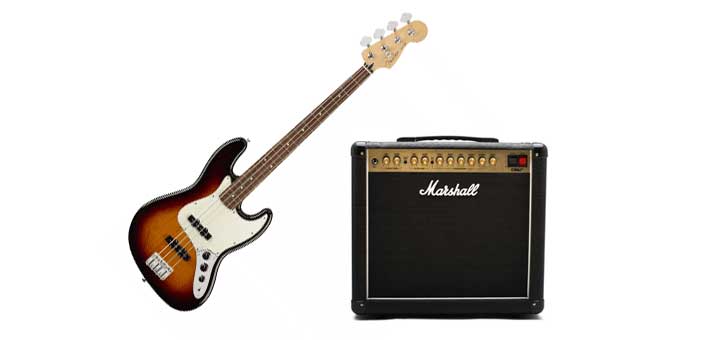
Yes, you can play a bass guitar through a guitar amp in the United States, but you should keep the volume low and avoid deep, heavy bass at high levels. A guitar amp will usually produce sound from a bass guitar, especially for quiet practice or short tests.
The main risk is the speaker. Most guitar amp speakers are built for the frequency range and movement of an electric guitar. Deep bass notes can make the speaker move too far. That may cause buzzing, distortion, or permanent speaker damage.
A guitar amp is fine for basic practice when used with care. For regular bass playing, a bass amp, powered speaker, audio interface, or headphone amp is the safer and better choice.

The short answer: Is it safe?
A bass guitar can safely plug into the input of most guitar amps at a low or moderate volume. The amp will amplify the signal, but the sound may be thin, distorted, or lacking in low-end power.
The risk rises when you:
- Turn the volume up high
- Use strong bass boost
- Play low notes for long periods
- Use an active bass with a hot output
- Push a small guitar speaker into heavy distortion
- Connect the wrong type of output or speaker load
A solid-state guitar combo is often more forgiving for quiet bass practice. A tube guitar amp may also work, but it needs more care. Its speaker, output transformer, and tube circuit can respond poorly to deep bass at high volume.
The simple rule is:
Bass into a guitar amp is usually fine at low volume. Bass through a guitar amp at loud volume can damage the speaker.

Why a guitar amp is not a bass amp
A guitar amp and a bass amp both make an instrument signal louder, but they are designed for different jobs.
A guitar amp usually shapes sound around the midrange. This helps an electric guitar cut through a band. A bass amp is designed to reproduce lower frequencies with more power and control.
The speaker is a key difference. Bass notes require greater cone movement than many guitar notes. A small guitar speaker may not have enough excursion, which means the speaker cannot move far enough without strain.
This can create several problems:
- Farting or flapping sounds: The speaker may be reaching its movement limit.
- Harsh distortion: The amp or speaker may be clipping.
- Rattling: The cone, voice coil, or cabinet may be under stress.
- Loss of low end: The amp may not reproduce deep notes well.
- Speaker failure: Excess movement or heat can damage the speaker.
The amp’s watt rating does not tell the whole story. A low-watt amp can still suffer damage if its speaker is forced to reproduce deep bass at high volume. A higher-watt guitar amp may tolerate more use, but it is not automatically a bass amp.
Solid-state guitar amps versus tube amps
The type of guitar amp changes the level of risk and the sound you can expect.
Solid-state guitar amps
A solid-state amp uses transistors and other electronic components instead of power tubes. Many solid-state guitar amps can handle a bass guitar at low volume without trouble.
Still, the speaker remains the weak point. A solid-state amp may survive signal clipping, while its guitar speaker may not survive large low-frequency cone movement.
Start with the tone controls flat. Keep the bass control low. Raise the volume slowly. If the speaker flaps, rattles, or sounds strained, turn down at once.
Tube guitar amps
Tube guitar amps can produce warm and useful bass sounds, but they need more care. The amp may distort in a pleasing way, yet the connected guitar speaker may still be under stress.
Do not assume that tube distortion means the setup is safe. Distortion can hide warning sounds. Deep bass can also place extra demands on the amp’s output section and speaker.
Always connect a tube amp to the correct speaker load. If you are using a separate cabinet, match the impedance listed by the amp maker. Never run a tube amp without its required speaker load unless the manual specifically says that the design allows it.

How to connect a bass guitar to a guitar amp
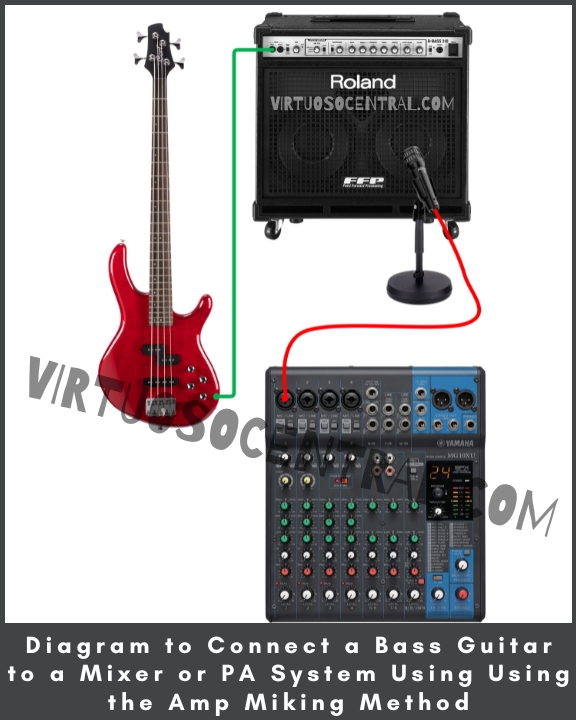
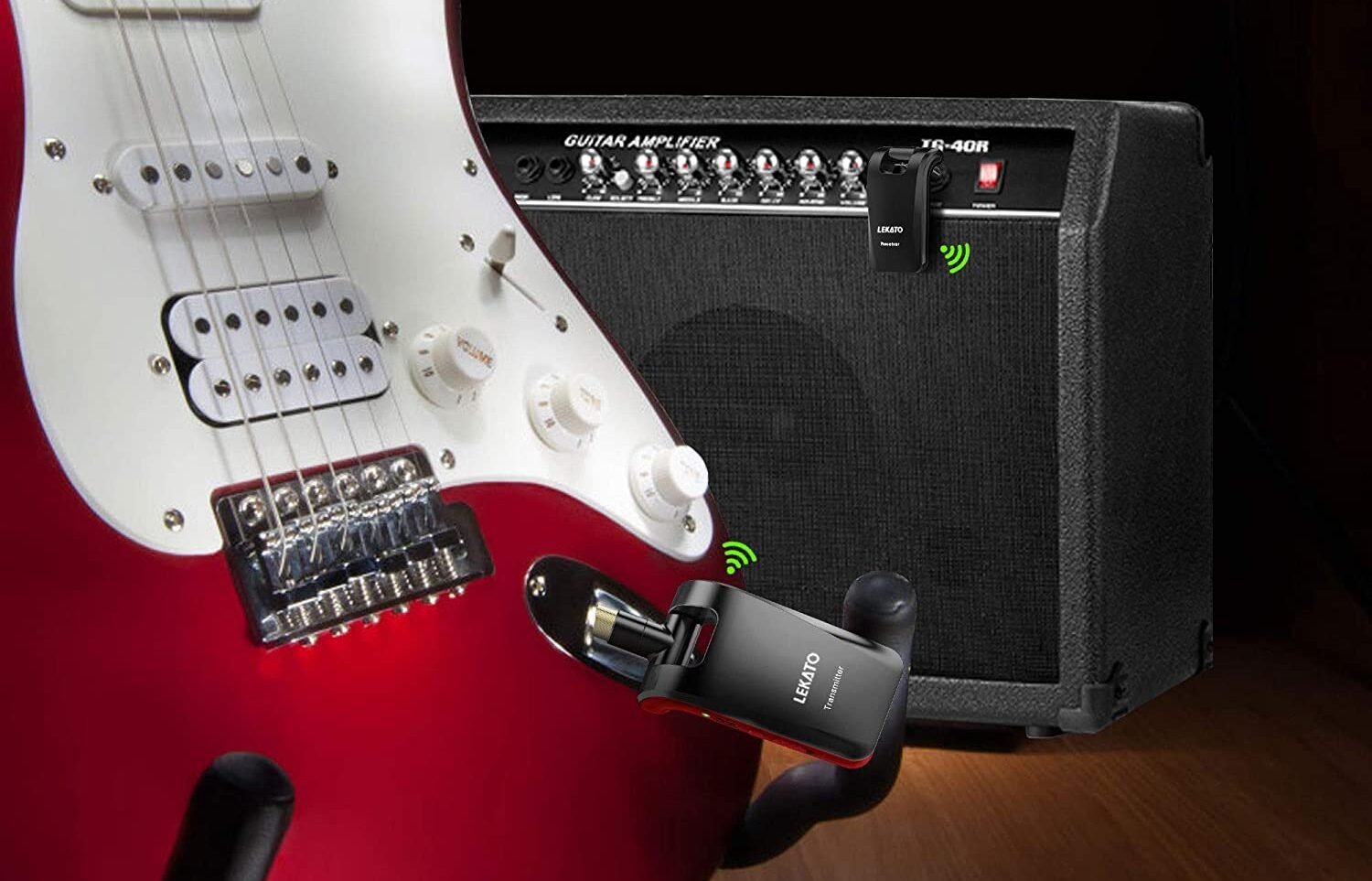
You only need a standard instrument cable for the basic connection.
Safe connection steps
- Turn the guitar amp off or turn its volume fully down.
- Plug one end of the instrument cable into the bass guitar.
- Plug the other end into the guitar amp’s instrument input.
- Set the bass volume near its normal playing level.
- Set the amp’s volume low.
- Turn on the amp.
- Play a few notes, starting with higher notes.
- Raise the volume slowly while listening to the speaker.
Use the instrument input, not the speaker output. A speaker output carries high power. It is not designed for a bass, guitar, audio interface, or another amp input.
If the bass has active electronics, start with the bass volume lower than normal. Active basses use a battery-powered preamp and may send a stronger signal. This can overload the guitar amp’s input and create unwanted distortion.
Signs that the setup is working
A safe test should produce:
- Clear notes at low volume
- No rattling or mechanical noise
- No strong flapping from the speaker
- No sudden drop in volume
- No burning smell
- No unusual heat from the amp
If you hear a rough, loose, or broken sound, lower the volume immediately. Do not keep playing to “see if it gets better.”
Best settings for playing bass through a guitar amp
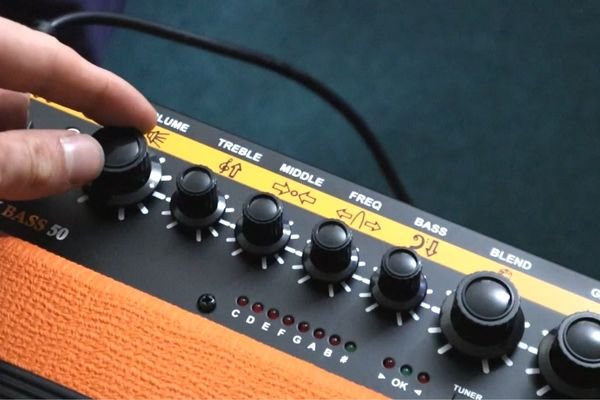
Use a gentle setting rather than trying to make the guitar amp sound like a full bass rig.
Begin with these settings:
| Control | Starting point |
|---|---|
| Volume | Low |
| Bass | Low or flat |
| Middle | Flat or slightly raised |
| Treble | Low to moderate |
| Gain or drive | Low |
| Reverb | Off or low |
The exact knob position differs between amps. These settings are only a safe starting point.
Avoid heavy bass boost. Boosting low frequencies sends more energy to the speaker and increases cone movement. Cutting some bass may sound less powerful, but it can protect the speaker and make the notes clearer.
A clean tone is usually the best first test. Once the amp works well at a quiet level, you can add a small amount of gain. Stop if the sound becomes loose, harsh, or mechanical.

When a guitar amp may be useful for bass
A guitar amp can be a practical temporary option in several situations.
Quiet home practice
For short practice sessions, a guitar amp may be enough. Keep the volume at a level that does not make the speaker work hard. This is especially useful when you do not yet own a bass amp.
Recording a distorted bass sound
Some players use a guitar amp to create a clipped or gritty bass tone. This can work well when the amp and speaker are used within their limits. A recording setup may also blend the guitar amp with a clean direct bass signal.
Effects and sound design
A guitar amp can give bass effects a different character. Fuzz, overdrive, delay, and modulation may sound interesting through a guitar amp. Use lower volume when testing unusual sounds.
Emergency rehearsal use
A guitar amp may help in an emergency, but it may not keep up with a loud drummer or a large band. Bass needs substantial clean power to sound full and remain clear in a group.

When you should use a bass amp instead
Use a bass amp when you need strong low end, higher volume, or regular playing.
A bass amp is the better choice for:
- Band rehearsal
- Live performance
- Long practice sessions
- Drop-tuned or extended-range bass
- Loud, clean bass tones
- Five-string or six-string bass
- Heavy use of low-frequency effects
A bass combo normally uses a speaker and cabinet designed for bass frequencies. It also gives you controls suited to bass, such as low-frequency shaping and enough power for clean volume.
For quiet practice, headphones may be a better option than a guitar amp. A bass headphone amp or audio interface can provide a monitored signal without forcing a small guitar speaker to reproduce deep bass.
A direct box, also called a DI, can send the bass to a mixer or recording interface. This preserves a clean bass signal, though a DI alone does not power a passive speaker.

Can you connect a bass amp head to a guitar speaker cabinet?
Only if the speaker cabinet can safely handle the amp’s output and impedance.
A bass amp head can send more low-frequency energy than a guitar speaker cabinet is designed to handle. The cabinet may sound weak, distort badly, or suffer speaker damage.
Before connecting an amp head to a cabinet, check:
- The cabinet’s impedance, such as 4, 8, or 16 ohms
- The amp’s required impedance
- The cabinet’s continuous power rating
- Whether the cabinet is designed for bass frequencies
- Whether the cable is a proper speaker cable
Do not use an instrument cable between an amp head and speaker cabinet. Use a speaker cable. Instrument cables are not designed to carry the high current from a power amp.
Never connect a speaker output to another amplifier’s input. That can damage both devices. Connect an instrument to an amp input, or connect an amp head to a compatible speaker cabinet. These are different types of connections.
Common mistakes and how to fix them
Mistake: Turning up the bass control first
A large bass boost can put extra strain on the speaker.
Fix: Start with the bass control flat or below flat. Increase it only if the speaker remains clean and quiet.
Mistake: Ignoring speaker noise
A guitar amp may still produce music while its speaker is under stress.
Fix: Treat flapping, rattling, buzzing, and loose-sounding notes as warning signs. Turn down before checking anything else.
Mistake: Using an active bass at full output
An active bass can overload the amp’s input.
Fix: Lower the bass’s volume or onboard boost. Then raise the guitar amp’s volume gradually.
Mistake: Assuming a powerful amp is automatically safe
More amplifier power does not make a guitar speaker suitable for bass.
Fix: Check the speaker’s design and rating. The speaker must handle the low-frequency energy, not just the amplifier.
Mistake: Using a guitar amp at drummer volume
A small guitar combo may not produce enough clean bass volume for a full band.
Fix: Use a bass amp, PA system, or suitable powered speaker for group playing.
A practical risk guide
This table gives a simple way to judge the setup.
| Situation | Risk level | Best approach |
|---|---|---|
| Bass into a solid-state guitar combo at low volume | Low | Usually acceptable |
| Bass into a tube combo at low volume | Low to moderate | Use care and the correct speaker load |
| Active bass with heavy boost | Moderate | Lower the bass output |
| Bass with strong low-frequency boost | Moderate to high | Cut bass and watch the speaker |
| Bass through a small guitar speaker at high volume | High | Use a bass amp instead |
| Bass amp head into an unknown guitar cabinet | High | Check impedance and power first |
| Amp speaker output into another amp input | Very high | Do not make this connection |
This is a general guide, not a guarantee. Amp design, speaker condition, playing style, and volume all affect the result.

Frequently asked questions
Can a bass guitar damage a guitar amp?
It can damage the speaker, especially at high volume or with strong bass boost. Low-volume practice is usually much safer. Tube amps also require the correct speaker load.
Will a bass sound good through a guitar amp?
It may sound usable, but it will often have less low-end depth and less clean volume than it has through a bass amp. A guitar amp can be useful for gritty tones or quiet practice.
Can I use a guitar amp for a five-string bass?
You can test one at low volume, but the low B string creates more demand on the speaker. A bass amp or direct monitoring system is a better choice for regular five-string playing.
Can I plug a bass into a guitar pedal and then into a guitar amp?
Yes. Most guitar pedals can accept a bass signal. Some pedals reduce low end, so check the sound and keep the amp volume moderate. The guitar amp speaker remains the main limit.
Is a bass amp louder than a guitar amp with the same wattage?
Not always. Wattage alone does not decide loudness. Speaker size, cabinet design, efficiency, frequency range, and clean headroom all matter. A bass amp is designed to handle low frequencies more effectively.
Should I buy a bass amp or a guitar amp?
Buy a bass amp if bass is your main instrument or if you need rehearsal or performance volume. A guitar amp is enough for quiet testing, temporary use, or special distorted sounds.
Conclusion
You can play a bass guitar through a guitar amp, but keep the volume low, avoid heavy bass boost, and watch for speaker strain. The connection is normally safe when the bass goes into the amp’s instrument input.
For regular bass practice, band rehearsal, or live playing, use a bass amp or a suitable direct-monitoring setup. If the speaker rattles, flaps, or sounds harsh, turn the amp down immediately. When in doubt, choose the system designed to handle bass frequencies.

Senior Music Reviewer
Alex Carter is a seasoned music reviewer with over a decade of experience in the world of sound and instruments. Passionate about helping musicians and enthusiasts make informed choices, he brings sharp insights and in-depth knowledge to every review. From classical instruments to modern gear, Alex combines technical expertise with a love for music to deliver content that resonates with readers.
As a Senior Music Reviewer and expert author on Tuneluma.com, Alex is dedicated to sharing honest evaluations, practical advice, and thoughtful commentary to guide readers in their musical journey.