A Minor Scale Guitar Chords: Easy Shapes To Learn
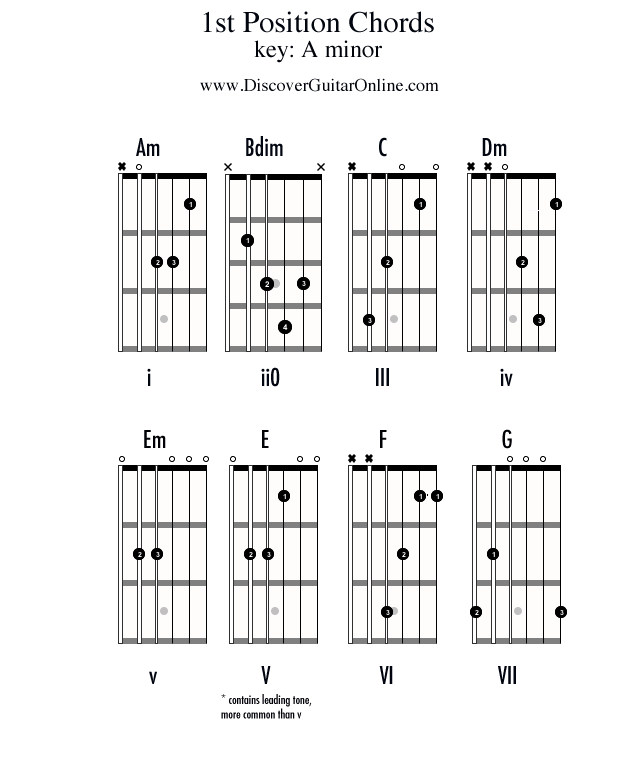
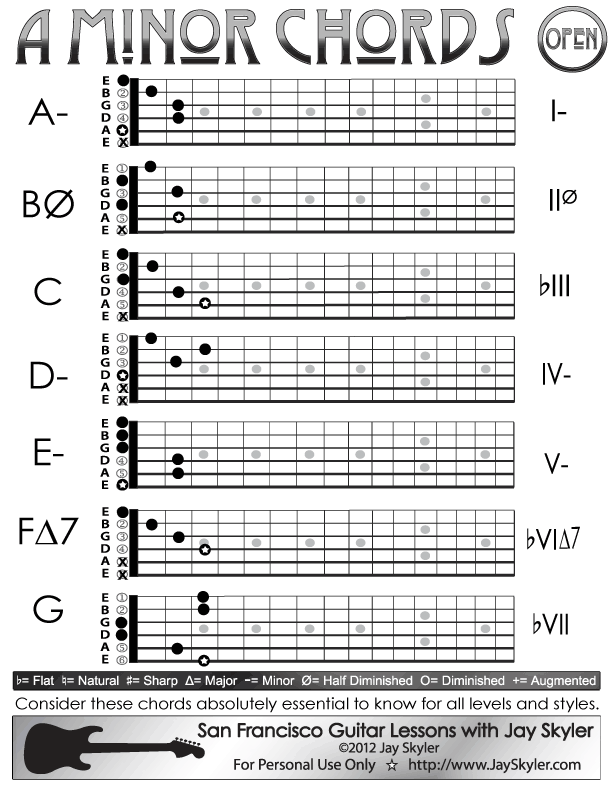
The A minor scale guitar chords are Am, B diminished, C, Dm, Em, F, and G.
The A minor scale is one of the best starting points for learning minor harmony on guitar. Its notes are easy to find, its open chords sound rich, and its dark yet familiar mood appears in rock, blues, folk, pop, and metal. This guide explains the A minor scale guitar chords, useful chord shapes, common progressions, and ways to use the scale in real playing.

What Is the A Minor Scale?
The A natural minor scale contains seven notes:
A, B, C, D, E, F, and G
It uses the same notes as the C major scale. This makes A minor the relative minor of C major. The difference is the tonal center. In A minor, the note A feels like home. In C major, the note C feels like home.
The natural minor scale follows this pattern:
Whole step, half step, whole step, whole step, half step, whole step, whole step
On guitar, one whole step equals two frets. One half step equals one fret.
The A minor scale guitar chords come from stacking notes from this scale in thirds. Each chord uses only notes found in A natural minor, so the chords naturally work together.
A Minor Scale Notes on the Guitar
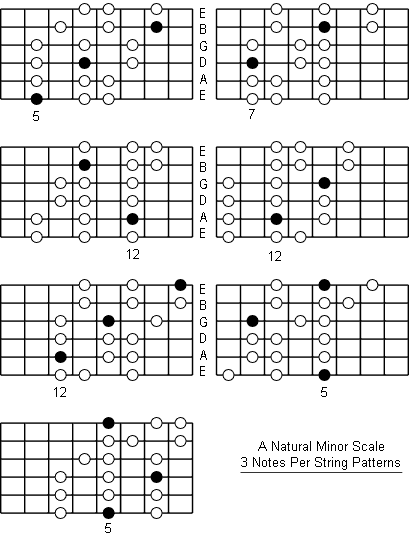
You can play A minor in many positions. A simple open position uses these notes:
e|----------------0--1--3--
B|----------0--1--3---------
G|----0--2------------------
D|--2--3--------------------
A|--0--2--3-----------------
E|--------------------------
This is not the only A minor scale shape. It is simply a useful first position near the open chords. As you gain skill, connect it to the fifth-position and seventh-position patterns.

A Minor Scale Guitar Chords Chart
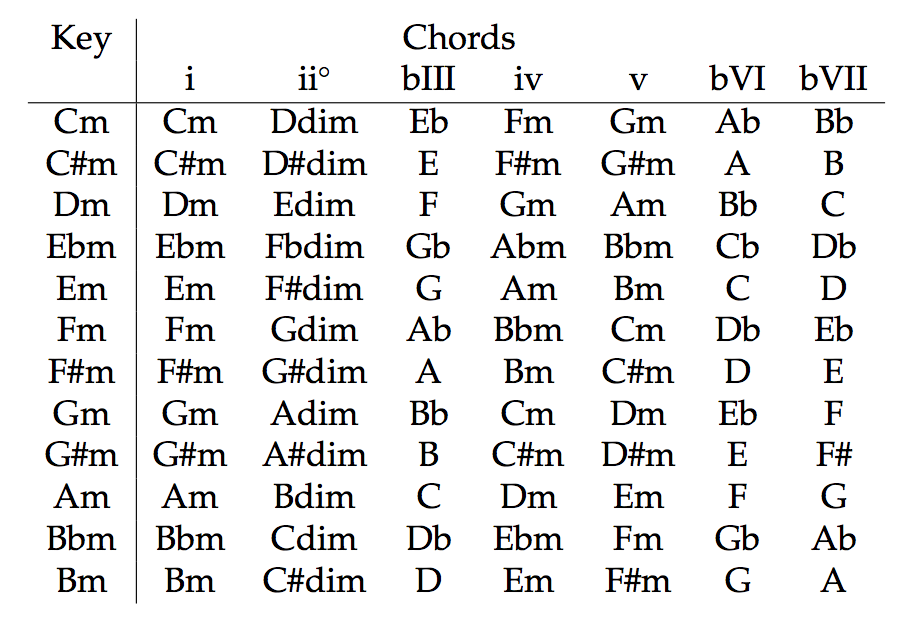
The main A minor scale guitar chords are built on each degree of the scale. Their chord qualities follow the natural minor pattern:
| Scale degree | Note | Triad | Seventh chord |
|---|---|---|---|
| i | A | Am | Am7 |
| ii° | B | Bdim | Bm7b5 |
| III | C | C | Cmaj7 |
| iv | D | Dm | Dm7 |
| v | E | Em | Em7 |
| VI | F | F | Fmaj7 |
| VII | G | G | G7 |
The lowercase Roman numerals show minor chords. The uppercase numerals show major chords. The small circle means diminished.
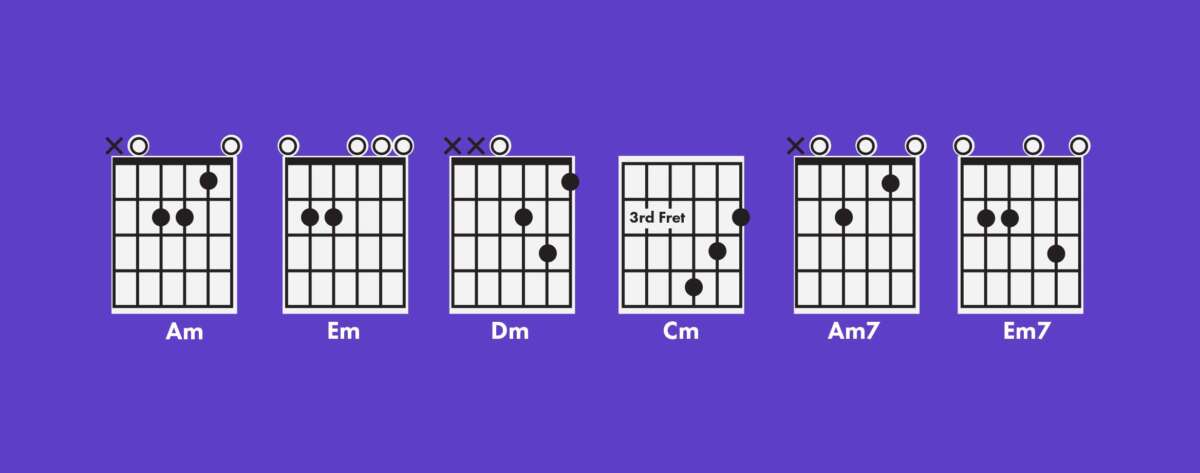
The most important A minor scale guitar chords for beginners are:
• Am
• C
• Dm
• Em
• F
• G
The B diminished chord is less common in basic strumming because it can sound tense and may feel awkward under the fingers. Still, it has an important role in music theory and chord progressions.
How the Chords Are Built
The A minor chord uses A, C, and E. These are the first, third, and fifth notes of the scale.
The B diminished chord uses B, D, and F. The distance between B and F creates a tense sound.
The C major chord uses C, E, and G. It is the relative major chord and often gives an A minor progression a brighter lift.
The D minor chord uses D, F, and A. It adds a strong emotional color.
The E minor chord uses E, G, and B. It sounds softer than an E major chord, which is important when staying strictly within natural minor.
The F major chord uses F, A, and C. It often gives minor progressions a broad and dramatic sound.
The G major chord uses G, B, and D. It can lead smoothly back to Am or move toward C.
Open Chord Shapes for A Minor
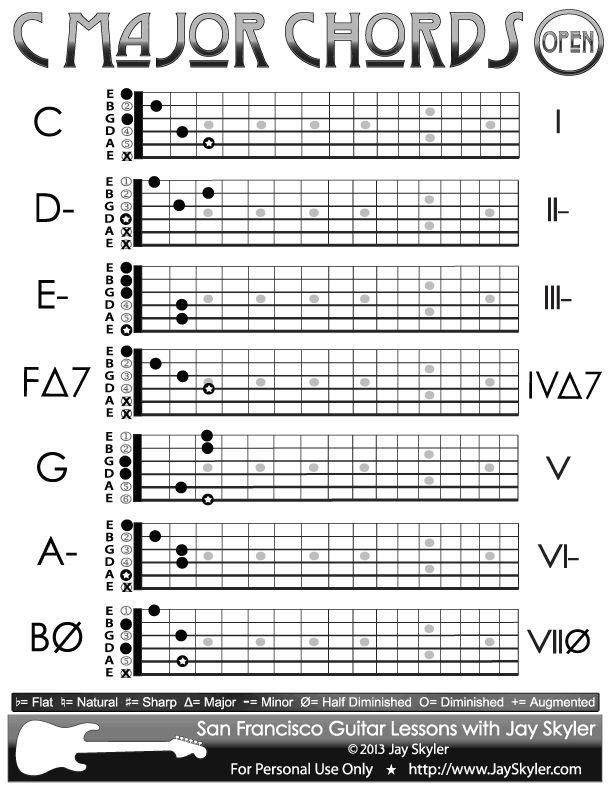
Open chords let you play many A minor scale guitar chords with less effort. They are ideal for beginners, acoustic players, and songwriters.
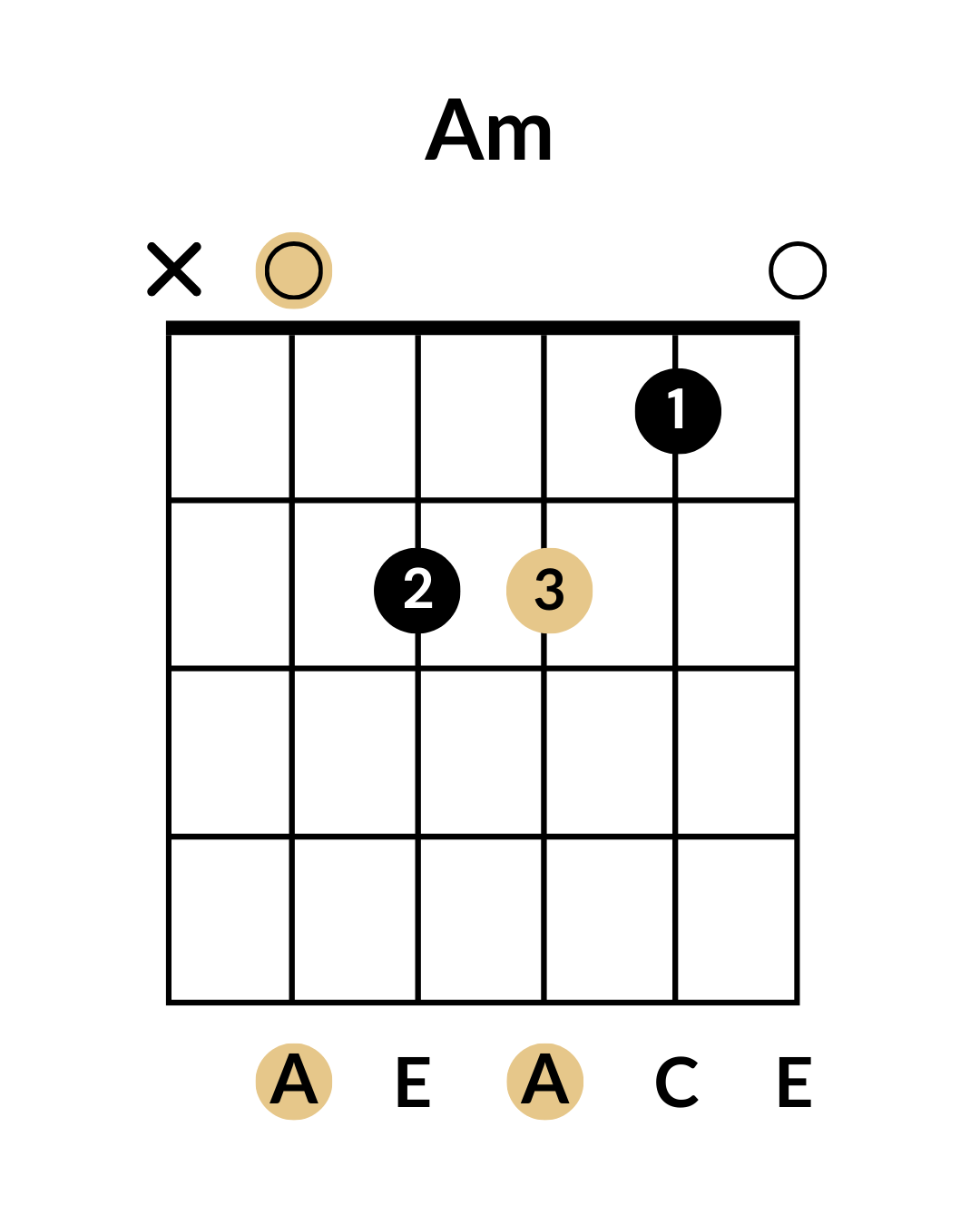
A Minor
e|--0--
B|--1--
G|--2--
D|--2--
A|--0--
E|--x--
Use your first finger on the B string, second finger on the D string, and third finger on the G string. Strum from the A string down.
C Major
e|--0--
B|--1--
G|--0--
D|--2--
A|--3--
E|--x--
C major shares two notes with Am, so moving between these chords feels smooth.
D Minor
e|--1--
B|--3--
G|--2--
D|--0--
A|--x--
E|--x--
Play from the D string. Dm is one of the most useful minor chords in the key of A minor.
E Minor
e|--0--
B|--0--
G|--0--
D|--2--
A|--2--
E|--0--
Em is easy to play and works well in folk, rock, and acoustic progressions.
F Major
A full F barre chord can be hard at first. Try this smaller version:
e|--1--
B|--1--
G|--2--
D|--3--
A|--3--
E|--x--
This shape avoids the low E string. It is a practical choice while you build barre strength.
G Major
e|--3--
B|--0--
G|--0--
D|--0--
A|--2--
E|--3--
G major adds movement and contrast to A minor chord progressions.
A common mistake is to rush through difficult chord changes. Practice each pair slowly, such as Am to F or Dm to G. Clean changes at 50 beats per minute are more useful than messy changes at 100 beats per minute.
Barre Chords and Movable Shapes
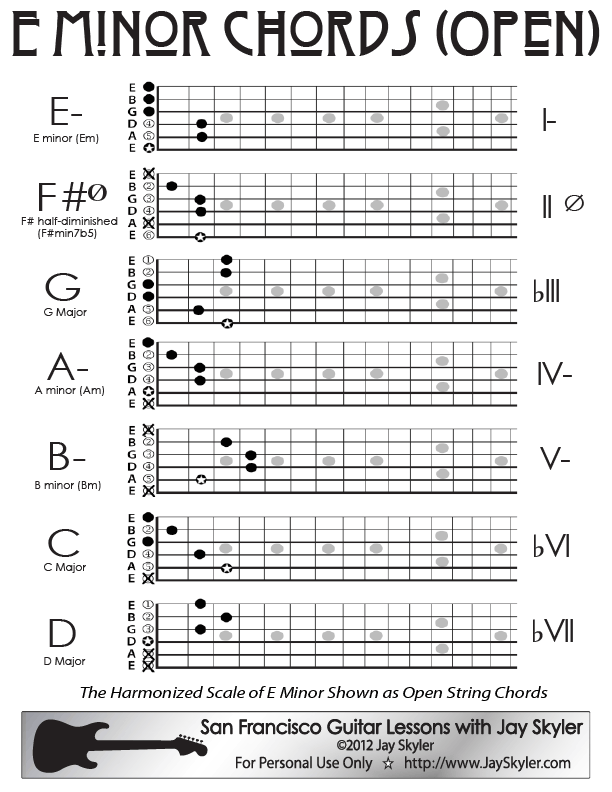
Open chords are useful, but movable shapes help you play A minor scale guitar chords across the neck.
A Minor Barre Chord
The fifth-string minor barre shape creates an A minor chord at the twelfth fret:
e|--12--
B|--13--
G|--14--
D|--14--
A|--12--
E|--x---
You can also use the same shape at the fifth fret to play D minor, or at the seventh fret to play E minor. The root note sits on the A string.
A Minor at the Fifth Fret
Another common A minor shape uses the sixth-string root at the fifth fret:
e|--5--
B|--5--
G|--5--
D|--7--
A|--7--
E|--5--
This shape is based on the E major chord form. It may feel difficult at first because one finger must cover several strings.
Why Movable Chords Matter
Movable shapes help you:
• Play the same chord in several keys
• Follow a bass line across the neck
• Create stronger rhythm guitar parts
• Connect chord shapes to scale patterns
• Avoid being limited to open-position chords
When learning A minor scale guitar chords, do not view each shape as an isolated form. Find the root notes first. Then learn how the third and fifth sit around each root.
Common A Minor Chord Progressions
Chord progressions create the emotional direction of a song. The same chords can sound calm, sad, dramatic, or powerful depending on order, rhythm, tempo, and melody.
Am to F to C to G
This progression is:
Am | F | C | G
It has a strong pop and rock sound. The Am chord gives the progression its minor center, while C and G add lift.
Try four downstrokes per chord. Then add a pattern such as:
Down, down, up, up, down, up
Keep your strumming hand moving even when you miss a string. Steady motion often improves rhythm faster than trying to make every stroke perfect.
Am to G to F to E
This progression is:
Am | G | F | E
The E major chord is not part of A natural minor because it contains G sharp. However, it belongs to A harmonic minor and creates a strong pull back to Am.
This is a key idea. Many songs in A minor use E major or E7 because the G sharp note acts as a leading tone. It sounds like a musical arrow pointing toward A.
Am to Dm to G to C
This progression is:
Am | Dm | G | C
It moves through several chords from the A minor scale. It can sound gentle and reflective, especially with fingerpicking.
Am to Em to F to G
This progression is:
Am | Em | F | G
It works well for acoustic music and simple songwriting. Use a steady eighth-note pattern or pick the bass note before the higher strings.
Am to C to G to F
This progression is:
Am | C | G | F
It gives you a wide range of color. Am sounds dark, C sounds open, G adds forward motion, and F brings weight before the loop returns.
Natural Minor, Harmonic Minor, and Melodic Minor
When guitarists talk about A minor, they may mean more than one minor scale.
A Natural Minor
A natural minor contains:
A, B, C, D, E, F, G
Its basic chord set includes:
Am, Bdim, C, Dm, Em, F, and G
This is the main source of the A minor scale guitar chords discussed in this guide.
A Harmonic Minor
A harmonic minor raises the seventh note:
A, B, C, D, E, F, G sharp
The raised G sharp creates an E major or E7 chord. This gives the scale a dramatic, classical, flamenco, and metal sound.
The main difference is simple:
• Natural minor uses Em
• Harmonic minor often uses E or E7
A Melodic Minor
In traditional theory, ascending A melodic minor raises both F and G:
A, B, C, D, E, F sharp, G sharp
Modern jazz often treats melodic minor as the same set of notes both ascending and descending. It has a more colorful sound and is usually studied after natural and harmonic minor.
Knowing these differences prevents confusion. If a song uses E major in A minor, that is not automatically a mistake. It may be using harmonic minor harmony.
How to Use the A Minor Scale Over Chords
The A minor scale works best when you connect the scale to the chord beneath it.
Over an Am chord, focus on:
A, C, and E
These are chord tones. Add B, D, F, and G as passing or color notes.
Over a C chord, focus on:
C, E, and G
Over a Dm chord, focus on:
D, F, and A
This approach helps your solos sound musical instead of random. A scale is like a box of paint, but chord tones tell you where to place the strongest colors.
A Simple A Minor Guitar Lick
Try this phrase on the high E and B strings:
e|----------------5--8--5-----
B|----------5--6-----------6--5
G|--5--7-----------------------
D|-----------------------------
A|-----------------------------
E|-----------------------------
Play it over Am. End on A for a settled sound. End on G or F for a more open, unresolved feeling.
Target Chord Tones
When the chord changes, aim for one of its notes.
For Am, land on A, C, or E.
For F, land on F, A, or C.
For C, land on C, E, or G.
For G, land on G, B, or D.
This method is more effective than playing the full scale at high speed. Good phrasing depends on timing, pauses, bends, slides, and note choice.
Fingerstyle and Arpeggio Ideas
A minor scale guitar chords sound especially rich when you pick individual notes instead of strumming every string.
Try this simple pattern over Am:
A string, G string, B string, e string,
B string, G string, A string
Count it as:
1, 2, 3, 4, 3, 2, 1
Let the notes ring when possible. This creates a calm, flowing sound.
For a progression such as Am, F, C, and G, keep your picking hand steady. Your fretting hand changes chords while your right hand repeats the pattern.
Arpeggios also show you which notes belong to each chord. For example, an Am arpeggio uses A, C, and E. Learning these notes makes it easier to create fills between vocal lines.
A useful practice habit is to play the bass note first, then the upper chord tones. This makes your playing sound more controlled and helps you hear the chord structure.
Common Mistakes to Avoid
Learning A minor scale guitar chords is straightforward, but a few mistakes can slow your progress.
Treating Every Note as Equal
Not every scale note has the same effect. Chord tones usually sound stable, while other notes may create tension.
Start by learning where the root, third, and fifth are in each chord shape.
Ignoring the E Major Chord
Some players avoid E major because it is not part of A natural minor. In real music, E major and E7 are extremely common in A minor because of harmonic minor harmony.
Use Em for a softer sound. Use E or E7 when you want a strong return to Am.
Strumming Too Hard
Heavy strumming can hide buzzing and poor timing. Start softly. Increase volume only when the chord changes are clean.
Learning Shapes Without Root Notes
A chord shape is much easier to understand when you know where its root is. Mark the root notes on a diagram or locate them on the low E and A strings.
Practicing Only in One Position
The open position is useful, but it can limit your fretboard knowledge. Add one movable barre shape and one scale pattern at a time.
A Practical Practice Plan
Use this short routine for 15 to 20 minutes.
-
Play the A natural minor scale slowly with alternate picking.
-
Practice Am, C, Dm, Em, F, and G as open chords.
-
Change between two chords for one minute without stopping.
-
Play the progression Am, F, C, G with a metronome.
-
Add the A minor scale over a backing track.
-
End each phrase on a chord tone.
-
Record yourself and listen for buzzing, uneven timing, and weak chord changes.
A metronome helps you measure progress honestly. Begin at a tempo where every note sounds clear. Increase the speed by only a few beats per minute after you can play the pattern several times without mistakes.
One practical lesson stands out from teaching and studying guitar: players often try to learn too many shapes at once. It is better to master six useful chords and one scale position than to collect dozens of forms you cannot use in time.
A Minor Chord Progression Songwriting Tips
A minor chords can support many moods. For a sad or reflective song, try Am, Dm, and Em. For a larger, more dramatic sound, add F and G.
Use these ideas when writing:
• Start and end on Am to make the minor key clear.
• Use C to create a brighter contrast.
• Use F to add depth and emotional weight.
• Use G to create movement toward C or Am.
• Use E7 to create a strong pull back to Am.
• Change the rhythm before adding more chords.
A simple progression can sound fresh when you change the arrangement. Play the first verse with light fingerpicking, add fuller strums in the chorus, and use single-note fills between vocal phrases.
Frequently Asked Questions About A Minor Scale Guitar Chords
What are the chords in the A minor scale on guitar?
The natural A minor scale contains Am, B diminished, C, Dm, Em, F, and G. These are the basic A minor scale guitar chords built from the notes A, B, C, D, E, F, and G.
What is the easiest A minor chord progression?
Am, F, C, and G is one of the easiest and most useful progressions. It works well with open chords and supports many strumming patterns.
Is E major in the key of A minor?
E major is not part of A natural minor, but it is common in the key of A minor. It comes from A harmonic minor, where G is raised to G sharp and creates a strong pull toward Am.
What is the relative major of A minor?
C major is the relative major of A minor. Both keys use the same notes, but A minor centers on A while C major centers on C.
Can I use the A minor pentatonic scale over these chords?
Yes, the A minor pentatonic scale works well over many progressions centered on Am. Its notes are A, C, D, E, and G, but you should still listen for chord changes and target notes.
Why does the B diminished chord sound tense?
B diminished contains B, D, and F. The unstable distance between B and F creates tension, so the chord often moves toward C or another chord rather than staying in place.
Which A minor scale guitar chords should beginners learn first?
Start with Am, C, Dm, Em, F, and G. Learn B diminished later, once your open chords and basic rhythm feel comfortable.
Conclusion
The A minor scale guitar chords give you a powerful set of tools for rhythm playing, songwriting, fingerstyle, and improvisation. Start with the natural minor group: Am, B diminished, C, Dm, Em, F, and G. Then explore E major from harmonic minor when you want a stronger return to Am.
Practice slowly, learn the root notes, and connect each chord to the A minor scale. Pick one progression today, record yourself, and listen for clean changes and steady timing. Keep exploring these shapes, and share your favorite A minor progression or guitar exercise with other players.

Senior Music Reviewer
Alex Carter is a seasoned music reviewer with over a decade of experience in the world of sound and instruments. Passionate about helping musicians and enthusiasts make informed choices, he brings sharp insights and in-depth knowledge to every review. From classical instruments to modern gear, Alex combines technical expertise with a love for music to deliver content that resonates with readers.
As a Senior Music Reviewer and expert author on Tuneluma.com, Alex is dedicated to sharing honest evaluations, practical advice, and thoughtful commentary to guide readers in their musical journey.