How Do I Read Guitar Music

How Do I Read Guitar Music: A Beginner’s Guide

To read guitar music, learn standard notation, guitar tab, rhythm symbols, and how each note maps to the fretboard.

Learning how do i read guitar music becomes much easier when you treat the page like a map. Standard notation shows pitch and rhythm, while tablature shows exactly where to place your fingers. This guide explains both systems, common symbols, practical reading steps, and simple exercises you can use to play real songs with confidence.

What Does Guitar Music Look Like?

Guitar music usually appears in one or more of three forms:

• Standard music notation shows pitch, rhythm, timing, and musical expression.

• Guitar tablature, or tab, shows which string and fret to play.

• Chord charts show finger shapes for playing several notes at once.

Many guitar books place standard notation above tablature. This format is helpful because you can see both the musical idea and the physical movement on the fretboard.

When people ask, “how do i read guitar music,” they often mean one of these systems. The best approach is to learn them together, but start with tab if you are a complete beginner. Then add standard notation as your reading skills grow.

What Does Guitar Music Look Like?
Source: wikihow.com

How to Read Guitar Tab

Guitar tab is often the fastest way to begin reading guitar music. It uses six horizontal lines, with each line representing one guitar string.

The lines usually appear in this order:

• Top line: high E string

• Second line: B string

• Third line: G string

• Fourth line: D string

• Fifth line: A string

• Bottom line: low E string

A number on a line tells you which fret to play. For example:

e|--------0--|
B|------1----|
G|----0------|
D|--2--------|
A|-----------|
E|-----------|

Read this tab from left to right. The notes form an open C major chord shape. A zero means play the string without pressing a fret. A number such as 3 means press the third fret.

Tab often uses symbols for common techniques:

h means hammer-on, as in 5h7

p means pull-off, as in 7p5

/ means slide up

\ means slide down

b means bend

r means release a bend

~ means vibrato or a sustained wavering pitch

x means a muted or percussive note

Tab is useful, but it has a weakness. Many tab sheets do not show rhythm clearly. You may know which notes to play but not exactly when to play them. Listen to a recording or use tab that includes rhythm marks whenever possible.
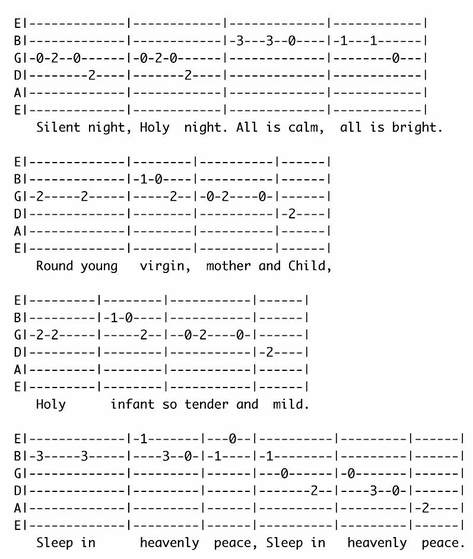
How to Read Guitar Tab
Source: start-playing-guitar.com

How to Read Standard Guitar Notation

Standard notation uses a staff made of five lines and four spaces. Guitar music is usually written in the treble clef, also called the G clef.

The lines of the treble clef are:

• E

• G

• B

• D

• F

A common memory phrase is “Every Good Boy Does Fine.” The spaces spell F, A, C, and E.

The notes above and below the staff use short lines called ledger lines. These lines extend the staff so composers can write higher or lower notes.

For guitar, written notes sound one octave lower than they appear. This is a normal convention. You do not need to change anything while reading, but it explains why written guitar music may seem higher than the sound from your instrument.

To understand how do i read guitar music in standard notation, learn one note at a time. Start with the open strings:

• Low E string: E

• A string: A

• D string: D

• G string: G

• B string: B

• High E string: E

Then learn the natural notes on the first few frets. The same pitch can appear in more than one place on a guitar, so standard notation does not always tell you one exact fingering. This is where finger numbers, position marks, or tab can help.

How to Read Standard Guitar Notation
Source: youtube.com

Learn Rhythm Before Playing Fast

Rhythm tells you when to play a note and how long to hold it. Good rhythm matters as much as correct notes. A player who misses a note but keeps steady time often sounds better than a player who plays every note with poor timing.

Most beginner guitar music uses a 4/4 time signature. The top number tells you there are four beats in each measure. The bottom number tells you that the quarter note receives one beat.

Common note values include:

• Whole note: four beats in 4/4 time

• Half note: two beats

• Quarter note: one beat

• Eighth note: one-half beat

• Sixteenth note: one-quarter beat

Rests use similar values, but they show silence. Silence is part of music. Do not treat rests as empty space.

Try counting aloud:

1 2 3 4

For eighth notes, count:
1 and 2 and 3 and 4 and

For sixteenth notes, count:

1 e and a 2 e and a 3 e and a 4 e and a

Use a metronome at a slow speed. Start around 50 to 60 beats per minute. Raise the speed only when you can play the passage evenly three times in a row.

This rhythm-first method is one of the most useful answers to how do i read guitar music. It prevents you from turning every song into a guessing game.

Learn Rhythm Before Playing Fast
Source: ampedstudio.com

Understand Measures and Time Signatures

Vertical lines divide music into measures, also called bars. Measures group beats into regular patterns, much like words group letters into readable phrases.

The time signature appears near the beginning of a song. Common examples include:

• 4/4: four quarter-note beats per measure

• 3/4: three quarter-note beats per measure

• 2/4: two quarter-note beats per measure

• 6/8: six eighth-note pulses, often felt as two groups of three

A new guitarist may count every note separately. With practice, you will begin to feel the larger beat. In 6/8 time, for example, you may feel “ONE two three FOUR five six.”

Look for the strong beats. In 4/4 music, beat one usually feels strongest, while beat three often has a smaller accent. This pattern helps you stay oriented when the notes become busy.

Understand Measures and Time Signatures
Source: gprotab.net

Learn Key Signatures and Accidentals

A key signature appears after the clef. It shows which notes are usually sharp or flat throughout the piece.

A sharp raises a note by one half step. A flat lowers it by one half step. A natural cancels a sharp or flat.

You may see these symbols:

• Sharp:

• Flat:

• Natural:

For example, an F sharp means play the note one fret higher than natural F. On guitar, one fret equals one half step. This makes the guitar layout helpful when learning pitch.

The key signature can also suggest the song’s home key. A piece in C major has no sharps or flats. A piece in G major usually has one sharp, F sharp.

Do not worry about memorizing every key at once. Start with C, G, D, A, and E major. These keys appear often in guitar music and connect well with common open chords.

Learn Key Signatures and Accidentals
Source: fretello.com

Match Written Notes to the Guitar Fretboard

The guitar fretboard repeats its note pattern every 12 frets. Open strings provide your starting points, and each fret moves up one half step.

For example, on the low E string:

• Open string: E

• First fret: F

• Second fret: F sharp

• Third fret: G

• Fifth fret: A

• Seventh fret: B

• Twelfth fret: E

The same pattern works on every string, but the tuning gap between the G and B strings changes the shape of familiar patterns. This is why some scale shapes shift when they cross those strings.

When reading standard notation, first identify the written note. Then choose a comfortable place to play it. Beginners often search for only one location, but experienced players choose positions based on the notes before and after it.

This is a key part of how do i read guitar music. Reading is not only naming notes. It also means making smart choices about position, fingering, tone, and movement.

Match Written Notes to the Guitar Fretboard
Source: wikihow.com

Read Chord Charts and Strumming Patterns

Chord charts use a small grid that represents the guitar’s neck. The vertical lines are strings, and the horizontal lines are frets. Dots show where to place your fingers.

You may also see:

• An open circle, which means play the open string

• An X, which means do not play the string

• Numbers that show suggested fingers

The common finger numbers are:

• 1: index finger

• 2: middle finger

• 3: ring finger

• 4: pinky

A strumming pattern may use arrows. Down arrows show downstrokes, and up arrows show upstrokes. Some patterns use muted strokes, accents, or rests.

Practice chords separately before adding the strumming pattern. Then switch between two chords, such as G and C, while counting steady quarter notes. Smooth chord changes matter more than speed.

When I teach beginners, I often see them stare at the chord shape and forget the beat. Keep your strumming hand moving like a pendulum, even when you do not strike the strings. This simple habit makes difficult patterns feel more natural.

Read Chord Charts and Strumming Patterns
Source: co.uk

A Simple Method for Reading Guitar Music

Use this process whenever you open a new piece of music.

  1. Check the tuning. Standard tuning is E A D G B E from the lowest string to the highest.

  2. Look at the key signature and time signature.

  3. Scan the music for repeated patterns, chord shapes, and difficult sections.

  4. Clap or count the rhythm before you play.

  5. Find the first few notes on the fretboard.

  6. Choose a comfortable hand position.

  7. Play slowly with a metronome.

  8. Stop at mistakes and isolate the problem.

  9. Repeat the passage several times without speeding up too soon.

  10. Add musical details such as dynamics, accents, slides, and vibrato.

Do not try to sight-read an entire song at full speed. Break it into one or two measures. Once each small part feels secure, connect the sections.

This method answers how do i read guitar music in a practical way. It turns reading into a repeatable skill instead of a test of memory.

Common Mistakes Beginners Should Avoid

Many reading problems come from rushing the process. The most common mistakes are easy to fix.

• Learning notes without learning rhythm. Use counting and a metronome from the start.

• Looking only at your picking hand. Check the page often so you build stronger visual focus.

• Memorizing tab without understanding timing. Listen to the song and mark the beat.

Playing too fast. Slow practice builds accurate movement.

• Ignoring fingerings. Use the suggested fingering, then change it only when you have a clear reason.

• Skipping rests. Silence must fit the beat just like a played note.

• Practicing only easy songs. Include short, challenging passages to develop new skills.

One mistake I made early in my playing was treating every wrong note as the main problem. Often, the real issue was poor timing or an awkward shift. Once I learned to diagnose the cause, my practice became shorter and more effective.

A 15-Minute Practice Routine

You do not need long practice sessions to improve. A focused 15-minute routine can build reading skill when you follow it often.

• Three minutes: name open strings and notes on the first five frets.

• Four minutes: clap and count a short rhythm.

• Five minutes: read a simple melody at a slow tempo.

• Two minutes: practice one difficult measure.

• One minute: play the passage again without stopping.

Use beginner melodies, simple folk songs, classical studies, or easy guitar method books. Choose music that is slightly below your maximum ability. If every measure feels impossible, the material is too hard for sight-reading practice.

After a few weeks, you should notice that common notes, rhythms, and patterns feel familiar. This is similar to reading words. At first, you sound out each letter. Later, you recognize the whole word at once.

Why Learn Standard Notation If Tab Is Easier?

Tab is excellent for learning riffs, solos, and exact fret positions. It is direct and guitar-friendly. However, standard notation offers information that tab may leave out.

Standard notation can show:

• Precise rhythm

• Melodic direction

• Key relationships

• Note duration

• Musical phrasing

• Dynamics and expression

• Music that was not written specifically for guitar

If you want to play classical guitar, jazz, session work, orchestral parts, or formal ensemble music, standard notation becomes more important. It also helps you communicate with singers and musicians who use other instruments.

You do not need to choose between tab and notation. Use tab as a road map for your fingers and notation as a wider view of the music.

How Long Does It Take to Read Guitar Music?

The time varies by your practice habits, music background, and goals. Many beginners can read simple tab within one lesson. Reading basic rhythms and simple melodies may take several weeks of steady practice.

Fluent sight-reading takes longer. It requires quick note recognition, rhythm control, fretboard knowledge, and the ability to look ahead.

Aim for steady progress rather than a fixed deadline. Ten to 15 focused minutes each day usually works better than one long session each week. Keep the tempo slow enough to avoid repeated errors, but fast enough to maintain a sense of flow.

A teacher can also help you identify weak areas. Feedback is especially useful when your rhythm, posture, or fingering creates a problem you cannot hear on your own.

Frequently Asked Questions About How Do I Read Guitar Music

Is guitar tab easier than standard notation?

Yes, guitar tab is usually easier for beginners because it shows the exact string and fret. Standard notation takes longer to learn but gives clearer information about pitch, rhythm, and musical expression.

Do I need to read music to play guitar?

No. You can learn many songs through tab, chords, recordings, and videos. Still, learning how do i read guitar music gives you more independence and helps you learn unfamiliar songs without relying on a recording.

What should I learn first when reading guitar music?

Start with string names, fret numbers, quarter notes, eighth notes, rests, and simple time signatures. Then practice short melodies and easy chord charts.

Why does guitar music sound different from the written notes?

Guitar is a transposing instrument in standard notation. The written notes appear one octave higher than the actual sound, but guitarists read the music as written.

How can I improve my guitar sight-reading?

Practice short pieces every day at a slow tempo. Count aloud, look slightly ahead of what you are playing, and avoid stopping each time you make a small mistake.

Can I read guitar tab without knowing note names?

Yes. You can read tab without knowing standard note names because the numbers show fret locations. Learning note names later will improve your rhythm, fretboard knowledge, and ability to use standard notation.

Conclusion

Learning how do i read guitar music starts with four skills: understanding tab, recognizing standard notation, counting rhythm, and locating notes on the fretboard. Begin with short pieces, use a metronome, and practice slowly enough to play with control.

Tab can help you start quickly, while standard notation gives you a deeper view of pitch, timing, and expression. Spend a few focused minutes reading each day, and the page will gradually feel less like a code and more like a clear musical map. Try one simple melody today, track your progress, and explore more beginner guitar resources as your confidence grows.

Similar Posts

Leave a Reply

Your email address will not be published. Required fields are marked *