How To Read Snare Drum Music: A Beginner’s Guide
Read snare drum music by learning the staff, rhythm, rests, sticking, dynamics, and how each symbol guides your hands.
Learning how to read snare drum music turns written marks into steady, controlled sound. The skill may look complex at first, but it follows a clear system. This guide explains how to read snare drum music step by step, with simple counts, practical examples, common mistakes, and practice methods used by drum teachers and working percussionists.

What Snare Drum Music Shows You
Snare drum music uses standard music notation to tell you three main things:
• When to play
• How long each sound lasts
• How loudly or softly to play
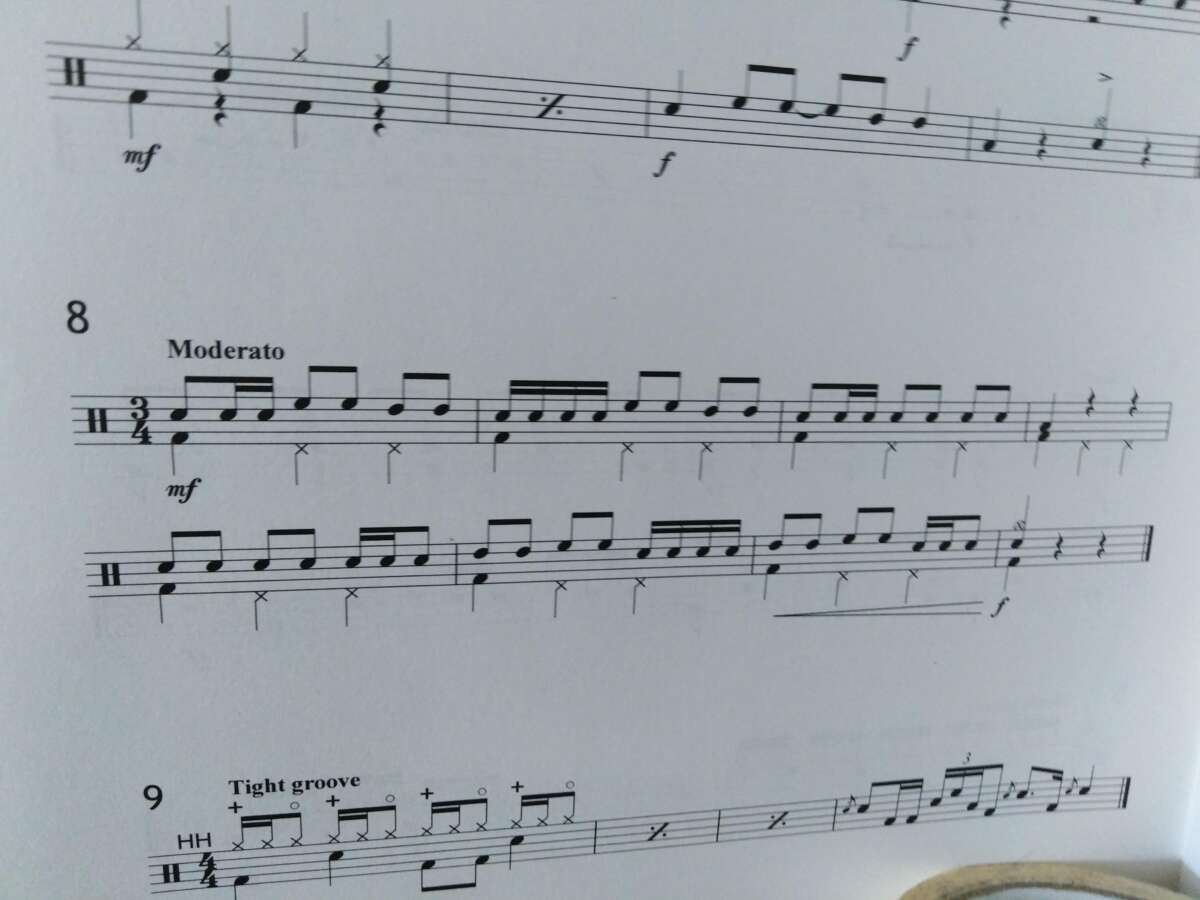
It can also show which hand to use, whether to play a roll, and how to repeat a section. Think of the page as a map. The horizontal flow shows time, while the symbols show what happens at each point in the beat.
When you learn how to read snare drum music, you are not only learning notes. You are learning rhythm, control, musical form, and expression.
Most beginner snare drum parts use one five-line staff. Unlike piano music, the staff does not usually show a wide range of pitches. The snare drum has a mainly unpitched sound, so the staff position often identifies the instrument rather than a specific melody note.
The exact note position can vary between books, teachers, publishers, and music software. Always check the legend or percussion key if one is provided.
The percussion clef
Snare drum music often uses a percussion clef. It looks like two vertical lines and tells you that the staff contains rhythm instruments rather than pitched notes.
The percussion clef does not work like a treble or bass clef. You do not need to memorize a pitch name for every line. Instead, you learn the position assigned to the snare drum, bass drum, cymbals, or other instruments.
For a single snare drum exercise, the most important information is often the rhythm. The staff position confirms that the notes belong to the snare drum part.

Learn the Staff, Measures, and Time Signature
The staff is the group of five horizontal lines where drum notes appear. Vertical bar lines divide the staff into measures, also called bars.
A measure is a small container of beats. The time signature tells you how many beats fit inside that container and what type of note receives one beat.
For example, 4/4 time is common in rock, pop, marching music, concert band, and many beginner exercises.
• The top number, 4, means four beats occur in each measure.
• The bottom number, 4, means a quarter note receives one beat.
You may count 4/4 as:
“1, 2, 3, 4”
You may also count it as:
“1 and 2 and 3 and 4 and”
The second method helps you read eighth notes. For sixteenth notes, count:
“1 e and a, 2 e and a, 3 e and a, 4 e and a”
These spoken syllables give each small part of the beat a clear place.
Common time signatures
Here are several time signatures you may see while learning how to read snare drum music:
• 2/4: Two quarter-note beats per measure. Common in marches and simple exercises.
• 3/4: Three quarter-note beats per measure. Often heard in waltzes.
• 4/4: Four quarter-note beats per measure. The most common starting point.
• 6/8: Six eighth-note beats per measure, often felt as two groups of three.
• Cut time, shown as a “C” with a line through it: Usually felt as two half-note beats per measure.
Do not confuse the number of written notes with the number of beats. Four eighth notes in 4/4 take up two beats, not four.
Bar lines and repeat signs
A single bar line marks the end of a measure. A double bar line may show the end of a section or piece.
Repeat signs tell you to play a section again. They usually look like two dots beside a bar line. The dots point toward the music you must repeat.
Other useful symbols include:
• First and second endings
• Coda signs
• Segno signs
• “D.S.”, meaning return to the sign
• “D.C.”, meaning return to the beginning
• “Fine,” meaning end
Read these signs before you start playing. Many errors happen because a drummer reads every note correctly but misses the form.
Understand Snare Drum Notes and Rests
Notes tell you when to make a sound. Rests tell you when to remain silent.
Silence is not empty space in music. A rest has a measured length, just like a note. If you skip a rest or hold it too long, the whole rhythm shifts.
Common note values
In 4/4 time, these note values are common:
• Whole note: Lasts four beats
• Half note: Lasts two beats
• Quarter note: Lasts one beat
• Eighth note: Lasts half a beat
• Sixteenth note: Lasts one quarter of a beat
A quarter note can be counted as “1.” Two eighth notes can be counted as “1 and.” Four sixteenth notes can be counted as “1 e and a.”
Here is a simple rhythm:
• Quarter note: “1”
• Two eighth notes: “2 and”
• Four sixteenth notes: “3 e and a”
• Quarter note: “4”
The rhythm is not about how many times you strike. It is about placing each strike at the correct moment.
Dotted notes
A dot after a note adds half of that note’s value.
For example:
• A dotted quarter note lasts one and a half beats.
• A dotted half note lasts three beats.
A dotted quarter note followed by an eighth note fills two beats. Count it as:
“1 and 2”
The first note begins on beat 1 and lasts through the “and.” The eighth note starts on beat 2.
Rests
Rests use their own symbols. You should learn the basic shapes along with the note values.
Common rests include:
• Whole rest: Four beats in 4/4
• Half rest: Two beats in 4/4
• Quarter rest: One beat
• Eighth rest: Half a beat
• Sixteenth rest: One quarter of a beat
When reading snare drum music, count rests out loud at first. Many students count notes but stop counting during silence. That causes them to enter too early.

Learn Note Stems, Flags, and Beams
The stem is the vertical line attached to a note head. Flags and beams show shorter note values.
One eighth note has a flag. Two or more eighth notes are often connected with a beam. Sixteenth notes have two flags or two beams.
The visual grouping helps you see how notes fit within the beat. For example, four sixteenth notes connected together usually occupy one quarter-note beat.
Do not play every written symbol with the same spacing. A group of four sixteenth notes must fit evenly into one beat. If you spread them out, the rhythm becomes too slow. If you rush them, the rhythm loses control.
A metronome can help you check this. Set it to a slow tempo and speak the subdivisions before playing them.
Ties
A tie is a curved line that joins two notes of the same pitch or instrument sound. A tied note is played once, and its value continues through the next note.
For example, a quarter note tied to an eighth note lasts one and a half beats. Do not strike the second note again.
Ties are different from slurs. In snare drum music, ties usually extend rhythm, while slurs may show connected phrasing in broader percussion writing.
Tuplets
A triplet divides a beat into three equal parts instead of two. In 4/4 time, an eighth-note triplet often fits three notes into one beat.
Count it as:
“Trip-o-let”
Or use:
“1-trip-let, 2-trip-let”
The number 3 usually appears above or below the grouped notes. Keep the three sounds even. Do not let the first note become too long.

Read Dynamics and Articulation Marks
Rhythm tells you when to play. Dynamics tell you how loudly to play.
Common dynamic marks include:
• pp: Very soft
• p: Soft
• mp: Moderately soft
• mf: Moderately loud
• f: Loud
• ff: Very loud
These marks describe musical levels, not exact decibel readings. A forte part in a small practice room should not be played with the same force as a forte part in a large marching ensemble.
You may also see gradual changes:
• Crescendo: Gradually get louder
• Decrescendo or diminuendo: Gradually get softer
A crescendo should develop over time. It should not sound like a sudden jump in volume.
Accent marks
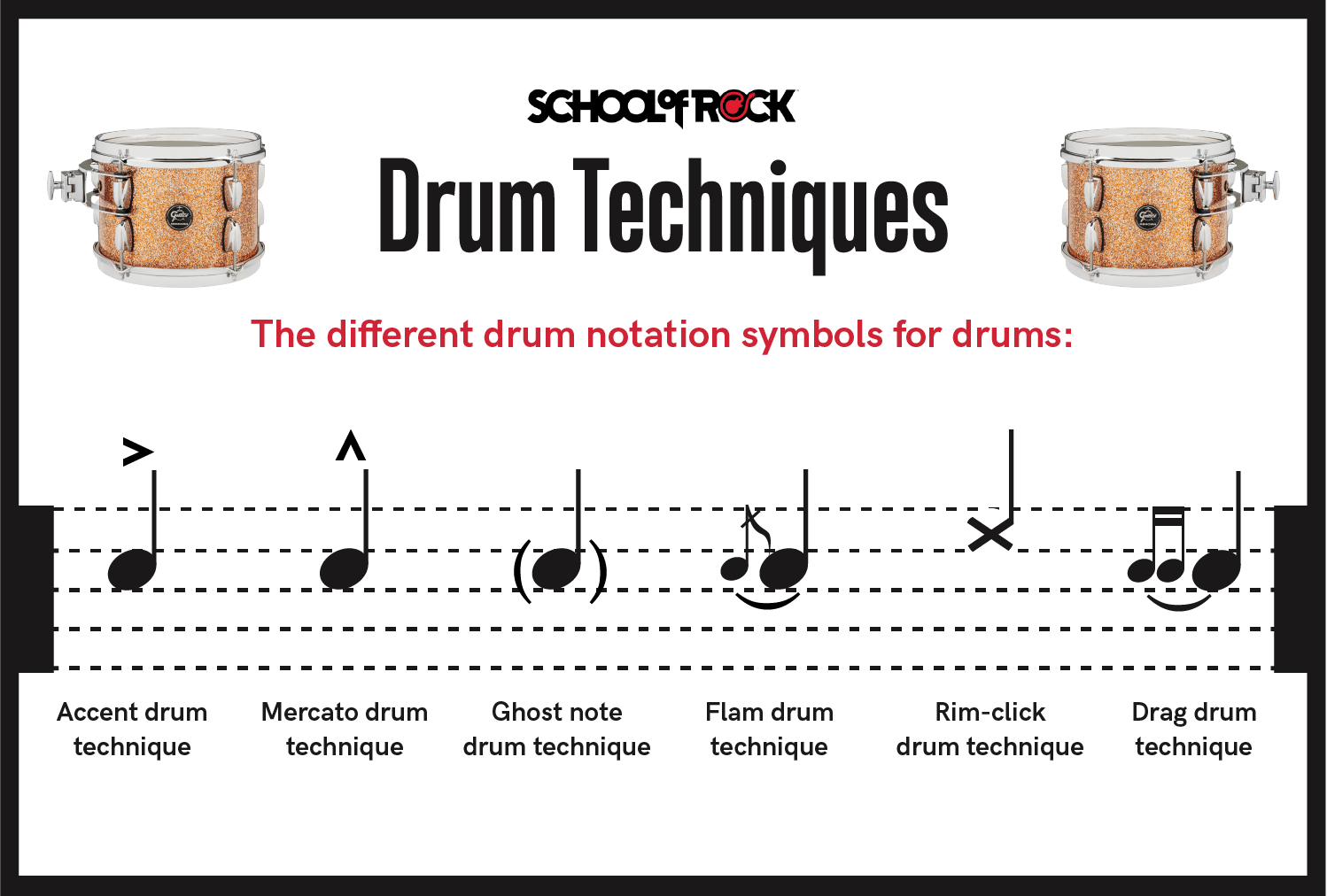
An accent mark looks like a small greater-than sign above or below a note. It tells you to give that note extra focus.
An accent does not always mean “hit as hard as possible.” A good accent is controlled. Keep the unaccented notes lower so the accented note stands out.
Ghost notes
A ghost note is played very softly. It may appear in parentheses or with a special marking, depending on the notation style.
Ghost notes are common in drum set parts, funk, jazz, and advanced snare studies. They support the groove without becoming the main sound.
Open and closed rolls
A roll mark may appear as one or more slashes through a note stem. It tells you to sustain the sound with repeated strokes.
A closed roll uses very fast, smooth strokes. An open roll uses clearly heard individual strokes. The notation and style guide help determine the intended sound.
Understand Sticking Notation
Sticking tells you which hand plays each note. The most common markings are:
• R: Right hand
• L: Left hand
You may see sticking written above or below the staff. Some books use capital letters, while others use small letters.
A simple alternating pattern looks like this:
R L R L R L R L
For a basic eighth-note rhythm, you might play:
R L R L
For accented patterns, a teacher may suggest:
R L R R L R L L
This type of sticking can help you prepare for repeated notes and moving accents.
Why sticking matters
Sticking affects speed, comfort, sound, and control. A poor sticking choice can make an easy rhythm feel awkward. A good sticking choice lets your hands move with less tension.
Do not change sticking without a reason. First learn the written pattern. Then test another option if the music feels uncomfortable or if a teacher recommends a change.
Common sticking mistakes
Beginners often make these errors:
• Starting every measure with the right hand
• Using one hand for every repeated note
• Ignoring written sticking
• Playing accents by squeezing the stick
• Lifting the sticks too high
• Allowing the weaker hand to become late
Your hands do not need to be identical at first. The goal is even timing and a consistent sound. Slow practice builds that balance.
Follow Tempo and Metronome Markings
Tempo tells you how fast the music should go. It may appear as a word, a number, or both.
Common tempo words include:
• Largo: Very slow
• Adagio: Slow
• Andante: Moderate and walking
• Moderato: Moderate
• Allegro: Fast
• Presto: Very fast
A marking such as quarter note = 80 means 80 quarter-note beats per minute.
Start below the written tempo if needed. Accuracy matters more than speed. Increase the metronome by a small amount only when you can play the passage several times without tension or mistakes.
How to practice with a metronome
Use this process:
- Clap the rhythm while the metronome plays.
- Count the rhythm using numbers and subdivisions.
- Tap the sticking on your leg or a practice pad.
- Play the passage slowly on the snare drum.
- Repeat it several times without stopping.
- Raise the tempo slightly when it feels steady.
A metronome is a guide, not a judge. If the click makes you tense, lower the volume or use it only on selected beats.
Tempo changes
Some music includes tempo changes such as:
• Ritardando, or rit.: Gradually slow down
• Accelerando, or accel.: Gradually speed up
• A tempo: Return to the previous tempo
• Fermata: Hold a note or rest longer than its written value
Follow the conductor, teacher, or ensemble when one is present. In a group, the shared pulse is more important than playing alone from memory.

A Step-by-Step Method for Reading Snare Drum Music
Use the following method each time you open a new exercise. It works for beginner rhythms and remains useful for advanced parts.
Step 1: Scan the page
Look for the time signature, tempo, repeats, dynamics, sticking, rolls, and unusual symbols. This first scan gives you a plan.
Step 2: Speak the count
Read the rhythm without playing. Use “1 and 2 and” for eighth notes and “1 e and a” for sixteenth notes.
If you cannot say the rhythm, you are not ready to play it at full speed.
Step 3: Tap the pulse
Tap your foot or lightly tap one hand. Keep the pulse steady while speaking the rhythm.
Do not tap every written note. Tap the main beat and speak the smaller subdivisions.
Step 4: Add sticking
Say “R” and “L” along with the count. For example:
“1 and 2 and”
“R L R L”
This connects the rhythm to your hands.
Step 5: Play slowly
Set a comfortable tempo. Use a relaxed grip and small stick motions. Focus on clean starts and equal spacing.
Step 6: Add dynamics
Once the rhythm is stable, shape the music. Add accents, soft notes, crescendos, and rolls.
Step 7: Review mistakes
Mark the exact place where you lost the beat. Practice that small section instead of restarting the entire page every time.
This method is one of the most useful ways to learn how to read snare drum music because it separates timing, movement, and expression.
Practice Examples for Beginners
Example 1: Quarter notes
In 4/4 time, four quarter notes fill one measure:
Count:
“1, 2, 3, 4”
Play:
R, L, R, L
Keep each note even. Do not rush beat 4 because you know the measure is about to end.
Example 2: Eighth notes
Eight eighth notes fill one measure:
Count:
“1 and 2 and 3 and 4 and”
Play:
R L R L R L R L
Keep the “and” between the main beats equal in length.
Example 3: Quarter notes and rests
Try this pattern:
• Beat 1: Quarter note
• Beat 2: Quarter rest
• Beat 3: Two eighth notes
• Beat 4: Quarter note
Count:
“1, 2, 3 and, 4”
The most important part is the silence on beat 2. Keep counting while your hands remain still.
Example 4: Sixteenth notes
Four sixteenth notes on beat 1 are counted:
“1 e and a”
You can play them as:
R L R L
Start very slowly. Make all four sounds equal before increasing speed.
Example 5: Accents
Play eight eighth notes, but accent beat 1 and beat 3:
“ONE and 2 and THREE and 4 and”
Use a higher controlled stroke for the accented notes. Keep the other notes soft and close to the drum.
Common Problems and How to Fix Them
Reading notes but losing the pulse
Some players focus so closely on the symbols that they forget the beat. Count aloud and use a metronome at a slow tempo.
Rushing easy sections
Drummers often speed up during simple notes and slow down during hard notes. Keep the pulse steady through both.
Record yourself for one minute. Listening back can reveal timing changes that are hard to feel while playing.
Ignoring rests
A rest still has rhythm. Count it with the same care as a played note.
Playing too loudly
Loud playing can hide uneven timing and poor control. Practice softly enough to hear every stroke clearly.
Stopping after every mistake
Stopping breaks your sense of musical time. Keep going when possible, then return to the problem area and practice it alone.
Looking too far ahead
Read slightly ahead of the note you are playing. This helps you prepare for changes in rhythm and dynamics.
Using tension
Tight shoulders, stiff wrists, and a squeezed grip reduce control. Take short breaks and shake out your hands when needed.
How to Improve Faster
Consistent short practice is usually more useful than rare, long sessions. Even 15 minutes can help if the work has a clear goal.
A simple practice plan may look like this:
• 3 minutes: Warm up with single strokes
• 4 minutes: Read quarter and eighth-note rhythms
• 4 minutes: Practice rests and subdivisions
• 3 minutes: Work on accents or dynamics
• 1 minute: Play the full exercise without stopping
Use a practice pad when a full drum is not available. A pad is useful for timing and sticking, although it cannot fully replace the sound and rebound of a real snare drum.
Practice with different tempos. Slow tempos expose spacing problems, while faster tempos test control. Both are important.
It also helps to read many types of music. Try beginner method books, concert band parts, marching exercises, drum set charts, and orchestral excerpts. Each style teaches a different form of control.
A useful lesson from many beginner rehearsals is this: do not chase speed before the rhythm feels calm. Speed built on tension will usually collapse. Speed built on relaxed movement can grow.
Helpful Tools and Learning Resources
Several tools can support your progress:
• A metronome for steady tempo
• A practice pad for quiet repetition
• A pencil for marking counts and sticking
• A recording device for checking timing
• A music stand for proper reading posture
• A drum method book with graded exercises
• A teacher or ensemble director for feedback
Choose music that is slightly challenging, not impossible. If every measure feels confusing, the exercise may be too advanced for your current level.
Credible percussion education often emphasizes rhythm reading, proper technique, musical listening, and gradual tempo growth. These principles appear across school band programs, private instruction, drum corps training, and professional percussion study.
Notation is not perfectly universal. Different publishers may place notes differently or use different roll symbols. When symbols conflict, use the key printed in the book and ask the director or teacher for clarification.
Frequently Asked Questions About How to Read Snare Drum Music
Do I need to read pitched music to play snare drum?
No. Snare drum music mainly uses rhythm notation because the drum does not produce a clear pitched note like a piano or trumpet. You do need to understand the staff, note values, rests, time signatures, and musical symbols.
What should I learn first when reading snare drum music?
Start with quarter notes, quarter rests, eighth notes, and 4/4 time. Then practice counting aloud before adding sticking, accents, rolls, and faster subdivisions.
How do I count sixteenth notes on snare drum?
Count sixteenth notes as “1 e and a, 2 e and a, 3 e and a, 4 e and a.” Begin slowly with a metronome and make all four parts of each beat even.
What do R and L mean in snare drum music?
R means right hand, and L means left hand. These marks show the suggested sticking, which can help you play rhythms with better control and less tension.
Why do snare drum notes appear in different places on the staff?
Percussion notation can vary by instrument, publisher, and software. Check the percussion key or legend, because the staff position identifies the instrument rather than showing a normal melodic pitch.
How long does it take to learn how to read snare drum music?
Many beginners can understand basic rhythms within a few practice sessions. Reading fluently takes longer and depends on steady practice, accurate counting, and exposure to different rhythms.
Should I use a metronome every time I practice?
A metronome is helpful, but you do not need it for every minute of practice. Use it to check your pulse, then spend some time playing freely while keeping the beat internally.
Conclusion
Reading snare drum music becomes much easier when you break it into parts. First learn the staff, time signature, note values, rests, and counting. Then add sticking, dynamics, rolls, accents, repeats, and tempo changes.
The best approach is simple: scan the page, speak the rhythm, tap the pulse, add sticking, and play slowly. With regular practice, the symbols will stop looking like a puzzle and start feeling like a clear set of instructions.
Choose one short exercise today and read it aloud before you play. Keep your hands relaxed, count every rest, and build speed only after the rhythm is steady. Continue exploring new percussion music, and share your progress or questions with a teacher, drummer, or music community.

Senior Music Reviewer
Alex Carter is a seasoned music reviewer with over a decade of experience in the world of sound and instruments. Passionate about helping musicians and enthusiasts make informed choices, he brings sharp insights and in-depth knowledge to every review. From classical instruments to modern gear, Alex combines technical expertise with a love for music to deliver content that resonates with readers.
As a Senior Music Reviewer and expert author on Tuneluma.com, Alex is dedicated to sharing honest evaluations, practical advice, and thoughtful commentary to guide readers in their musical journey.