
How Do You Play Silent Night On The Piano: Easy Guide
You can play Silent Night on the piano with a simple right-hand melody and a few easy left-hand chords.
Learning how to play Silent Night on the piano is a gentle way to build confidence, even if you are a complete beginner. The song uses a calm melody, simple chord changes, and a slow 3/4 rhythm. This guide explains the notes, chords, fingering, rhythm, practice method, and common mistakes so you can play the carol with a warm, steady sound.
What You Need to Know Before You Start
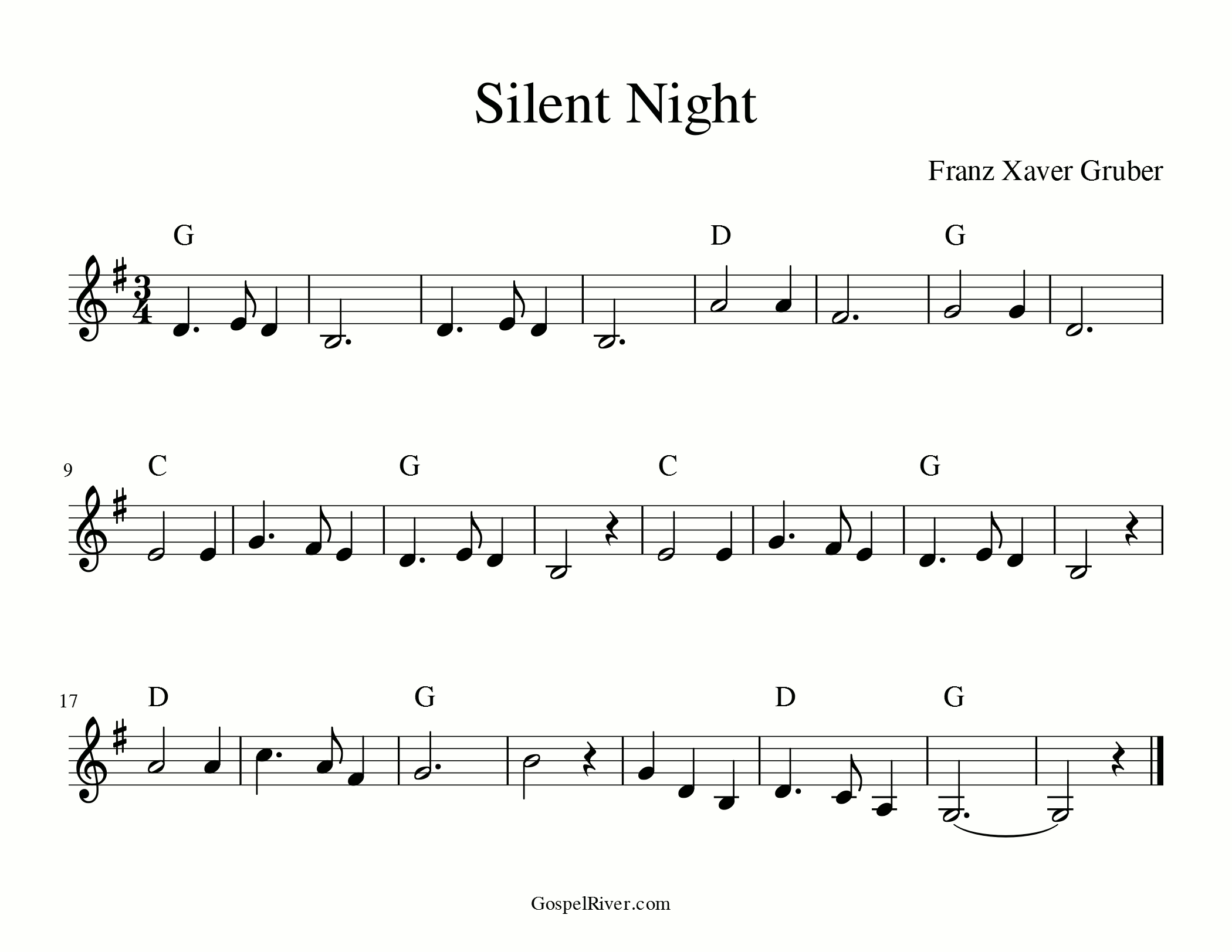
Silent Night was written in 1818 by Franz Xaver Gruber, with lyrics by Joseph Mohr. The original song is commonly played in 3/4 time, which gives it a soft, rocking pulse.
For this guide, we will use the key of C major. This key has no sharps or flats, so it is one of the easiest keys for new piano players.
You will use:
• Your right hand to play the melody
• Your left hand to play bass notes or chords
• A slow, even count of “1, 2, 3”
• The C major scale as your main group of notes
Find middle C first. On most pianos, middle C is near the center of the keyboard. It is the white key just to the left of a group of two black keys.

The Easy Piano Notes for Silent Night
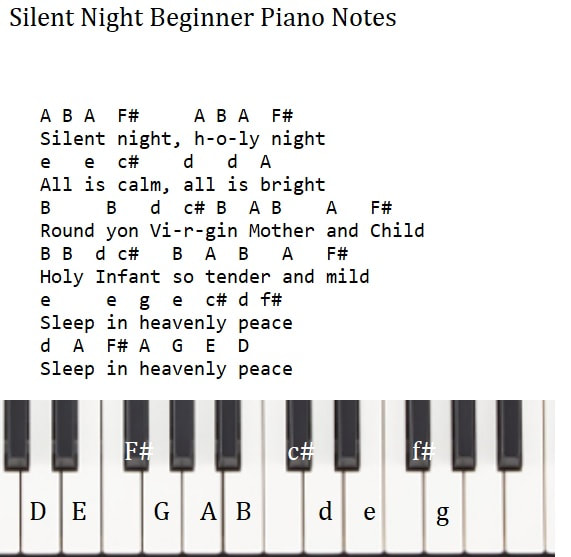
The right-hand melody begins with the notes G, A, G, and E. These notes match the words “Si-lent night.”
Here is a simple version of the opening melody in C major:
G  A  G  E
Si-lent night

G  A  G  E
Ho-ly night

D  D  B  C  C  G
All is calm, all is bright
The note names above show the main tune. You still need to listen to the song or use sheet music to learn the exact rhythm and note lengths.
A longer beginner-friendly outline is:
G  A  G  E
G  A  G  E

D  D  F  D
C  C  G

A  A  C  B  A  G
A  G  E

G  A  G  E
G  A  G  E

D  D  F  D
C  C  G
Different arrangements may change a few notes, especially in the middle section. This happens because Silent Night has many traditional piano versions. If your sheet music differs slightly, follow its rhythm and note markings.
The most important part is to learn the tune in short phrases. Do not try to memorize the whole song at once. Start with “Silent night, holy night,” then add the next phrase after your fingers feel comfortable.

Simple Chords for Silent Night
The easiest way to play Silent Night on the piano is to use basic chords in the left hand. In C major, the main chords are C, G7, and F.
Here are the notes in each chord:
• C major: C, E, G
• F major: F, A, C
• G7: G, B, D, F
If full chords feel hard, play only the lowest note of each chord. For example, play C for a C chord, F for an F chord, and G for a G7 chord.
A simple chord pattern may look like this:
C       G7      C
Silent night, holy night

F       C       G7      C
All is calm, all is bright
You can hold each chord for one full measure. Since the song is in 3/4 time, count:
1 2 3
Play the chord on count 1, then let it ring through counts 2 and 3.
For a fuller sound, use a broken-chord pattern:
Bass note – chord – chord
1          2       3
For a C chord, play C with the left-hand pinky on beat 1. Then play E and G together on beats 2 and 3. This creates a soft, flowing accompaniment.

How to Play Silent Night on the Piano Step by Step
Follow these steps if you are learning how to play Silent Night on the piano for the first time.
1. Find the starting note
Place your right-hand thumb on middle C. Move up to G with your fifth finger. The melody begins on G in this simple arrangement.
You do not need to use the same finger for every note. Choose a position that keeps your hand relaxed and close to the keys.
2. Learn the right-hand melody
Practice the first four notes:
G A G E
Play them slowly. Say the lyric as you play. The words help you remember both the melody and the rhythm.
Next, practice:
G A G E
This repeats the opening idea. Repeated phrases make Silent Night easier than many other holiday songs.
3. Add the next phrase
Practice the notes for “All is calm, all is bright.” In a basic arrangement, the melody moves through:
D  D  F  D
C  C  G
Keep your fingers light. The song should sound peaceful, not forceful.
4. Add the left hand
Once your right hand feels steady, add one left-hand bass note at the start of each measure. Use C, F, or G based on the chord symbols in your arrangement.
Do not add complex chords too soon. A single bass note can sound musical and gives you time to build coordination.
5. Join both hands slowly
Play one measure at a time. Stop after each measure and check whether both hands stayed together.
Use a metronome at about 50 to 60 beats per minute. In 3/4 time, let the first beat feel strong and the next two beats feel light.
6. Shape the ending
The final phrase should become softer. Slow down slightly at the end, but do not stop between notes.
A gentle ending makes the song feel complete. Think of the sound as a candle flame rather than a drumbeat.
How to Count the Rhythm
Silent Night has a waltz-like 3/4 rhythm. This means each measure has three beats, with the first beat usually receiving the most emphasis.
Count each measure like this:
ONE, two, three
ONE, two, three
Avoid giving all three beats the same strength. That can make the song sound stiff.
A useful left-hand pattern is:
Beat 1: bass note
Beat 2: chord
Beat 3: chord
For example, with a C chord:
Beat 1: C
Beat 2: E and G
Beat 3: E and G
For a simple chord version, you can also play the full chord once on beat 1 and hold it. This is often the best choice for young players and adults who are new to piano.
If the melody feels rushed, count out loud. Speaking the beat can help your hands settle into the song. Many beginners know the notes but lose the rhythm because they start playing faster than they can think.

Beginner Fingering Tips
Fingering is not fixed in every Silent Night arrangement. The best fingering depends on the starting position, hand size, and difficulty of the version you use.
For the opening phrase, you might use:
G  A  G  E
5  1  5  3
This fingering may require a small hand movement. Another option is to shift your hand so the thumb can reach A more easily.
Keep these points in mind:
• Keep your wrist level and loose.
• Avoid lifting your fingers high above the keys.
• Move your hand as a unit when the melody changes position.
• Use the thumb carefully when crossing under the hand.
• Choose comfort and control over strict fingering rules.
A common mistake is pressing every note with too much force. Silent Night sounds best with a soft touch. Start quietly, then increase the volume only if the melody disappears.
If your hands feel tense, stop and shake them gently. Tension slows learning and can lead to discomfort.
Common Mistakes to Avoid
Knowing how to play Silent Night on the piano is not only about finding the correct notes. Musical control matters just as much.
Playing too fast
The song has a calm mood. If you rush, the melody can lose its peaceful character.
Start at a speed that feels almost too slow. Once you can play without stopping, increase the tempo by a small amount.
Ignoring the 3/4 meter
Some beginners count the song in four beats because they are used to common time. This changes the natural flow.
Always feel the strong first beat followed by two lighter beats.
Using too many chords
A large chord in every beat can make the accompaniment sound heavy. Begin with one chord per measure, then add movement only when the melody feels secure.
Forgetting the melody
The right hand should usually stand out above the left hand. If the left hand is louder, the listener may lose the tune.
Practice the melody alone until you can sing it while playing.
Holding the sustain pedal too long
The sustain pedal can blend notes, but too much pedal makes the music cloudy. Change the pedal when the harmony changes.
If you are unsure, practice without the pedal first. Add a small amount later.

A Simple Practice Plan
A short daily routine can help you learn how to play Silent Night on the piano without feeling overwhelmed.
Try this 15-minute plan:
-
Warm up for three minutes with the C major scale.
-
Practice the right-hand melody for five minutes.
-
Practice the left-hand chords for three minutes.
-
Join both hands for three minutes.
-
Play the full song once without stopping.
During practice, focus on one goal at a time. For example, work on rhythm during one session and smooth chord changes during the next.
If you make a mistake, keep the beat going when possible. Stopping after every error can make the song sound broken. Instead, mark the difficult measure and repeat it several times at a slow speed.
A helpful teaching principle is to practice the hardest part first. If the middle phrase causes trouble, do not always begin at the introduction. Work directly on that phrase while your attention is fresh.
How to Make the Song Sound More Expressive
Once you can play the notes, add musical feeling. This is what turns a basic exercise into a performance.
Use a soft dynamic for the first verse. You can make the middle phrase slightly fuller, then return to a gentle sound near the end.
Try these expressive ideas:
• Play the melody louder than the accompaniment.
• Use a smooth touch between connected notes.
• Breathe slightly between phrases.
• Slow down a little during the final two measures.
• Use the sustain pedal lightly after changing chords.
Imagine that the melody is a quiet message shared across a room. This image can help you avoid sharp attacks and uneven timing.
You can also sing the words while playing. Singing reveals whether the melody flows naturally. If you cannot sing a phrase comfortably, your piano phrasing may need more space.
Easy Variations for Different Skill Levels
There is more than one way to play Silent Night on the piano. Choose a version that matches your current ability.
Very easy version
Play the melody with your right hand and single bass notes with your left hand. This version is ideal for a first performance.
Beginner chord version
Use C, F, and G7 chords in the left hand. Hold each chord for one measure while the right hand plays the melody.
Early intermediate version
Use broken chords, such as:
Bass note, fifth, third, fifth
For a C chord, this could be:
C, G, E, G
This creates a gentle flowing pattern.
Intermediate version
Add chord inversions to reduce hand movement. For example, use a nearby G7 shape instead of jumping across the keyboard.
You can also add a short introduction using the C and G7 chords. Keep the introduction simple so it supports the song rather than distracting from it.
Advanced version
An advanced arrangement may include richer harmony, passing chords, octave melody, or a second verse with decorative notes. These versions can sound beautiful, but they require stronger control and should come after the basic melody is secure.
Playing Silent Night for Other People
If you plan to play Silent Night at a holiday gathering, choose reliability over difficulty. A simple arrangement played with good timing often sounds better than a hard arrangement filled with stops and mistakes.
Before playing:
• Check that your bench height feels comfortable.
• Test the sustain pedal.
• Play the first few notes quietly.
• Take one calm breath before you begin.
• Keep your eyes on the music or use memory only if it feels secure.
If you lose your place, stop the melody for a moment and return at the beginning of the next phrase. Most listeners will not notice a small recovery if you keep the rhythm calm.
For a group setting, play slightly slower than you would play alone. People may sing along, and a steady tempo gives them room to follow.
Why Silent Night Is Good for Beginner Pianists
Silent Night is useful for early piano study because it teaches several core skills at once.
It helps you practice:
• Playing a familiar melody
• Reading notes in the treble clef
• Coordinating both hands
• Counting in 3/4 time
• Changing between basic chords
• Controlling soft dynamics
• Using the sustain pedal
The song also gives beginners an emotional reason to practice. Familiar music can feel more rewarding than a technical exercise with no personal meaning.
Still, Silent Night is not effortless for every player. The slow tempo exposes uneven timing, weak finger control, and poor coordination. That is helpful because you can hear exactly what needs work.
Frequently Asked Questions About How Do You Play Silent Night on the Piano
What are the easiest piano notes for Silent Night?
In C major, the opening melody uses G, A, G, and E. The rest of the tune mainly uses notes from the C major scale, although some arrangements include a few different notes.
What chords are used in Silent Night?
A simple version commonly uses C major, F major, and G7. Some arrangements add A minor, D minor, or other passing chords for a richer sound.
Is Silent Night easy to play on the piano?
Yes, the melody is suitable for beginners, especially when played slowly in C major. Playing both hands together and keeping the 3/4 rhythm steady may take more practice.
What key is best for a beginner to play Silent Night?
C major is usually the easiest key because it uses only white keys. If you plan to sing, you may later move the song to another key that better fits your voice.
Do I need to read sheet music to play Silent Night?
No. You can learn the melody from letter names, a tutorial, or by ear. Sheet music becomes helpful when you want to follow exact rhythm, dynamics, fingering, and chord changes.
Should I use the sustain pedal?
You can use the sustain pedal lightly after each chord change. Practice without it first, because too much pedal can mix the harmonies and make the song sound unclear.
How long does it take to learn Silent Night on the piano?
A beginner may learn a simple melody in a few practice sessions. Learning to play both hands smoothly with expression can take one to several weeks, depending on practice time and prior experience.
Conclusion
Learning how to play Silent Night on the piano starts with a simple melody, three basic chords, and a steady 3/4 count. Begin in C major, practice the right hand alone, add single bass notes, and then build toward full chords and gentle pedal use.
Keep the tempo slow, let the melody lead, and give each phrase room to breathe. With a few focused practice sessions, you can turn this timeless carol into a warm performance for yourself, your family, or a holiday gathering. Explore more beginner piano songs, and share how your version of Silent Night sounds.

Senior Music Reviewer
Alex Carter is a seasoned music reviewer with over a decade of experience in the world of sound and instruments. Passionate about helping musicians and enthusiasts make informed choices, he brings sharp insights and in-depth knowledge to every review. From classical instruments to modern gear, Alex combines technical expertise with a love for music to deliver content that resonates with readers.
As a Senior Music Reviewer and expert author on Tuneluma.com, Alex is dedicated to sharing honest evaluations, practical advice, and thoughtful commentary to guide readers in their musical journey.