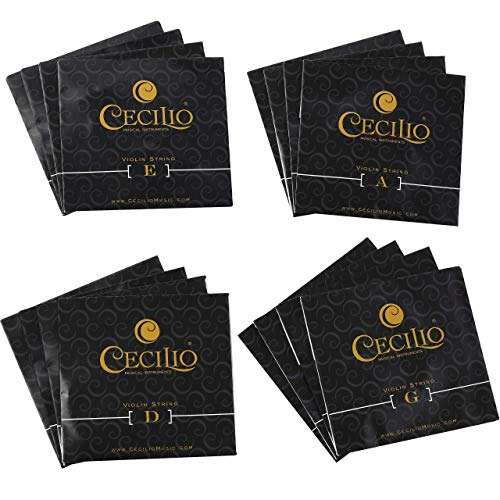
In the United States, a new set of violin strings usually costs $15 to $120, before tax and shipping. Most student and intermediate players spend $25 to $60 for a full set. Professional or specialty strings often cost $70 to $120 or more.
The price depends on the violin’s size, the string material, the brand, and whether a shop installs the strings. A basic student set may cost less than $20, while premium synthetic-core strings can cost several times more.
Quick answer: What should you budget?
For most players in the U.S., these are realistic price ranges:
| Violin string type | Typical price for four strings | Best suited for |
|---|---|---|
| Basic steel strings | $10–$25 | Beginners, school instruments, bright sound |
| Student synthetic-core strings | $20–$40 | Beginners and early intermediate players |
| Intermediate synthetic-core strings | $35–$70 | Regular practice and performance |
| Premium synthetic-core strings | $60–$120+ | Advanced players and professionals |
| Specialty or soloist sets | $80–$150+ | Players seeking a specific tone or response |
| Individual replacement string | $5–$35 | Replacing one broken or worn string |
| String installation at a shop | $10–$30 | Players who do not want to change strings themselves |
| Full setup with new strings | $60–$150+ | Instruments needing bridge, peg, or adjustment work |
These are general U.S. retail ranges. Sales, shipping, taxes, string size, and local labor rates can change the final total.


What makes violin strings cost more?
The biggest price factors are the core material, winding, brand, size, and intended use.
String core material
The core is the inner part of the string. It strongly affects sound, feel, stability, and price.
- Steel-core strings are often the least expensive. They tend to produce a clear, direct, and bright sound.
- Synthetic-core strings use a man-made fiber inside the winding. They often offer a warmer and more complex sound than basic steel strings.
- Gut-core strings use natural gut. They can produce a rich sound, but they are less common for beginners and need more care.
- Specialty cores may combine materials to create a certain response or tone.
Synthetic-core sets often cost more than basic steel sets because they use more complex materials and construction.
Winding materials
The core may be wrapped with aluminum, silver, chrome steel, tungsten, or other metals. The winding changes the string’s weight, feel, tone, and durability.
A silver-wound G string, for example, may cost more than a basic steel G string. A tungsten-wound string can also cost more because tungsten is dense and helps make a string thinner while keeping suitable tension.
Brand and product line
String makers sell several levels of product. A brand may offer:
- A low-cost student set
- A mid-priced general-purpose set
- A premium performance set
- Specialty strings for solo, chamber, baroque, or orchestral playing
The price difference does not mean the most expensive set is best for every violin. A costly string can sound harsh, weak, or unstable on an instrument that does not suit it.
Violin size
Full-size 4/4 violin strings are the most common and usually have the widest selection. Smaller violins, such as 1/2, 1/4, and 1/8 sizes, may have fewer choices.
A smaller set may cost about the same as a full-size set. Do not assume that a smaller violin always needs cheaper strings.
Where you buy them
A U.S. music store, violin shop, online string retailer, or general marketplace may list different prices. A specialist shop may charge more but offer better product advice and proper storage.


Check the full order cost. A $25 set with $10 shipping may cost more than a $30 set bought locally.

Typical prices by player level
Your playing level can help set a sensible budget, but it should not be the only factor.
Beginner violin strings: about $10 to $35
A beginner usually does not need the most expensive string set. A dependable steel or student synthetic set is often enough.
Basic steel strings may cost around $10 to $25. Student synthetic-core strings often fall between $20 and $35.
Choose this range when:
- The violin is used for lessons or school orchestra.
- The player is still learning basic bow control.
- The instrument is inexpensive or rented.
- You are not yet sure what tone you prefer.
A very cheap set can be useful for a temporary repair, but extremely low prices may reflect poor quality, old stock, or an unknown seller.
Intermediate violin strings: about $35 to $70
Players who practice often may benefit from a better synthetic-core set. These strings can offer more color and a smoother response.
Many popular intermediate sets fall between $35 and $60. Some cost closer to $70, especially when they use premium winding materials or include specialty designs.
This range is often the best value for a player who:
- Practices several days each week
- Performs in school, community, or amateur groups
- Wants more warmth or projection
- Plans to keep the same violin for several years
Advanced and professional strings: about $60 to $120 or more
Premium sets may cost $60 to $120. Some soloist or specialty sets cost more than $120.
These strings may provide a particular mix of:
- Fast response
- Strong projection
- Warmth
- Focus
- Playing comfort
- Fine control at different bow speeds
The extra cost does not guarantee a better result. The violin, bow, setup, and player all affect the outcome.
A premium string set that does not match the instrument can waste money. It may also make the violin harder to control.


Examples of common violin string price tiers
The following examples describe common product categories, not fixed prices. Retail prices change by store and over time.
| Example category | Common U.S. price range | General character |
|---|---|---|
| Basic steel student set | $10–$20 | Clear, bright, simple response |
| Popular student synthetic set | $20–$35 | Balanced and easy to use |
| Well-known intermediate set | $35–$60 | More warmth and tonal color |
| Premium synthetic set | $60–$100 | Stronger detail and projection |
| High-end soloist set | $90–$150+ | Designed for demanding performance use |
| Premium single A, D, G, or E string | $8–$35 | Useful for mixing brands or replacing one string |
Some well-known violin string families include D’Addario Prelude, D’Addario Ascente, Thomastik-Infeld Dominant, Pirastro Tonica, Pirastro Evah Pirazzi, and Larsen violin strings. Each product line has different versions, sizes, tensions, and prices.
Use the manufacturer’s product information to confirm the intended violin size and string type. Retail listings can contain errors, especially when sellers group several sizes or versions under one page.
Do you need to replace all four violin strings?
You do not always need a complete set. If one string breaks soon after installation, replacing that single string may be enough.
A full set is usually better when:
- The strings are old and worn.
- The strings have lost their tone.
- More than one string needs replacement.
- You are changing to a different string type.
- The current set has uneven tension or response.
- You want the violin to sound balanced across all four strings.
Replacing only one string can save money, but the new string may sound brighter than the other three. This difference often becomes less noticeable as the new string settles.
For a normal full replacement, buy a matched set. The four strings are designed to work together.

How often should violin strings be replaced?
Many players replace violin strings every six to twelve months. Frequent players may replace them every two to four months. A casual player may use the same set longer.
Replace strings sooner when you notice:
- A dull or weak sound
- Less volume than before
- Rough spots or damaged winding
- Whistling or unstable response
- Frequent tuning problems
- A string that feels stiff or false
- Visible corrosion
- A string that will not hold its pitch
Playing time matters more than the calendar. A student who practices two hours daily may wear out strings much faster than a player who practices once a week.
Sweat, humidity, hand oils, bow pressure, and string quality also affect string life. Wipe the strings with a clean, dry cloth after playing. Do not use household cleaners or oils unless the string maker specifically recommends them.
Estimated yearly string cost
You can estimate yearly cost with a simple calculation:
Annual string cost = price of one set × number of sets used per year
For example:


- A $25 set replaced twice per year costs about $50 annually.
- A $50 set replaced four times per year costs about $200 annually.
- A $90 set replaced every six months costs about $180 annually.
This calculation excludes installation, tax, and shipping.
A more expensive set may be cheaper over time if it lasts longer, but do not assume that premium strings always have a longer life. Tone and playing conditions affect durability.

How much does it cost to have violin strings installed?
A music store or violin shop may charge $10 to $30 to install strings. Some shops include installation when you buy the strings there. Others charge more if the instrument also needs repair or adjustment.
A full violin setup may cost $60 to $150 or more, depending on the shop and the work required. A setup can include:
- String replacement
- Bridge inspection or fitting
- Peg adjustment
- Soundpost inspection
- Fingerboard and nut checks
- General cleaning
- Minor repairs
Changing strings is not the same as a full setup. New strings cannot fix a badly fitted bridge, loose peg, open seam, damaged tailpiece, or soundpost problem.
If the bridge moves, leans, or falls while you change strings, stop and ask a qualified violin shop for help. The bridge must stand in the correct position and angle.
Can you change violin strings yourself?
Yes. Many players change their own strings. The task is simple once learned, but careless replacement can cause problems.
Before starting, have:
- The correct string set
- A violin tuner
- A clean cloth
- A peg compound if needed
- A stable place to work
Change one string at a time. This keeps the bridge and soundpost under more consistent tension.
Basic steps:
- Loosen and remove one old string.
- Check that the bridge remains upright.
- Place the ball or loop end in the tailpiece.
- Guide the other end into the correct peg.
- Wind the string neatly toward the peg wall.
- Tune slowly.
- Check the bridge again.
- Stretch and retune gently as the string settles.
Do not pull a string hard to speed up the process. Excess force can break the string or damage the violin.
If the peg slips, the bridge tilts, the string sits outside its groove, or the violin makes a sudden crack, stop. A violin repair professional should inspect the instrument.


How to choose the right violin strings for your budget
Start with the violin and the player, not the highest price.
For a beginner or rental violin
Choose a reliable student set in the $15 to $35 range. Ask the teacher or rental shop what type is already on the violin.
Keeping a familiar string type can make tuning and tone easier to manage.
For a student who practices often
Consider a mid-priced synthetic set around $30 to $60. This can provide a useful balance between cost, comfort, and tone.
Ask whether the violin sounds too bright, too dark, thin, or muffled. The answer can guide the next string choice.
For an advanced player
Compare several premium sets in the $60 to $120 range. If possible, test strings with a teacher, luthier, or violin shop.
A good choice should match:
- The violin’s natural tone
- The bow
- The player’s technique
- The music being played
- The desired projection and response
When money is tight
Replace the most damaged string first. If the whole set is worn, choose a dependable student or intermediate set rather than mixing random low-cost strings.
Avoid buying strings solely because a listing uses words such as “professional,” “concert,” or “premium.” Those words do not prove that the strings will suit your violin.

Common mistakes when buying violin strings
Several simple mistakes can increase cost or cause poor results.
Buying the wrong size
A 3/4 violin and a 4/4 violin do not use the same string length. Check the violin size before ordering.
Confusing a single string with a full set
Some listings show one string in the product image but sell only a single A, D, G, or E string. Read the quantity carefully.
Ignoring tension
Many string lines come in low, medium, or high tension. Medium tension is a common starting point, but the best choice depends on the instrument.
Choosing by price alone
Cheap strings can work well on some instruments. Expensive strings can work poorly on others. Sound, response, and stability matter more than price by itself.


Mixing strings without a plan
Mixing brands is not always wrong. Players sometimes use a different E string or combine strings to balance a violin. However, random combinations may create uneven volume or response.
Leaving strings on too long
Old strings may make the violin feel difficult to play. A player may then press harder with the bow or hand, which can create poor habits.

Where to buy new violin strings in the United States
You can buy violin strings from:
- Local violin shops
- Full-service music stores
- Specialty string retailers
- Large online music stores
- Manufacturer-authorized dealers
- School or orchestra supply stores
A local violin shop can help match strings to the instrument. An online store may offer more brands and lower listed prices. Check return rules because some shops will not accept opened string packages.
Buy from a seller that provides clear information about:
- String size
- String model
- Tension
- Quantity
- Manufacturer
- Return policy
- Shipping cost
Avoid unusually cheap listings with unclear product details. Old, counterfeit, damaged, or poorly stored strings may not perform as expected.
For product specifications, consult the makers’ official pages, such as D’Addario’s violin strings information, Thomastik-Infeld’s string catalog, Pirastro’s product information, and Larsen Strings. These pages help confirm sizes and product families, while the seller determines the current retail price.

Frequently asked questions
Are expensive violin strings worth the money?
They can be worth the money for a player who needs a specific sound or response. They are not automatically better for every violin. A mid-priced set is often the best starting point when you do not know which sound you want.
What are the cheapest decent violin strings?
Basic steel sets often provide the lowest reasonable cost, usually around $10 to $25. A dependable student synthetic set may cost more but can offer a warmer and more flexible sound.
Is it cheaper to buy strings online?
The listed price may be lower online, but shipping and tax can reduce the savings. Compare the final checkout price with the price at a local music or violin shop.
Can one violin use different brands of strings?
Yes. Many players mix brands, especially when testing a different E string or balancing the tone. Change one variable at a time so you can tell what affects the sound.
Should a beginner buy premium violin strings?
Usually not as a first step. A beginner may gain more from a good setup, proper tuning, lessons, and a suitable bow. A reliable set in the $20 to $40 range is often a sensible starting point.
Bottom line
Most new violin strings in the United States cost $15 to $60 per set. Beginners can usually stay near the lower end, while advanced players may spend $60 to $120 or more for premium strings.
Before buying, confirm the violin size, string quantity, tension, and return policy. If you are unsure, ask a teacher or violin shop to recommend a set that matches the instrument. Start with a dependable mid-priced option, then compare other strings only when you have a clear reason to change.

Senior Music Reviewer
Alex Carter is a seasoned music reviewer with over a decade of experience in the world of sound and instruments. Passionate about helping musicians and enthusiasts make informed choices, he brings sharp insights and in-depth knowledge to every review. From classical instruments to modern gear, Alex combines technical expertise with a love for music to deliver content that resonates with readers.
As a Senior Music Reviewer and expert author on Tuneluma.com, Alex is dedicated to sharing honest evaluations, practical advice, and thoughtful commentary to guide readers in their musical journey.