Introduction
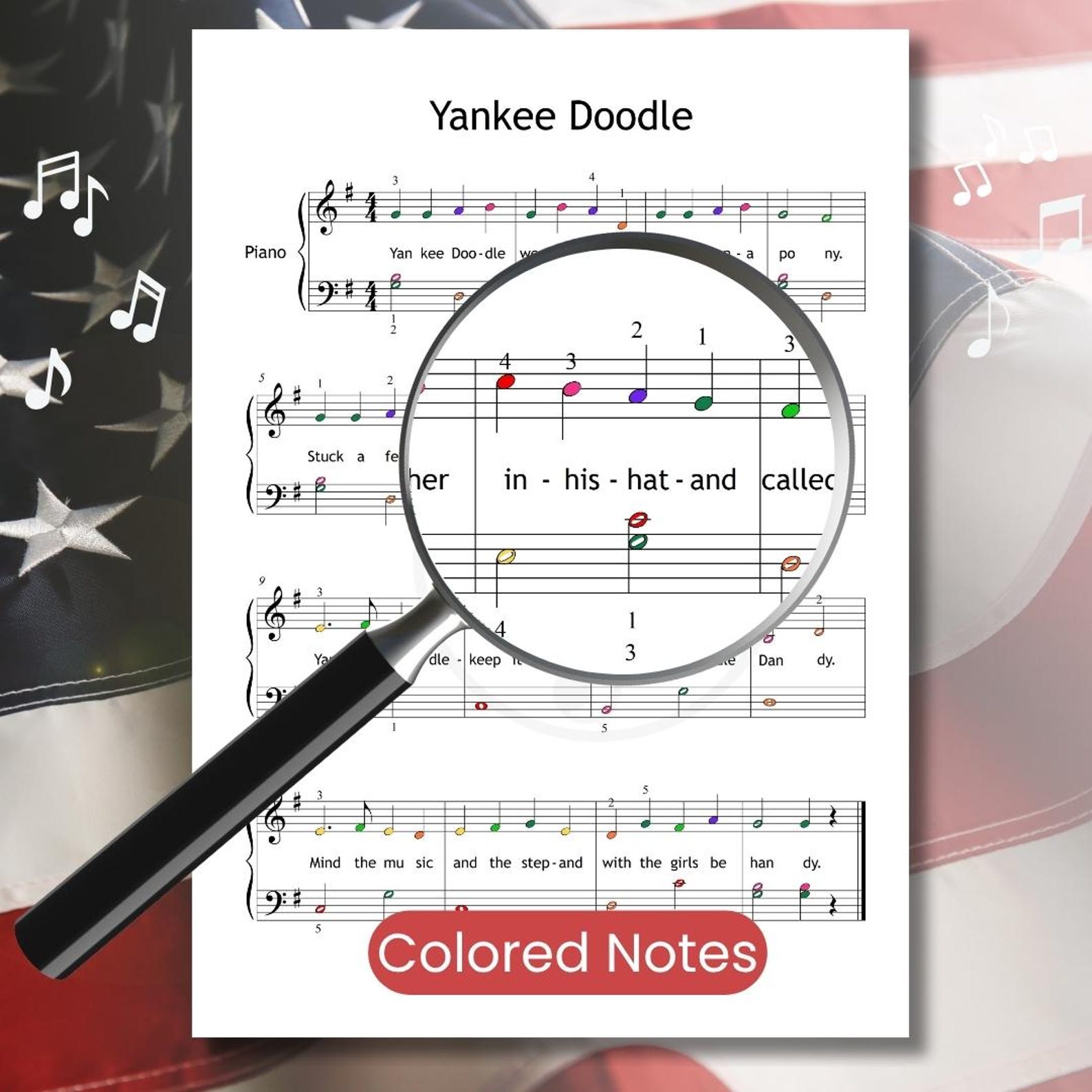
To play “Yankee Doodle” on the piano, start with a simple version in C major. Use your right hand for the tune and your left hand for easy chords or single bass notes. You can play the song with only a few white keys.
This guide uses the common American version of the tune. Folk songs can have small changes in notes and rhythm, so your version may sound slightly different. The goal is to learn the melody first, then add a steady beat and simple harmony.

What You Need Before You Start
You do not need to read music to begin. You need:
- A piano or keyboard
- A comfortable seat
- A way to find middle C
- Your right-hand thumb, index finger, and other fingers
- A slow, steady count
Find middle C. On a piano, it is the white key just to the left of the group of two black keys near the center.
The easiest key for this song is C major. C major uses only white keys:
C – D – E – F – G – A – B
The song usually uses a 2/4 beat. This means each bar has two main beats:
ONE – two | ONE – two
A traditional song may begin with a short pickup note before the first full bar. Do not worry about that at first. You can begin on the first clear phrase and add the pickup later.

The Right-Hand Melody
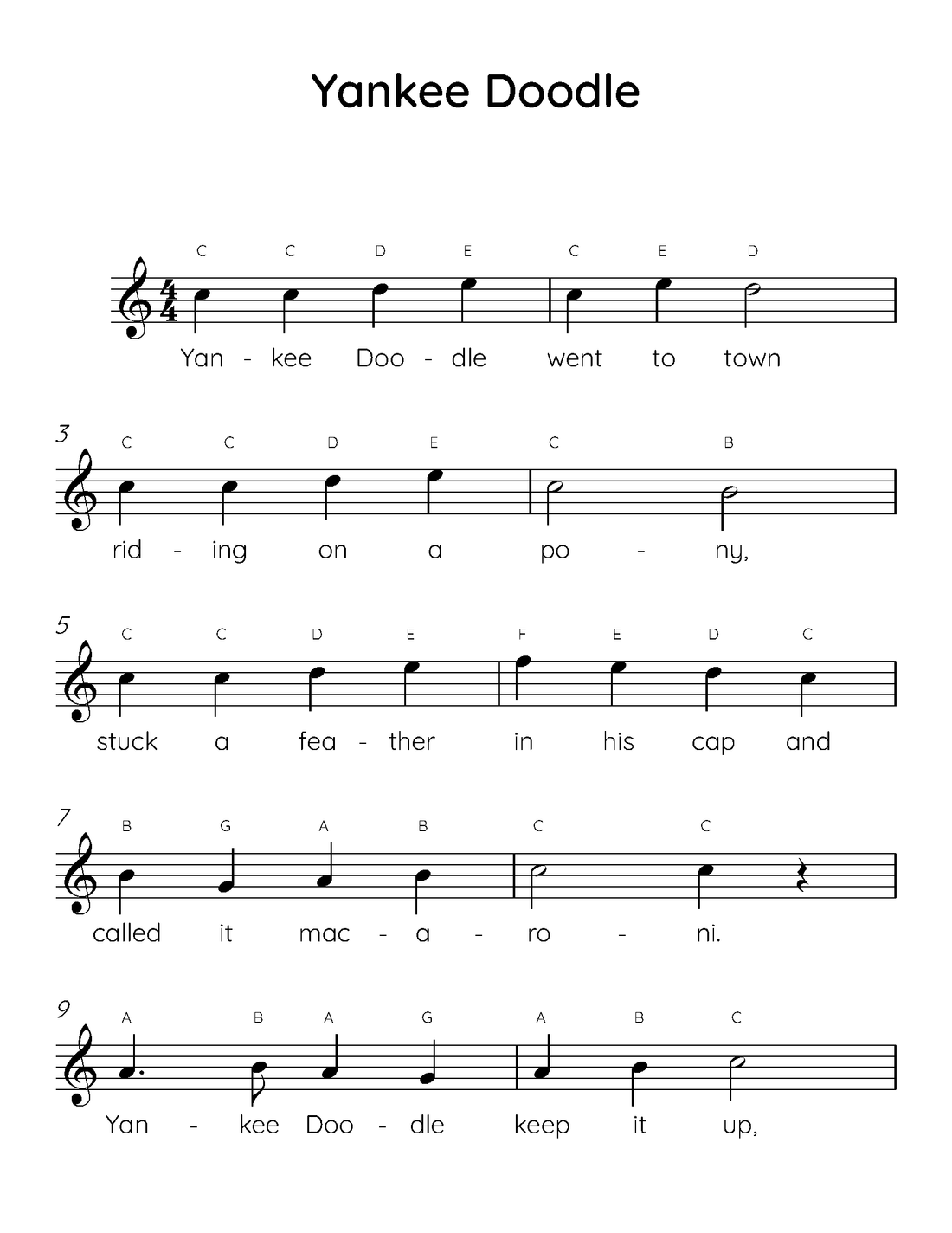
The simplest way to learn “Yankee Doodle” is to play the melody with your right hand. The following notes show a common beginner version in C major.
Main melody notes
Play these notes slowly:
G  G  A  G  C  B  G
G  G  A  G  D  C
G  G  A  G  C  B  A
G  F  E  F  G  C
These lines match the main shape of the song:
Yankee Doodle went to town
Riding on a pony
Stuck a feather in his cap
And called it macaroni
The exact note-to-word match may vary with the version you hear. Listen for the melody’s shape rather than trying to force every word onto one note.
A simple rhythm
Use short notes for most of the melody. Let the final note of each phrase ring a little longer.
You can count like this:
ONE and TWO and | ONE and TWO and
The word “and” divides each beat into two equal parts. Start with a slow count. Speed comes later.
Suggested right-hand fingering
For the opening phrase, try:
| Note | G | G | A | G | C | B | G |
|---|---|---|---|---|---|---|---|
| Finger | 1 | 1 | 2 | 1 | 3 | 2 | 1 |
Here, finger 1 is the thumb, finger 2 is the index finger, and finger 3 is the middle finger.
This fingering is only a guide. Move your hand when needed. Do not stretch or twist your fingers to keep one position.

Step-by-Step: How to Learn the Tune
1. Learn the first phrase
Place your right-hand thumb on G. Play:
G G A G C B G
Say the words as you play. Keep your hand relaxed. If you miss a note, stop and repeat only the small part that caused trouble.
2. Learn the second phrase
next, play:
G G A G D C
The jump to D may feel larger. Let your hand move instead of reaching with one finger.
3. Learn the third phrase
Play:
G G A G C B A
This phrase rises and then moves down. Keep the sound even. Avoid making the first note of every group too loud.
4. Learn the ending
Finish with:
G F E F G C
Hold the final C for a moment. A held final note makes the song sound complete.
5. Join the phrases
Play the first phrase twice. Then add the second phrase. When that feels easy, join all four lines.
Do not rush to full speed. A slow performance with an even beat sounds better than a fast performance with many pauses.
Add the Left Hand With Easy Chords
Once the right hand feels comfortable, add the left hand. You can use three basic chords:
| Chord | Notes | Use |
|---|---|---|
| C major | C–E–G | Main home chord |
| F major | F–A–C | Adds movement |
| G major | G–B–D | Leads back to C |
A chord is a group of notes played together. If three notes feel hard, play only the lowest note of each chord with your left hand.
Simple chord pattern
Try this basic pattern:
C  | C  | G  | C
F  | C  | G  | C
Play one chord at the start of each bar. Hold it while the right hand plays the tune.
For an even easier version, play only these bass notes:
C  | C  | G  | C
F  | C  | G  | C
The left hand does not need to play constantly. Its job is to support the tune and keep the beat.
Use a broken-chord pattern
When block chords feel easy, break each chord into separate notes.
For C major, play:
C – G – C – G
For F major:
F – C – F – C
For G major:
G – D – G – D
Use one note on each beat or half-beat. Keep the pattern soft so the melody stays clear.

A Beginner Practice Plan
A short practice plan can help you learn the song without feeling stuck.
Practice for five minutes
Minute 1: Find the notes
Play C, D, E, F, and G slowly. This warms up your hand and helps you locate the keys.
Minutes 2 and 3: Practice the melody
Work on one phrase at a time. Repeat a difficult phrase three times before moving on.
Minute 4: Add the beat
Count “one and two and” while you play. Tap your foot gently if it helps.
Minute 5: Play the whole tune
Play slowly from start to finish. Do not stop after every mistake. Mark the trouble spot and fix it after the run-through.
A metronome can help. Begin near 60 beats per minute, then increase the speed only when the notes stay even. The exact performance speed is flexible.

Common Problems and Simple Fixes
The melody sounds wrong
Check that you are starting on the correct G and using the white keys in the C-major version. Also check the rhythm. A correct group of notes can still sound wrong if the notes have uneven lengths.
Your hands feel tense
Lower your shoulders and let your fingers rest close to the keys. Play more softly. Tension often comes from pressing too hard or trying to play too fast.
You lose your place
Divide the song into four short phrases. Learn each phrase as a small musical thought. Pause briefly between phrases while practicing, then remove the pauses later.
The left hand covers the tune
Play the left hand much more softly than the right hand. If the melody still disappears, use only one bass note instead of a full chord.
You cannot stretch to the chords
Move your whole hand. Never force your fingers apart. You can also play the chord as separate notes or use only its lowest note.
The song does not sound like the version you know
“Yankee Doodle” has many traditional arrangements. Some begin with a pickup note. Some use different rhythms, keys, or ending notes. Compare the melody’s main shape before changing every note.
How to Make It Sound More Musical
Use a clear difference between the melody and the accompaniment. The right hand should usually be louder. The left hand should provide a light pulse.
Add a small pause at the end of each phrase. This gives the tune room to breathe. Do not pause between every note.
You can also repeat the song in layers:
- Right hand alone
- Right hand with left-hand bass notes
- Right hand with full chords
- Right hand with broken chords
- A slightly faster final performance
Keep the rhythm steady as you add each layer. More notes do not always make a better performance.

Key Takeaways
- Learn “Yankee Doodle” in C major first.
- Start with the right-hand melody.
- Use the note pattern G G A G C B G for the opening phrase.
- Count in 2/4 time, using “one and two and.”
- Add C, F, and G chords after the melody feels secure.
- Play the left hand softly.
- Slow practice is better than rushed practice.
- Traditional versions may use different notes or rhythms.
Frequently Asked Questions
Is “Yankee Doodle” easy to play on the piano?
Yes. The beginner version uses mostly white keys and a short, repeating melody. It is suitable for a new piano player who can find middle C and play simple right-hand notes.
What key is easiest for playing “Yankee Doodle”?
C major is usually the easiest starting key because it uses only the white keys. Once you can play it in C major, you can move the tune to another key if needed.
Can I play “Yankee Doodle” with one hand?
Yes. Play the melody with your right hand. You can add the left hand later for bass notes or chords.
What chords go with “Yankee Doodle”?
The main beginner chords are C major, F major, and G major. In a simple arrangement, C acts as the home chord, F adds contrast, and G creates a strong return to C.
Why do different versions have different notes?
“Yankee Doodle” is a traditional American song. Traditional melodies often change as people teach, sing, and arrange them. A school, band, or piano book may use a different key or rhythm.
Conclusion
The easiest way to play “Yankee Doodle” on the piano is to learn the right-hand melody in C major, one phrase at a time. Begin with G G A G C B G, keep a steady two-beat count, and add simple C, F, and G chords only after the melody feels natural.
Your next step is simple: play the first phrase slowly five times, then add the second phrase without stopping.

Senior Music Reviewer
Alex Carter is a seasoned music reviewer with over a decade of experience in the world of sound and instruments. Passionate about helping musicians and enthusiasts make informed choices, he brings sharp insights and in-depth knowledge to every review. From classical instruments to modern gear, Alex combines technical expertise with a love for music to deliver content that resonates with readers.
As a Senior Music Reviewer and expert author on Tuneluma.com, Alex is dedicated to sharing honest evaluations, practical advice, and thoughtful commentary to guide readers in their musical journey.