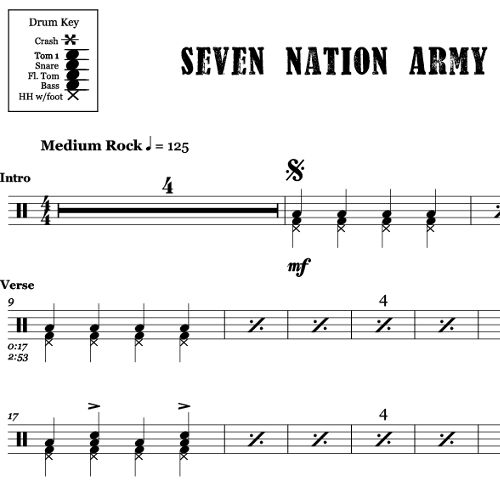
Play a steady four beat rock groove with eighth note hi hats, a strong backbeat, and simple fills.
Learning how to play Seven Nation Army on drums is a great way to build timing, control, and confidence. The song sounds huge, yet its drum part is simple enough for a beginner. With the right count, sticking, and practice plan, you can play the groove with the power and feel of the original recording.
Understand the Drum Part in Seven Nation Army
Seven Nation Army by The White Stripes is built around a famous repeating riff. Many listeners call it a bass line, but the original recording uses a guitar played through an octave effect. The drum part supports that riff with a steady rock pulse.
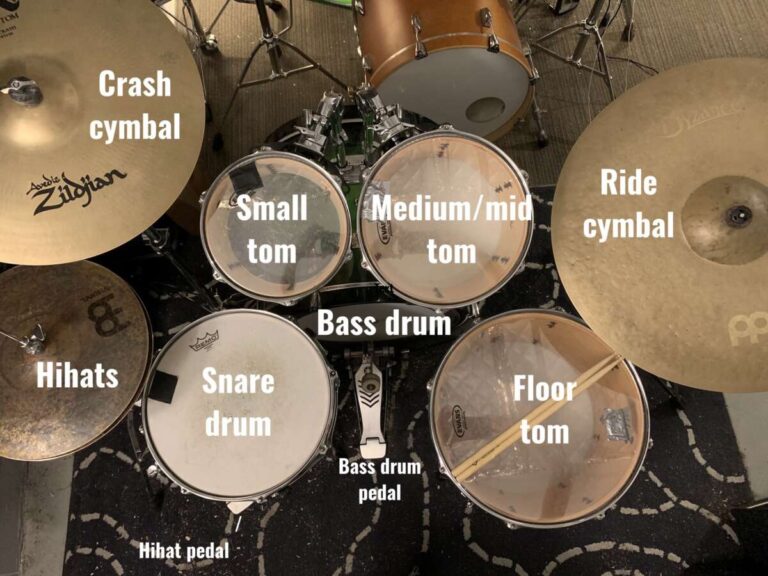
The main drum groove uses four basic sounds:
• Bass drum on beats 1 and 3
• Snare drum on beats 2 and 4
• Closed hi hat in steady eighth notes
• Crash cymbal at key song changes
Count the beat like this:
1 and 2 and 3 and 4 and
Play the hi hat on every number and every “and.” Play the bass drum on 1 and 3. Play the snare on 2 and 4.
This pattern feels like a firm walking pace. The hi hat keeps time, the bass drum gives weight, and the snare creates the song’s backbeat. When these parts lock together, the groove sounds much bigger than it looks on paper.
The studio performance has a raw, direct feel. It does not depend on complex drum fills. Instead, it uses space, strong hits, and a steady pulse. That is an important lesson when learning how to play Seven Nation Army on drums: simple parts still need great time.

What You Need Before You Start
You do not need a large drum kit to learn how to play Seven Nation Army on drums. A basic five piece kit is enough, but you can also practice on a practice pad or electronic kit.
Use these parts if you have them:
• Bass drum
• Snare drum
• Hi hat
• Crash cymbal
• Drum throne or stable seat
If you are using a practice pad, tap the hi hat rhythm with your right hand. Tap the snare notes with your left hand. You can lightly tap the bass drum pattern with your foot or say it out loud.
Set a metronome near 120 to 124 beats per minute. The exact tempo may vary by performance, recording, or live version. Start slower if you are new. Clean timing matters more than speed.
Keep your grip loose. Hold the sticks like small pencils, not like tools you need to squeeze. A tight grip can make the groove sound stiff and can cause hand pain.
Your posture also matters. Sit tall, keep your shoulders relaxed, and place your feet where they can move with ease. Good setup removes tension and makes how to play Seven Nation Army on drums feel much easier.

Learn the Basic Groove Step by Step
The best way to learn how to play Seven Nation Army on drums is to add one part at a time. Do not try to play the full beat at speed on your first attempt.
Step 1: Count the beat
Say:
1 and 2 and 3 and 4 and
Keep the count even. Imagine each count as a train wheel moving along the track. If the count speeds up or slows down, the whole song will lose its drive.
Step 2: Add the hi hat
Play closed hi hat notes on every count:
1 and 2 and 3 and 4 and
Use small wrist motions. Do not lift the stick too high. The goal is a smooth stream of sound.
Step 3: Add the snare
Place the snare on beats 2 and 4:
1 and 2 and 3 and 4 and S S
Keep the hi hat steady while adding the snare. The snare should sound clear but not painfully loud.
Step 4: Add the bass drum
Place the bass drum on beats 1 and 3:
1 and 2 and 3 and 4 andB S B S
Now you have the core rock beat. Play it slowly until your hands and foot move without effort.
Step 5: Add the song feel
Once the notes are steady, add energy. Play the bass drum with a solid but controlled stroke. Give the snare a sharp backbeat. Keep the hi hat crisp and even.
Many beginners hit every drum too hard. That can make the sound messy. Strong drumming comes from control, not force.

Add the Main Song Sections
The song uses changes in energy more than complex drum patterns. This makes it useful for learning dynamics.
The quieter section
Use the basic groove with a controlled hi hat. Keep the snare firm but avoid overplaying. This creates room for the vocal and main riff.
The louder section
Open the sound slightly by raising the volume of the snare and bass drum. You can move from a closed hi hat to a crash cymbal at the start of a new section.
A simple approach is:
• Crash on the first beat of the louder section
• Return to the hi hat for the rest of the bar
• Keep the bass drum and snare pattern steady
Short transitions
You can add a short fill at the end of a phrase. A simple four note fill may work well:
snare, snare, tom, floor tom
Play it on the last four eighth notes before the next section. Then return to the main beat on beat 1.
Do not add a fill every few bars. The original style depends on repetition and impact. A fill has more power when the listener does not expect it.
This approach shows how to play Seven Nation Army on drums with musical judgment. You are not only copying notes. You are shaping volume, tension, and release.

Use the Right Tempo and Count
Tempo control is one of the most important parts of how to play Seven Nation Army on drums. A metronome helps you hear whether your beat is stable.
Try this practice ladder:
-
Start at 80 beats per minute.
-
Play the groove for two minutes.
-
Move to 90 beats per minute.
-
Repeat at 100, 110, and 120 beats per minute.
-
Stop increasing the tempo when your beat becomes uneven.
Record yourself on a phone. Listen for these problems:
• The hi hat speeds up during fills
• The bass drum arrives late
• The snare becomes too soft
• The beat changes when you get tired
A recording often reveals timing issues that are hard to notice while playing. This is a practical habit used by many drummers because it turns vague problems into clear ones.
The recording may sit near 124 beats per minute, but matching that number is not the only goal. A drummer with excellent time can make a slightly slower performance sound better than a rushed copy.
Practice the Groove Without a Drum Kit
You can work on how to play Seven Nation Army on drums almost anywhere. The key is to separate the limbs and keep the pulse in your mind.
Try this body practice:
• Tap your right hand on your leg for the hi hat
• Tap your left hand for the snare on 2 and 4
• Tap your foot for the bass drum on 1 and 3
• Count out loud while you play
You can also practice with a simple backing track. Choose one without drums if possible. This lets you supply the groove instead of hiding behind a recorded drum part.
Another useful method is silent practice. Move your feet and hands with very small motions. This builds coordination and helps you learn the pattern without tiring your muscles.
In my experience teaching basic rock grooves, students often improve faster when they practice for ten focused minutes instead of playing for one unfocused hour. Short sessions help you notice mistakes before they become habits.
Try three rounds:
• Two minutes at a slow tempo
• Two minutes at the target tempo
• Two minutes while listening to the song
Rest briefly between rounds. Your goal is steady progress, not exhaustion.

Common Mistakes to Avoid
Several small errors can weaken an otherwise correct performance. Fixing these issues will make how to play Seven Nation Army on drums sound more natural.
Rushing the beat
Excitement often makes new drummers speed up. Keep your hi hat hand relaxed and let the metronome guide you.
Missing the snare backbeat
The snare on beats 2 and 4 is the center of the groove. Practice clapping on 2 and 4 before playing the full beat.
Playing too many fills
Extra fills can distract from the main riff. Use fills only at clear musical changes.
Hitting too hard
Loud does not always mean powerful. Use relaxed motion and let the drum produce the sound.
Losing the hi hat pulse
The hi hat is your timekeeper. If it stops or becomes uneven, the groove can fall apart.
Ignoring dynamics
The song gains power through contrast. Keep quieter sections controlled and make louder sections feel larger.
One mistake I often see is trying to sound dramatic before the basic beat is stable. Build the foundation first. Once the groove feels automatic, musical expression becomes much easier.
Make the Groove Sound More Like Rock
Once you can play the basic pattern, focus on tone and feel. These details help you move beyond simply playing the correct notes.
Keep the hi hat slightly loose if your cymbal allows it. A small amount of foot pressure can change the sound from tight and bright to thicker and darker. Use this carefully, because too much opening can create unwanted noise.
Play the snare near the center for a full sound. If your snare has a strong rim sound, avoid hitting the rim by accident unless you want a special effect.
For the bass drum, aim for a deep and even tone. Keep your heel position stable. Whether you use heel up or heel down, choose the method that lets you control the volume.
Listen to the original track for space. Notice how the drummer does not fill every gap. The quiet moments are part of the groove. Silence works like the space between words in a sentence; without it, the message becomes hard to follow.
These details are central to how to play Seven Nation Army on drums with style rather than just accuracy.
A Simple Seven Day Practice Plan
A short plan can keep your practice clear and measurable.
Day one: Count and clap
Count four beat bars and clap on 2 and 4. Learn to feel the backbeat before touching the kit.
Day two: Add the hi hat
Play steady eighth notes at 80 beats per minute. Keep each note the same length and volume.
Day three: Add the snare
Keep the hi hat moving while placing the snare on 2 and 4. Practice for five minutes without stopping.
Day four: Add the bass drum
Play bass drum on 1 and 3. Slow down if your foot pulls against your hands.
Day five: Practice dynamics
Play one minute softly and one minute loudly. Keep the tempo the same during both rounds.
Day six: Add transitions
Practice one crash at the start of a new section. Add one short fill only after the main groove feels safe.
Day seven: Perform and record
Play along with the song or a backing track. Record the performance and note one strength and one area to improve.
This plan makes learning how to play Seven Nation Army on drums less overwhelming. Each day has one clear job, so you can build skill without guessing what to practice.
Frequently Asked Questions About How to Play Seven Nation Army on Drums
Is Seven Nation Army easy to play on drums?
Yes. The main groove uses a common rock beat with eighth note hi hats, a snare on 2 and 4, and a bass drum on 1 and 3. The challenge is keeping the beat steady and matching the song’s dynamics.
What tempo is Seven Nation Army played at?
The commonly heard studio recording is close to 124 beats per minute. Start at a slower tempo, then increase the speed only when your timing stays even.
Do I need a full drum kit to learn the song?
No. You can practice the rhythm on a practice pad, desk, or your legs. A full kit helps with sound and coordination, but it is not required at the beginning.
What drum pattern is used in Seven Nation Army?
The core pattern is a basic four beat rock groove. Play eighth notes on the hi hat, bass drum on beats 1 and 3, and snare drum on beats 2 and 4.
Should I use drum fills when playing the song?
Use only a few short fills at section changes. Too many fills can weaken the main groove and make the performance sound busy.
How can I make the drum part sound more powerful?
Focus on steady time, a clear snare backbeat, and strong changes in volume. Relaxed technique usually sounds more powerful than hitting every drum as hard as possible.
Conclusion
Learning how to play Seven Nation Army on drums starts with a simple rock groove. Count steady eighth notes, place the bass drum on 1 and 3, and keep the snare strong on 2 and 4. Then add controlled dynamics, a few crashes, and short fills at the right moments.
Practice slowly, record yourself, and build speed in small steps. The song is a useful lesson in timing, restraint, and musical power. Pick up your sticks today, play the groove for five focused minutes, and share your progress or explore another classic drum song next.

Senior Music Reviewer
Alex Carter is a seasoned music reviewer with over a decade of experience in the world of sound and instruments. Passionate about helping musicians and enthusiasts make informed choices, he brings sharp insights and in-depth knowledge to every review. From classical instruments to modern gear, Alex combines technical expertise with a love for music to deliver content that resonates with readers.
As a Senior Music Reviewer and expert author on Tuneluma.com, Alex is dedicated to sharing honest evaluations, practical advice, and thoughtful commentary to guide readers in their musical journey.