The Furman SS6B is the best power conditioner for guitar amp setups needing simple, reliable noise and surge protection.
You plug in your guitar amp, pedals, mixer, and phone charger, then hear a buzz that was not there at home. Poor wiring, radio noise, voltage spikes, and crowded stage power can all cause trouble. A good power conditioner adds useful protection and may reduce unwanted AC noise. I compared ten popular options for home studios, pedalboards, rehearsal rooms, and live racks. I focused on outlet layout, noise filtering, surge protection, size, ease of use, and value.
See the differences between my top picks at a glance.
| Product | Best For | Outlets | Key Protection | Format | Buy |
|---|---|---|---|---|---|
| Black Lion PG-P | Portable rigs | Portable unit | Filtering and surge protection | Portable | View on Amazon |
| Pyle PCO875 | Small racks | 10 | Sequencing, filter, voltage readout | Rack mount | View on Amazon |
| Radial Power-2 | Professional rigs | Rack outlets | Filtering and surge protection | Rack mount | View on Amazon |
| Pyle PC0850.5 | Basic studio racks | 7 | AC filter and spike protection | 1U rack mount | View on Amazon |
| Portable HiFi Filter | Compact audio rigs | 6 | EMI/RFI filter and surge protection | Portable | View on Amazon |
| Furman SS6B | General guitar use | 6 | 540-joule surge, RFI/EMI filter | Strip | View on Amazon |
| Black Lion PG-P Plus | Portable stage rigs | Portable unit | Filtering and surge protection | Portable | View on Amazon |
| TODN N600 | Studio systems | See listing | Noise reduction and surge protection | Studio unit | View on Amazon |
| Pyle PCO885.5 | Large racks | 18 | AC filter and outlet expansion | 2U rack mount | View on Amazon |
| MICNAUX 20A Sequencer | Complex audio racks | 10 | Sequencing, display, surge protection | Rack mount | View on Amazon |
Black Lion Audio PG-P Portable Power Conditioner

The Black Lion Audio PG-P is a smart pick for players who move between home, rehearsal, and small stages. Its portable design fits a compact guitar setup without taking rack space. The unit aims to filter dirty AC power and protect connected gear from common surges. That matters when you use an amp, pedal supply, tuner, and recording gear on the same circuit.
I like this model for simple rigs that need more order than a basic extension strip can provide. It is easier to carry than a full rack conditioner and should suit musicians who value clean setup time. It does not replace a voltage regulator, isolation transformer, or electrician’s work on unsafe wiring. Still, it offers a useful balance of portability and protection for many guitar amp systems.
Pros:
- Portable design for rehearsal and gig bags
- Useful AC filtering for audio systems
- Surge protection for connected equipment
- Good fit for small guitar and pedal rigs
- More focused than a low-cost power strip
Cons:
- Not a full voltage regulator
- Portable format may not suit a rack system
- Outlet layout may limit bulky adapters
What Amazon Buyers Are Saying
Customer feedback commonly focuses on the compact size, simple setup, and usefulness in portable audio systems. Some buyers value the added sense of security around costly studio gear. As with most power filters, users should not expect every ground loop or amp hum problem to disappear. Check the current Amazon reviews for the latest comments about outlet spacing, noise results, and long-term reliability.
My Recommendation
I recommend the PG-P for players who need portable protection without a rack case. It is worth considering for a compact amp and pedal setup, but users with large racks should choose a rack model. My overall rating is 4.3 out of 5.
Pyle PCO875 Rack Power Sequencer

The Pyle PCO875 adds more control than a normal power strip. It offers ten outlets, rack mounting, a voltage readout, and power sequencing features. The listed 13-amp and 2000-watt ratings make it suitable for many small audio racks when the total load stays within the stated limits. This design can help you power several devices from one front-panel unit.
For a guitar amp rack, the voltage display gives a quick look at incoming power. That does not mean the unit corrects low or high voltage, so I would still watch the reading at venues with poor electrical service. The sequencer can also help reduce the harsh turn-on rush that happens when several rack devices start together. It is a practical choice for players who want features at a modest cost.
Pros:
- Ten outlets for a growing rack
- Rack-mount format saves floor space
- Voltage readout adds useful information
- Power sequencing suits multi-device systems
- Helpful outlet capacity for studio use
Cons:
- Voltage display does not regulate voltage
- Large rack size may be too much for a simple amp
- Users must respect the total current limit
What Amazon Buyers Are Saying
Amazon feedback for this type of Pyle rack unit often centers on the number of outlets, the display, and the convenience of rack installation. Some buyers may report that fit, switch feel, or instructions vary by setup. A power sequencer also needs careful planning, since not every device should start in the same order. Read current buyer comments before purchase, especially if you plan to connect a high-power amplifier.
My Recommendation
This is a good value pick for a small guitar or studio rack that needs a display and sequencing. It is less attractive for a single combo amp. I rate it 4.1 out of 5.
Radial Power-2 Power Conditioner

The Radial Power-2 targets players and engineers who want a serious rack power solution. Radial has a strong reputation in live sound, and this unit is built for organized professional rigs. It provides power distribution, filtering, and protection in a rack-friendly format. That makes it a natural match for preamps, effects units, wireless systems, and amp processors.
I would choose it when reliability and clean rack wiring matter more than the lowest price. It may be more conditioner than a beginner needs, but touring players can benefit from a purpose-built unit. As always, a conditioner cannot fix a faulty wall outlet or replace safe stage power. Confirm the current rating and rack depth before adding it to a compact case.
Pros:
- Professional rack-oriented design
- Good match for complex guitar systems
- Helps organize power in a road rig
- Filtering and protection support sensitive gear
- Strong choice for studio and live use
Cons:
- Higher cost than basic power strips
- May be unnecessary for a small combo amp
- Rack installation takes more planning
What Amazon Buyers Are Saying
Buyers who choose Radial products often focus on build confidence, rack convenience, and use in professional audio systems. Some users may find that the price reflects construction and brand support rather than extra consumer features. The best way to judge current satisfaction is to review recent Amazon comments about noise performance, fit, and service. Results can also depend on the condition of the venue’s electrical system.
My Recommendation
The Radial Power-2 is a strong premium choice for a serious guitar rack. It makes less sense for a single home amp, but it earns consideration for touring and studio systems. My rating is 4.6 out of 5.
Pyle PC0850.5 1U Power Conditioner

The Pyle PC0850.5 is a simple 1U rack power conditioner for small audio systems. Its seven outlets, AC noise filter, circuit breaker, and spike protection cover the basic needs of a compact rack. The 1U size keeps it easy to install above or below other equipment. It can work well with a guitar processor, wireless receiver, pedal power supply, and small studio devices.
This model makes sense when you want rack order without paying for a display or advanced sequencing. Seven outlets are enough for many players, but you should count every plug before buying. The built-in breaker adds a useful reset option if the connected load trips protection. It will not regulate unstable voltage, so do not treat it as a substitute for a voltage regulator.
Pros:
- Compact 1U rack format
- Seven outlets for basic audio systems
- Built-in AC noise filtering
- Spike protection and circuit breaker
- Simple choice for home studios
Cons:
- Fewer outlets than larger rack units
- No listed voltage display
- Not designed to correct voltage changes
What Amazon Buyers Are Saying
Feedback on compact rack conditioners usually highlights easy mounting, useful outlet access, and low cost. Some buyers may want more space between outlets for large power adapters. Noise results can vary because amp hum may come from cables, pedals, lighting, or grounding rather than AC power alone. Review current Amazon feedback for the latest comments on fit and switch operation.
My Recommendation
I recommend the PC0850.5 for a small, budget-conscious rack. It is a practical basic conditioner, though it lacks the control features found on pricier models. I rate it 4.0 out of 5.
Portable HiFi AC Power Filter

This six-way portable power filter is aimed at compact audio systems. It lists EMI and RFI noise filtering, surge protection, and a 10-amp capacity. USB and USB-C charging ports add convenience for phones, small controllers, and other low-power devices. For a home guitar desk, that mix can reduce the need for extra adapters.
The portable shape suits players who keep an amp, interface, pedals, and mobile devices in one work area. I would use it for low to moderate loads and check the product label before connecting a high-powered amplifier. USB ports do not make the unit a guitar-specific conditioner. Still, the design may be useful when convenience and small size matter most.
Pros:
- Six outlets for a compact setup
- EMI and RFI filtering is listed
- Surge protection for connected equipment
- USB and USB-C charging convenience
- Portable format for desks and practice rooms
Cons:
- 10-amp rating limits heavy loads
- Not a rack-mount solution
- USB ports add little value to some players
What Amazon Buyers Are Saying
Buyers of compact power filters often like the small footprint and extra charging ports. Some may question how much audible change the filter creates in a particular room. That concern is fair, since hum can have many causes outside the AC line. Check current customer comments for reports about port durability, outlet spacing, and use with amplifiers.
My Recommendation
This is worth considering for a small home audio station, not a demanding stage rig. Keep the 10-amp limit in mind and avoid overloading it. My rating is 3.9 out of 5.
Furman SS6B Power Conditioner
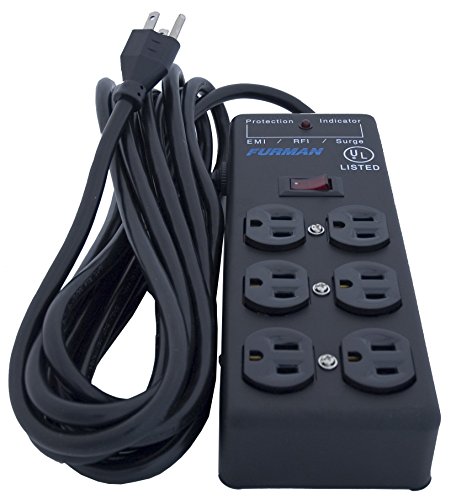
The Furman SS6B is my top overall choice for most guitar amp owners. It has six outlets, a long 15-foot cord, a steel case, a resettable circuit breaker, and listed RFI/EMI filtration. Its 540-joule surge protection rating gives buyers a clear point of comparison. The long cable also helps when the wall outlet sits far from the amp or pedalboard.
This unit does not look complex, and that is part of its appeal. I can place it near a combo amp, pedalboard, recording interface, or small PA without needing a rack case. It may reduce radio-frequency and electromagnetic interference, but it cannot cure every ground loop. For a dependable everyday setup, the SS6B offers one of the best blends of protection, reach, and price.
Pros:
- 540-joule surge protection
- RFI and EMI filtration
- Strong steel construction
- Long 15-foot power cord
- Resettable circuit breaker
- Excellent fit for guitar amp setups
Cons:
- Only six outlets
- No voltage display or regulation
- Strip format takes floor or desk space
What Amazon Buyers Are Saying
Customer feedback commonly praises the long cord, solid case, and simple setup. Many buyers choose it for guitar gear, home theater, computers, and studio equipment. Some users may expect a power conditioner to remove all hum, yet that result depends on the whole signal chain and building wiring. Current reviews remain useful for checking switch feel, outlet spacing, and long-term use.
My Recommendation
The Furman SS6B is the best power conditioner for guitar amp owners who want a simple, trusted, portable solution. It is not a voltage regulator, but it covers the needs of many home and live setups. I rate it 4.7 out of 5.
Black Lion Audio PG-P Plus

The Black Lion Audio PG-P Plus builds on the portable conditioner idea for musicians who need a compact stage companion. It combines power distribution with surge protection and filtering in a unit made for audio use. The portable design can sit beside an amp, under a desk, or near a pedalboard. That makes it attractive to players who do not want a rack case.
I see it as a useful middle ground between a basic strip and a full rack conditioner. It can help keep a small rig neat, but buyers should confirm the exact outlet and load details on the current listing. A conditioner does not create clean power from an unsafe circuit. Use it as one part of a safe setup, not as permission to exceed the venue’s electrical limit.
Pros:
- Portable design for musicians
- Surge protection for audio equipment
- Power filtering for compact systems
- Easy fit beside an amp or pedalboard
- Useful alternative to a basic strip
Cons:
- Not a rack-mount conditioner
- Does not regulate voltage
- Exact load needs should be checked before use
What Amazon Buyers Are Saying
Buyers tend to look for easy transport, tidy connections, and less worry during live use. Some may compare it with older Black Lion models or with Furman strips. Audible results will differ from room to room, especially when the real issue is a ground loop or a noisy pedal supply. Read the latest Amazon feedback for current comments on durability and outlet layout.
My Recommendation
The PG-P Plus is a good choice for a portable audio rig that needs more than a simple extension cord. It is worth the cost when mobility matters. I rate it 4.2 out of 5.
TODN N600 Studio Power Conditioner

The TODN N600 is designed for studio users who want power cleanup and protection in one unit. Its listing highlights noise reduction, surge protection, and CE-EMC, LVD, and RoHS certifications. Those marks relate to stated compliance areas, but they do not guarantee that every amplifier will sound quieter. The unit may suit a desktop studio or a rack-based recording system.
I would compare its dimensions, outlet layout, and load rating with your gear before ordering. Studio systems often include interfaces, monitors, computers, synths, and guitar equipment, so outlet planning matters. This model could be useful when you want a dedicated audio power device rather than a general household strip. Still, buyers should keep realistic expectations about what filtering can and cannot fix.
Pros:
- Made with studio use in mind
- Lists noise reduction and surge protection
- Certification information adds product detail
- Useful for desktop audio systems
- May help organize several devices
Cons:
- Current outlet details need close checking
- Not a replacement for voltage regulation
- Limited long-term buyer history may matter to some users
What Amazon Buyers Are Saying
Feedback for newer studio power products may focus on setup, noise results, and perceived build quality. Because user experiences can vary, I would give extra weight to recent reviews that name the exact equipment connected. Some complaints with any conditioner may actually involve cables, dimmers, or grounding. Check the current Amazon page for verified comments and updated specifications.
My Recommendation
The TODN N600 is worth a look for a home studio that needs a dedicated power filter. I would choose a better-known option when touring reliability is the main goal. My rating is 3.9 out of 5.
Pyle PCO885.5 18-Outlet Power Conditioner

The Pyle PCO885.5 is built for large audio racks with many connected devices. It provides 18 outlets, a 15-amp design, a stated 3600-watt capacity, and a 2U rack format. The high outlet count can simplify a system with guitar processors, wireless units, mixers, interfaces, monitors, and control gear. Its AC filter may also help manage noise in a busy rack.
This is clearly more than most combo amp users need. The large format takes rack space, and the total load still must remain within safe limits. I like it for studios, rehearsal rooms, and installed systems where many low- and medium-power devices share one rack. Before use, check the power draw of every device, especially powered speakers and amplifiers.
Pros:
- Very high outlet count
- 15-amp and 3600-watt listing
- 2U rack format for large systems
- AC filtering for busy audio setups
- Useful for studios with many devices
Cons:
- Too large for most simple amp rigs
- High outlet count can tempt overloading
- Rack space and cable planning are required
What Amazon Buyers Are Saying
Customers who need many outlets often value the space and rack format. Some may find the unit excessive for a small system or may need longer cables to reach rear equipment. Buyer comments can also reveal how well the outlet layout fits real adapters. Review recent feedback before connecting power amplifiers or other high-draw gear.
My Recommendation
The PCO885.5 is a practical large-rack solution, not my first choice for one guitar amp. It offers strong capacity on paper, but careful load planning is essential. I rate it 4.1 out of 5.
MICNAUX 20A Rack Power Sequencer

The MICNAUX rack conditioner is made for users who need control over a complex audio system. Its listing includes ten outlets, a 20-amp design, a voltage display, surge protection, an external switch, and eight independent controls. The sequencing feature can help power groups of equipment in a planned order. That can be useful in a studio rack or larger guitar processing system.
This model offers more control than a basic conditioner, but it also demands more careful setup. A 20-amp product must match the circuit, plug, cable, and venue requirements. I would not buy it only because the current number looks higher. Check installation instructions and use a qualified electrician when the circuit is unclear. For the right rack, the control options can be genuinely helpful.
Pros:
- Ten outlets for complex systems
- Voltage display for quick monitoring
- Eight independent outlet controls
- Power sequencing for planned startup
- External switch for easier operation
- High-capacity design for suitable circuits
Cons:
- 20-amp setup needs careful circuit planning
- More complex than most guitarists need
- May require professional installation advice
What Amazon Buyers Are Saying
Feedback on advanced sequencers often centers on control, display visibility, and rack convenience. Some users may find the controls useful, while others may see them as extra complexity. Current buyer reviews are especially important for a newer product because they can show real installation experiences. Do not rely on a review alone to confirm electrical compatibility with your venue.
My Recommendation
The MICNAUX is worth considering for an advanced rack with several power groups. It is not the best fit for a normal combo amp or small pedalboard. My rating is 4.0 out of 5.
How to Choose the Best Power Conditioner for Guitar Amp
Choosing the best power conditioner for guitar amp use starts with your real setup. A single combo amp needs a different product from a touring rack with processors and wireless units. Focus on safe power, useful filtering, the right outlet count, and a format that fits your space.
1. Match the Conditioner to Your Amp Setup
First, count every device that needs AC power. Include the amplifier, pedal supply, tuner, wireless receiver, interface, mixer, monitor, and phone charger. A six-outlet strip may work for a small rig. A rack conditioner with ten or more outlets makes more sense for a large system.
Also check the total current draw. A power conditioner does not increase the safe limit of a wall circuit. Never connect more load than the product, cable, plug, or building circuit can support. Tube amps, powered speakers, and large amplifiers need special care because they can draw more power than small pedals.
2. Look for Real Protection and Noise Features
Surge protection helps defend equipment from short voltage spikes. RFI and EMI filtering may reduce radio and electrical interference that enters through the AC line. A circuit breaker can stop an overload and offer a reset option. These features help, but they do not fix bad building wiring, ground loops, broken cables, or noisy light dimmers.
Do not confuse a voltage display with voltage regulation. A display only shows information. A regulator actively manages voltage. If you play in places with serious voltage swings, ask an electrician or power specialist about a suitable regulator or UPS. For normal use, a reliable surge protector and filter may be enough.
3. Compare Build, Layout, and Long-Term Value
Choose a format that suits your work. A portable conditioner is easy to carry to rehearsal. A 1U rack model saves floor space. A strip with a long cable helps when the outlet sits far from the amp. Look for a strong case, a clear switch, a resettable breaker, and enough room for bulky plugs.
Finally, compare the cost with the value of your gear. A cheap strip may be fine for a low-cost practice setup, but a touring rack deserves a sturdier solution. Read current product details and customer feedback before ordering. Product specifications can change, so confirm the outlet count, current rating, warranty, and plug type on the listing.
Final Verdict: Which Should You Buy?
The Furman SS6B is the best power conditioner for guitar amp use overall. It offers useful filtering, 540-joule surge protection, a long cord, and a tough case without needless complexity.
Choose the Radial Power-2 for a premium rack, or the Black Lion PG-P for portable use. For most players, the SS6B delivers the best mix of protection, ease, and value.
FAQs Of best power conditioner for guitar amp
Does a guitar amp need a power conditioner?
A guitar amp can work without one, but a conditioner adds surge protection and may reduce AC noise. It cannot repair unsafe wiring or every ground loop.
What is the best power conditioner for guitar amp use?
The Furman SS6B is the best overall choice for many players. It offers six outlets, RFI/EMI filtering, 540-joule surge protection, and a long cord.
Will a power conditioner remove amp hum?
It may reduce noise from the AC line, but hum can also come from cables, pedals, lighting, grounding, or the guitar itself.
Can I plug a tube amp into a power conditioner?
Yes, if the conditioner supports the amplifier’s current needs. Check the amp and conditioner ratings, and never exceed the safe limit of the circuit.
Is a power conditioner the same as a voltage regulator?
No. A conditioner filters noise and helps protect against surges. A voltage regulator actively corrects certain high or low voltage conditions.

Senior Music Reviewer
Alex Carter is a seasoned music reviewer with over a decade of experience in the world of sound and instruments. Passionate about helping musicians and enthusiasts make informed choices, he brings sharp insights and in-depth knowledge to every review. From classical instruments to modern gear, Alex combines technical expertise with a love for music to deliver content that resonates with readers.
As a Senior Music Reviewer and expert author on Tuneluma.com, Alex is dedicated to sharing honest evaluations, practical advice, and thoughtful commentary to guide readers in their musical journey.